
Bed Mover Service Contracts for Australian Hospitals
Could a single missed maintenance check be the catalyst for a preventable staff injury or a budget-draining emergency repair? In the high-pressure environment of an Australian hospital, you're constantly balancing patient flow with the rigorous demands of workplace health and safety. It's a difficult tightrope to walk when equipment downtime forces staff to manually move heavy beds, which can lead to the types of musculoskeletal injuries that previously affected 20% of workers in some South Australian hospitals.
Securing a comprehensive bed mover service contract is more than just a line item in your facility budget; it's a commitment to a zero-injury workplace. By formalising your maintenance, you gain predictable costs and the peace of mind that comes with expert-led care for your StaminaLift or Easi series units. This article explains how structured support extends the life of your motorised fleet, manages complex battery health, and ensures your team stays protected. We'll look at how transitioning from reactive repairs to a proactive service model prioritises both caregiver well-being and operational efficiency.
Table of Contents
The Critical Role of Bed Mover Maintenance in Australian Healthcare
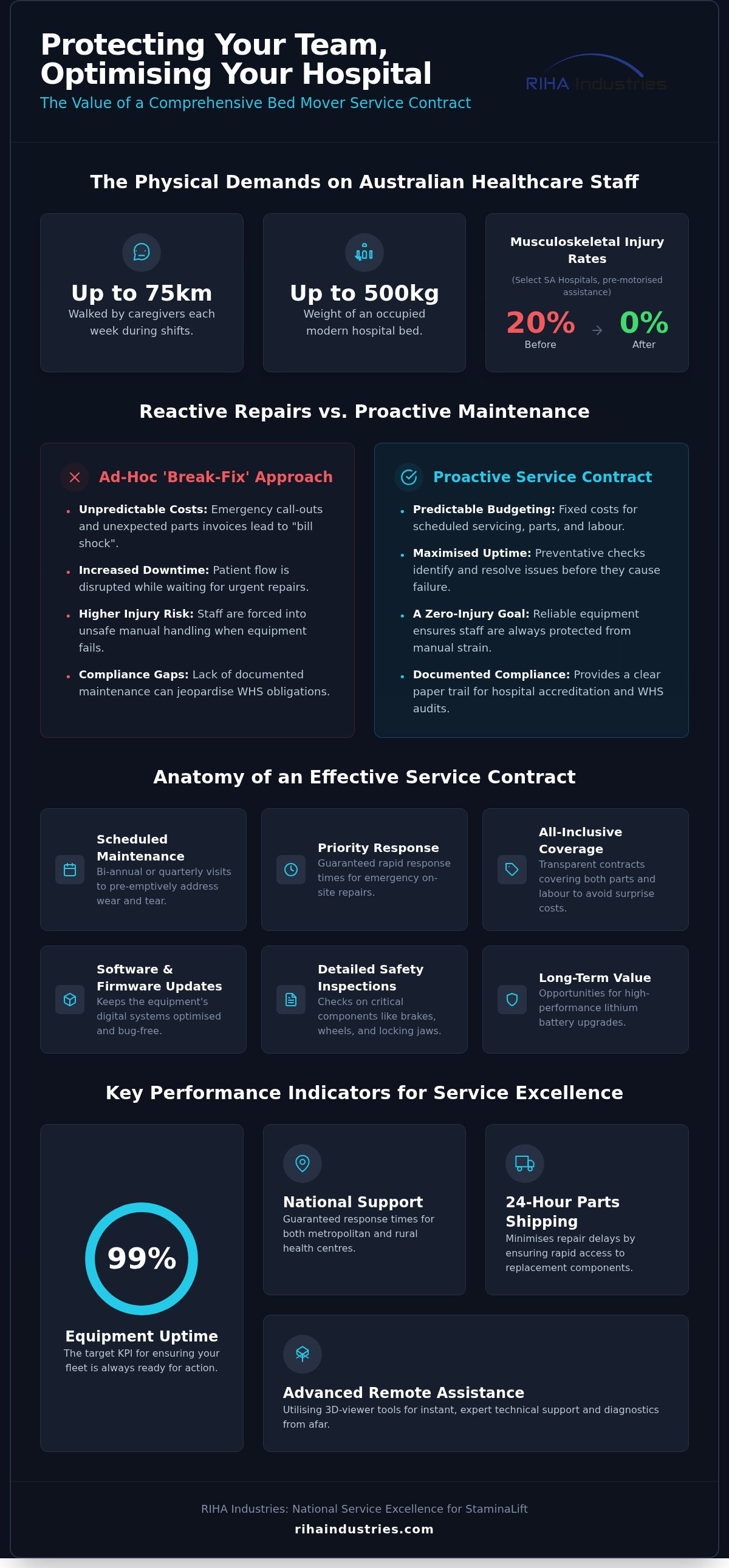
Hospital staff are often pushed to their physical limits, with some healthcare workers walking up to 75km per week during their shifts. When you add the task of moving modern hospital beds, which can weigh up to 500kg when occupied, the risk of musculoskeletal injury becomes a significant concern. Motorised movers are designed to mitigate this risk, but they only provide protection when they are fully functional. This is why a bed mover service contract is a critical component of any hospital's safety strategy.
Equipment downtime is more than a technical inconvenience; it's a safety hazard. When a bed mover fails, staff are frequently forced back into manual handling to maintain patient flow. This reactive shift often leads to the very injuries the equipment was intended to prevent. In some South Australian hospitals, injury rates were reduced from 20% to zero through the consistent use of motorised assistance. Maintaining these results requires a proactive approach. By prioritising regular servicing, facilities can sustain a zero-injury workplace and ensure the physical burden on caregivers remains at an absolute minimum.
WHS Compliance and Duty of Care
Australian Work Health and Safety standards require that all motorised equipment is maintained in a safe working condition. For hospital administrators, documented maintenance isn't just a best practice; it's essential for hospital accreditation and meeting a legal duty of care. Using unserviced patient transfer systems can lead to severe legal implications if an incident occurs. A formal bed mover service contract provides the necessary paper trail to prove that your facility is meeting its obligations to staff and patient safety. It transforms maintenance from a reactive chore into a documented safety insurance policy.
Impact on Operational Efficiency
Operational flow depends on the seamless movement of patients between wards. Devices like the StaminaLift TS5000 allow for efficient one-person operation, which significantly reduces portering delays and helps prevent "bed block." However, if the equipment loses its signature 360-degree manoeuvrability due to poor maintenance, navigating tight ward corners becomes dangerous and slow. Regular preventative maintenance ensures that these tools remain agile and responsive, protecting the rhythm of the hospital and the health of the staff. When your fleet is reliable, your team can focus on patient care rather than equipment troubleshooting.
What Should a Comprehensive Bed Mover Service Contract Include?
Selecting a bed mover service contract is a strategic decision that protects your facility's most valuable assets: its people and its equipment. A high-quality agreement shouldn't be a simple "break-fix" arrangement. Instead, it should provide a comprehensive safety net that includes scheduled preventative maintenance visits, typically on a bi-annual or quarterly basis. These visits allow technicians to identify wear and tear before it results in a mid-shift failure, keeping your motorised fleet ready for action.
Uptime is non-negotiable in a clinical setting. Your contract should guarantee priority response times for emergency on-site repairs, ensuring that a disabled unit doesn't disrupt patient flow for long. To avoid budget volatility, look for agreements that cover both parts and labour. This transparency allows facility managers to forecast annual maintenance costs with precision, removing the stress of unexpected invoices and "bill shock."
Modern units like the StaminaLift series rely on sophisticated software for Bluetooth-enabled diagnostics. A professional contract ensures your fleet receives regular firmware updates, keeping the equipment's digital "brain" as healthy as its mechanical components. This proactive digital care prevents software glitches that could otherwise lead to unnecessary downtime.
Mechanical and Electrical Inspections
Reliability starts with the physical integrity of the machine. During a scheduled inspection, technicians focus on the "connect and lock" jaw mechanisms. These are the critical points where the mover attaches to the bed; any misalignment here compromises safety. Testing automatic braking and emergency release systems is equally vital, as these features provide the controlled movement necessary in crowded corridors. Technicians also inspect the non-marking drive wheels. Maintaining these wheels protects hospital flooring from scuffs while ensuring the unit retains the 360-degree manoeuvrability needed for tight ward corners.
Battery Management and Upgrades
Power management is often the most complex part of fleet maintenance. Technicians monitor charging cycles via integrated battery chargers to prevent premature failure and ensure maximum range. Within a structured schedule, you can also manage Lithium battery upgrades, which offer longer life and faster charging than traditional options. We also verify that retractable cable reels remain functional and safe to use. If you're looking to enhance your facility's safety profile, you can explore our range of preventative maintenance and repairs to keep your fleet in peak condition.
Ad-hoc Repairs vs. Preventative Maintenance Contracts
Relying on ad-hoc repairs might seem like a cost-saving measure, but it often conceals significant financial risks. When a bed mover breaks down, the immediate repair bill represents only a fraction of the total impact. Facilities must also account for expedited shipping, the cost of equipment downtime, and the staff overtime required to manage the resulting bottleneck. A structured bed mover service contract eliminates these "hidden costs" by replacing reactive chaos with a predictable, fixed-cost model that stabilises annual facility management budgets.
Proactive care significantly extends the operational life of assets like the StaminaLift 2100 or the universal TS5000. By identifying minor wear before it causes a catastrophic failure, you protect your initial capital investment and ensure engineering sustainability. This approach mirrors the results seen in South Australian hospitals, where regular equipment checks contributed to reducing staff injury rates from 20% to zero. It's a proven model that prioritises long-term reliability over short-term fixes, ensuring your equipment remains a protective ally for your staff.
Cost-Benefit Analysis for Facility Managers
Analysing the Total Cost of Ownership (TCO) reveals that preventative maintenance is far more economical than a "break-fix" strategy. A single nurse back injury claim can incur massive costs in workers' compensation and lost productivity, often far exceeding the price of an annual service agreement. Investing in a bed mover service contract provides a high ROI by preventing these incidents before they happen. It also allows managers to predict parts replacement, such as wheels or drive components, ensuring the fleet is always available for duty without the stress of unbudgeted expenses.
Minimising Clinical Disruptions
Healthcare environments never stop, so maintenance shouldn't get in the way of patient outcomes. We organise servicing during low-activity periods to avoid ward disruption, ensuring that critical tools like the bariatric StaminaLift Transfer System 6000 are always ready for heavy loads. If a repair is needed, our 24-hour part shipping ensures that downtime is kept to an absolute minimum. This level of support ensures your motorised fleet remains a silent, reliable partner in patient care, allowing your team to move beds weighing up to 500kg with total confidence and zero strain.
Key Performance Indicators for Hospital Service Agreements
Measuring the success of your equipment maintenance requires clear, data-driven benchmarks. A robust bed mover service contract should be built around Key Performance Indicators (KPIs) that reflect the high-stakes nature of healthcare operations. The most critical of these is the uptime guarantee, where the goal is to ensure your motorised movers are available for use at least 99% of the time. High uptime directly supports patient flow and ensures that staff never have to resort to manual handling because a machine is out of commission.
Response times are equally vital, though they must be realistic based on geography. A service agreement should define specific windows for metropolitan healthcare centres versus rural clinics, ensuring that even remote facilities receive the support they need. We also track first-time fix rates for common mechanical issues. Resolving a problem during the initial visit reduces clinical disruption and demonstrates technical excellence. When these benchmarks are met, staff satisfaction and confidence in equipment reliability naturally rise, creating a culture where safety is a given, not a gamble.
Diagnostic Feedback and Usage History
Modern StaminaLift units utilise Bluetooth connectivity to provide detailed diagnostic feedback. This data allows facility managers to identify specific staff training needs by reviewing usage patterns. If one machine shows excessive wear or improper charging compliance, it may indicate that a particular team needs a refresher on best practices. Tracking equipment utilisation also helps you balance the workload across your fleet, preventing premature failure of any single unit and ensuring consistent battery health across the board.
Training and Re-Certification
Human expertise is just as important as mechanical precision. We include annual staff training and re-certification as a core component of our service agreements. This ensures that new porters are fully certified on the safe use of Easi Rider tugs and other motorised systems. Understanding the patient handling equipment selection criteria is vital for long-term safety. To ensure your facility meets these rigorous standards, you can request a service contract assessment to see how we can support your specific needs.
RIHA Industries: National Service Excellence for StaminaLift
RIHA Industries stands as a global leader in the healthcare equipment sector, driven by a philosophy of "Engineering Sustainability." We understand that a bed mover service contract isn't just about technical maintenance; it's about providing a reliable safety net for the caregivers who keep our hospitals running. By engaging directly with us, facilities bypass the delays often associated with third-party distributors. This direct line ensures you receive expert technical support from the people who designed and manufactured the equipment, resulting in faster resolutions and superior quality control.
Our national service coverage spans the entire Australian continent, ensuring that a high standard of care is available from busy metropolitan hubs to remote rural clinics. We take pride in our in-house manufacturing capabilities, which allow us to produce parts for older or even discontinued models. This commitment ensures that your investment remains operational for its full lifecycle, reducing waste and providing long-term value for your organisation. We don't just sell machines; we provide a stable, long-term partnership that prioritises the well-being of your staff.
Innovative Support for Rural Facilities
Supporting remote healthcare centres requires a blend of traditional engineering and modern technology. We use advanced 3D-viewer tools to assist on-site hospital engineers with complex part replacements, bridging the gap between our central experts and your local team. For legacy equipment where parts are no longer in standard production, we use large-scale 3D printing to create precise, durable components. This innovative approach keeps your fleet moving regardless of your geographical location. We back this up with a guaranteed 24-hour response to all technical inquiries, ensuring you're never left without a clear path forward.
Securing Your Facility’s Future
Every healthcare environment has unique demands, which is why we tailor our support agreements for acute care, aged care, and surgical centres. Whether you're managing a fleet of StaminaLift TS5000 units or specialised bariatric equipment, our team ensures your specific operational needs are met. For more detailed insights on maintaining your motorised assets, consult our hospital bed mover repair service guide. Ready to protect your staff? Contact RIHA Industries for a service assessment to discuss a customised bed mover service contract that secures the future of your facility and the safety of your team.
Securing Long-Term Safety for Your Healthcare Team
Maintaining a motorised fleet is a fundamental pillar of hospital safety, not merely a technical requirement. Reliability is non-negotiable. By moving from reactive repairs to a structured bed mover service contract, you protect your staff from the physical strain of manual handling while ensuring predictable budget management. We've seen how this proactive approach can reduce injury rates to zero, as demonstrated in South Australian hospitals. It's about empowering your team with tools that are always ready for the high-stakes environment of patient care.
As an FDA-registered manufacturer with national Australian service coverage, RIHA Industries provides the expertise needed to extend equipment life and maintain WHS compliance. Our commitment to engineering sustainability ensures that every unit remains a reliable ally for your caregivers. You can take the next step toward a zero-injury workplace by choosing a partner dedicated to technical excellence and long-term support.
Request a custom service contract proposal for your facility to safeguard your team and optimise your hospital's operational efficiency today.
Frequently Asked Questions
What is the typical duration of a bed mover service contract?
Typical durations vary based on the specific needs of the facility, though most agreements run for 12 to 36 months. This allows hospital administrators to secure long-term pricing and ensures a consistent maintenance schedule for their motorised fleet. A flexible bed mover service contract can be tailored to align with hospital accreditation cycles, providing documented evidence of equipment safety and compliance over several years.
Does the service contract cover all StaminaLift models, including the TS6000?
Yes, our comprehensive agreements cover the entire range of StaminaLift and Easi series equipment. This includes the flagship StaminaLift TS5000, the original 2100 model, and the heavy-duty TS6000 designed for bariatric transport. By including all models under a single bed mover service contract, facility managers can simplify their administrative processes and ensure that every patient transfer device receives the same high standard of technical care.
How often should a hospital bed mover be professionally serviced?
Professional servicing should occur at least twice a year to maintain peak performance and staff safety. High-use environments, such as acute care wards or busy metropolitan emergency departments, often benefit from quarterly inspections. Regular visits allow technicians to monitor battery health, update software via Bluetooth, and check the "connect and lock" jaw mechanisms, ensuring the equipment remains a reliable, protective ally for your caregivers.
Are replacement parts included in the monthly or annual contract fee?
Most structured service agreements include both parts and labour to provide facility managers with total budget predictability. By covering the cost of replacement wheels, retractable cable reels, and electrical components within the fee, hospitals avoid the "bill shock" of unexpected repair invoices. This model ensures that technicians can replace worn parts immediately during a preventative visit, which significantly reduces the risk of future equipment downtime.
Can RIHA Industries service bed movers in remote or rural Australian locations?
RIHA Industries provides national service coverage across Australia, including support for remote and rural facilities. We use innovative 3D-viewer tools to assist on-site hospital engineers with part replacements and technical troubleshooting. This digital support, combined with our 24-hour shipping for Australian-made parts, ensures that regional healthcare centres receive the same level of expert care as their metropolitan counterparts without unnecessary delays.
What happens if our equipment requires an emergency repair outside of a scheduled visit?
Emergency repairs are prioritised under a formal service agreement to ensure your motorised fleet returns to service as quickly as possible. While scheduled visits prevent most issues, our contracts include specific KPIs for priority response times. If a unit fails, our technicians provide rapid on-site or remote assistance. This safety net prevents staff from being forced back into dangerous manual handling while waiting for a repair.
Does a service contract include staff training and safety certification?
Staff training and safety certification are core components of our service offerings. We provide hands-on training for porters and nurses to ensure they are confident in operating Easi Rider tugs and StaminaLift movers. Certifying new staff members on the safe use of equipment is essential for maintaining a zero-injury workplace and meeting the rigorous WHS standards required in modern Australian healthcare environments.
How does regular maintenance affect the warranty of my StaminaLift equipment?
Regular maintenance performed by authorised technicians is essential for protecting the warranty of your StaminaLift equipment. Using uncertified repairers or neglecting scheduled service can void your coverage and lead to higher long-term costs. A documented service history proves that the equipment has been cared for according to manufacturer standards, which preserves the integrity of your warranty and ensures the continued safety of your patient transfer systems.


