Capital Expenditure Request for Hospital Equipment: A Practical Template
A capital request can stall even when the equipment need is clear. A capital expenditure request for hospital equipment has to show more than what needs replacing or buying: decision-makers need to understand the care or workforce issue, the evidence behind it and the operational value of acting. Approval pathways vary, and lifecycle requirements are easy to overlook, so building a clear case takes careful preparation.
A credible proposal balances staff and patient safety with service continuity, affordability and practical implementation, without promising benefits the evidence can’t support. This guide provides a reusable request structure to help you make those connections and support a well-informed decision.
You’ll see how to define the need, present supporting evidence, compare options and explain whole-of-life implications, including compatibility, staff training, maintenance and implementation. The result is a balanced business case that makes operational demands visible alongside capital costs, helping reviewers assess what equipment is needed and why it’s right for the people and service it will support.
Table of Contents
What a hospital equipment capital expenditure request needs to achieve
A capital expenditure request is a proposal seeking approval to invest in significant equipment that supports a service over time. A strong capital expenditure request for hospital equipment gives decision-makers a reasoned basis to assess the need, the options and the implications of proceeding. Start with the service problem, not a product name or preferred supplier.
Capital expenditure generally relates to acquiring or improving assets intended for longer-term use. The overview of What is Capital Expenditure? provides useful background, but the organisation’s own accounting policy determines how a proposed purchase is classified. Thresholds, approval pathways and delegated authority differ between organisations, so follow the relevant internal process rather than relying on a general rule.
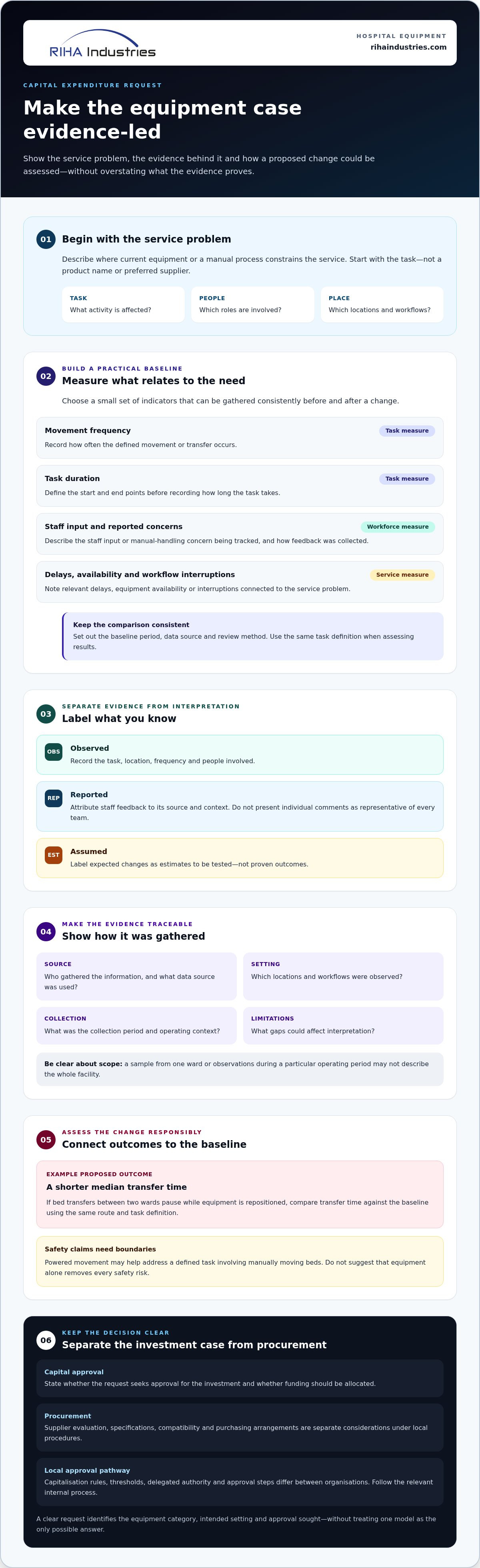
Keep the decisions clear. Capital approval may consider whether the investment is justified and whether funding should be allocated. Procurement is the separate process for evaluating specifications, suppliers and purchasing arrangements. Budget endorsement and capital approval may also involve distinct steps or decision-makers. State which decision is being sought and avoid implying that approval to fund automatically completes procurement.
Start with the clinical and operational need
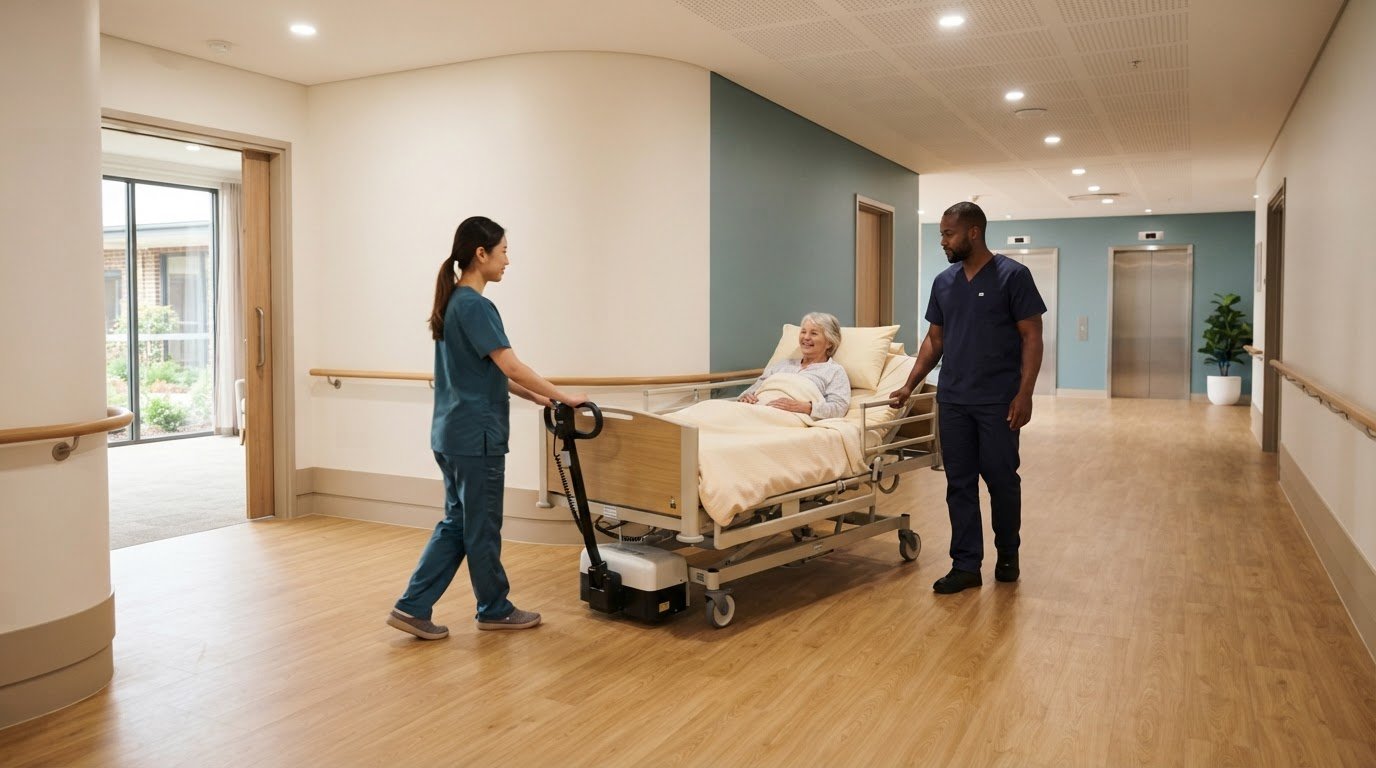
Describe where current equipment or a manual process constrains the service. For instance, teams may need to move beds between departments, but the current approach could require repeated manual effort or make transfers difficult to coordinate around other tasks. Identify the affected roles, locations and patient-handling activities. Describe the work as observed, without suggesting that equipment alone will remove every safety risk.
Separate evidence from interpretation. A short record of movement frequency, task duration, workflow delays or staff feedback can help show the scale and context of the issue. Note how information was gathered, under what operating conditions and what it does not establish. Staff reports can identify a concern, while a movement log may help quantify how often a task occurs. Avoid turning an anecdote into a broad claim about the whole facility.
Observed: record the task, location, frequency and people involved.
Reported: attribute staff feedback to its source and context.
Assumed: label expected changes as estimates to be tested, not proven outcomes.
Clarify what decision the request seeks
State the equipment category, intended setting and approval sought in plain language. For example, the request might seek approval to assess powered bed-moving equipment for transfers between specified departments, or specialised clinical procedural equipment from suppliers such as Jett Medical Canada. This frames the need without prematurely treating one model as the only answer. If a particular option is preferred, explain why its functions appear relevant and compare it fairly with alternatives.
Keep the request focused on the investment decision. Procurement can then assess detailed requirements such as equipment fit, compatibility with existing beds and workflows, supplier evaluation and purchasing steps under local procedures. For a more equipment-specific evaluation, use the hospital bed mover procurement guide. Separating these stages helps reviewers see what they are being asked to approve now and what still needs to be assessed before a purchase proceeds.
Build an evidence-led case for hospital equipment investment
Evidence helps decision-makers understand whether a proposed investment addresses a real service need and how its effects could be assessed. For a capital expenditure request for hospital equipment, start with a clear baseline: describe the current task, who performs it, how often it occurs and where delays or manual effort arise. Choose measures that relate directly to the problem rather than gathering data simply because it’s available.
Choose measures that decision-makers can review
Select a small set of indicators that can be gathered consistently before and after a change. Depending on the need, these might include transfer frequency, time taken for a defined task, staff input, equipment availability or reported manual-handling concerns. Set out the baseline period, data source and proposed review method so reviewers can see how results will be assessed.
Make the evidence traceable. Record who gathered it, the locations and workflows observed, the collection period and any gaps that could affect interpretation. If staff feedback informs the request, describe how it was collected and avoid presenting individual comments as representative of every team. Explain limitations too, such as a sample drawn from one ward or observations made during a particular operating period.
Task measures: define the start and end points before recording duration.
Workforce measures: describe the staff input or reported concern being tracked.
Service measures: note relevant delays, equipment availability or workflow interruptions.
For example, if bed transfers between two wards routinely pause while equipment is repositioned, one proposed outcome could be a shorter median transfer time. Measure it against the baseline using the same route and task definition.
Present safety evidence responsibly
Powered movement may help address a defined task that currently involves manually moving beds, but it shouldn’t be presented as a complete solution to every manual-handling risk. Consider the task, environment, equipment fit and how staff would use it. Training, suitable procedures and local risk controls remain relevant to the overall assessment.
Separate three kinds of evidence in the request: published research, local observations and projected benefits. Identify the source and context for published findings; label local records as observations from the stated setting; and describe anticipated changes as projections to be tested, not established results. This distinction helps prevent a plausible benefit from being mistaken for a guaranteed outcome.
Patient-handling equipment selection criteria can help teams consider how equipment choice relates to the task and workforce. RIHA Industries demonstrates its powered equipment in hospital settings, allowing teams to assess practical relevance against a documented workflow. Explore RIHA hospital demonstrations as one way to inform that assessment.
Compare hospital equipment options beyond the initial purchase
A useful comparison shows why one response fits the documented need better than another. Consider the current approach, relevant equipment options, and whether a staged trial or deferred decision is reasonable. Apply the same criteria to each option, including operational fit, implementation, staff familiarisation, maintenance and potential downtime. When information is missing, mark it as unknown and identify how it will be assessed rather than filling the gap with assumptions.
Assess functional fit and implementation
Check the proposed equipment against the real working environment. Document the loads to be moved, routes, gradients, turning space, thresholds and manoeuvring constraints. Consider how existing beds or trolleys connect, whether attachments are required, who will operate the equipment and what staff familiarisation involves. A hospital demonstration can help the team assess practical fit along actual routes before finalising its comparison.
Use a consistent framework such as this, adapting the criteria to the task and recording evidence for each option:
Set out whole-of-life considerations
Keep the requested capital amount distinct from expected ownership considerations. List implementation, staff training, maintenance, parts access, battery needs and the effect of equipment downtime as separate items. Their relevance and detail depend on the option and local operating requirements, so identify information gaps for follow-up rather than implying a confirmed cost or support arrangement.
For service-life planning, the hospital bed mover maintenance guide can help frame maintenance as part of the equipment decision, not an afterthought. A balanced comparison lets reviewers see the trade-offs between continuing as is, adopting equipment and taking a staged approach. It also shows how compatibility, staff readiness and ongoing support will be considered alongside the initial investment.
Use this hospital equipment capital request template
A reusable structure makes the case easier to complete and review. Adapt this capital expenditure request for hospital equipment template to your organisation’s current form, accounting rules and approval pathway. Keep statements evidence-based, distinguish confirmed information from assumptions, and assign someone to resolve each outstanding item before submission.
Fill in the business case fields
Begin with one sentence stating the need, then use the fields below to give it operational context. Keep the summary direct: what decision is sought, why the service needs it and what evidence supports the request.
Request owner, department and date: [Name, role, department and submission date]
Decision sought: [Approval requested and equipment category or scope]
Need in one sentence: [State the service constraint or requirement]
Operational context: [Explain the affected setting, teams, workflow and patient-handling task]
Baseline evidence: [Summarise measures, source, collection period and limitations]
Options considered: [Current approach, equipment options, staged approach or deferral]
Preferred option and rationale: [Explain how it responds to the need and compare relevant trade-offs]
Whole-of-life considerations: [Record implementation, training, maintenance, parts, battery and downtime considerations separately from the capital request]
Anticipated outcomes and measures: [State expected changes as projections and how they could be reviewed against the baseline]
Risks, assumptions and dependencies: [Include site readiness, compatibility, staff familiarisation and unresolved questions]
Unknowns and owners: [Identify each information gap, who will resolve it and by when]
Review responsibility: [Name the role responsible for monitoring measures and reporting outcomes]
Attachments and approvals: [Reference supporting evidence and record relevant review or approval fields]
Executive summary: [Briefly state the need, recommendation, evidence and decision required]
Make the request easy to assess
Use clear references in the request, such as “Attachment A: transfer log”, so reviewers can trace key claims to their evidence. Keep the supporting material together, and make sure its dates and scope match the summary. If the request depends on site readiness, staff training or maintenance planning, name the dependency and the person or team responsible for progressing it.
Before submitting, use your organisation’s current template and follow its approval thresholds and delegations. Requirements vary, so avoid relying on another facility’s forms or assumptions. A complete request helps reviewers distinguish the service case from procurement steps that may follow approval.
For requests involving powered bed movement, RIHA’s powered equipment can be assessed against your documented requirements as you develop the case.
Turn an approved equipment request into a supported solution
Approval is a decision point, not the end of the assessment. The equipment and support plan still need to match the task, workplace and operating requirements documented in the request. Use those requirements as a practical checklist to evaluate fit, plan implementation and track whether the solution performs as intended.
RIHA Industries designs and manufactures Australian-made powered bed movers and tugs for healthcare facilities. Its equipment is relevant to a capital expenditure request for hospital equipment when the documented need involves bed movement or another suitable heavy-load movement task. Match the product’s capabilities to the operating conditions rather than relying on a model name alone.
Match the solution to the documented task
For bed movement, assess StaminaLift transfer systems or the StaminaLift 2100 Bed Mover against the beds, routes and transfer workflow in scope. The StaminaLift Transfer System 5000 is compatible with 95% of all hospital beds and has a 300 kg lift capacity and 600 kg push or pull capacity. The Bariatric Transfer System 6000 is designed for bariatric and acute care beds, with a 450 kg lift capacity and 900 kg push or pull capacity. The StaminaLift 2100 is suited to Australian-manufactured beds found in Australia and Hong Kong. Easi Rider and Easi Mover tugs can move equipment loads up to 1500 kg, making them relevant to tasks such as moving linen and meal trolleys or large medical equipment.
Compatibility: assess the relevant bed or load, connection method and attachment requirements.
Operating environment: consider route width, gradients, turning space, thresholds and storage.
Task demands: compare the documented load and movement requirements with equipment capability.
Staff familiarisation: plan who will operate the equipment and how training will support consistent use.
A hospital demonstration helps decision-makers and intended users assess practical fit in the relevant environment. Examine the proposed task and workflow, and record what the demonstration establishes and what still needs assessment. This keeps the evaluation grounded in the request rather than assumptions about how equipment may perform on site.
Plan implementation and ongoing support
Include responsibilities for setup, staff training, preventative maintenance and repairs in the operating plan. Identify who will coordinate each activity, how equipment availability will be managed during maintenance or downtime, and how performance will be reviewed against the request’s measures. RIHA provides national service coverage in Australia and ships parts worldwide within 24 hours, details that can inform service and parts planning.
Consider Australian manufacturing and ongoing maintenance support alongside the equipment itself. A clear plan connects the approved investment to daily use, supports staff familiarisation and makes service responsibilities visible before implementation begins.
To assess practical fit against the documented task, arrange a hospital equipment demonstration with RIHA.
Put the approved investment into practice
Approval creates an opportunity to turn a documented need into a practical improvement for the service. Keep the original measures visible as implementation progresses, and agree who will review them, when that review will occur and how findings will inform any adjustments. This follow-through helps the team learn from the investment and gives future planning a clearer operational basis.
A capital expenditure request for hospital equipment is strongest when its reasoning remains useful after the funding decision. Connect approval to the people responsible for implementation, the teams who will use the equipment and the service outcomes the request set out to examine. If circumstances change, record what has changed and revisit the assumptions rather than treating the original case as fixed.
Explore how RIHA’s powered healthcare mobility equipment could work in your setting by arranging a practical equipment demonstration with RIHA.
Frequently Asked Questions
Does every hospital use the same capital expenditure approval threshold?
No, hospitals don’t all use the same threshold. Each organisation sets its own accounting policy and approval delegations, and these may differ across departments or funding arrangements. Follow current internal guidance to establish whether the request is treated as capital expenditure and which approver is responsible. If classification is unclear, consult the relevant finance team before building the request around an assumed threshold.
Who should sponsor a hospital equipment capital expenditure request?
The sponsor is usually someone accountable for the service need and able to support the request through internal review. This might be a department or service manager, supported by staff who understand the workflow and relevant clinical, facilities, safety or finance stakeholders. For example, a bed-moving request could draw on input from transport staff and the teams whose work is affected. Confirm local delegation requirements before nominating the sponsor.
How early should a hospital submit an equipment request before its new financial year?
There’s no single lead time that applies to every hospital. Work backwards from your organisation’s budget and capital planning dates, allowing time to gather evidence, consult affected teams, clarify specifications and complete internal reviews. Use the current submission calendar and departmental deadlines to plan the work. Starting well ahead of those dates gives you time to resolve gaps without rushing the case.
Can a hospital submit an equipment request outside its annual budget cycle?
Possibly, but it depends on the organisation’s funding rules and whether an out-of-cycle pathway exists. A new or urgent service need may require a separate review, while another request might need to wait for the next planning round. Explain what has changed, why the timing matters and the operational implications of deferral. Follow the internal process before assuming extra funding or an exception can be approved.
Are capital expenditure approval and procurement approval the same process?
No, they’re related but can involve different decisions. Capital approval considers whether the organisation should allocate funding for the investment; procurement approval concerns how the purchase will be evaluated and arranged under internal rules. For example, funding may be endorsed before a detailed supplier evaluation begins. Map the sequence with the relevant teams so the request doesn’t present funding endorsement as permission to place an order.
How many supplier quotes should a hospital equipment request include?
There isn’t one quote count that applies to every hospital or purchase. The required evidence may depend on the organisation’s procurement policy, the type of purchase and any applicable funding conditions. A capital request can explain the need and options at an early stage, while quote requirements may be handled during procurement. Follow the relevant internal process, and don’t invent or imply a required number in the business case.
What should a hospital do if its capital expenditure request is declined?
Ask for the decision rationale and whether the request was declined because of evidence, timing, scope, funding priority or another factor. Then decide whether to address a specific gap, revise the options, seek a smaller staged approach or resubmit in a later cycle. Keep the service need and supporting records current. If the priority has changed, update the case rather than resubmitting the original unchanged.
Can hospital staff request an equipment demonstration before preparing a capital case?
Yes. A demonstration can help staff explore practical fit before finalising a case. RIHA Industries demonstrates its healthcare mobility equipment so relevant teams can consider how it relates to their documented tasks and environment. For example, staff can observe manoeuvring in a representative area and note questions about compatibility or familiarisation. Treat observations as input to the assessment, not proof of outcomes that haven’t yet been measured.