Compare multi-directional bed movers by load capacity and drive
The most capable bed mover isn’t automatically the best fit for every ward. A multi-directional bed mover can help caregivers manoeuvre hospital beds in tight spaces, while powered drive and steering assistance can reduce the effort involved. The right option depends on the route, the complete load and the space available to turn and store the equipment.
Choosing a mover involves more than its drive type. Capacity, bed attachment, caregiver handling and storage all affect how well it suits daily use. This comparison explains the differences between manual, powered and multi-directional systems, what to assess when matching capacity and attachments to existing beds, and why size and storage matter. Use these criteria to weigh practical trade-offs before selecting a solution for your care environment.
Table of Contents
What technologies are used to aid caregivers in transporting patients on hospital beds?
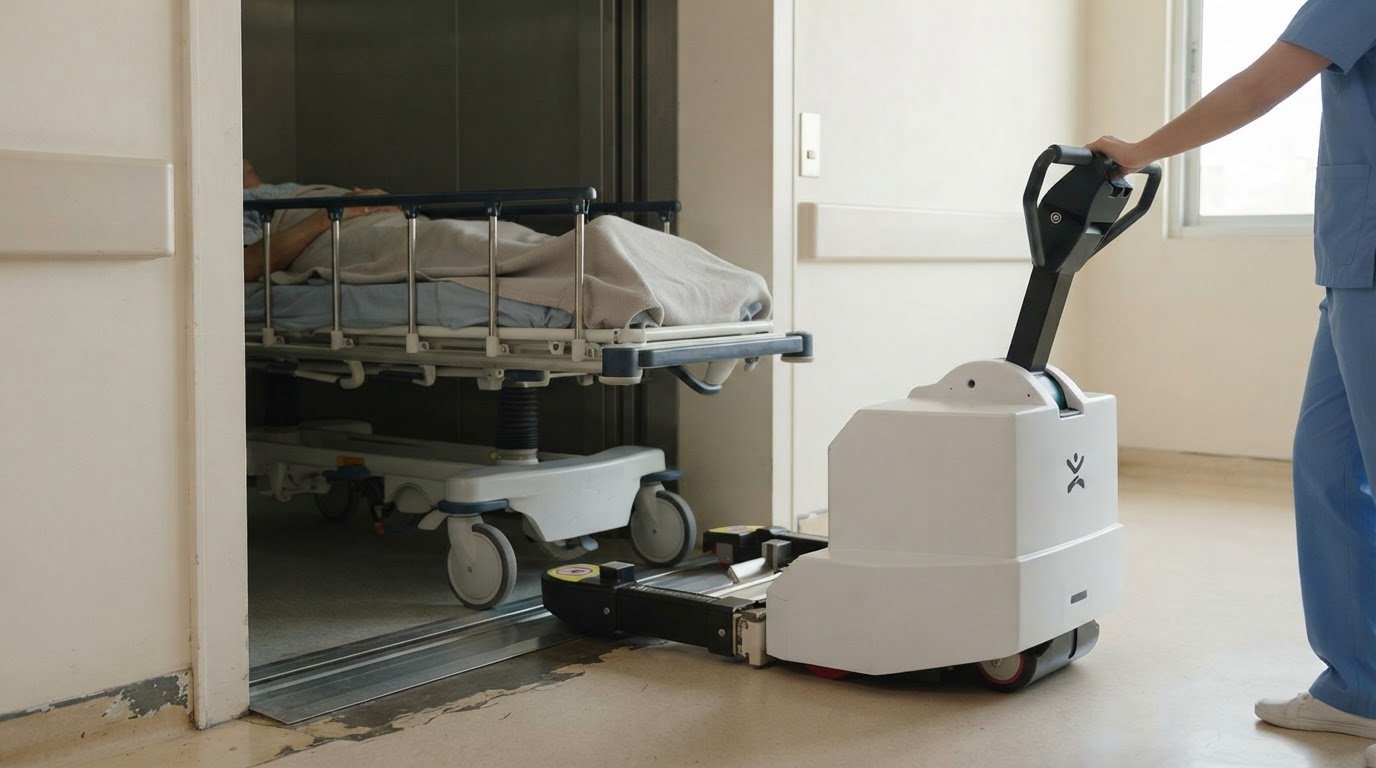
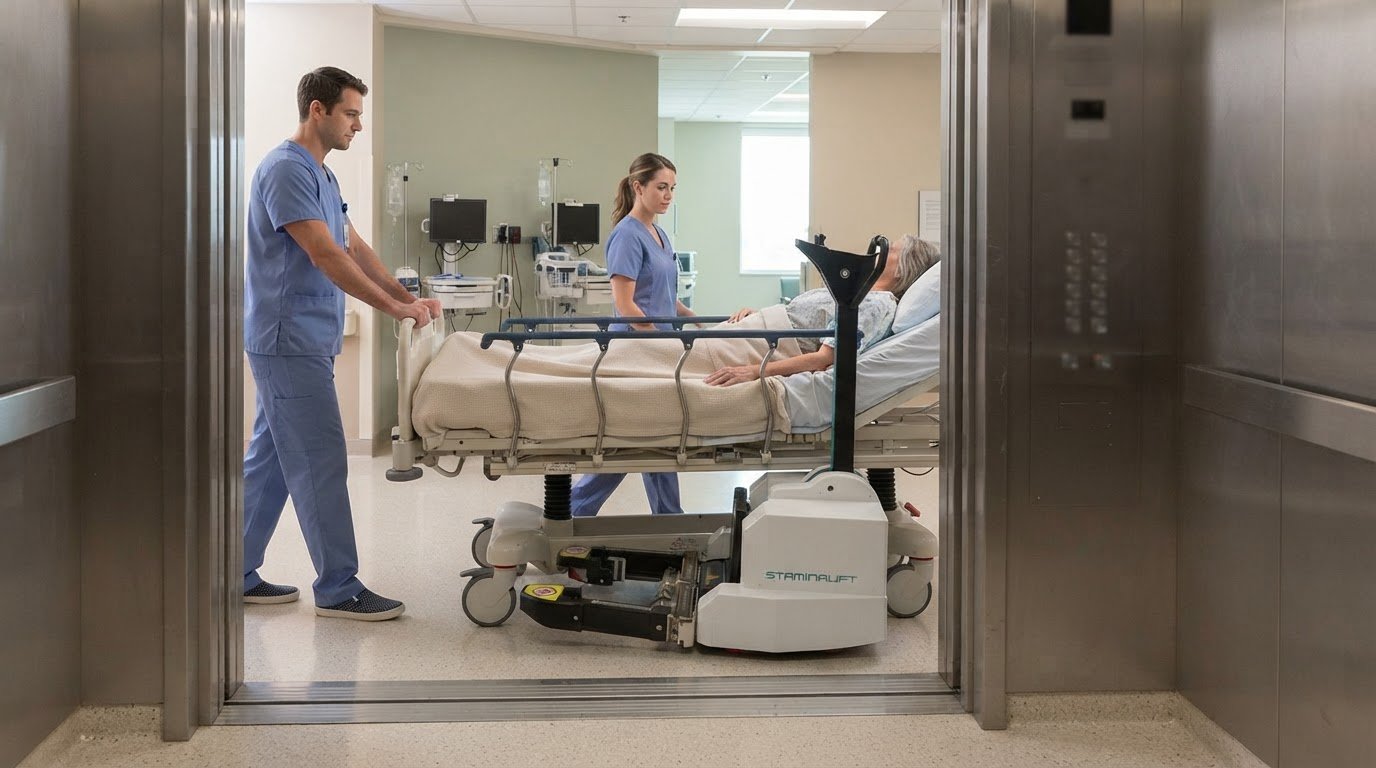
Hospitals use powered drives, steering assistance and robotic systems to move occupied beds. A multi-directional bed mover adds sideways movement or tighter turning, which can help in confined rooms and corridors. These technologies move the bed; they do not perform patient lifting or repositioning.
Powered bed movement uses a motor to assist travel, while the caregiver guides and controls the bed. Steering assistance, such as a fifth-wheel design, can support directional control in a room or corridor. Robotic bed movers add powered, omni-directional movement, allowing equipment to travel in more than one direction. The practical difference is how each system combines propulsion, steering and operator control.
Options include powered bed movers with assisted steering, systems with a fifth wheel, and robotic movers with omni-directional mobility. Some attach to the bed, while others operate as separate transport devices. Assess the attachment method, controls, turning behaviour and intended bed compatibility together.
A bed mover transports the bed horizontally with the patient on it. A patient lift raises or transfers someone between surfaces, such as a bed and chair. A bed transport system may have its own powered drive or steering, so compare its function with the specific task rather than treating these devices as interchangeable.
In US healthcare facilities, training should cover the mover’s controls, attachment procedure, route hazards, stopping and emergency response. Facility procedures should also define safe patient handling and the operator’s role during transport. Practise the route with the bed empty first, then follow the facility’s patient-transfer process.
Hospitals can buy systems through manufacturers or healthcare equipment distributors, and equipment rental businesses may offer rental options. Before selecting a system, compare bed compatibility, drive type, load rating, attachment and storage needs. A demonstration can show how its controls and turning movement work on staff’s usual routes.
Research offers some evidence for these design choices. A study of a robotic hospital bed mover with omni-directional mobility estimated that it halved the force required to push hospital beds. An experimental evaluation also found that the mover performed better than a manual transport stretcher.
Caregivers perceive fifth-wheel steering assistance as improving productivity in patient rooms and corridors. Another study measured hand forces on 10 caregivers moving a bariatric bed manually and with a powered drive.
Rated load capacity
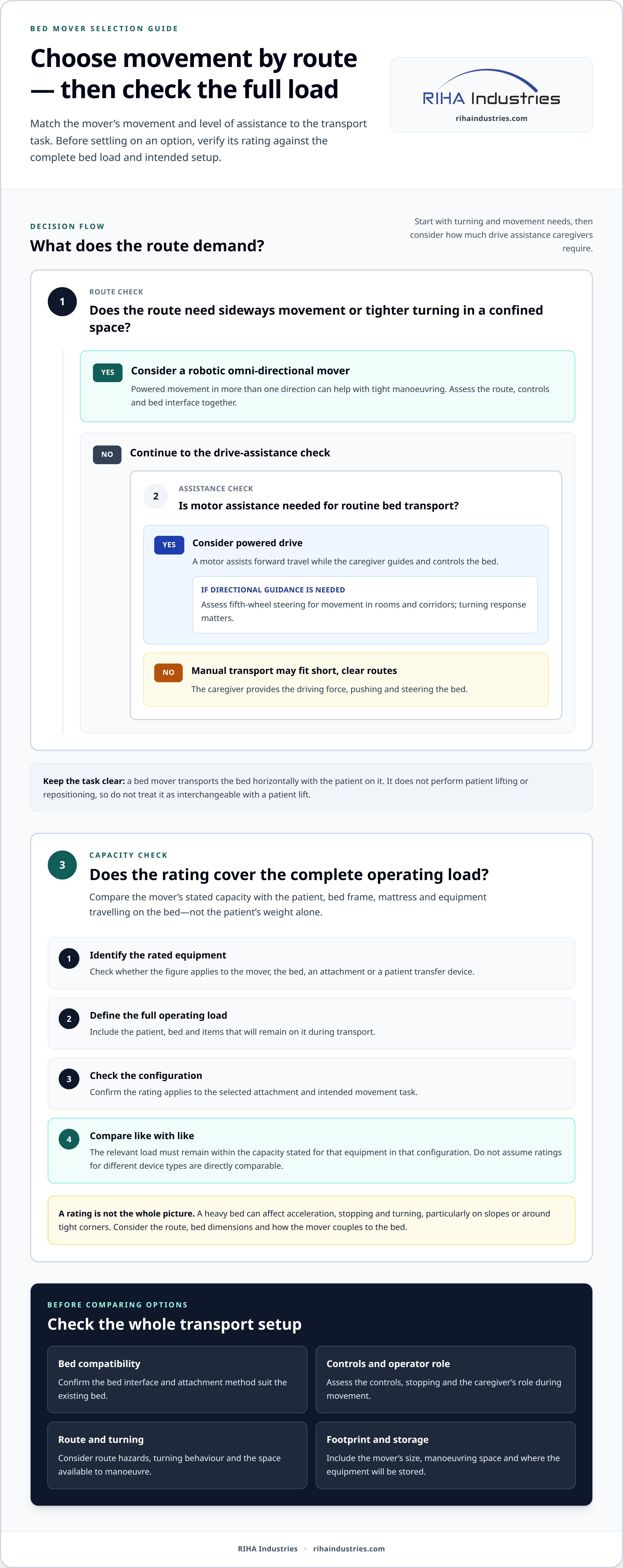
A mover’s rated capacity is the maximum load it is designed to carry or move. The rating must suit the complete load, not just the patient’s body weight. For a hospital bed, account for the patient, bed frame, mattress and equipment travelling on it. Capacity applies to the equipment’s stated use, so distinguish a bed mover’s rating from a patient transfer device’s rating.
“Payload” usually describes the load carried, while “weight capacity” may refer to the maximum supported load. Product specifications can use these terms differently, so read the rating alongside the intended configuration and attachment method. For example, a mover connected to a bed may have a different capacity basis from a separate transfer device. Don’t assume two ratings are directly comparable just because both appear in pounds.
That figure is an example of a transfer-device rating, not a bed-mover specification. It cannot establish a hospital bed’s capacity or the safe load for a mover. Compare like with like: bed mover against bed mover, accounting for the intended bed and attachment.
Use this sequence to interpret a capacity rating:
Identify the rated equipment. Establish whether the figure applies to the mover, the bed, an attachment or a patient transfer device.
Define the full operating load. Include the patient, bed and items that will remain on it during transport.
Check the configuration. Confirm that the rating applies to the selected attachment and the intended movement task.
Compare the figures. The relevant load must remain within the capacity stated for the equipment in that configuration.
Capacity alone doesn’t explain how a mover handles a load. A heavy bed can affect acceleration, stopping and turning, particularly on slopes or around tight corners. Consider the transport route, bed dimensions and how the mover couples to the bed. These factors show whether a rating suits routine movement, rather than merely meeting a figure on paper.
A patient’s weight may be only part of the load. The mattress, monitoring equipment and other items on the bed add to the total being moved. If equipment is removed before transport, the operating load changes. Record the usual transport setup, then compare the complete load with the mover’s stated rating. This makes capacity selection more relevant to daily use.
When comparing specifications, prioritise the applicable load rating, supported bed configuration and transport task. A higher stated capacity is not automatically a better fit if the attachment or movement requirements differ.
Reducing caregiver physical strain
Powered assistance can reduce the force caregivers apply while moving a loaded bed, particularly during demanding manoeuvres. In a cited study, a powered drive decreased peak forces by 38% while manoeuvring a bariatric bed into an elevator. On a ramp, peak forces fell by 94%. These results show why route conditions matter when assessing ergonomic effort.
The physical demands change throughout a journey. Straight-line pushing, turning into an elevator and controlling a bed on a slope involve different actions. In the cited study, average hand forces during straight-line pushing did not vary between bed designs. A mover’s ergonomic value may therefore be clearer during turns, on ramps or along other challenging sections of the route.
Stopping control also matters. A bed that is difficult to slow or steer can require sudden effort from caregivers, especially near a doorway or another person. The cited bariatric-bed study found that powered drive reduced stopping distance by 55%, while manoeuvring powered-drive beds reduced hand force by 34% compared with manual transport. These findings relate to the study conditions, not every bed or route.
Caregiver injuries can result from repeated or forceful handling, but a powered mover doesn’t remove every physical risk. Staff still need to guide the bed, maintain a clear view and manage patient movement. A sharp turn, uneven threshold or crowded corridor can add handling demands, even when the drive provides assistance. Plan the route and operator roles together.
Use an ergonomic assessment to examine each part of the transfer:
Starting movement: note the effort needed to get the loaded bed moving from rest.
Steering: observe the caregiver’s hand position and effort through a tight turn.
Stopping: assess how the operator slows the bed before a doorway or lift.
Route changes: include ramps, thresholds and elevator entry in the assessment.
ISO/TR 12296:2012(E) is the cited technical report on ergonomics and manual handling of people in the healthcare sector. Its subject makes it relevant to reviewing bed transport as part of a broader manual-handling approach. Pair that review with direct observation: a straight corridor test alone won’t show the effort required at an elevator entrance or on a ramp.
Compare manual and powered movement on the actual route, using the same bed and transport setup. Record where caregivers push, steer or brake, then identify which manoeuvres require the most effort. This practical comparison helps match drive assistance to the task while keeping patient supervision and clear communication central to safe movement.
Attachment and drive mechanisms
A multi-directional bed mover helps move a hospital bed in more than one direction. It couples to or works alongside the bed, while its drive and steering support controlled movement. The operator guides the bed using the mover’s controls rather than relying solely on manual pushing.
Attachment determines how force transfers between the mover and bed. The coupling must engage the intended frame area securely, remain stable during turns and release in a controlled way after transport. Bed frames vary, so compatibility depends on their structure and the mover’s connection design. An adaptor can bridge a mismatch: one listed system requires an adaptor for two beds.
Follow a consistent connection sequence before use. Position the mover at the specified attachment point, engage its coupling and confirm the connection is secure. Check that cables, brakes and other bed components remain clear. A loose or misaligned attachment can affect steering, so don’t start moving until the connection is seated as intended.
Drive mechanisms also differ. Manual systems rely on staff for force and direction. Powered models use a motor, with a battery supplying electricity, but the operator still controls travel and steering. Battery level, charging arrangements and operating instructions all matter in routine use. Don’t assume every powered mover uses the same charging method or has the same operating time.
Turning capability depends on the drive and wheel arrangement. A system designed for lateral movement can help reposition a bed across a confined room, while a forward-drive model may suit a straight corridor route. Omni-directional movement supports travel in multiple directions, but the operator still needs a clear path, control of the bed and room to manoeuvre.
Compare mechanisms by how they perform the transport task:
Attachment: check the bed-frame connection, alignment and release process.
Drive: identify whether movement is manual or motor-assisted.
Steering: assess forward travel, turning and sideways repositioning.
Power: understand the battery and charging process from the operating instructions.
Controls: consider how the operator starts, slows and stops movement.
A bed may fit a mover’s general category but have a frame shape that prevents direct coupling. An adaptor may resolve that connection issue; a different drive mechanism will not. Check attachment compatibility and movement capability separately, then assess them together on the intended route. This shows whether the complete setup supports safe, controlled transport.
Bed mover size and storage
A bed mover needs to fit both the transport route and its storage location. A compact unit may be easier to park, but its working footprint still matters beside a bed. Assess the equipment in its operating position, not just its stored profile. For example, a mover that fits in a cupboard may need extra space to approach and connect to a bed.
Measure the complete route from storage to the first bed, including doorways, corners and lift entrances. Record the narrowest clear passage and the space available for turning. A mover that travels along a corridor may still be difficult to position in a patient room. Assess the bed and mover together because their combined width affects the turning space required.
Storage planning also means considering access. If staff must move other equipment to reach a parked mover, retrieval can become awkward during a busy shift. Choose a location close to the beds it serves while keeping access routes clear. In a shared store, mark a defined parking position so the mover doesn’t obstruct a doorway or other equipment.
Check these points during a site assessment:
Stored footprint: measure the space the mover occupies when parked.
Operating footprint: allow room to approach, attach and steer beside a bed.
Route clearance: include doorways, corners and thresholds on the actual journey.
Access to controls: make sure the operator can reach controls without being trapped between the mover and bed.
Charging access: if the mover uses a battery, include the charging position in the storage plan.
A floor plan can reveal conflicts before equipment arrives. Mark the storage bay, bed approach and turning area, then trace a typical trip from the bay to a room. For example, parking a mover near a lift may reduce corridor travel, but only if staff can approach without blocking the entrance. Test the layout with the bed and mover in their intended positions.
Storage needs can change between shifts. A mover left connected to a bed takes up clinical space, while a parked unit must remain accessible for the next transport. Agree where the equipment should be returned after use and how its battery will be managed. A consistent return point helps staff find it without first moving unrelated equipment.
The clearest choice is the smallest mover that suits the required bed, movement task and route, while leaving enough room to attach and steer it safely. Assess storage and manoeuvring space together: a compact stored size alone doesn’t guarantee a practical fit.
RIHA Industries
RIHA Industries offers patient transfer systems and bed movers for healthcare settings where existing equipment and transport requirements need to work together. Its range includes the StaminaLift Transfer System 5000, StaminaLift Transfer System 6000 and StaminaLift 2100 Bed Mover, designed to integrate with existing hospital equipment. Easi Rider and Easi Mover tugs provide further options for moving heavy loads.
When comparing bed movement and transfer equipment, start with your facility’s requirements. Consider the beds in use, the tasks staff perform, load capacity, attachment needs and available storage space. Matching these practical details to each product’s intended role helps focus the selection.
Put the right movement solution into practice
Turn the comparison into a practical decision for your care environment. Identify the routes beds travel, the manoeuvres that demand the most control, and how equipment will be accessed and stored between transfers. Then consider which tasks need powered assistance and how the mover must work with the beds already in use. This gives your team a clear basis for discussing a multi-directional bed mover and related patient-transfer equipment.
RIHA Industries offers equipment including the StaminaLift Transfer System 5000, StaminaLift 2100 Bed Mover and StaminaLift Transfer System 6000. These options provide a starting point for a conversation focused on your facility’s transport tasks and existing equipment, rather than a feature list in isolation.
Contact RIHA Industries to discuss the movement requirements you’re working to address. A considered next step can help your team move towards a solution that fits its day-to-day environment.
Frequently Asked Questions
Which bed mover should you choose?
Choose a mover that suits your facility’s beds, transport tasks and staff workflow. Identify which beds need moving, then compare attachment compatibility, rated load, drive style and manoeuvring requirements. A multi-directional bed mover may suit routes that require close positioning around furniture or equipment. Include storage and operator training in the decision so the equipment fits routine use as well as the transport route.
What is the weight capacity and battery life of common bed movers?
Capacity and battery life vary by model, configuration and operating conditions, so there’s no single figure for all bed movers. Capacity may refer to lifting, pushing or pulling, which are different functions. Battery use depends on the load, route and frequency of movement. Compare the precise rating for the intended task and plan charging around actual use. A transfer device’s rating, for example, shouldn’t be treated as a bed mover’s capacity.
Which bed movers are best for home versus hospital use?
The best fit depends on the setting’s equipment and transport needs. Hospitals may need a system that integrates with existing beds and supports repeated movement between care areas. At home, available floor space, doorway clearance and the specific bed become central considerations. RIHA Industries supplies healthcare bed movers and patient transfer systems, including equipment designed to integrate with existing hospital equipment. Match the intended use and bed compatibility before comparing movement features.
What safety features and risks should buyers consider?
Consider how the equipment stops, how accidental operation is controlled and how staff should respond if the mover loses power. A safe transport plan should also account for patient comfort, clear communication and people entering the route. For example, one caregiver can coordinate movement while another staff member observes the patient. Include charging routines and equipment condition in local procedures, as an uncharged or poorly maintained mover may disrupt planned transfers.
Can a bed mover fit through standard doorways and elevators?
Fit depends on the mover’s dimensions, its attachment to the bed and the clear opening along the route. A multi-directional bed mover may turn differently from a forward-only unit, but the combined width of bed and mover still determines clearance. Measure the narrowest doorway and elevator entrance, then consider turning and positioning space inside each area. Assess the intended route with the bed configuration in use, including handles or equipment extending beyond the frame.