
Compliance with Australian WHS Manual Handling Codes: A 2026 Healthcare Safety Guide
Could your facility survive a rigorous safety audit today? While many healthcare providers rely on staff training to manage risks, manual handling remains the primary cause of musculoskeletal injuries among Australian nurses. It’s a frustrating reality when you’re trying to balance patient care with the strict demands of compliance with Australian WHS manual handling codes. You likely feel the pressure of interpreting what "reasonably practicable" actually means in a crowded, high-pressure ward, especially when your ageing equipment no longer meets modern safety standards.
We believe that your team deserves to work in an environment where their physical well-being is guaranteed through thoughtful engineering. By mastering the complexities of the 2026 safety landscape, you can eliminate manual handling injuries and foster a culture of stability and morale. This guide provides a clear roadmap to achieving zero-injury targets and full legal compliance with Safe Work Australia codes. We will examine how shifting to motorised, Australian-made transfer solutions satisfies the highest level of the Hierarchy of Control, ensuring your workforce remains protected, empowered, and ready for the future of healthcare.
Table of Contents
Navigating Compliance with Australian WHS Manual Handling Codes
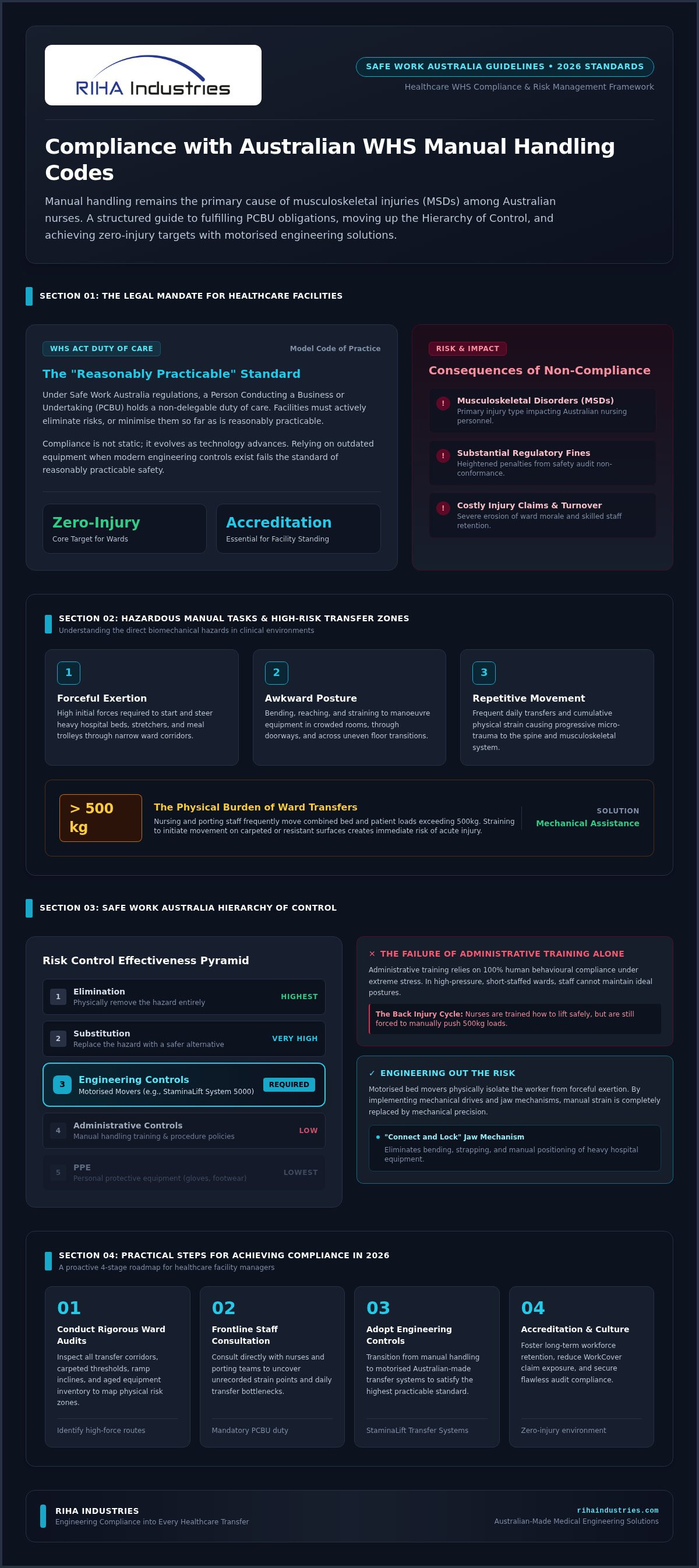
Safe Work Australia serves as the national authority that defines how we protect our healthcare workforce. For hospitals and residential care facilities, this guidance is distilled into the "Hazardous Manual Tasks" Code of Practice. As a Person Conducting a Business or Undertaking (PCBU), your legal obligation in 2026 is precise. You must eliminate or minimise risks so far as is "reasonably practicable." This isn't a static requirement; it evolves as new technology makes safer work methods available. Achieving compliance with Australian WHS manual handling codes means you're actively seeking ways to remove the physical burden from your staff, particularly during high-risk activities like bed and trolley transfers.
The Primary Duty of Care in Healthcare Facilities
Hospital boards and facility managers carry the primary duty of care under the WHS Act. It's a significant responsibility that requires a proactive stance on risk management. When safety protocols lapse, the consequences are severe. Beyond the obvious risk to staff health, non-compliance leads to costly workplace injury claims and substantial regulatory fines. Maintaining rigorous compliance with Australian WHS manual handling codes is also a fundamental requirement for facility accreditation. It signals to your staff and the wider community that you prioritise safety as a core operational pillar rather than a secondary concern. By investing in compliant systems, you provide a sense of relief and empowerment to those on the front lines.
Identifying Hazardous Manual Tasks in the Ward
A Hazardous Manual Task is any activity requiring forceful exertion, awkward posture, or repetitive movement. In a clinical setting, these tasks are frequent and often unavoidable without the right equipment. The manual handling of loads in wards often involves pushing heavy hospital beds, stretchers, and meal trolleys through narrow corridors. These tasks demand high-force requirements that directly contribute to musculoskeletal disorders (MSDs) among nursing and porting staff. Repetitive movements, such as steering a heavy bed or straining to initiate movement on a carpeted surface, create cumulative wear on the body. Identifying these specific high-risk zones allows you to target your safety interventions where they'll have the greatest human impact. When you recognise these hazards early, you can implement engineering controls that replace manual effort with mechanical precision, ensuring every transfer is both safe and efficient.
The Hierarchy of Control: Why Engineering Beats Administration
Effective risk management in a clinical environment is built upon the Hierarchy of Control. This framework ranks safety interventions from most effective to least effective: Elimination, Substitution, Engineering, Administration, and PPE. While many facilities focus heavily on administrative controls, such as manual handling training, these are actually the least reliable methods for protecting staff. Achieving true compliance with Australian WHS manual handling codes requires prioritising higher-level controls. The Model Code of Practice for Hazardous Manual Tasks emphasizes that engineering controls should be implemented whenever it's reasonably practicable to do so. These controls don't rely on human behaviour; they physically change the task to remove the hazard entirely.
The Failure of Administrative Controls
Administrative controls fail because they assume staff will always have the time and mental capacity to follow perfect form. In high-pressure wards, this is rarely the case. Staff often revert to unsafe habits when they're short-staffed or facing an emergency, leading to a cumulative physical burden that training alone cannot fix. This creates a "back injury cycle" where nurses are taught how to lift but are still expected to push 500kg beds manually. Regulators are increasingly critical of facilities that rely solely on education while ignoring available engineering solutions. When a safety inspector visits, they look for evidence that you've moved up the hierarchy to provide a safer work environment through mechanical assistance.
Engineering Out the Risk with Motorised Movers
Motorised movers, such as the StaminaLift Transfer System 5000, represent the pinnacle of engineering controls in healthcare. By utilising a "connect and lock" jaw mechanism, these devices eliminate the need for nurses to bend, strap, or manually initiate the movement of heavy beds. This technology provides effortless 360-degree manoeuvrability, allowing for fluid movement in tight corridors without the need for awkward postures or forceful exertion. Implementing these solutions is a critical step in how to reduce nurse back injuries and ensures your facility stays ahead of 2026 compliance requirements. Transitioning to motorised equipment provides immediate relief for your team, replacing physical strain with controlled, mechanical precision. For those seeking a long-term safety partner, investing in Australian-made engineering ensures your facility meets the highest national standards while protecting your most valuable asset: your people.
Assessing the Physical Burden of Hospital Transfers
The physical reality of hospital porting often goes unmeasured in traditional risk assessments. While a single transfer might seem manageable, the cumulative effect of moving modern hospital beds, which often exceed 500kg when occupied, creates a massive physiological load. Pushing these weights across varying floor surfaces, such as high-friction carpets or through heavy fire doors, requires force that frequently exceeds safe limits. When you factor in the necessity of navigating ramps and inclines, the risk to your workforce escalates rapidly. Achieving compliance with Australian WHS manual handling codes requires a shift from viewing transfers as isolated events to recognising them as a continuous physical demand that necessitates mechanical intervention.
Quantifying Cumulative Strain on Caregivers
Physical fatigue isn't just a result of the heaviest lift of the day; it's the product of frequency and duration. Hospital staff regularly walk up to 15km per shift, which totals an exhausting 75km over a standard working week. These minor tasks, when repeated hundreds of times, lead to chronic musculoskeletal disorders that sideline experienced professionals. A porter walking 12 miles daily is at significantly higher risk of MSDs without mechanical assistance. By assessing the total volume of movement rather than just peak loads, facility managers can better understand why staff morale and retention often dip in high-traffic wards. Engineering solutions provide the relief needed to sustain a healthy, productive workforce over the long term.
Bariatric Compliance: Handling Loads up to One Tonne
Bariatric patient transport presents a unique challenge where manual handling is physically impossible for a single person to perform safely. Under 2026 safety standards, attempting to manually move such extreme weights is a clear breach of duty. The StaminaLift Transfer System 6000 is specifically engineered for these high-stakes scenarios, capable of moving nearly one tonne up a 7-degree incline with precision. Compliance in this area depends on equipment that features automatic braking and safety lockouts to prevent runaway loads on ramps. These motorised solutions ensure that even the most demanding transfers are handled with dignity for the patient and absolute safety for the caregiver, fulfilling your obligations under the national safety codes.
Practical Steps for Achieving WHS Compliance in 2026
Transitioning from risk identification to active mitigation requires a structured and methodical approach. To maintain compliance with Australian WHS manual handling codes in 2026, facilities must move beyond passive observation and implement a system that prioritises staff well-being through mechanical assistance. A robust compliance strategy follows these five essential steps:
Conduct a thorough audit: Review every manual handling task within the facility to identify where physical limits are being pushed.
Consult with staff: Engage directly with nurses and porters to pinpoint specific "pain points" and high-risk transfer zones in the ward.
Implement engineering controls: Replace manual pushing and pulling by prioritising the rollout of motorised bed and trolley movers.
Establish preventative maintenance: Create a rigorous programme for all safety equipment to ensure operational reliability and reduce liability.
Provide formal certification: Train staff thoroughly on motorised aids to ensure equipment is used to its full safety potential.
Staff Training and Bluetooth Diagnostics
Modern safety technology now integrates advanced diagnostics to simplify the compliance process. Bluetooth connectivity allows facility managers to monitor equipment usage patterns in real-time, making it easier to identify training gaps before an incident occurs. Programmable joystick controls further enhance safety by allowing the equipment to be tailored to different user preferences and skill levels. Formal certification ensures that every operator feels empowered and confident, turning a mechanical tool into a seamless extension of their daily workflow. This level of technical integration provides a sense of security for both the management and the frontline team.
The Role of Preventative Maintenance in Compliance
Operating with faulty or poorly maintained equipment is a significant WHS liability that can compromise the safety of the entire ward. Maintaining compliance with Australian WHS manual handling codes is an ongoing commitment that requires equipment to be in peak working order at all times. This is why national service coverage and 24-hour parts shipping are critical for maintaining operational reliability in high-pressure environments. For detailed guidance on keeping your fleet in top condition, consult our hospital bed mover repair service guide. Reliable engineering is the foundation of a safe workplace, and choosing Australian-made solutions ensures you have the local support needed to keep your facility running without interruption. To see how these systems can transform your ward safety, explore our range of motorised transfer solutions today.
RIHA Industries: Engineering Compliance into Every Transfer
RIHA Industries stands as the premier Australian manufacturer dedicated to solving the physical challenges of healthcare through precision engineering. By integrating motorised technology into daily workflows, the StaminaLift and Easi series have become the gold standard for achieving compliance with Australian WHS manual handling codes. The evidence of this impact is undeniable. At a major South Australian hospital, the implementation of these motorised movers saw bed-moving injuries reduced from 20% to zero in just two years. This wasn't just a win for safety; it was a total transformation of workplace culture. With the StaminaLift Transfer System 5000 being compatible with 95% of global hospital beds, facilities can achieve this level of protection without needing to replace their existing bed fleet.
The StaminaLift Advantage: Safety by Design
Safety is engineered into every component of our equipment. The 360-degree turning radius allows operators to navigate tight corners and elevators with effortless control, removing the need for the awkward postures that often lead to strain. We understand that a quiet healing environment is essential for patient recovery. Our movers operate at a low noise level of 65 dB, ensuring that safety doesn't come at the cost of clinical peace. The compact design allows the movers to fit neatly under beds when connected, which significantly reduces tripping hazards in busy ward corridors. These thoughtful details empower staff to move heavy loads with confidence and ease.
ROI: The Financial Case for WHS Compliance
Investing in motorised solutions is as much a financial decision as it is a safety one. Our ROI calculator helps facility managers quantify the significant labour savings and injury reduction costs achieved through automation. By enabling a single operator to move a heavy bed safely, clinical staff are freed up to focus on direct patient care. This efficiency directly addresses the staffing pressures felt across the sector, improving both retention and morale. To ensure long-term sustainability, we utilise 3D-printed parts to extend the life of equipment fleets, providing a durable solution that grows with your facility. This commitment to technical excellence ensures that compliance with Australian WHS manual handling codes is a sustainable achievement rather than a temporary fix. Choosing Australian-made engineering means you're partnering with a leader dedicated to the long-term health of your workforce and your facility.
Securing the Future of Your Healthcare Workforce
Achieving compliance with Australian WHS manual handling codes is a fundamental commitment to the safety and longevity of your team. By prioritising engineering controls over administrative training, you replace hazardous physical strain with mechanical precision. We've seen major hospitals reduce bed-moving injuries to zero by adopting these technologies, proving that a safer workplace is a tangible reality for those who lead with innovation.
Our FDA-registered and Australian-made equipment is backed by comprehensive national service coverage, ensuring your facility remains both compliant and operational. Transitioning to these motorised systems empowers your staff, allowing them to focus on patient care without the constant risk of cumulative musculoskeletal injuries. It's time to transform your ward into a centre of safety, where the physical burden is lifted and your workforce can thrive in a supportive environment.
Your workforce deserves a protective ally that understands the high-stakes nature of modern healthcare and provides the technical excellence required to meet it.
Frequently Asked Questions
What are the main requirements for compliance with Australian WHS manual handling codes?
The primary requirements involve a systematic process of identifying hazardous manual tasks, assessing risks, and implementing effective controls. PCBUs have a legal obligation to eliminate or minimise the risk of musculoskeletal disorders so far as is reasonably practicable. This process must include consultation with workers and a regular review of safety measures. Following the Model Code of Practice ensures that your facility meets the national standards for protecting healthcare staff from physical strain.
How does the "Hierarchy of Control" apply to hospital bed transfers?
The Hierarchy of Control ranks safety interventions by their effectiveness, starting with the total elimination of the hazard. In hospital transfers, engineering controls like motorised bed movers are preferred because they physically change the task to reduce effort. Administrative controls, such as manual handling training, are considered less reliable because they depend on human behaviour. Prioritising engineering solutions ensures a higher level of protection for staff navigating high-pressure ward environments.
What is the maximum weight a nurse can safely push according to WHS guidelines?
Australian WHS codes don't define a specific weight limit in kilograms for pushing or pulling tasks. Instead, safety is determined by the force required, the frequency of the task, and the posture of the staff member. Environmental factors like carpeted floors or ramps significantly increase the physical burden. When the force needed to move a bed exceeds safe limits, mechanical assistance becomes necessary to prevent cumulative injury and long-term musculoskeletal damage.
Are motorised bed movers considered a mandatory engineering control?
While not explicitly named as "mandatory" in the legislation, motorised movers are often required to achieve compliance with Australian WHS manual handling codes. This is because the law requires the highest level of control that is reasonably practicable. If motorised technology is available and effective at reducing known risks, regulators expect its use over lower-level controls like training. Implementing these movers demonstrates a proactive and legally sound approach to workplace safety.
How often should hospital manual handling equipment be serviced for WHS compliance?
Equipment should be serviced at least every six to twelve months in accordance with the manufacturer’s preventative maintenance guidelines. Regular inspections are vital to ensure that safety features like automatic brakes, emergency stops, and jaw locking mechanisms remain fully operational. Maintaining detailed service records is a critical part of your safety audit trail. Consistent maintenance not only ensures legal compliance but also extends the operational life of your equipment fleet.
Can one person safely move a bariatric bed using motorised equipment?
Yes, specialised motorised movers allow a single operator to transport bariatric beds safely without additional assistance. High-capacity systems, such as the TS6000, are specifically engineered to move loads up to 900kg, including on 7-degree inclines. This mechanical precision removes the need for multiple staff members to push a single load, which significantly reduces the risk of injury. It ensures that even the most demanding transfers are managed with dignity and absolute safety.
What are the penalties for non-compliance with manual handling codes in Australia?
Non-compliance can result in severe financial penalties, with fines for corporate entities reaching millions of dollars under the WHS Act. Individual officers can also be held personally liable for breaches of their duty of care. Beyond legal fines, facilities face the high costs of workplace injury claims and potential loss of accreditation. Investing in compliant engineering solutions is a strategic way to protect your staff while securing the financial stability of your organisation.
How do I conduct a WHS risk assessment for patient transfers?
Start by auditing all transfer tasks and consulting with frontline staff to identify high-risk zones. You must evaluate the weight of the load, the frequency of the task, and environmental factors like floor surfaces or narrow corridors. Once hazards are identified, you must implement the highest level of control possible. This thorough evaluation ensures your facility maintains compliance with Australian WHS manual handling codes by targeting the most physically demanding activities with effective engineering solutions.


