Electric Patient Movers for Bariatric Patients: Room Fit and Power
A safe bariatric transfer depends on planning, not strength alone. An electric patient mover for bariatric patients can support a transfer when staff consider the patient’s mobility, equipment capacity, sling and route together. Staff should be trained to use the equipment and pause the move if the patient feels discomfort or becomes unstable.
Moving a bariatric patient can be complex, particularly in tight spaces or when substantial support is needed. The key is to match the transfer method to the person and surroundings, rather than assume one type of lift suits every move.
This guide explains how powered lifts assist with bariatric transfers, what to consider when assessing room clearance and power, and how different systems may suit different tasks. It also covers how mobility, sling fit, staff preparation and the route through a facility affect a safer, more manageable transfer.
Table of Contents
How Do I Move a Plus-Size/Bariatric Patient?
Plan a bariatric transfer around the person’s mobility, equipment capacity and route, rather than relying on manual lifting. In the United States, 41.9% of adults were classified as obese between 2017 and 2020, according to the Centers for Disease Control and Prevention.
Planning a Safe Move and Route
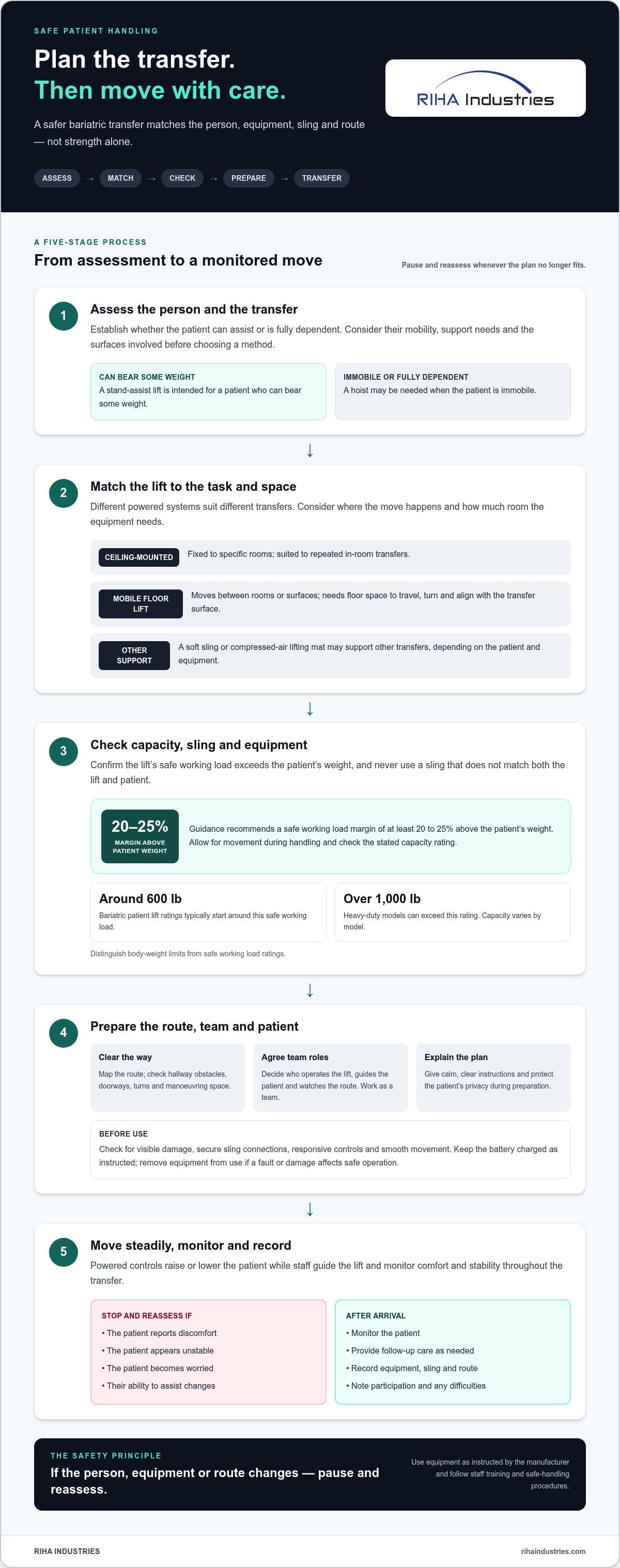
Plan a safe move by assessing the patient, equipment and route before the transfer begins. Establish whether the patient can assist or is fully dependent, as this guides the transfer method. Map the route to the treatment area, clear hallway obstacles, and check doorways and turns. A clear path helps staff manoeuvre equipment without rushing or compromising the patient’s dignity.
Policies and Safe Handling Practices
Safe-handling policies set out how staff assess, plan and carry out patient transfers. Consistent procedures help teams avoid improvised lifting when a patient needs substantial support. Staff should be trained and competent with the specific equipment, and caregivers should work as a team rather than lift alone. Stop and reassess if the patient reports discomfort, appears unstable or becomes worried.
Lift Installation and Safety Features
Safe installation places a lift where it can support the intended transfer without obstructing the room or route. Before use, confirm its safe working load exceeds the patient’s weight; guidance recommends a margin of at least 20 to 25% above that weight. The sling must suit both the patient and lift. Clear controls, stable support and an emergency stop or lowering function are important safety features to consider.
Choose lifting equipment for the transfer, not simply the patient’s body size. A hoist may be needed when someone is immobile, while a stand-assist lift is intended for a patient who can bear some weight. The lift’s capacity should exceed the patient’s weight to allow for movement during handling. Never use a sling that does not match the lift and patient.
Before moving, organise the team and explain the plan to the patient. Agree on who operates the lift, who guides the patient and who watches the route. Give calm, clear instructions and protect the patient’s privacy during preparation. If their ability to assist changes, pause and reassess rather than continue with the original plan.
Assess mobility and dependence before selecting a transfer method.
Check the lift’s capacity and sling compatibility before use.
Clear the planned route and coordinate staff roles before movement.
Stop the transfer if discomfort, instability or worry arises.
Documenting the completed move in the patient’s record can help inform future transfers. Note the equipment and sling used, the route, the patient’s participation and any difficulties. After arrival, monitor the patient and provide follow-up care as needed. These steps make each transfer useful when planning the next one.
How electronic bariatric lifts work
An electric lift uses powered movement to raise, lower or transfer a patient with less manual lifting. Controls operate the motor, while a compatible sling or support surface holds the patient during movement. Staff guide and monitor the transfer, keeping the patient’s comfort and stability in view.
Different lift types suit different transfer needs. Ceiling-mounted lifts remain fixed to specific rooms and support repeated in-room transfers. Mobile floor lifts move between rooms or surfaces but need enough floor space to travel and turn. Stand-assist lifts suit patients who can bear some weight, not fully dependent transfers. A soft sling or compressed-air lifting mat may support other transfers, depending on the patient and equipment.
With a mobile lift, staff position the base and boom around the bed, chair or other surface. The sling connects to the lift, and powered controls raise or lower the patient in a controlled manner. The team guides the patient and lift throughout. Clear floor space is important because turning room affects how easily staff can align the lift with the transfer surface.
Maintain and inspect equipment according to the manufacturer’s instructions. Before use, staff can check for visible damage, secure sling connections, responsive controls and smooth movement. Keep the battery charged as instructed, and remove equipment from use if a fault or damage affects safe operation. RIHA Industries provides preventative maintenance and repair services to support equipment upkeep.
In the United States, Medicare or insurance coverage depends on plan terms, equipment classification, documented clinical need and intended use. These factors determine whether a bariatric lift is covered and what documentation a claim requires.
There is no single price range that applies to all bariatric electric patient movers. Price depends on the lift type, capacity, configuration and required features, and is provided after a quote request. Healthcare providers and carers sourcing patient handling aids can also consult established retailers like USA Medical and Surgical Supplies to review suitable equipment and accessories.
Capacity varies by model and rating. Bariatric patient lifts typically have safe working load ratings starting around 600 lb, while heavy-duty models can exceed 1,000 lb. Compare the patient’s weight with the lift’s stated capacity, and distinguish body-weight limits from safe working load ratings.
When choosing an electric patient mover for bariatric patients, consider the transfer type, available floor space, battery readiness and capacity rating. Consulting healthcare product specialists such as Novus Medical can also help facilities navigate device options to meet specific clinical demands. Matching these factors to the task helps staff select equipment for the movement required, rather than assume every powered lift works in every room.
Lift footprint and room clearance
A mobile lift needs enough floor space to approach, turn and position beside each transfer surface. Room suitability depends on the lift’s full footprint, the patient’s position and the route staff need to take.
Start with the manufacturer’s dimensions for the lift, including its base and legs, rather than considering the frame alone. Compare them with the room layout and approach to the bed or chair. A larger base may limit access around furniture, while the boom and sling also need room to align over the patient.
Assess the transfer area as a working zone, not just a parking spot. A lift might fit beside a bed but leave too little room for staff to guide the sling or position the patient. Allow space for the lift to approach and staff to work, while keeping the destination surface accessible.
Mark the lift’s footprint beside the bed and receiving chair.
Allow for the legs to move into position around each surface.
Trace the route through doorways, corridors and turning points.
Identify furniture or equipment that could obstruct movement.
Mobile floor lifts need adequate space and turning room to move between rooms or surfaces. A doorway may be wide enough for the lift to pass straight through, but the corridor beyond may not allow a turn. Map the full route from the starting point to the destination, including the approach to each threshold and corner.
Ceiling-mounted lifts have a different room-fit consideration: they are fixed to specific rooms and suit repeated in-room transfers. Their travel path follows the installed track, so its layout determines which areas the lift can serve. A mobile lift can move between rooms but needs clear floor space along its route. Choose based on whether transfers happen repeatedly in one room or across different locations.
Room layouts can change during a transfer. A chair moved for cleaning, a bedside table or a screen across the route can reduce manoeuvring space. Identify movable obstacles before connecting the patient to the lift. Keep essential equipment accessible without blocking the lift’s approach or staff access to the patient.
Plan for emergency access as well as routine transfers. Staff may need to bring another piece of equipment into the room or move the patient towards an exit. Keep the route clear enough for the lift and team to carry out the planned movement without forcing a turn or shifting heavy furniture mid-transfer.
Assess room suitability along the actual transfer path. Position the lift at the starting surface, consider how it aligns with the destination, then allow for the space needed at each turn. This shows whether the lift can move safely through the room and reach the transfer point without obstruction.
Power and control systems
Electric power drives a lift’s raising and lowering mechanism, while controls let caregivers direct each movement. For example, an operator can raise a patient from a bed, then lower them towards a chair. This powered assistance reduces reliance on manual lifting, but staff still guide and monitor the transfer.
Power arrangements vary by lift design. A mobile lift may use a rechargeable battery, while a ceiling-mounted system draws power through its fixed installation. The power source affects where the equipment can operate, how it is charged and how the facility organises transfers. Match the system to the room and movement pattern, not just the patient’s weight.
For a battery-powered lift, include charging in routine equipment preparation. Staff can check that the charge indicator shows readiness before positioning the lift, then return it to its charging point after use. A low battery can interrupt powered movement, so facilities need a clear process for charging, storing and identifying equipment that is not ready.
Controls should support deliberate movement rather than abrupt changes. A handset commonly groups functions such as raising and lowering, allowing the operator to make small adjustments while another caregiver observes the patient and sling. Clear labels and reachable buttons help staff operate the lift without losing sight of the patient.
Before selecting a system, assess how its controls work in the intended setting. Consider whether the operator can reach the handset from a safe working position, see the patient during movement and communicate with the team. For a bed-to-chair transfer, for example, one caregiver may guide the patient while the operator controls the lift.
Identify the power source and its charging or connection requirements.
Check that control labels are clear and accessible to the operator.
Consider how caregivers will coordinate movement and communication.
Understand what happens if power is interrupted during a transfer.
Emergency lowering is an important feature to assess when comparing powered lifts. It provides a way to lower the patient if the usual powered controls stop working. The method varies by system, so staff need to know its location and operation before a transfer begins. Training should cover how to respond calmly while maintaining patient support.
Power and controls also affect how a lift fits into daily care for bariatric patients. A system used across rooms needs a practical charging routine and controls staff can operate while moving equipment. A lift dedicated to one room has different installation and power considerations. In either case, caregivers should understand the controls before assisting with a transfer.
Reliable operation depends on matching the power system and room setup to staff workflows. A facility can plan where a mobile lift is charged, who prepares it and how staff respond to an interruption. These practical steps help keep equipment ready and allow the team to focus on controlled movement and patient comfort.
Benefits and applications
Powered patient-moving equipment can support transfers that would otherwise place considerable physical demands on caregivers. Its suitability depends on the task, the patient’s mobility, equipment capacity and clinical setting. A bed-to-chair transfer, for example, differs from repositioning someone who can bear weight but cannot walk.
Reducing manual lifting can help limit physical strain during patient handling. A National Association of EMTs study found that 47% of providers had suffered back injuries while performing their duties. Powered assistance doesn’t remove the need for trained staff, but it changes how the load is moved and supported during a transfer.
Patient comfort and skin protection also matter during movement. Pressure injuries are three times more likely to develop in morbidly obese patients. A suitable lift and sling can help caregivers move and position someone with controlled support. Staff should continue to monitor the patient’s comfort and positioning throughout the transfer.
Applications differ according to what the patient can do. A turn-assist device can help transfer someone who cannot walk but can bear weight. A fully dependent patient may need a different transfer method and support surface. Choosing equipment around the person’s abilities helps avoid asking them to perform a movement they cannot safely manage.
Capacity is another essential consideration. Some specially engineered patient-moving systems include stretchers with payload capacities of up to 800 lbs. This figure applies to those systems, not to every lift or patient mover. Staff need to compare the equipment’s stated capacity with the patient’s weight and the intended use.
For a bed-to-chair transfer, match the lift and sling to both surfaces.
For repositioning, consider whether the patient can assist or bear weight.
For a transport task, assess the route, support needs and equipment capacity.
For repeated clinical transfers, consider how the equipment fits the care routine.
Powered movement can support dignity by reducing awkward handling and allowing staff to explain each stage clearly. Before a transfer, tell the patient what the equipment will do and how to signal discomfort. During the move, caregivers can coordinate their roles, protect privacy and pause if the patient becomes worried or unstable.
These systems are part of a broader safe-handling approach, not a replacement for clinical judgement or staff preparation. The intended transfer, patient participation, sling compatibility and available support all shape how equipment should be used. A system suited to one task may not suit another, even for the same patient.
Facilities considering powered transfer equipment can compare how patient transfer systems support their clinical tasks and equipment needs.
RIHA Industries: StaminaLift Transfer System 5000
The StaminaLift Transfer System 5000 is designed to integrate with existing hospital equipment, supporting facilities assessing patient transfer requirements. Its place in a transfer plan depends on the task, room layout and equipment already in use. Consider how the system fits the intended movement and staff workflow alongside the clearance and capacity factors outlined above.
RIHA Industries also offers the StaminaLift Transfer System 6000 and StaminaLift 2100 Bed Mover. These provide further options for facilities reviewing patient transfer systems and bed-moving equipment as part of their operational needs. The Easi Rider and Easi Mover are tugs designed to assist staff in moving heavy loads.
Contact RIHA Industries to discuss how its patient transfer systems can support your facility’s equipment needs.
Plan for transfers that work in practice
Make transfer planning part of everyday clinical operations. Bring care staff and facilities teams together to consider the actual tasks, patient needs and room arrangements. This shared view helps make choosing an electric patient mover for bariatric patients a practical decision, connected to how transfers happen across the facility rather than an isolated equipment purchase.
Start with the movements your team needs to support and the spaces where they take place. Then consider how equipment fits existing routines, staff responsibilities and maintenance planning. A clear, shared plan helps teams make considered choices and support consistent patient handling as needs change.
To discuss patient movers for your facility, contact RIHA Industries. A thoughtful equipment plan can help your team move forward with greater clarity and confidence.
Frequently Asked Questions
What To Consider?
Consider the transfer task, the patient’s ability to participate, the room layout and how staff will use the equipment. A patient moving from a bed to an examination table, for example, may need different support from someone being repositioned in a chair. Also consider sling fit, storage, charging arrangements and cleaning procedures. These details help determine whether the equipment fits the clinical workflow as well as the patient’s needs.
What types of electric patient movers are suitable for bariatric patients?
Suitable options include mobile floor lifts, ceiling-mounted lifts and stand-assist lifts. The right choice depends on the patient’s mobility and the transfer. A ceiling lift may suit repeated transfers within one room, while a mobile lift can serve different rooms if space allows. Stand-assist equipment is for people who can bear some weight. Sling-based systems support dependent transfers, with the sling selected to suit the person and task.
How do electric bariatric patient movers compare with ceiling lifts and manual transfer devices?
Mobile electric lifts travel on the floor and can serve multiple locations, while ceiling lifts use a fixed track for transfers within its coverage. Both provide powered movement. Manual transfer methods may be appropriate in some situations, depending on the patient’s ability to participate and staff technique. A transfer board may suit a patient who can assist, while a dependent transfer may need powered support.
What room dimensions and doorway widths are required for bariatric patient movers?
There is no single room or doorway measurement that suits every lift. Required clearance depends on the model, base width, turning movement, patient position and route to the transfer surface. Measure the narrowest doorway and corridor, then consider turns and obstacles beyond them. Allow for the lift’s approach beside the bed and its position at the receiving chair, not just whether it passes through the doorway.
How do caregivers safely transfer a bariatric patient using an electric patient mover?
Caregivers should follow their facility’s handling procedure and the lift’s operating instructions. Before connecting the patient, explain the planned movement, check the sling and attachment points, and agree on who controls the lift. During the transfer, move steadily and keep communicating with the patient and team. If the patient experiences discomfort, becomes unstable or feels worried, stop and reassess before proceeding.