
Electric Tugs: 2026 Guide to Safer Hospital Logistics
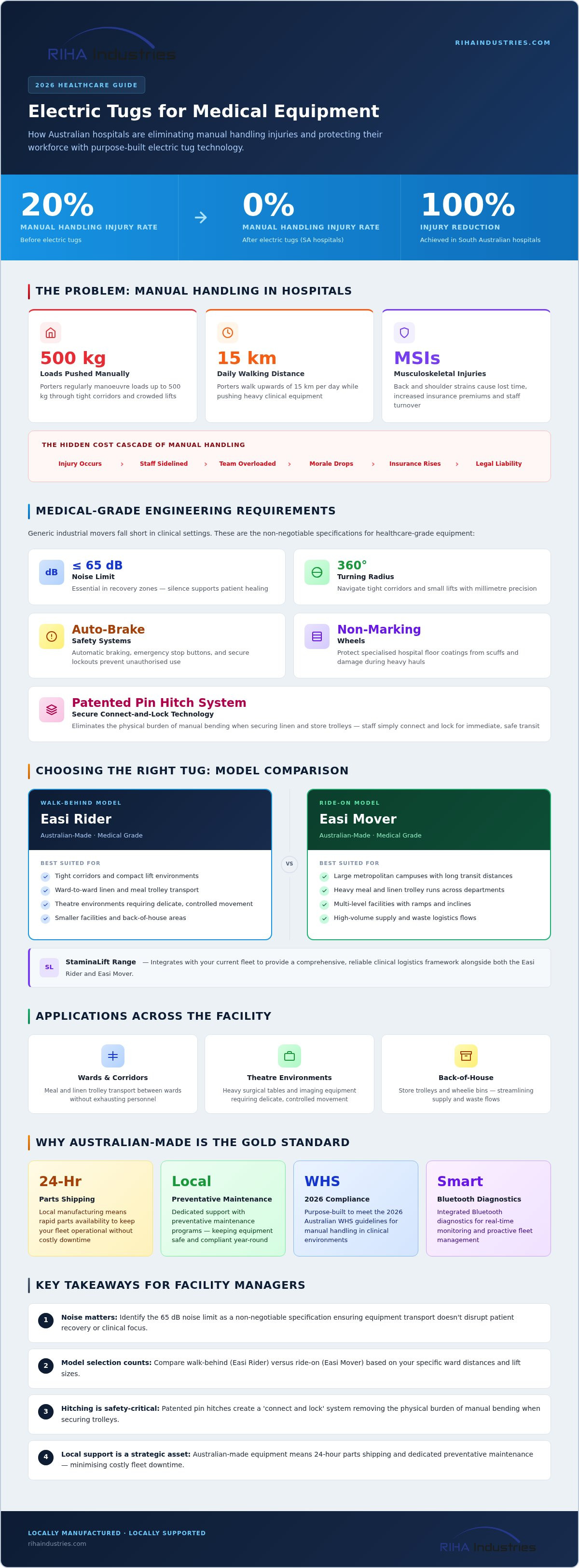
In some South Australian hospitals, the implementation of purpose-built towing technology reduced manual handling injuries from 20% to absolutely zero. It's a striking figure that highlights a critical reality: the physical strain on your porters and clinical staff isn't just an operational hurdle, it's a preventable safety risk. When staff are forced to manually manoeuvre heavy meal trolleys or linen carts through tight corridors and crowded lifts, the risk of musculoskeletal injury remains constant. Finding the right electric tug for medical equipment is no longer about simple convenience; it's about fulfilling a duty of care to the people who keep your facility running.
We understand that your primary goal is a workplace where staff feel protected and equipment moves seamlessly between wards. This 2026 guide reveals how medical-grade tugs, such as the Australian-made Easi Rider and Easi Mover, eliminate manual handling risks through patented hitching systems and superior 360-degree control. You'll discover how these solutions, alongside the StaminaLift range, integrate with your current fleet to provide a reliable, locally supported logistics framework. We will also look at how smart features like Bluetooth diagnostics and compact engineering allow for effortless navigation in the most demanding healthcare environments.
Table of Contents
Why Modern Healthcare Facilities are Switching to Electric Tugs for Medical Equipment
The Anatomy of a Medical-Grade Electric Tug: Precision Engineering for Sensitive Environments
Easi Rider vs Easi Mover: Selecting the Right Tug for Your Facility’s Needs
Solving the Compatibility Challenge: Patented Hitches and Customised Attachments
Why Australian-Made Electric Tugs are the Gold Standard for Healthcare Safety
Why Modern Healthcare Facilities are Switching to Electric Tugs for Medical Equipment
A medical-grade electric tug for medical equipment is a precision safety instrument designed to assist staff in transporting heavy trolleys and clinical gear without physical strain. These specialised motorised devices are engineered to interface with the unique hitches found in healthcare environments, ensuring that equipment remains stable during transit. In the demanding setting of a modern hospital, porters often walk upwards of 15km per day while pushing loads that can reach 500kg. This relentless physical pressure is why many Australian facilities are transitioning to powered industrial trucks tailored specifically for clinical logistics. The shift isn't just about efficiency; it's a direct response to the 2026 Australian WHS guidelines regarding manual handling. By adopting these solutions, some South Australian hospitals have successfully reduced manual handling injuries from 20% to zero.
The Hidden Costs of Manual Handling in Hospitals
The true cost of manual transport extends far beyond simple logistics. Staff musculoskeletal injuries (MSIs) represent a significant drain on hospital resources through lost time and increased insurance premiums. When porters or nurses are sidelined by preventable back or shoulder strains, the remaining team faces higher pressure, which often damages morale and staff retention in high-pressure wards. Non-compliant handling practices also carry legal risks for the organisation. Investing in a reliable electric tug for medical equipment provides a proactive defence against these liabilities, ensuring that the facility meets its duty of care while fostering a culture of safety and empowerment for the workforce.
Beyond Bed Moving: The Versatility of Electric Tugs
While bed moving is a common application, the utility of modern tugs spans the entire facility. Large metropolitan campuses rely on them to transport heavy meal and linen trolleys across long distances, ensuring services remain on schedule without exhausting personnel. They're equally vital in theatre environments for moving heavy surgical tables or imaging equipment that requires delicate, controlled movement. In back-of-house areas, these tugs manage store trolleys and wheelie bins, streamlining the flow of supplies and waste. This versatility makes them an essential component of a modern, integrated logistics strategy that protects staff across every department.
The Anatomy of a Medical-Grade Electric Tug: Precision Engineering for Sensitive Environments
Generic industrial movers often fall short in clinical settings because they lack the refinement required for patient-facing areas. A medical-grade electric tug for medical equipment is designed with a specific set of engineering priorities that balance high-capacity power with extreme environmental sensitivity. For example, maintaining a noise level below the 65 dB threshold is essential in recovery zones where silence supports healing. Beyond acoustics, these units feature non-marking wheels to protect specialised hospital floor coatings from the scuffs and damage typically caused by heavy hauls. High-level safety is integrated through automatic braking and emergency stop buttons, ensuring compliance with powered industrial truck safety standards while preventing unauthorised use through secure lockouts.
Manoeuvrability is equally critical when navigating the architectural constraints of a busy healthcare facility. With a 360-degree turning radius, these tugs allow porters to guide heavy loads through tight corridors and small elevators with millimetre precision. This level of control reduces the risk of accidental collisions with walls or expensive medical equipment, providing a sense of confidence to the operator. Exploring these technical specifications helps facility managers choose a solution that aligns with their specific ward layout and operational demands.
Power and Performance on Hospital Ramps
Ramps and inclines are common in multi-level facilities, often presenting a significant hurdle for manual transport. Professional electric tugs are engineered to manage a maximum 7-degree incline under full load, providing consistent torque without the risk of rollback. To ensure reliability across a double shift, high-capacity batteries are utilised to provide a full day of operation without requiring a recharge. In the rare event of a total power loss, a dedicated brake bypass system allows staff to move the unit manually, ensuring that thoroughfares are never blocked by a stationary device.
Smart Technology and Diagnostics
Modern logistics equipment now incorporates digital tools to simplify fleet management and maintenance. Bluetooth connectivity allows supervisors to monitor battery health and usage history directly from a mobile device, which helps in identifying staff training needs or peak usage patterns. Maintenance is further streamlined through the use of 3D viewer tools. These digital resources allow in-house technical teams to visualise the internal components of the electric tug for medical equipment, making it easier to identify and replace parts without the need for extensive downtime or external service calls.
Easi Rider vs Easi Mover: Selecting the Right Tug for Your Facility’s Needs
Selecting the most effective electric tug for medical equipment requires a careful assessment of your facility's physical layout and the specific workflows of your logistics team. While both the Easi Mover and the Easi Rider are built to handle loads up to 1500kg, they solve different challenges within the hospital environment. This choice is a critical component of workplace ergonomics and injury prevention, as the right equipment ensures that staff remain productive without the risk of physical burnout. By providing a motorised solution that matches the environment, you're not just moving equipment; you're protecting your most valuable asset: your people.
When to Choose the Walk-Behind Easi Mover
The Easi Mover is the preferred choice for facilities where precision in tight spaces is the priority. It's a compact walk-behind tug specifically designed to navigate busy wards and clinical areas where corridors are often crowded with staff and patients. Its small footprint allows it to fit into standard hospital lifts and be tucked away in small storage alcoves when not in use. This unit is particularly well-suited for moving theatre tables and sensitive medical gear that requires slow, deliberate movement. The single-throttle control system offers a level of simplicity that makes it accessible to all staff members, ensuring that everyone can operate the equipment safely with minimal training.
The Case for the Ride-On Easi Rider
In larger, metropolitan hospitals where porters must travel long distances between service hubs and patient wards, the Easi Rider is the superior option. It's an Australian-made ride-on solution that eliminates the fatigue associated with walking 15km or more across a sprawling campus. The unit features a fold-up platform, providing the flexibility of dual-mode operation; staff can ride during long basement transfers and then walk behind the unit for better visibility in ward areas. With its joystick precision, the Easi Rider allows for effortless control of loads up to 1500kg, even when fully loaded with linen or meal trolleys. This makes it a highly efficient electric tug for medical equipment in high-volume environments where speed and staff comfort are equally important.
Solving the Compatibility Challenge: Patented Hitches and Customised Attachments
A significant hurdle in hospital logistics is the sheer variety of trolley frames and hitching points across different departments. A high-quality electric tug for medical equipment must provide a secure 'connect and lock' mechanism that eliminates the need for staff to bend or kneel when securing a load. This focus on ergonomics aligns with Australian WHS standards by removing the physical stressors that lead to long-term injury. RIHA Industries addresses this through patented pin hitches specifically designed for linen and store trolleys with 22mm pins, ensuring a rigid and stable connection during transit.
Versatility is further enhanced by adjustable hitches that accommodate both round and square tube frames ranging from 20mm to 40mm. For environments where equipment height varies significantly, electric adjustable hitches allow operators to align the tug with the load via a simple push-button interface. This total elimination of manual lifting or positioning is a major advantage in theatre environments. If you're looking to standardise your fleet across diverse equipment types, you can explore our range of patented hitching solutions to see how they integrate with your existing assets.
Universal Compatibility for Global Equipment
RIHA hitches are engineered to integrate with nearly any globally available trolley or bin system found in Australian healthcare facilities. Because medical infrastructure is rarely uniform, custom modifications are often required for unique theatre tables and specialised surgical equipment. Our tool-free coupling systems allow for rapid equipment changes, ensuring that porters can switch from a meal trolley to a store bin without delay. This seamless integration ensures that the electric tug for medical equipment becomes a universal tool rather than a niche device limited to one specific trolley type.
Accessories for Specialised Medical Needs
Operational safety in a ward environment requires more than just a strong motor; it requires thoughtful accessory design. Specialised attachments such as oxygen bottle holders can be fitted to either the head or foot of the tug, allowing for safe transport during patient transfers. For equipment with wider wheelbases, extended racks provide the necessary stability to prevent tipping. We also incorporate retractable charging cables into our designs, which significantly reduces tripping hazards in busy corridors and charging bays. These small but critical engineering choices reflect a deep understanding of the daily challenges faced by healthcare professionals.
Why Australian-Made Electric Tugs are the Gold Standard for Healthcare Safety
RIHA Industries has built a legacy of excellence by remaining 100% Australian-owned and operated from our manufacturing facility in Edinburgh North. When a facility invests in an electric tug for medical equipment, they're purchasing more than just a machine; they're securing a commitment to long-term reliability. Being "Certified Australian-made" means every component undergoes rigorous quality control that meets our local safety standards. This proximity allows us to offer national service coverage that ensures critical hospital fleets experience minimal downtime. If a part is needed, we provide 24-hour shipping globally, ensuring that healthcare providers have the support they need to keep their operations running safely.
The ROI of Investing in Quality
Procuring high-end logistics equipment is a strategic financial decision. By using the RIHA ROI calculator, facility managers can clearly justify the investment through significant labour savings and reduced physical strain on personnel. Because we manufacture replacement parts in-house, we can extend the operational life of every electric tug for medical equipment far beyond the industry average. The financial burden of workers' compensation claims is also drastically reduced when staff are protected by proven injury prevention technology. Investing in quality today prevents the compounding costs of workplace injuries tomorrow.
A Partner in Healthcare Innovation
We believe the best solutions come from direct engagement with the professionals who use our equipment every day. This is why RIHA Industries bypasses traditional distributors to work directly with hospitals, fostering a partnership built on transparency and technical excellence. Our team utilises rapid prototyping and 3D printing to trial bespoke solutions for specific facility challenges, ensuring every piece of equipment is fit for purpose. For a deeper look at how to optimise your logistics team's performance, consult our hospital porter equipment guide. This collaborative approach ensures we don't just supply tools; we provide a roadmap for safer, more efficient healthcare environments.
Advancing Towards a Safer Healthcare Future
Protecting the well-being of your clinical and logistics staff is a priority that requires more than just standard equipment. By integrating a specialised electric tug for medical equipment into your facility, you address the root causes of musculoskeletal injuries while improving operational efficiency across every ward. From the precision control of the Easi Mover to the long-distance performance of the Easi Rider, these solutions are designed to bridge the gap between heavy physical demands and human well-being.
Our Australian-made and FDA-registered systems have already demonstrated their value by reducing manual handling injuries to zero in major hospitals. With reliable national service coverage and a commitment to precision engineering, we're ready to help you transform your facility's logistics for the long term. Request a hands-on demonstration of our Easi series tugs today and see how thoughtful engineering can empower your team. We're dedicated to helping you create a safer, more efficient workplace for every healthcare professional.
Frequently Asked Questions
What is an electric tug for medical equipment used for?
An electric tug for medical equipment is primarily used to automate the transport of heavy loads such as linen, meal, and store trolleys across hospital campuses. These devices are also essential for moving specialised clinical assets, including theatre tables and bariatric gear, that exceed safe manual handling limits. By providing motorised assistance, they allow a single staff member to manage equipment that would otherwise require multiple porters or risk significant physical strain.
Can one person operate an electric tug for heavy medical trolleys?
Yes, our electric tugs are specifically engineered for effortless single-person operation, even when towing loads up to 1500kg. The intuitive joystick or throttle controls allow porters to guide heavy medical trolleys with high precision through crowded corridors. It's a design philosophy that reduces the need for additional transport personnel, allowing your facility to reallocate staff to direct patient care while maintaining a high standard of safety and logistical efficiency.
Are electric tugs compatible with all types of hospital trolleys?
Most hospital trolleys are compatible through our range of patented attachment mechanisms. Our hitches are designed to connect with round or square tube frames between 20mm and 40mm in diameter, covering a vast majority of global equipment brands. For unique requirements, we offer custom modifications and specialised pin hitches. This universal approach ensures that your facility can integrate an electric tug for medical equipment into your existing fleet without needing to replace your current trolleys.
How long does the battery last on a medical electric tug?
Both the Easi Rider and Easi Mover are equipped with heavy-duty battery systems designed to last through a full standard hospital shift. The Easi Rider utilises a 72V system, while the Mover relies on high-capacity 12V batteries, both of which provide consistent power for continuous operation. Staff can monitor battery health and charging cycles in real-time via Bluetooth connectivity, ensuring it's always ready for peak periods without unexpected downtime.
Do electric tugs require a special licence to operate in hospitals?
Operating an electric tug in an Australian hospital doesn't require a formal government-issued licence, but staff should complete facility-approved competency training. RIHA Industries provides comprehensive training and certification to ensure every operator understands the safety features, such as the emergency stop and automatic braking systems. This internal certification process helps facilities meet their WHS obligations while ensuring that equipment is handled correctly to prevent accidental damage to ward infrastructure or clinical gear.
Can electric tugs handle ramps and inclines in medical facilities?
Yes, these units are engineered to maintain full control while navigating the ramps and inclines commonly found in modern medical facilities. They're rated to handle a maximum 7-degree incline under a full load of up to 1500kg. The integrated automatic braking system ensures the tug remains stationary on slopes when the controls are released, providing an essential layer of protection for both the operator and other people in the corridor.
How do electric tugs improve OHS/WHS compliance in healthcare?
These devices improve WHS compliance by eliminating the high-risk physical activities associated with manual handling, such as pushing, pulling, and repetitive bending. The "connect and lock" jaw mechanism allows operators to secure loads at the press of a button, removing the need for awkward postures. By automating the most strenuous parts of hospital logistics, facilities can proactively meet 2026 safety guidelines and create a workplace that prioritises long-term staff health.
What maintenance is required for a medical-grade electric tug?
Routine preventative maintenance is essential to ensure the long-term reliability and safety of the equipment. This includes regular checks of the battery systems, drive wheels, and hitching mechanisms to prevent wear-related failures. We support facilities with Bluetooth diagnostics for usage monitoring and an online 3D viewer to assist in-house technical teams with part identification. For more complex requirements, we provide national service coverage across Australia to keep your critical fleet operational.


