
Evaluating Hospital Bed Movers: The 2026 Procurement and Safety Guide
- 11 minutes ago
- 12 min read
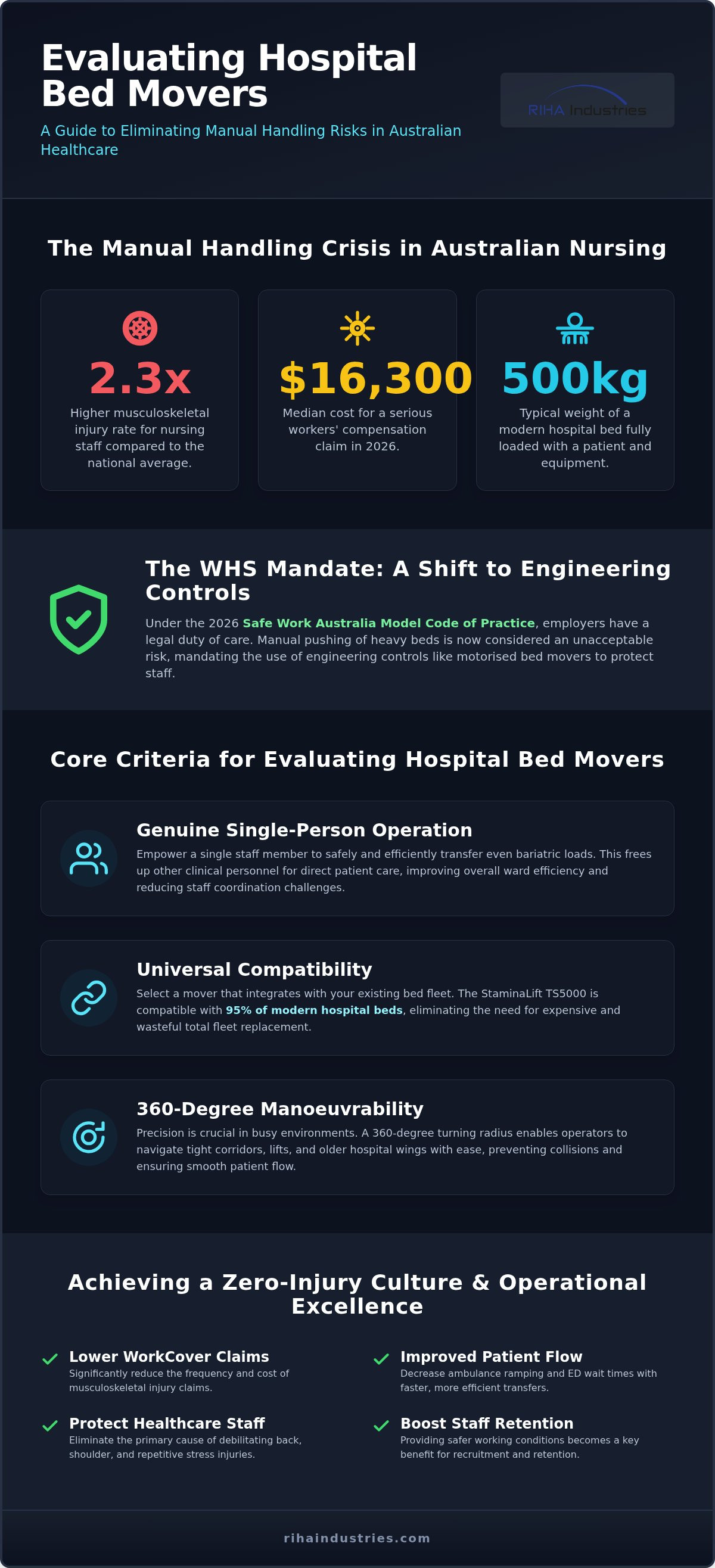
Nursing staff in Australia currently face musculoskeletal injury rates that are 2.3 times the national average. With the median cost for a serious workers' compensation claim reaching $16,300 in 2026, the physical and financial toll of manual handling has never been more pressing. You likely recognise the daily strain your team faces when navigating heavy bariatric loads through tight corridors or managing transfers during a staff shortage. It's a significant burden that traditional lifting techniques simply cannot solve on their own.
By evaluating hospital bed movers through the lens of modern engineering controls, you can effectively eliminate these risks and protect your healthcare professionals from debilitating back injuries. This guide provides the framework to help your facility achieve a zero-injury culture while ensuring full WHS compliance. We will explore the latest 2026 regulatory updates from Safe Work Australia, the necessity of genuine single-person operation, and how the 360-degree manoeuvrability of the StaminaLift and Easi series can transform your internal logistics. You'll learn how to select a long-term partner that offers the universal compatibility and local support required to keep your wards moving safely.
Table of Contents
The WHS Case for Motorised Bed Handling in Australian Hospitals
The daily reality for Australian hospital porters and nurses often involves moving loads that exceed half a tonne. When a modern hospital bed is fully loaded with a patient, oxygen cylinders, and specialised clinical equipment, the total mass frequently reaches 500kg. Pushing and pulling these weights manually is a primary driver of serious WorkCover claims. In fact, body stressing accounts for 34.5% of all serious workers' compensation claims nationally. When evaluating hospital bed movers, facilities must look beyond the initial purchase price and consider the staggering "hidden costs" of inaction. These include escalating staff absenteeism, the high price of rehabilitation, and the constant need for expensive agency hire to fill gaps left by injured employees.
Modern WHS standards in 2026 have shifted. Under the Model Code of Practice for the Healthcare and Social Assistance Industry, manual pushing of heavy beds is increasingly viewed as an unacceptable risk. Employers have a legal duty of care to implement engineering controls. A motorised Bed Mover provides a mechanical solution that aligns with the hierarchy of control, moving the risk away from the human frame and onto a stable, engineered system. This proactive approach is also a vital tool for staff retention. As the Australian healthcare workforce ages, providing equipment that reduces physical strain becomes a significant recruitment benefit.
Quantifying Musculoskeletal Risks
The clinical toll of manual handling manifests as debilitating lower back strain, shoulder impingement, and repetitive stress injuries. Nursing staff face musculoskeletal injury rates 2.3 times the national average. These risks intensify with bariatric patients, where the load simply exceeds safe manual limits for even a team of three or four people. By using specific patient handling equipment selection criteria, facility managers can identify where manual intervention is most dangerous. Implementing the StaminaLift series allows these high-risk tasks to be performed safely without compromising the health of the carer.
Operational Impact on Patient Flow
Safety isn't the only benefit. Efficient bed handling directly impacts clinical outcomes by reducing ambulance ramping and ED wait times. When a single staff member can perform a transfer using a StaminaLift 2100 or TS5000, it frees up other clinical staff for direct patient care. Precision is essential in high-traffic zones. Navigating busy corridors and lifts requires the 360-degree turning radius found in Australian-made Easi series movers. This level of control prevents collisions and ensures that patient flow remains steady, even in older hospital wings with narrow doorways.
Categorising Hospital Bed Movers and Electric Tugs
When evaluating hospital bed movers, it's vital to choose a solution that complements your existing infrastructure rather than forcing a total fleet replacement. While some manufacturers advocate for beds with built-in motorised drives, this often proves prohibitively expensive and creates unnecessary waste. Standalone movers offer a versatile alternative, allowing a single unit to service dozens of different bed models. This flexibility is essential for compliance with the Model Code of Practice: Hazardous manual tasks, which mandates that employers provide appropriate mechanical aids to mitigate physical risks.
The selection process should begin with a clear categorisation of your facility's needs. Universal movers are the workhorses of the ward, while specialised bariatric systems handle the most extreme loads. Logistics-focused electric tugs manage the heavy flow of linen and meals. By matching the equipment to the specific task, you ensure that every transfer is performed with maximum efficiency and minimal physical burden on the operator.
The StaminaLift Series: Purpose-Built for Healthcare
The StaminaLift range represents the pinnacle of medical-grade transport engineering. The TS5000 is the flagship model, designed with universal compatibility in mind. It connects to 95% of modern hospital beds, making it the primary choice for facilities with mixed fleets. For more specialised requirements, the TS6000 addresses the growing bariatric challenge. It is engineered to move nearly one tonne with precision, ensuring that even the most complex acute care transfers remain a one-person task. In contrast, the StaminaLift 2100 offers a compact footprint. It is specifically tailored for Australian-manufactured frames and the tighter spaces often found in aged care settings or metropolitan wards.
Easi Series Tugs for Facility Logistics
Efficient facility management extends beyond patient beds to the heavy trolleys used for linen, meals, and waste. The Easi Mover is a robust, walk-behind hospital porter equipment solution that eliminates the strain of manual trolley pushing. For larger medical campuses where staff must cover significant distances, the Easi Rider provides ride-on capability. This reduces fatigue and increases the speed of internal logistics. When selecting a tug, the hitching system is the most critical component. Evaluating pin, adjustable, and electric hitches ensures a secure, universal connection to your entire trolley fleet. If you're unsure which model best fits your ward's layout, you can explore our full range of Australian-made movers to find a tailored solution.
Core Criteria for Evaluating Hospital Bed Movers
Selecting the right equipment requires a shift in focus from simple power to operational versatility. When evaluating hospital bed movers, the most critical benchmark is universal compatibility. A mover that requires manual strapping or complex adjustments for different bed models creates a bottleneck in high-pressure wards. You need a system that integrates with at least 95% of your existing fleet. The StaminaLift TS5000 achieves this through a patented jaw system, ensuring that porters don't waste time searching for specific attachments during a patient transfer.
Manoeuvrability is equally vital. Australian hospitals, particularly older wings, often feature tight corridors and narrow lift entries. A 360-degree turning radius is not just a convenience; it is a safety requirement. It allows a single operator to pivot a fully loaded bed within its own length. This precision prevents damage to facility infrastructure and reduces the risk of collisions in busy thoroughfares. Additionally, the unit must possess the torque to handle a 7-degree incline under full bariatric load, a standard the StaminaLift TS6000 meets for 2026 requirements.
Attachment Mechanisms and Footprints
The hitching process is where most manual handling injuries occur if the equipment is poorly designed. The "Connect and Lock" advantage allows for hands-free hitching, which effectively eliminates the need for staff to bend or twist. This protects the lumbar spine from the awkward postures identified as high-risk in WHS audits. Space-saving is another priority. The "Z-move" design features a low-profile under-bed footprint. This allows the mover to tuck away during transport, making it easier to navigate crowded wards. Jaw adaptability is also essential. The mover must accommodate wheel sizes ranging from 100mm to 300mm to ensure total fleet coverage.
Safety Systems and Diagnostic Technology
Staff and patient safety rely on robust fail-safes. Automatic braking and emergency release systems are non-negotiable features. These ensure the bed remains stationary on inclines and can be manually moved if power is lost. Modern units now incorporate Bluetooth connectivity for real-time diagnostics. This technology allows facility managers to monitor battery health and usage history, ensuring the fleet is always ready for duty. Clinical environments also require a quiet atmosphere for patient recovery. Our movers maintain a noise threshold of 65 dB. This ensures that transfers can occur at any hour without disrupting the healing environment or causing unnecessary stress to patients.
Australian Standards and Compliance Requirements
Adhering to national safety benchmarks is a legal necessity for healthcare facilities in 2026. Under the model WHS laws, employers must eliminate or minimise risks from hazardous manual tasks. When evaluating hospital bed movers, compliance isn't just about the machine's power; it's about meeting the rigorous standards set by Safe Work Australia. Selecting a mover that is FDA-registered provides an additional layer of clinical assurance. As the only FDA-registered bed mover manufacturer in the United States, RIHA Industries brings a level of quality control to the Australian market that generic industrial tugs cannot match. This registration ensures the equipment is designed specifically for the high-stakes medical environment, where precision and reliability are non-negotiable.
Local manufacturing offers a distinct advantage for long-term OHS compliance. Choosing Australian-made equipment like the StaminaLift series ensures that your facility isn't left vulnerable by global supply chain delays. We provide 24-hour parts shipping to keep your fleet operational. This local support, combined with structured staff training and certification, ensures that your safety investment continues to protect workers for years. To ensure your facility meets these high standards, you can view our full range of compliant transport solutions today.
Achieving Zero-Injury Outcomes
The transition to motorised handling has delivered measurable success across the country. In South Australian hospitals, the implementation of our transfer systems saw injury rates related to bed moving reduced from 20% to zero over a two-year period. This success relies on the equipment's ability to facilitate genuine one-person operation, which effectively solves the "two-porter" staffing requirement during peak periods. To maintain these results, movers must be integrated into a comprehensive hospital equipment maintenance programme. Regular servicing prevents mechanical degradation, ensuring that the safety features your staff rely on remain fully functional.
Engineering for Sustainability
Durability is a core component of a sustainable procurement strategy. Our equipment utilises stainless steel construction to ensure long-term resistance to corrosion and ease of disinfection in sterile environments. We have also embraced modern manufacturing techniques, such as CAD and 3D-printed parts, to extend the life of older equipment fleets by providing modernised replacement components. Performance is further enhanced by our lithium battery upgrades. These units deliver 20% better performance than traditional lead-acid alternatives and feature significantly faster charging cycles. This ensures your movers spend more time on the ward and less time at the charging station, providing the reliability required for 24/7 clinical operations.
From Trial to Implementation: The Procurement Journey
Moving from the evaluation phase to successful implementation requires a structured approach that accounts for the unique architectural and clinical demands of your facility. Conducting a meticulous site assessment is the foundational step. This process involves more than just measuring doorways; it requires a detailed analysis of floor surfaces, lift dimensions, and the specific corridor inclines your staff navigate daily. By evaluating hospital bed movers within the context of your ward's physical constraints, you ensure the selected unit can manage the transition from older hospital wings to modern acute care centres without operational friction.
A hands-on demonstration in your specific ward environment is non-negotiable. While technical specifications provide a baseline, the intuitive feel of joystick controls and the effectiveness of the braking system on your facility's ramps can only be verified through a trial. This period also allows you to calculate a realistic return on investment. Beyond the immediate reduction in WorkCover claims, you should factor in staff time savings. When a single porter can perform a transfer that previously required two or three people, the operational efficiency gains are substantial. Over the long term, the durability of Australian-made equipment like the StaminaLift series further strengthens the financial case by reducing the frequency of fleet replacements.
The 2026 Procurement Framework
Successful acquisition relies on close collaboration between WHS officers, Nursing Unit Managers, and facility engineers. Defining your specific needs early ensures that the equipment chosen aligns with both clinical workflows and safety mandates. We recommend using our 2026 hospital bed mover procurement guide to help justify capital expenditure through data-driven safety outcomes. To assist in this visualisation, we offer 3D and AR models that allow you to see exactly how the equipment footprint fits within your storage areas and high-traffic zones before a single unit arrives on site.
Maintenance and After-Sales Support
Reliability is the cornerstone of a successful safety programme. To maintain 100% fleet uptime, it's essential to establish a formal hospital bed mover repair service schedule from the day of implementation. This proactive approach prevents minor wear from becoming a major operational bottleneck. Our support system includes online 3D viewers for in-house engineering teams, facilitating rapid part identification and troubleshooting. Because we manufacture locally, we guarantee 24-hour parts availability, ensuring that your investment in staff safety remains active and effective around the clock. When evaluating hospital bed movers, remember that the quality of the after-sales support is just as critical as the machine's initial performance.
Future-Proofing Your Facility's Safety Culture
Transitioning to motorised bed handling is a decisive step toward eliminating the physical toll on your healthcare team. By evaluating hospital bed movers through the lens of universal compatibility and 360-degree manoeuvrability, you're not just buying equipment; you're investing in a zero-injury future. These systems have already reduced bed-moving injuries to zero in South Australian hospitals, proving that thoughtful engineering can solve even the most complex manual handling challenges. Our Australian-made solutions are compatible with 95% of global bed brands, ensuring your facility remains compliant and efficient as standards evolve.
Securing the right technology allows your staff to focus on what they do best: providing exceptional patient care. Our FDA-registered equipment is designed to handle the rigours of 2026 clinical environments while providing the local support you need for total fleet reliability. Take the first step toward a safer ward today and book a hands-on demonstration of the StaminaLift range for your facility. We look forward to partnering with you to create a more supportive and injury-free workplace for every member of your team.
Frequently Asked Questions
Are motorised bed movers compatible with all hospital bed brands?
StaminaLift movers are compatible with 95% of global hospital bed brands. They utilise a patented "connect and lock" jaw system, which effectively eliminates the need for manual strapping or complex adjustments. When evaluating hospital bed movers, universal compatibility is a vital factor to ensure you don't need a different unit for every bed type in your facility. This versatility allows a single mover to service your entire existing fleet seamlessly.
Do I need a special licence to operate a StaminaLift bed mover in Australia?
No specialised driver's licence is required to operate our bed movers within a clinical facility. The equipment is designed for intuitive use by nurses, porters, and ward assistants. We provide comprehensive on-site training to ensure all operators are confident in the machine's safety features and manoeuvrability. This approach helps facilities maintain WHS compliance without the administrative burden of external licensing or lengthy certification processes for staff.
How long does the battery last on a standard hospital shift?
Our motorised movers are engineered to last through a full double shift under typical usage conditions. Performance depends on the specific loads moved and the number of inclines navigated during the day. Our latest lithium battery upgrades offer 20% better performance and faster charging cycles compared to traditional lead-acid alternatives. This ensures the equipment is ready for duty whenever a patient transfer is required, minimising downtime during peak periods.
Can the TS6000 handle steep ramps and inclines while fully loaded?
Yes, the StaminaLift Transfer System 6000 is specifically rated to handle a 7-degree incline while under full bariatric load. This capacity is critical for navigating the architectural challenges found in many older Australian hospital wings. The unit provides the necessary torque to move loads of nearly one tonne safely. It ensures that steep ramps don't become a barrier to efficient patient flow or a source of staff injury.
What is the difference between a bed mover and an electric tug?
A bed mover is a specialised medical device designed to connect directly to hospital bed frames, whereas an electric tug is a general logistics tool. Bed movers, like the StaminaLift series, feature 360-degree manoeuvrability and medical-grade safety systems for patient transport. Electric tugs, such as the Easi Mover, are better suited for transporting linen, meal trolleys, and waste bins across large medical campuses using various universal hitching systems.
Is staff training provided by RIHA Industries upon delivery?
We provide comprehensive on-site training for all clinical and porterage staff as part of our implementation process. This training covers safe hitching techniques, navigating tight spaces, and emergency fail-safe operations. By educating your team on the correct use of the equipment, we help ensure long-term OHS compliance and the total elimination of manual handling injuries. Our goal is to empower your staff to work safely and efficiently.
How does motorised equipment help with bariatric patient transfers?
Motorised movers transform high-risk bariatric transfers into safe, single-person operations. Moving a bariatric load manually often requires four or more staff members and carries a high risk of musculoskeletal injury. When evaluating hospital bed movers for acute care, the TS6000 model provides the mechanical power to handle these extreme weights safely. This protects staff from debilitating back strain while maintaining the patient's dignity and comfort during transport through the facility.
How do I choose between the StaminaLift 5000 and 6000 models?
The choice depends on your specific patient demographic and the maximum load requirements of your ward. The TS5000 is our flagship universal mover, perfect for 95% of standard hospital beds and typical patient weights. If your facility frequently manages bariatric patients or requires the capacity to move loads approaching one tonne, the TS6000 is the appropriate choice. We recommend a site assessment to determine the best mix for your equipment fleet.


