Financial Impact of Nurse Injuries: Costs and Lost Income
Lost earnings, added caregiving responsibilities and financial strain can also affect a nurse’s household and well-being.
It’s understandable to focus first on the injury and workers’ compensation claim. But financial pressure can continue during recovery, particularly when income changes or a family member takes on caregiving responsibilities.
This article explains how workplace injuries can affect workers’ compensation, take-home income and family finances in the United States. It also covers direct and indirect costs for healthcare organisations, the relationship between financial hardship and nurses’ well-being, and how safer patient handling can help reduce physical strain at work.
Table of Contents
Workers’ compensation costs for injured nurses
A nurse’s injury can create immediate compensation expenses and longer-term pressure on hospital staffing and care. The financial impact depends on factors such as recovery time, injury severity and the costs of covering the nurse’s work.
Lost wages and benefits
Workers’ compensation costs include expenses related to an injured nurse’s claim. Lost wages and benefits can also affect household income during recovery.
For nurses, time away from work can mean reduced earnings and interrupted benefits, depending on their circumstances. For hospitals, compensation expenses are only part of the impact: staffing can also be disrupted. The financial impact of nurse injuries therefore reaches beyond the claim, affecting both household stability and a hospital’s ability to maintain staffing.
Healthcare costs by injury type
Healthcare costs depend on the injury, required treatment and recovery period.
Those figures show that hospital costs can shift substantially over time. Pressure injuries are also associated with a 57% increase in length of stay, a 22% higher rate of patient readmission, and a 5% greater mortality risk in the United States. For patients, these outcomes can mean more time in hospital and greater care needs.
Direct and indirect injury costs
Direct costs include workers’ compensation and injury-related medical care. Indirect costs can include staffing gaps and replacement expenses.
OSHA reporting and workers’ compensation are separate processes. OSHA addresses workplace injury reporting, while compensation claims follow applicable state systems. State rules shape the claim process and benefits. For nurses, the practical challenge may be managing lost income while treatment and recovery continue.
Cost variation by injury and severity
Costs depend on injury type and severity, as well as state compensation rules.
These figures describe injuries of different severities, not one standard claim. State compensation rules also affect how wage benefits and medical expenses are handled, so costs and claim outcomes vary across the United States.
Lost income for injured people and family caregivers
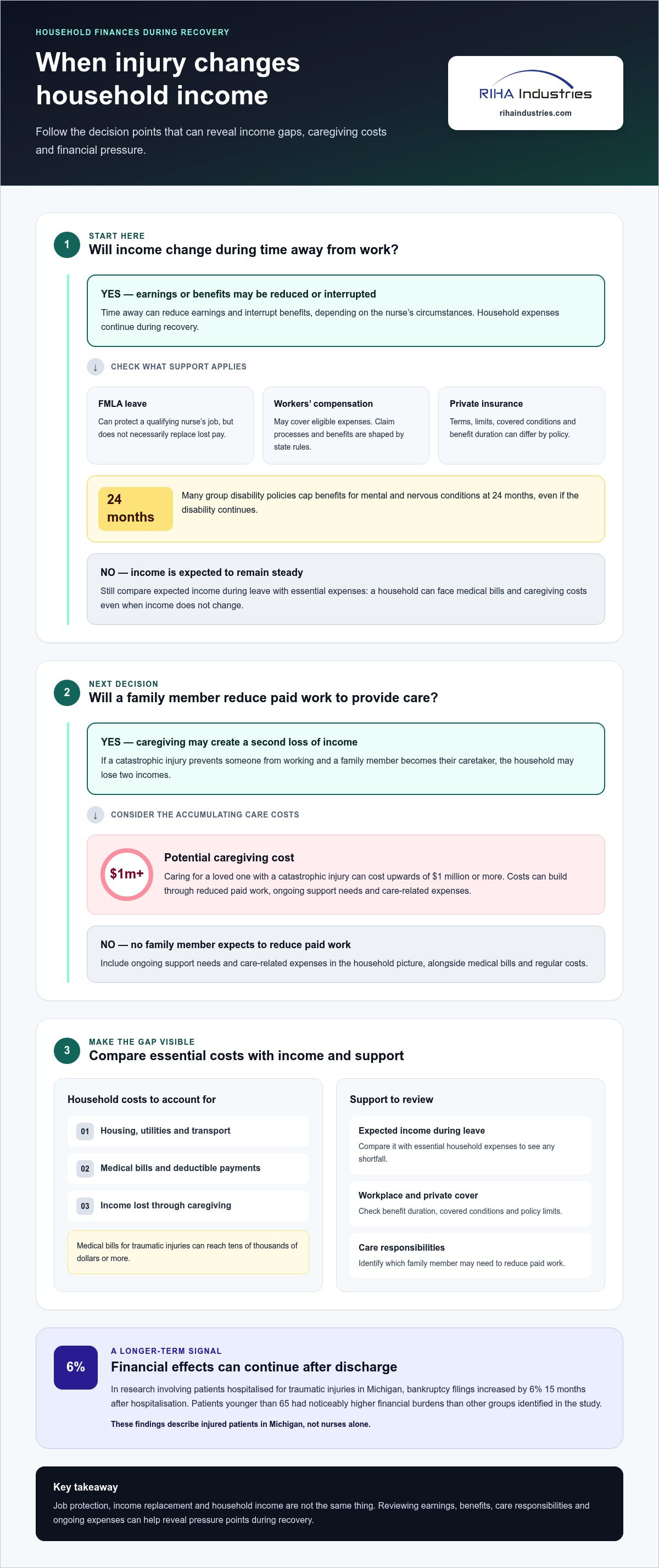
An injury can reduce a nurse’s income while household expenses continue. The federal Family and Medical Leave Act (FMLA) can protect a nurse’s job during qualifying leave, but it doesn’t necessarily replace lost pay. Keeping a position and maintaining the same household income are different outcomes. Nurses recovering from injuries may still need to plan for routine expenses during time away from work.
Income protection depends on the support available through work, insurance and household savings. Workers’ compensation may cover eligible expenses, while private insurance policies can have their own terms and limits. Many group disability policies cap benefits for mental and nervous conditions at 24 months, even if the disability continues. Understanding which type of income a policy protects, how long benefits may last and what conditions apply helps nurses assess potential gaps.
Emergency savings can help cover bills that continue during recovery, such as housing, utilities and transport. List essential expenses alongside the income expected during leave to make any shortfall easier to see. Medical bills for traumatic injuries can reach tens of thousands of dollars or more, adding pressure when a paycheque is reduced.
Family caregiving can create a second loss of income. If a catastrophic injury prevents someone from working and a family member becomes their caretaker, a household may lose two incomes. Caring for a loved one with a catastrophic injury can cost upwards of $1 million or more. These costs can build through reduced paid work, ongoing support needs and expenses associated with care, rather than appearing as one bill.
Research involving patients hospitalised for traumatic injuries in Michigan found that financial effects continued after discharge. Among those patients, bankruptcy filings increased by 6% 15 months after hospitalisation. Patients younger than 65 had noticeably higher financial burdens than other groups identified in the study. These findings describe injured patients in Michigan, not nurses alone, but they show how income disruption and medical expenses can continue well into recovery.
To make the household impact clearer, nurses and family members can:
Compare expected income during leave with essential household expenses.
Review workplace and private income-protection terms, including duration and covered conditions.
Identify which family member may need to reduce paid work for caregiving.
Track medical bills and deductible payments alongside regular expenses.
Financial hardship is associated with poorer well-being among nurses. Reviewing income, caregiving demands and ongoing expenses can help a household spot pressure points early and organise available support during recovery.
Musculoskeletal and physical workplace injuries
Musculoskeletal injuries can affect a nurse’s ability to lift, turn, transfer and support patients during routine care. Repeated forceful movements, awkward reaches and rushed repositioning can place physical demands on hospital staff. An injury may disrupt a shift, while ongoing pain can make everyday tasks harder. The economic effects can include time away, modified duties and staffing pressure, with costs varying by injury and recovery.
U.S. hospitals record an average of around 6-8 workplace injuries daily, and injuries occur at almost twice the rate of any other sector in the country. These figures cover workplace injuries broadly, not musculoskeletal injuries alone. They underline why physical hazards matter across hospital operations, from patient transfers to moving equipment and responding to urgent care needs.
Patient handling is one practical area to review. Manually repositioning a patient who needs substantial assistance, for example, may require a nurse to bear force while reaching or twisting. Repeated tasks can compound physical strain over a shift. Reviewing transfer methods, equipment use and team coordination can help identify tasks that place avoidable demands on staff.
Physical harm also includes workplace violence. Healthcare workers make up roughly 10% of the U.S. workforce but experience approximately 73% of nonfatal injuries from workplace violence. Surveys cited on the page found that 44% of nurses report physical assault by patients. Press Ganey reports that more than two nurses are assaulted every hour in the United States. These figures show that injury prevention must consider both patient handling and assault risks.
Reporting matters because unreported injuries can remain invisible in workplace records. Around 24% of nurses reportedly change shifts or take sick leave to recover instead of notifying their employer and filing a workers’ compensation claim. A nurse who changes a shift to manage a back strain, for instance, may still face lost work time without the incident being recorded as an injury. Recording incidents helps hospitals see recurring tasks or locations that need attention.
For an injured nurse, the financial effect depends on how pain or reduced mobility affects work, recovery and income. For a hospital, missed shifts can add pressure to staffing and continuity of care. A practical review traces the task, the movements involved, the assistance available and whether the same hazard occurs elsewhere.
Identify tasks involving lifting, turning, reaching or repeated force.
Record injuries and near misses, including the task and work area.
Review transfer methods and team support for patients needing assistance.
Consider assault hazards alongside physical handling risks.
How much do nurse injuries cost U.S. hospitals annually?
There is no single annual cost that represents every U.S. hospital. The total depends on the number and severity of injuries, time away from work and required care. A short absence and a catastrophic injury create very different financial demands. Burns, traumatic brain injuries and amputations can cost well into the hundreds of thousands of dollars annually.
That variation matters when interpreting a hospital-wide total. Combining minor injuries with serious, long-term harm can hide what drives spending. An injury requiring ongoing treatment may bring costs beyond the initial response, while a nurse who cannot work can also leave a staffing gap. Hospital leaders need to understand the categories behind a total, not just its headline figure.
Healthcare and social assistance has the highest number of nonfatal occupational injuries and illnesses of any private industry sector in the United States. Hospitals therefore manage injury-related costs within a high-injury industry. But the sector-wide ranking does not show an individual hospital’s annual costs. The hospital’s own injury mix and workforce circumstances shape the result.
A useful annual review separates costs by injury type and outcome. For example, a hospital can distinguish cases involving treatment only from those leading to missed shifts, restricted duties or a nurse’s departure. This helps reveal whether changes in spending reflect fewer incidents, less severe harm or different staffing effects. It also gives decision-makers a clearer basis for identifying recurring risks.
Consider two contrasting cases: one nurse sustains an injury but continues working with modified duties, while another cannot return to work. Hospital costs differ because recovery, staffing cover and replacement needs differ. The second case may involve a longer absence and greater disruption to team capacity. No single average fully represents both scenarios.
Hospitals can make annual figures more useful by recording consistent details for each case, such as:
The injury type and whether it required treatment or time away.
Any changes to the nurse’s duties during recovery.
Staffing effects, including shifts that needed coverage.
Whether the injury involved extended care or a lasting work impact.
Compare these categories across reporting periods instead of treating one year’s total as a complete picture. If severe cases account for a large share of costs, prevention priorities may differ from those for frequent, less severe injuries. This helps hospitals connect annual spending with the injuries and work conditions contributing to it.
What are the direct and indirect financial costs of nurse injuries?
Direct costs are closely tied to treating an injury and supporting a workers’ compensation claim. Indirect costs arise from consequences such as missed shifts, disrupted staffing and reduced household income. A nurse’s injury can therefore affect the nurse, their family and the hospital through different financial pathways.
For a nurse, direct costs may include treatment-related bills and out-of-pocket expenses. Medical bills for traumatic injuries can reach tens of thousands of dollars or more. The final burden depends on the care required and the person’s insurance arrangements.
Research tracking more than 12,000 patients hospitalised for traumatic injuries in Michigan in 2019 and 2020 found that privately insured patients were the only insured group with significant increases in both medical debt and bankruptcy after injury. Medicare enrollees experienced only small increases in medical debt and no change in bankruptcy after injury. These findings concern injured patients, not nurses alone, but show how insurance coverage can shape financial consequences.
Indirect costs can begin when an injured nurse cannot perform their usual duties. A hospital may need to adjust rosters, cover shifts or redistribute work among available staff. If a nurse with a physical injury cannot assist with patient transfers, for example, colleagues may take on different duties as staffing arrangements change. This disruption is an operational cost, even when it does not appear as a medical bill.
Replacement costs can also follow an injury that prevents a nurse from returning to work. This is a broader consequence than treatment alone: the hospital must address the staffing gap, while the nurse’s household may face a change in earnings. The duration of the absence and whether the nurse returns to work influence how these pressures develop.
Patients can experience financial effects too. In the Michigan study, privately insured patients had significant increases in medical debt and bankruptcy after traumatic injury, while low-income patients under 65 covered by Medicaid had no statistically significant increase in either outcome. The study’s comparison groups show why coverage and income matter when assessing injury-related financial strain.
To understand the full cost of a workplace injury, separate expenses into clear categories:
Direct: treatment-related bills, claim expenses and out-of-pocket payments.
Workforce: altered duties, missed shifts and the cost of replacing a nurse.
Household: reduced income alongside continuing bills and care needs.
Patient: medical debt or financial strain associated with injury and recovery.
Reviewing these categories helps distinguish the immediate claim from wider financial consequences for nurses, hospitals and patients.
RIHA Industries: StaminaLift Transfer System 5000
RIHA Industries’ StaminaLift Transfer System 5000 is a patient transfer system for healthcare settings. Its equipment range is designed to integrate with existing hospital equipment, making it relevant when a facility is reviewing patient transfer processes and the physical demands placed on nursing staff.
The right response to injury-related risks starts with understanding the work: consider which transfers place physical demands on staff and what equipment supports those tasks. RIHA Industries also offers the StaminaLift Transfer System 6000 and StaminaLift 2100 Bed Mover. These options relate to patient transfer and bed-moving needs, rather than replacing a broader review of workplace practices.
Contact RIHA Industries to discuss patient transfer and bed-moving equipment for your healthcare setting.
Make safer handling part of future planning
Workplace injury prevention is most effective when it informs everyday decisions, not just the response after someone is hurt. As patient needs, staffing patterns and care environments change, review how transfer tasks are carried out and where physical effort falls on nursing teams. This makes injury risk a practical consideration in equipment and workflow planning.
The financial impact of nurse injuries reaches beyond an individual claim, so planning should consider staff well-being alongside continuity of care. Patient transfer equipment can form part of that approach, alongside suitable procedures and team support. Start by identifying the tasks that create the greatest physical demands in your setting.
For healthcare teams considering patient transfer equipment, contact RIHA Industries for support and discuss the needs of your facility. A considered next step can help your team keep staff safety in view as care practices evolve.
Frequently Asked Questions
What is the average cost of a nurse workplace injury to an employer in the United States?
This is a compensation benchmark, not a universal total for every incident or a complete measure of operational costs. A hospital may also face staffing disruption and recruitment expenses if a nurse cannot return. For budgeting, separate claim-related costs from workforce effects, then compare injury types and absence outcomes.
What are the most common and costly injuries among nurses?
Musculoskeletal injuries linked to physically demanding tasks and injuries from workplace violence are important categories to consider. Patient handling can involve forceful movement, while assaults create a separate physical hazard. More severe injuries, including burns, traumatic brain injuries and amputations, can cost well into the hundreds of thousands of dollars annually. Injury type and severity shape treatment needs, time away and longer-term effects.
How much do workers’ compensation claims for nurses typically cost?
The cost of a particular claim depends on injury severity, treatment needs and recovery. A claim involving a brief absence has a different cost profile from one involving extended care or lasting work limitations. The average provides a broad reference, but hospitals should assess claim expenses alongside staffing disruption and changes to the nurse’s duties.
How do nurse injuries affect staffing costs, overtime, and nurse turnover?
An injury can leave a roster gap that a hospital must manage through changed duties, shift cover or recruitment. Overtime may add staffing pressure when available nurses cover work that would otherwise be handled by the injured colleague. A prolonged absence can disrupt team routines and contribute to turnover if work demands remain difficult to manage. Tracking absences and coverage patterns helps identify where injury-related disruption is concentrated.
How much can hospitals save by preventing nurse injuries?
Potential savings depend on which injuries a hospital prevents and the costs those cases would otherwise create. A useful assessment compares injury-related claims, absences, staffing cover and recruitment with the resources used for prevention. For example, a hospital reviewing patient transfers can examine which tasks cause physical strain and whether workflow or equipment changes address them. This gives decision-makers a facility-specific view of financial effects without relying on a single savings estimate.