How to Prevent Patient Falls During Transport: A Practical Healthcare Guide
Updated: Oct 13
What if the greatest risk of a patient fall arises between destinations? Moving from a bed to a trolley or chair, then through a busy corridor, can introduce different hazards at each stage. Understanding how to prevent patient falls during transport starts with treating the entire journey as a coordinated safety process, not a routine task.
The challenge is making sure everyone understands the patient’s needs, the risks involved and their role before movement begins. A repeatable approach helps teams prepare consistently and respond when conditions change.
This guide explains what to assess before transport, how to communicate during handovers and movement, and how to prepare the patient, route and equipment. It also explains how powered bed movers can support controlled bed movement as one part of a broader plan, alongside clinical judgement, staff training and facility procedures.
Table of Contents
Why patient falls can happen during transport
A transport-related fall is a fall that occurs while a patient is being moved between locations or between transport equipment. It can happen during a transfer onto or off a bed, trolley or chair, or while the patient is travelling through a healthcare facility. The term covers the whole journey, not just the moment a patient changes position.
Each stage brings different conditions to manage. A patient may move from a bed onto a trolley, travel along a corridor, then transfer again to an imaging table. A chair journey can involve different positioning and support needs from a bed move. The general context of patient transport services includes movement between care locations, but safety considerations depend on the individual journey and setting.
Risk can change as the patient’s condition, movement method or surroundings change. Symptoms may affect steadiness or alertness, equipment may be positioned differently at the destination, and a clear route can become busier during the journey. That’s why understanding how to prevent patient falls during transport means considering both the patient and the changing circumstances around them.
Which parts of a transport journey need attention?
Transfers onto and off equipment need particular attention because the patient changes support surfaces and may need to reposition or bear weight. Movement along corridors and ramps brings different considerations, such as the route, changes in floor level and the need for clear communication. Neither stage should be assumed safe just because the other went smoothly.
Handover points matter, too. A patient travelling between a ward, an imaging department and another care area may encounter different staff, equipment and surroundings at each stage. A change of surface or setting can introduce a new hazard. Staff need to pass on relevant information and reassess the circumstances, rather than assume the original plan covers every transition.
Why a single transport procedure will not suit every patient
Mobility, cognition and current symptoms can affect the support a patient needs during movement. A person who can usually assist may be less able to do so if their condition changes. Someone who has difficulty understanding instructions may need information communicated differently. These are considerations for an individual assessment, not reasons to use the same approach for every patient.
Staff should use the patient’s care plan and relevant facility procedures to guide decisions about support, equipment and movement. If the patient’s presentation or circumstances change, the plan may need review by the appropriate clinical staff before movement continues. A consistent safety process helps teams notice changes, while clinical judgement determines the response.
How patient factors and transport conditions affect fall risk
A useful pre-movement check looks beyond whether the route appears clear. Patient needs, equipment readiness, the environment and team communication all influence how safely a journey can proceed. Check the patient, equipment, environment and communication before movement, then reassess if any factor changes.
Patient needs: Consider the person’s mobility, alertness, symptoms and documented transfer instructions.
Equipment readiness: Confirm that the equipment suits the planned journey and is in suitable working condition.
Environment: Assess the route and destination for obstacles, access constraints and changes in floor level.
Team communication: Make sure staff understand relevant assistance needs and their roles before movement begins.
These checks work together. Suitable equipment won’t resolve an unclear handover, and a clear route doesn’t remove the need to consider a change in the patient’s condition. Rushed movement can also disrupt the plan: staff may miss an obstacle, overlook a change in support needs or assume someone else is coordinating the transfer.
Patient needs staff should consider before movement
Review the patient’s current mobility, alertness and symptoms alongside the transfer instructions in their care plan. Consider whether they can follow directions and provide the assistance anticipated for this particular movement. A previous transfer is not a substitute for checking how the patient is presenting now.
If their condition or ability appears different from what the plan anticipates, pause and follow local clinical procedures. These observations are prompts for appropriate staff to assess the situation, not a basis for colleagues to diagnose a cause or independently change clinical care.
Equipment, route and handover factors
Check that the planned equipment is appropriate for the patient and journey, and ready for use. Think beyond the starting point: tight turns, ramps, thresholds and obstacles can affect movement between care areas. Confirm that the destination is ready to receive the patient, so the team isn’t left managing an unplanned wait or another change of setting.
Before setting off, communicate relevant assistance needs, transfer instructions and any change in the patient’s presentation to the staff involved. Be clear about who is coordinating movement and who is responsible for key tasks. This is especially important during handovers between wards and departments, where assumptions about what has already been communicated can leave gaps.
No single checklist item determines whether a transfer is appropriate. Staff need to interpret what they observe in the context of the patient’s individual care plan and facility procedures. If a change creates uncertainty, clarify responsibilities and seek appropriate clinical input before continuing. Slowing down is part of a controlled process, not a failure to keep the journey moving.
Understanding how to prevent patient falls during transport includes matching the movement process to the patient and the conditions on the day. Where powered bed movement forms part of a facility’s approach, information about powered bed movers and transfer systems can help staff understand the equipment’s role alongside assessment, communication and local procedures.
Compare transport approaches without treating equipment as a fall-prevention guarantee
The right way to move a patient depends on the person, the task and the care setting. Manual movement and powered bed movement serve different purposes, so neither should be selected by default. Staff should follow the patient’s assessment, care plan, training and facility procedures when deciding how to proceed.
A powered bed mover assists with moving a compatible bed; it doesn’t position, secure or supervise the patient. Those responsibilities remain part of the clinical team’s transfer and monitoring process. Considering how to prevent patient falls during transport means looking at the complete plan, not treating a piece of equipment as a fall-prevention measure on its own.
When manual movement may be part of the facility procedure
Manual movement may form part of a facility procedure when the patient’s assessed needs and care plan support that approach. Staff should work within their training, follow local instructions and clarify responsibilities before starting. It isn’t a universal method: the patient’s ability, the transfer task and current circumstances all matter. If any of these differ from the plan, pause and follow local procedures.
Where powered bed movers can support equipment movement
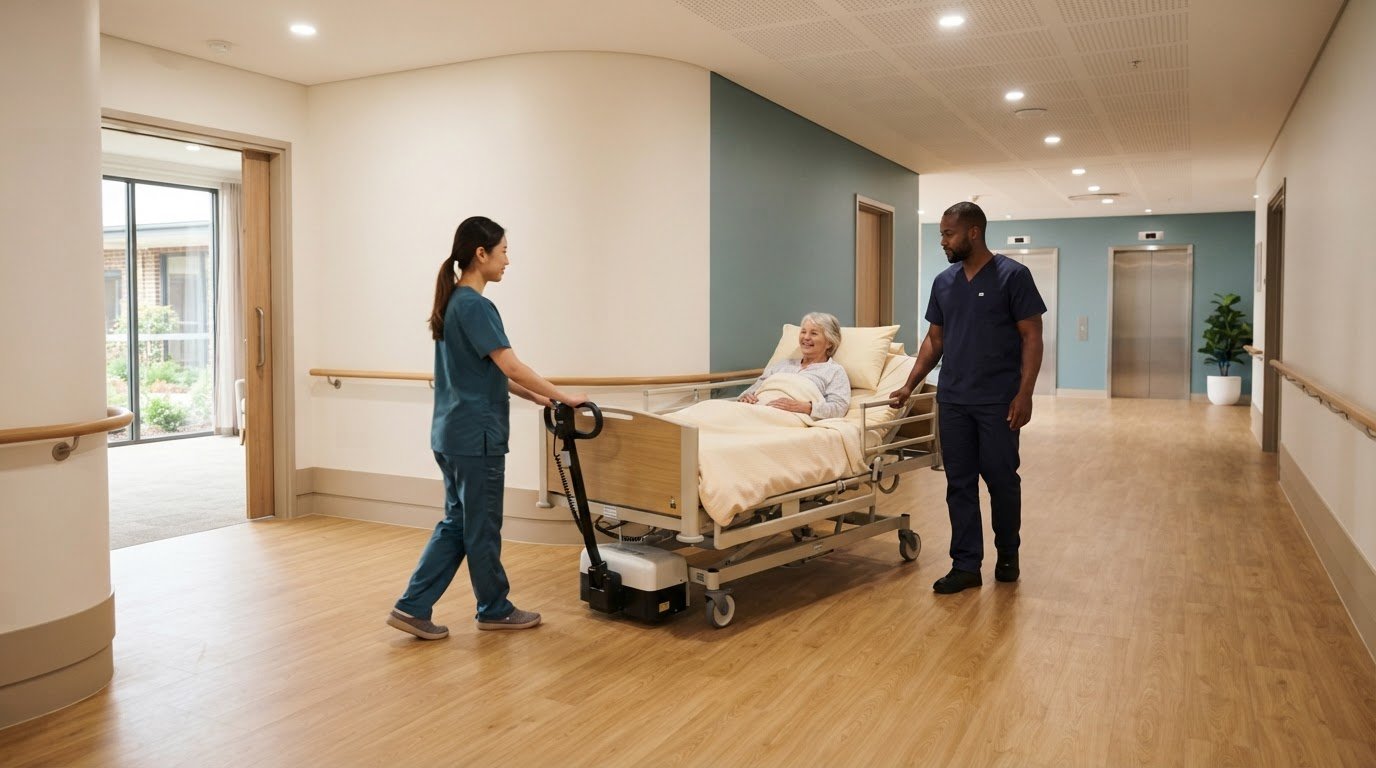
A compatible powered bed mover can assist staff to move a bed through the facility, supporting a controlled equipment movement process. The StaminaLift Transfer System 5000 is designed to move compatible beds. Its role is bed movement, not patient handling: clinical staff remain responsible for decisions about transfer method, patient position and supervision throughout the journey.
Before selecting a powered mover, consider whether it is compatible with the bed and suited to the intended route. Staff training and equipment readiness are also part of using it within facility procedures. If a route includes a tight turn or threshold, plan for that feature rather than assuming the equipment alone will manage every condition.
Whichever approach is chosen, the method should fit the patient and the journey. A bed mover can support movement of compatible equipment, but it can’t make an unsuitable transfer appropriate or remove the need for clinical oversight. Clear roles, an understood plan and equipment used for its intended purpose help the team work in a coordinated way.
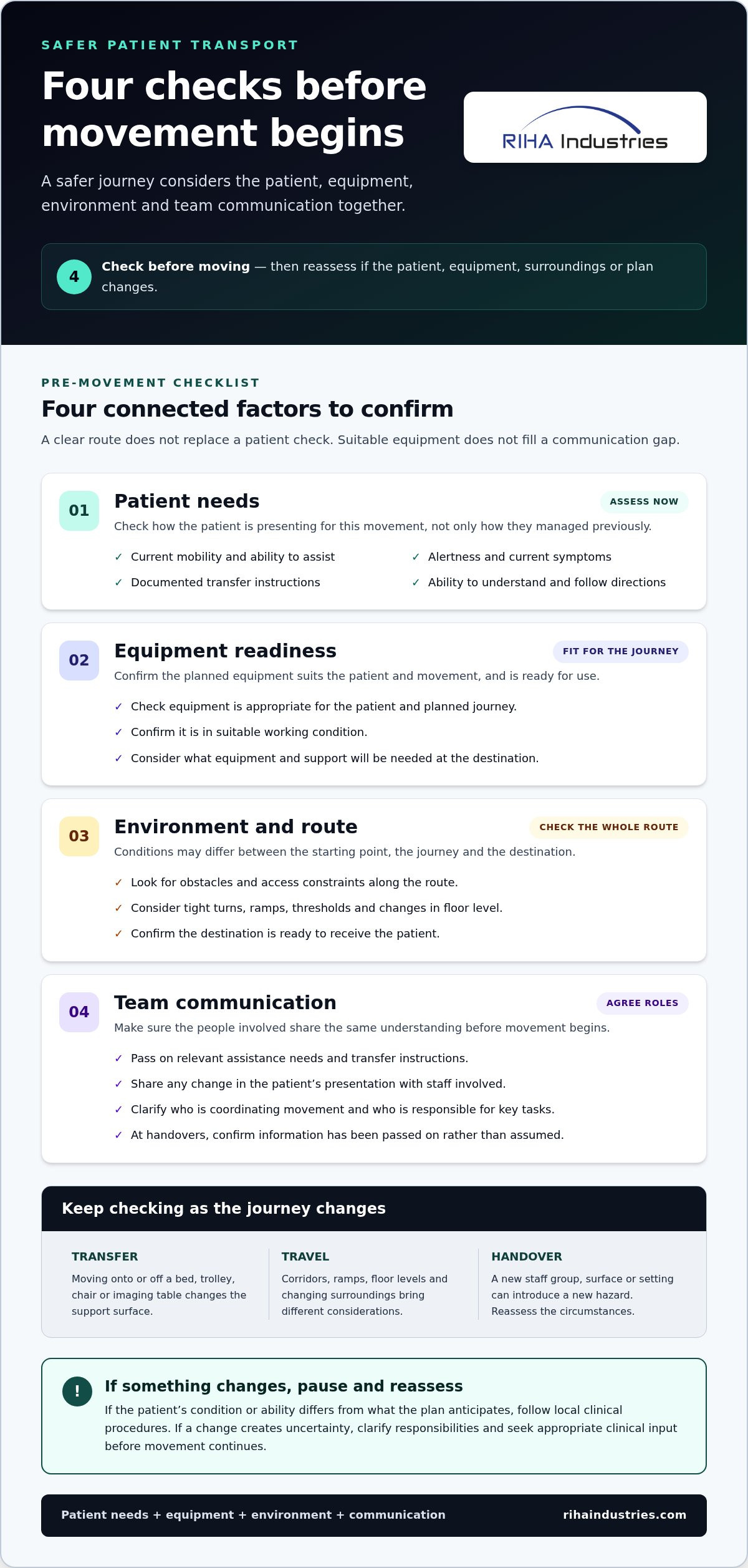
A before-during-after checklist for safer patient transport
A consistent sequence helps staff check the plan at key points without treating transport as a routine task. Use this checklist to support local procedures, not replace clinical judgement. The patient’s current condition and care plan should guide each decision, from preparation through to handover.
Prepare the patient and plan. Confirm the destination, review the patient’s care plan and transfer instructions, and identify the assistance they need for this journey. Explain what will happen in a way that suits the patient’s communication and comprehension needs. Allow time for questions or clarification before equipment is moved.
Confirm equipment and route readiness. Check that the chosen equipment is suitable for the task and ready for use, following facility procedures. Consider the full route, including access points, turns, thresholds and ramps, and address obstacles where possible. Make sure the destination is ready to receive the patient, helping the team avoid an unplanned pause or change of plan.
Agree roles, then move. Before starting, make sure everyone involved understands their role and how the team will communicate during movement. Confirm relevant assistance needs and any instructions that affect the transfer. Proceed in line with the patient’s assessment and local procedures, keeping communication clear rather than assuming who is directing the movement.
Monitor and pause if conditions change. Continue to observe the patient and route as the journey progresses. If the patient’s presentation changes, an obstacle appears or equipment seems unsuitable, pause the movement. Follow local procedures and seek appropriate clinical guidance before continuing. Don’t press on simply to keep to a schedule.
Hand over at the destination. Communicate relevant observations, assistance needs and any changes during the journey to the receiving team. Follow the destination’s handover process and make sure responsibility for the patient is clearly transferred before concluding the movement. This gives the next team information to support their care.
These steps can be adapted to different routes and equipment, but the sequence remains useful: prepare, confirm, move, monitor and hand over. Apply it alongside clinical judgement and facility procedures. If the patient’s needs or transport conditions no longer match the plan, stop and escalate through the appropriate local process rather than improvising.
For facilities reviewing how equipment fits into their transport process, explore RIHA’s powered bed movers and patient transfer systems as part of a wider approach that includes staff training, maintenance and clinical oversight.
How suitable equipment and training fit into a safer transport system
Equipment can support a safer transport process when it’s selected for the task, used by trained staff and kept ready for use. But it’s one part of a wider system. Patient assessment, the care plan, supervision, communication and facility procedures remain central to decisions about how a patient is moved and supported. Similarly, in broader patient care and home settings where mobility is a concern, alert solutions like One Button Phone illustrate how dedicated fall-detection technology serves to support personal safety alongside attentive oversight.
For facilities considering how to prevent patient falls during transport, the distinction matters: a powered bed mover can assist with moving compatible equipment, but it doesn’t independently prevent falls or replace clinical care. Its value lies in supporting a planned movement process, with trained staff using it for its intended purpose.
What powered bed movers can and cannot do
A powered bed mover assists staff to move a compatible bed through a facility. StaminaLift systems have automatic braking when the joystick is released, a feature relevant to controlling equipment movement. The mover doesn’t secure or supervise the patient, assess their condition or decide whether a transfer is appropriate.
Staff remain responsible for following the patient’s care plan and facility procedures, including decisions about positioning, supervision and any transfer onto or off the bed. Equipment should support those responsibilities, not substitute for them.
Build safe use into training and equipment care
Safe implementation starts with matching equipment to the beds and movement tasks it will support. Staff who use powered bed movers need role-appropriate training and should follow the equipment instructions and facility procedures. RIHA provides training and certification for safe and effective product use, helping staff understand the equipment as part of their broader transport workflow.
Maintenance matters, too. A planned maintenance and repair approach helps facilities include equipment readiness in their transport processes, rather than relying only on checks at the point of use. RIHA provides maintenance and repair support, alongside national service coverage in Australia. Facilities should integrate equipment care and staff training with their own procedures for clinical assessment and patient supervision.
Broader selection decisions can consider task suitability, compatibility, staff training and ongoing equipment care. RIHA’s patient handling equipment selection criteria can help frame those wider considerations, while the StaminaLift Transfer System 5000 buying guide provides further information about that system.
A powered mover is most useful when its role is clear: supporting the movement of compatible beds within a coordinated safety process. If your facility is reviewing equipment for this purpose, explore the StaminaLift Transfer System 5000 buying guide as a practical next step.
Make safer transport part of everyday practice
Safer movement is built through consistent decisions, even when departments are busy or a journey changes at short notice. Use this guidance to review how your facility applies its procedures across common transport journeys. A brief team discussion can reveal where responsibilities, handover details or equipment processes need to be clearer.
Understanding how to prevent patient falls during transport means keeping the patient’s needs at the centre while making the process practical for staff to follow. Choose a frequently used journey and review it with the team, from preparation through to handover. This can help identify where local procedures or staff communication could be strengthened.
RIHA Industries’ Australian-made StaminaLift equipment is designed for healthcare bed movement, with training, maintenance and national service support available. Explore RIHA’s patient transport systems and support to consider how powered bed movement may fit your facility’s needs. With clear procedures and the right support behind them, teams can keep improving the way patients move through care.
Frequently Asked Questions
How can healthcare staff reduce the risk of a patient falling during transport?
Match the movement plan to the patient’s current abilities and the journey, then make sure everyone involved understands it. For example, agree on a simple cue the patient can follow before movement begins, and avoid rushing if they need extra time to respond. To understand how to prevent patient falls during transport, teams should also consider whether a change in symptoms or surroundings means the plan needs clinical review.
What should staff check before moving a patient on a bed or trolley?
Confirm the destination and that the receiving area is ready, then check that the bed or trolley is suitable for the patient and in usable condition. Follow local procedures for brakes, attachments, positioning and any required safety features. Check that personal items, tubing or other equipment won’t obstruct movement, and that the patient understands what is about to happen. If a check raises concern, stop and resolve it before setting off.
What should staff do if a patient’s condition changes during transport?
Pause the movement in a safe position and get appropriate clinical assistance. Keep the patient supported and supervised, and explain calmly that the team is stopping to reassess. Don’t continue based on the original plan if the patient’s alertness, symptoms or ability to participate has changed. Follow the facility’s escalation procedures and resume only when the responsible clinical staff have determined the next step is appropriate.
Can bed rails prevent a patient from falling during transport?
Bed rails shouldn’t be treated as a stand-alone fall-prevention measure. Their suitability depends on the patient’s needs and the care plan; in some circumstances, rails may create other risks, including difficulty exiting or entrapment. Staff should use them only in line with facility procedures and individual assessment. Rails don’t replace appropriate positioning, observation or a planned response to the patient’s movement during transport.
Does a powered bed mover prevent patient falls?
No. A powered bed mover assists with moving compatible equipment, not with assessing or supervising the patient. It doesn’t ensure that a patient remains safely positioned or make a transfer appropriate. Staff still need to follow the care plan and facility procedures, maintain suitable oversight and respond to changes during the journey. Think of the mover as one operational aid within a broader clinical transport process, not a patient-safety guarantee.
Who should be involved in planning transport for a patient at risk of falling?
Planning should involve the staff responsible for the patient’s care and the people who will carry out or receive the transport. Depending on the journey, this may include the treating nurse, relevant clinical staff, transport personnel and the receiving department. Include the patient, and a carer where appropriate, so their needs and communication preferences are understood. The facility’s procedures and the patient’s condition determine who needs to contribute.
What should staff do after a patient falls during transport?
Follow the facility’s post-fall procedure and summon clinical assistance promptly. Don’t immediately lift or reposition the patient unless there’s an immediate danger; allow appropriately qualified staff to assess and guide the response. Keep the area safe, reassure the patient and communicate relevant details to the responsible clinician. Record and report the event through local processes, including where it happened and what staff observed, so the care team can determine follow-up actions.