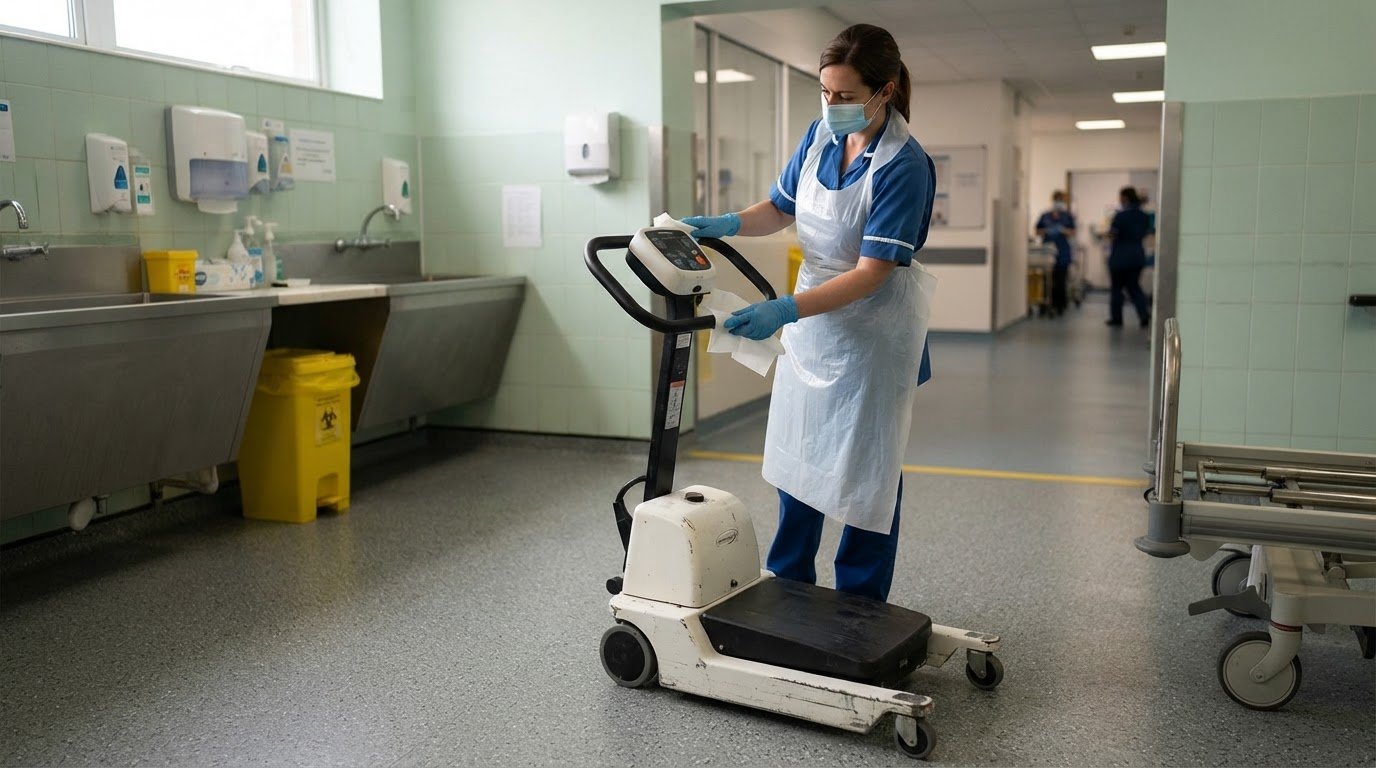
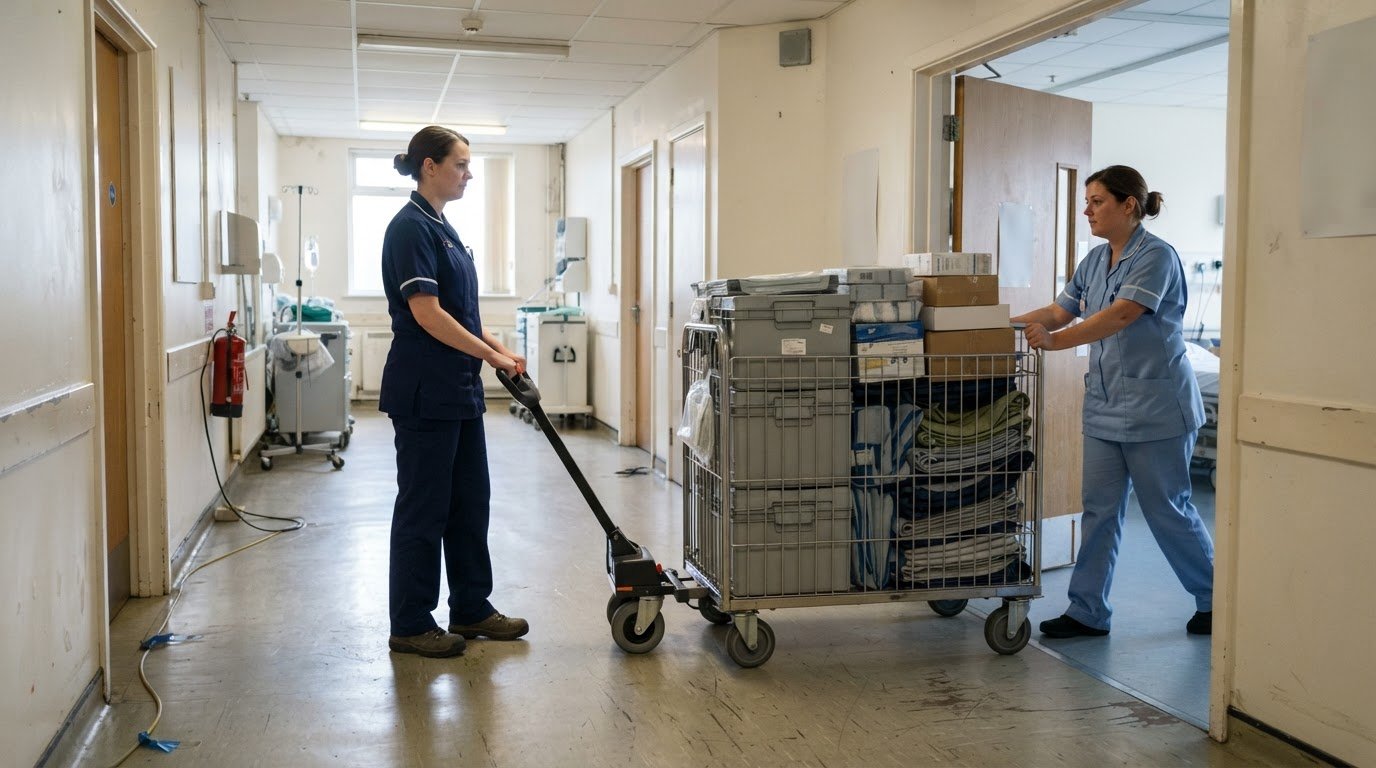
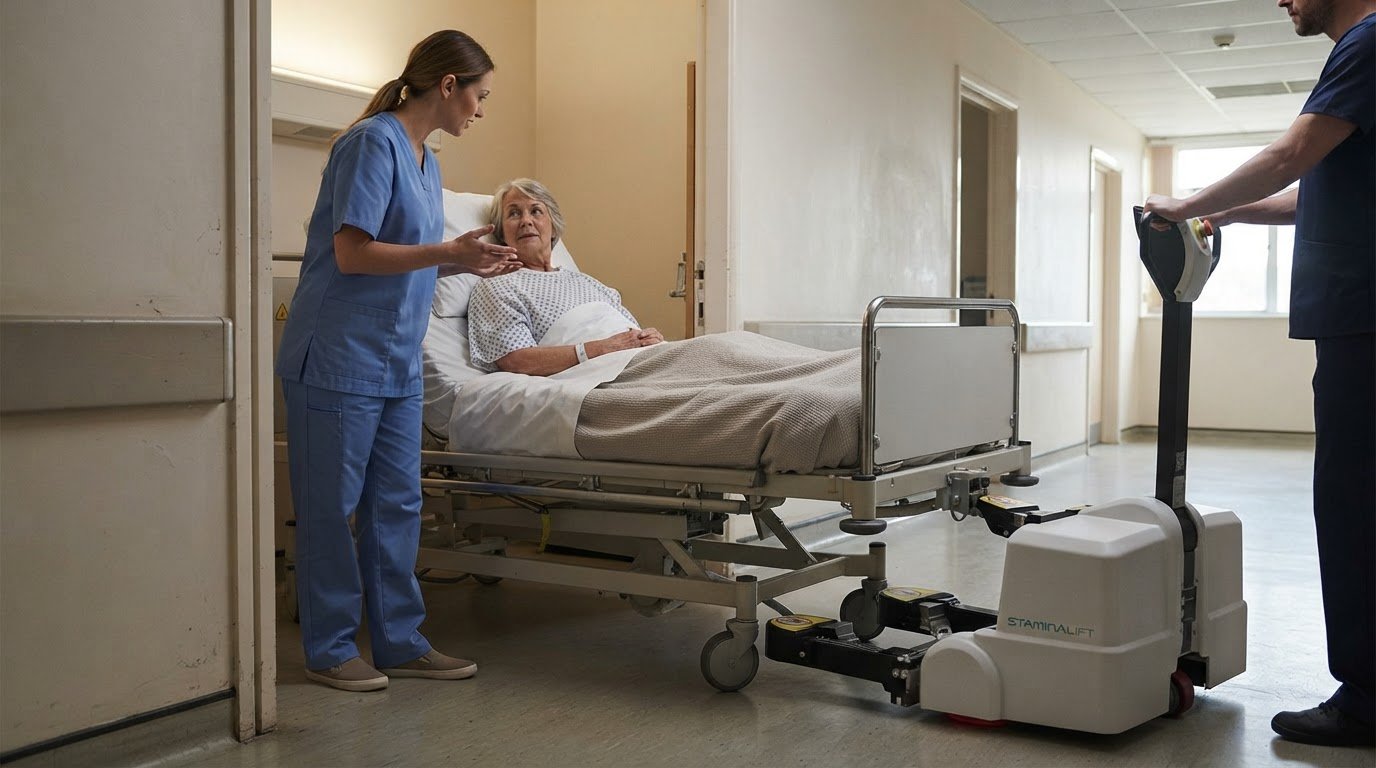
ICU Bed Mover Guide: Safer, More Controlled Hospital Transfers
What if the most capable ICU bed mover on paper isn’t the right fit for your facility? The mover needs to connect to the bed’s frame, wheelbase and attachment points, then remain controllable through tight corridors and around clinical equipment. Because ICU bed models can vary across a facility, compatibility should never be assumed.
Staff need equipment that helps manage heavy beds without adding complexity or disrupting patient transfers. Start by checking the actual bed and its connection to the mover. Then consider capacity and manoeuvrability in the spaces where staff will use it.
This guide explains how to assess bed compatibility, distinguish lifting capacity from push-or-pull capacity, and evaluate controls against your routes and workflow. It also covers practical implementation considerations, so you can compare equipment with staff needs and patient-care routines in mind.
Table of Contents
What makes an ICU bed mover different from general bed-moving equipment?
An ICU bed mover is powered equipment that assists staff to move a compatible hospital bed, including when the bed is occupied and connected equipment needs to move with it. Unlike general load-moving equipment, it must be assessed against the bed’s design and the clinical environment where it will operate. The Bed mover reference describes the device as motorised equipment for moving heavy hospital beds. In an ICU, the practical question is whether the specific mover and bed can work together along the intended route.
Patient acuity and attached monitors, pumps or other accessories can affect how a transfer is planned. Equipment may extend beyond the bed frame, while cables and lines may need to be managed. Consider clearances and movement before attempting a route. A mover assists with moving the bed. It doesn’t assess the patient, manage clinical connections or replace the facility’s transfer procedures.
Why ICU bed movement needs a facility-specific assessment
ICU layouts and bed models vary, so suitability can’t be assumed from a general compatibility claim. A doorway may accommodate the bed frame but become restrictive once accessories are attached. Turning areas, nearby equipment, corridor width and the bed’s wheelbase can all affect how the bed and mover travel together.
Involve clinical staff, facilities teams and the people responsible for the beds and moving equipment. Together, they can identify representative beds, attachments and routes, then flag places where clearance or turning could be difficult. This focuses equipment selection on the conditions staff will actually encounter, rather than on a specification in isolation.
What an ICU bed mover does, and doesn’t do
Powered assistance helps staff move a compatible bed with greater control than manual pushing alone. However, the mover isn’t a patient-lifting device and doesn’t transfer a patient between surfaces. It assists with moving the bed itself, while patient handling remains a separate clinical task governed by facility procedures.
Operators still need to follow local procedures and receive appropriate training for the equipment and bed combination. Before movement, teams should confirm that the attachment is suitable, account for accessories and connections, and check that the planned route is clear. This keeps the equipment’s role clear and supports a considered approach to ICU bed movement.
How ICU bed movers connect, manoeuvre and control heavy beds
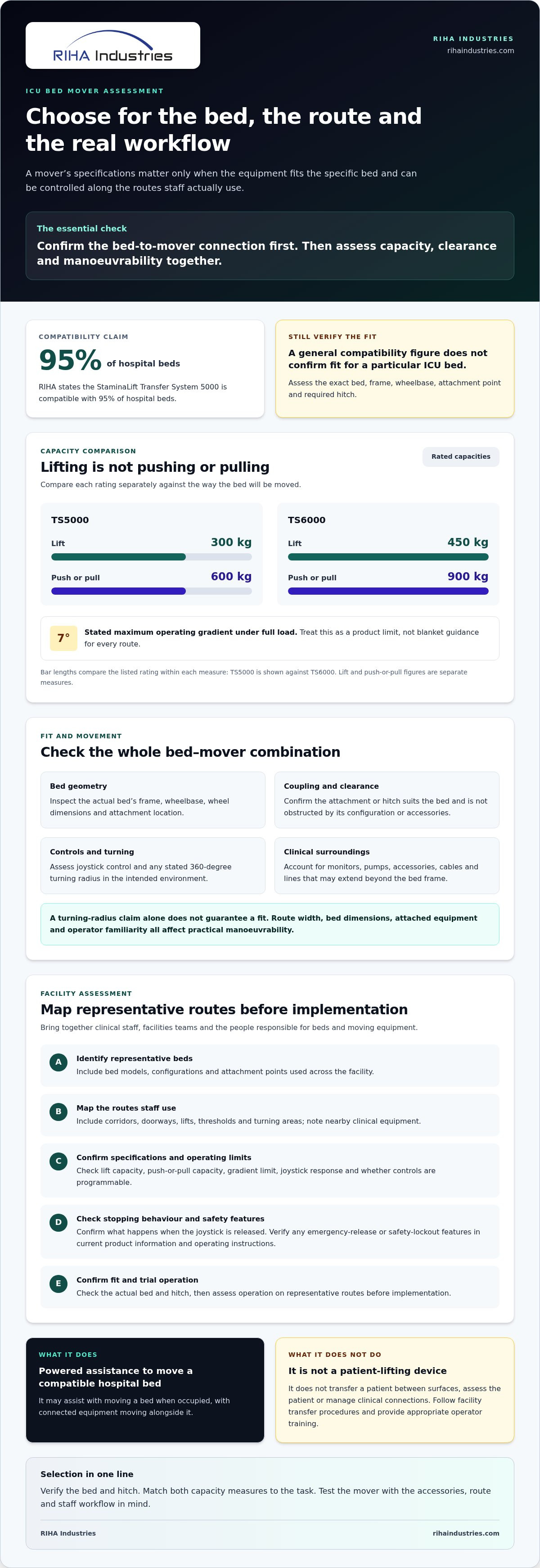
A bed mover can provide controlled assistance only if it couples securely to the bed. The attachment or hitch must suit the bed’s frame and accessible connection point. Before selecting equipment, confirm the manufacturer, model, wheel dimensions, bed configuration and attachment requirements. A general compatibility figure doesn’t prove a particular ICU bed will fit. RIHA states that the StaminaLift Transfer System 5000 is compatible with 95% of hospital beds, but each proposed ICU bed and hitch still needs assessment.
Checking ICU bed geometry and attachment compatibility
Inspect the actual bed, not just its product description. Note the wheelbase, attachment location and clearance around the frame. Then check whether accessories or the bed configuration obstruct coupling or movement. Share these details with RIHA to confirm the fit and required hitch before selection. This check is especially important in facilities where ICU beds from different manufacturers have different frame designs.
Once the mover is attached, controls and steering affect how staff guide the bed. Joystick operation lets the operator direct powered movement, while a stated 360-degree turning radius may help when changing direction. Neither feature guarantees that the bed will turn within a particular ward or doorway. Route width, bed dimensions, attached equipment and operator familiarity all affect practical manoeuvrability, so assess the mover in its intended environment.
Understanding controls, braking and operating limits
Check current specifications for joystick response, whether the controls are programmable and what happens when the operator releases the joystick. Automatic braking on release is a feature to confirm for the specific model. Don’t assume emergency-release or safety-lockout features are present without checking current product information and operating instructions.
Read capacity figures carefully. The TS5000 is rated for a 300 kg lift and 600 kg push or pull. The TS6000 is rated for a 450 kg lift and 900 kg push or pull. These are separate measures, not interchangeable descriptions of one capacity. The stated maximum operating gradient under full load is seven degrees. Treat this as a product limit, not blanket guidance for every route.
Check the mover’s lift and push-or-pull capacity, along with its gradient limit, against the intended load and operating conditions. Confirm what the load calculation includes, and seek current product guidance before use. A bed mover assists with moving the bed rather than lifting a patient. OSHA’s guidance on high-risk manual patient handling activities provides relevant context for healthcare workplace handling risks.
For model-specific details, review RIHA’s bed-moving systems and confirm the bed, attachment and operating limits before choosing equipment.
How to compare ICU bed movers for capacity, fit and manoeuvrability
Start a useful comparison with the beds and routes your team actually uses, not a headline specification. Check lift capacity separately from push-or-pull capacity. Confirm bed compatibility, turning space, controls and available support. The CDC’s Safe Patient Handling and Mobility (SPHM) resource provides broader context on using technology as part of safer handling approaches. No single mover can be ranked as the best option without verified product details and facility requirements.
When to assess the StaminaLift Transfer System 5000
The TS5000’s stated capacities are 300 kg for lifting and 600 kg for pushing or pulling. Its 95% hospital-bed compatibility figure is a general claim, not a guarantee of ICU-bed fit. Check the proposed bed’s model, frame and attachment point before deciding. For more detail, consult StaminaLift Transfer System 5000: The Definitive Buying Guide for Australian Hospitals.
When bariatric and acute-care requirements need closer review
The TS6000 is designed for bariatric and acute-care beds. Its stated capacity is 450 kg for lifting and 900 kg for pushing or pulling. These figures describe different functions, so compare each against the intended use rather than treating them as one rating. Acute-care suitability doesn’t confirm compatibility with every ICU bed. Verify bed fit, attachment and route requirements. The 2026 Hospital Bed Mover Procurement Guide covers broader procurement criteria.
For either option, measure turning areas and assess how the loaded bed and mover travel together. Ask for current specifications on controls and confirm what training and national service support apply to your facility. This gives your team a more meaningful basis for comparison than a model ranking made without site context.
How hospitals can assess an ICU bed mover before implementation
A structured assessment helps teams check whether an ICU bed mover suits their bed fleet, routes and day-to-day procedures before routine use. Involve staff who move beds regularly, along with clinical, facilities and equipment decision-makers. Work through these steps together:
1. Map the beds. Record each bed’s manufacturer, model, wheelbase and configuration across the intended ICU areas. Include relevant attachments and note whether different bed types share the same routes.
2. Inspect representative routes. Walk the paths used for transfers, including doorways, lifts, thresholds, turning areas and ramps. Measure practical clearances and identify gradients that need checking against the mover’s stated operating limits.
3. Confirm fit. Provide the supplier with bed and attachment details to verify compatibility and the required hitch for each model. Don’t rely on a general compatibility claim to confirm that a specific bed will fit.
4. Trial the operation. Where practical, assess the bed and mover together on representative routes. Observe attachment, steering, turning and control in the actual environment, following facility procedures and involving appropriate staff.
5. Plan support. Agree on operator familiarisation, safe-use procedures and responsibilities before routine deployment. Discuss preventative maintenance, repair pathways and spare-parts support with the supplier.
What to include in a facility bed and route assessment
Go beyond a bed list. Note transfer frequency, common destinations and points where movement could interrupt nearby work, without assuming a particular staffing or time saving. Record tight turns, lift access, thresholds and ramp conditions. Consider how attached equipment affects clearance. These observations give the team practical criteria for reviewing fit and planning a trial.
For workforce context, the article How to Reduce Nurse Back Injuries: Patient Handling Equipment Selection Criteria for 2026 can complement the site assessment with further equipment-selection considerations.
Planning staff familiarisation and ongoing support
Before deployment, clarify who may operate the equipment, what training is needed and which local procedures apply. Ask the supplier how preventative maintenance and repairs are handled, and how spare-parts support is arranged. This helps facilities plan for equipment upkeep as well as initial adoption. For related considerations, see Hospital Bed Mover Repair Service: A Preventative Maintenance Guide for 2026.
To assess bed compatibility, attachment needs and the intended operating environment, contact RIHA Industries about your ICU bed mover requirements.
Choosing an ICU bed mover with RIHA Industries
Equipment selection is more straightforward when the discussion starts with your beds and operating environment. RIHA Industries designs and manufactures Australian-made bed movers, including the StaminaLift Transfer System 5000, StaminaLift Transfer System 6000 and StaminaLift 2100 Bed Mover. The range includes options for different bed-moving requirements, but the right match depends on the specific bed, attachment and intended use.
RIHA provides national service coverage in Australia, and training and support are part of its offering. Confirm current availability and the arrangements relevant to your facility during procurement. A product discussion can help establish what needs checking before selection, rather than relying on a general compatibility claim or capacity figure alone.
What information to provide for a useful product discussion
Prepare practical details about your bed fleet and the environments where equipment will be used. This helps RIHA assess whether a proposed ICU bed mover and attachment may suit your requirements. Useful information includes:
Bed manufacturers, model numbers, wheel dimensions and accessible attachment points.
Typical bed configurations, including accessories that could affect clearance or coupling.
Representative routes, with relevant doorways, turning areas, lifts, thresholds and ramps.
Load requirements, including whether bariatric or acute-care beds are part of the intended use.
How often beds are moved and any workflow considerations staff want addressed.
Ask RIHA to confirm compatibility for each proposed bed model, the required attachment and the applicable operating limits. Clarify which capacity measure relates to your intended task, and discuss operator training, preventative maintenance and repair arrangements. Specific questions help your team compare equipment against actual needs and plan for its use over time.
Arrange an ICU bed mover assessment
A product discussion, and a demonstration if available, may help your team evaluate attachment, controls and movement on representative routes. Involve staff who regularly move beds, along with relevant clinical and facilities decision-makers. Their feedback can help determine whether the equipment fits existing procedures and identify where further checks are needed. A discussion or trial can support informed selection, but it can’t establish universal bed compatibility or guarantee a particular safety or workflow outcome.
To discuss your bed models, attachment requirements and operating environment, Discuss ICU bed mover requirements with RIHA Industries.
Take the next step towards more controlled bed movement
Choosing an ICU bed mover starts with your facility’s actual beds, attachments and transfer routes. Confirm compatibility for each bed model, compare lift and push-or-pull capacities separately, and consider turning space, controls and operating limits. A site assessment and staff input can help establish whether the equipment fits the way your teams work.
RIHA Industries designs Australian-made StaminaLift equipment and provides national service coverage in Australia. Before procurement, discuss bed-specific compatibility, attachment requirements and your operating environment. Confirm current details for staff training and support so implementation planning reflects your facility’s needs.
Discuss your ICU bed mover requirements with RIHA Industries and take a considered next step towards equipment that supports your staff and patient-care workflows.
Frequently Asked Questions
What is an ICU bed mover?
An ICU bed mover is powered equipment that assists staff in moving a compatible hospital bed. It couples to the bed using an appropriate attachment and helps guide movement along a planned route. It moves the bed, not the patient between surfaces, and doesn’t manage clinical connections or replace local transfer procedures. Check compatibility, operating limits and staff training before using one in an ICU.
Can an ICU bed mover connect to any hospital bed?
No. Bed frames, wheelbases and attachment points vary, so compatibility needs to be checked for each bed model. RIHA states that the StaminaLift Transfer System 5000 is compatible with 95% of hospital beds, but that general figure doesn’t confirm fit with a particular ICU bed. Provide the bed manufacturer and model, wheel dimensions and attachment details, then confirm the required hitch before selecting a mover.
How do hospitals choose the right ICU bed mover?
Start by mapping the beds and routes where the mover will be used. Confirm attachment fit, then compare lift capacity separately from push-or-pull capacity against the intended load. Assess turning areas, doorways, lifts, thresholds and ramps, as well as controls and operator training. Involve staff who move beds regularly and relevant clinical and facilities decision-makers. A practical trial on representative routes can help check whether the equipment suits local workflows.
What is the difference between the StaminaLift TS5000 and TS6000?
The TS5000 has a stated capacity of 300 kg for lifting and 600 kg for pushing or pulling. The TS6000 is designed for bariatric and acute-care beds, with a stated capacity of 450 kg for lifting and 900 kg for pushing or pulling. These are separate capacity measures, not interchangeable figures. Confirm current specifications and compatibility with the specific ICU bed and attachment before deciding which model to assess.
Can a powered bed mover be used on hospital ramps?
Ramp use depends on the specific mover, load and operating conditions, so check the current model specifications and assess the route before use. RIHA states a maximum operating gradient of seven degrees under full load for its bed movers. Treat this as a stated product limit, not blanket approval for every ramp or bed configuration. Confirm the intended load, route gradient and safe-use procedures with the supplier and facility team.
Does an ICU bed mover reduce manual handling risk?
A powered mover assists with moving a compatible bed and may reduce the physical effort of pushing or pulling it. It doesn’t eliminate all manual handling or guarantee that injuries will be prevented. Staff still need to follow facility procedures, receive appropriate training and manage patient connections and accessories as required. Consider the mover as one part of a broader approach to safe bed movement and patient handling.
What should a hospital check before buying an ICU bed mover?
Document bed makes, models, wheel dimensions, configurations and attachment points across the intended areas. Check capacity requirements, route clearances, turning space, lifts, thresholds and ramps. Ask the supplier to confirm bed-specific compatibility, required hitches and applicable operating limits. Before routine use, consider a representative route trial, operator familiarisation, maintenance arrangements and repair support. This gives procurement teams a practical basis for assessing fit beyond headline specifications.
Does RIHA Industries provide servicing and support in Australia?
RIHA Industries provides national service coverage within Australia and offers preventative maintenance and repairs, as well as training and support. Confirm current availability and the arrangements that apply to your facility and equipment. Discuss maintenance requirements, repair pathways and operator familiarisation during procurement so the support plan is clear before routine deployment. Bed-specific compatibility should also be confirmed for each proposed model and attachment.