
Manual Handling Solutions for Aged Care: The 2026 Guide to Ergonomic Safety
- Jul 11
- 11 min read
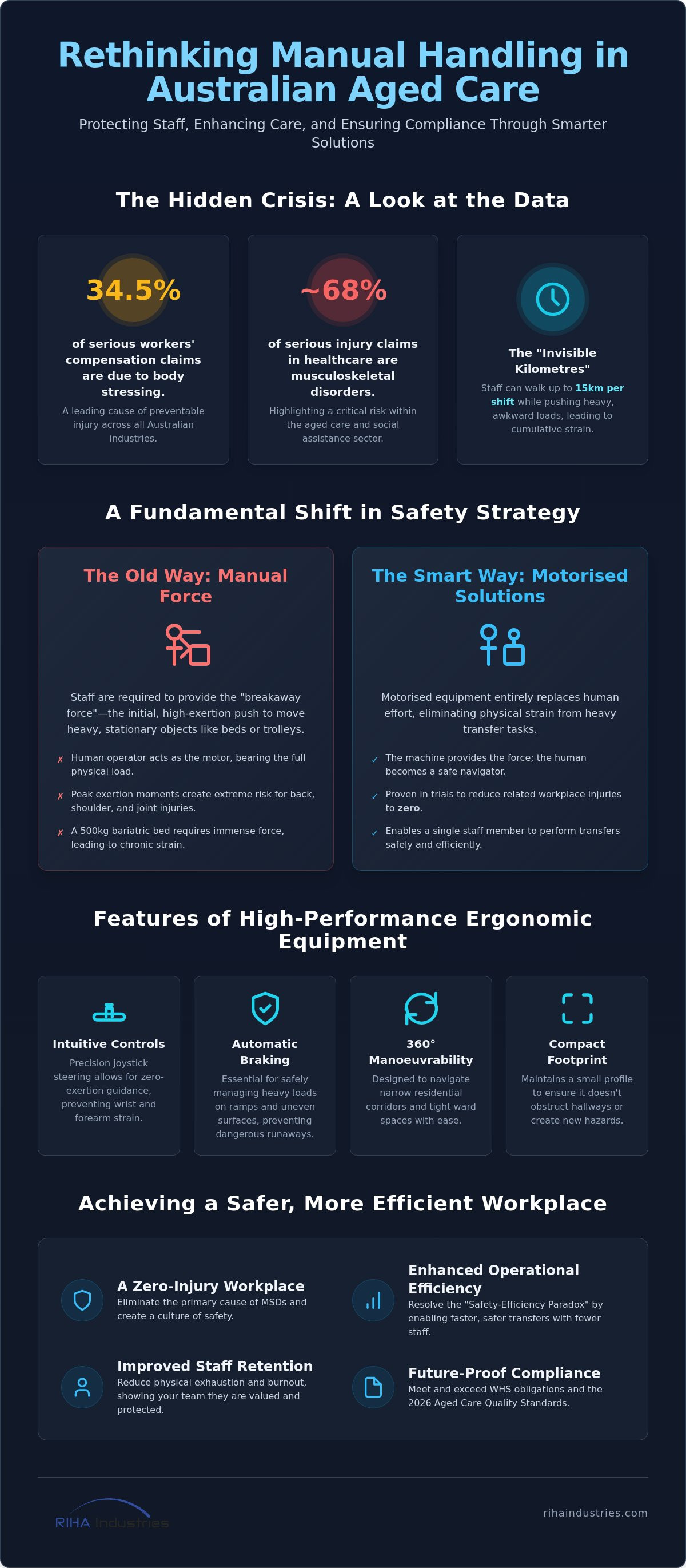
Did you know that body stressing accounts for 34.5% of all serious workers' compensation claims across Australia? Within the healthcare and social assistance sector, musculoskeletal disorders represent approximately 68% of serious injury claims, highlighting a critical need for more effective manual handling solutions for aged care. You've likely seen the impact of these figures firsthand through rising staff turnover and the physical exhaustion of your nursing team as they navigate the demanding logistics of modern residential care.
We understand that maintaining a safe environment is about more than just meeting a compliance checklist; it's about protecting the people who provide essential care to our most vulnerable. This guide will show you how to identify specific ergonomic risks and implement advanced motorised equipment to eliminate staff injuries and improve resident dignity. We'll explore the latest 2026 regulatory standards, including the 2025 Model Code of Practice, and demonstrate how integrating smart technology can transform heavy transfers into a routine, stress-free process that supports a zero-injury workplace and enhances operational efficiency.
Table of Contents
Identifying Manual Handling Hazards in Aged Care Facilities
Effective manual handling solutions for aged care are not merely protocols; they're comprehensive systems designed to eliminate hazardous physical force from the daily workflow. While clinical training often focuses on resident transfers, the most significant risk frequently stems from the "Invisible Kilometres" that staff navigate during every shift. Nursing and support staff can walk up to 15km daily while pushing heavy, awkward loads. This cumulative strain is a primary driver of workplace injury, yet it often goes unaddressed in traditional safety audits.
High-risk tasks extend far beyond the bedside. Moving bariatric beds, transporting multi-tiered meal trolleys, and manoeuvring heavy linen carts through narrow corridors create constant physical demand. These repetitive actions lead to chronic musculoskeletal disorders (MSDs), which account for approximately 68% of serious injury claims in the Australian healthcare sector. Without the right mechanical intervention, your team is essentially acting as the motor for your facility's logistics. This constant exertion creates a high-stakes environment where a single slip or heavy push can lead to a career-ending injury.
The Hidden Impact of Cumulative Strain
Pushing a modern bariatric bed combined with a patient can exceed 500kg in total weight. This requires immense initial force to overcome inertia, placing extreme stress on the lower back and shoulder joints. The Manual handling of loads in this manner often leads to micro-tears and long-term joint degradation that staff might ignore until a major injury occurs. This physical toll creates a psychological burden too. When staff are exhausted, care quality can slip, and retention rates often plummet. Learning how to reduce nurse back injuries is therefore essential for both staff well-being and operational stability.
Australian WHS Compliance and Your Obligations
Under the Work Health and Safety Act, aged care providers have a strict duty of care to eliminate or minimise risks as far as is reasonably practicable. The 2026 Aged Care Quality Standards reinforce this by positioning staff safety as a fundamental pillar of resident care. If your facility relies on manual force for heavy transfers, you're likely exposed to significant legal and financial risks. Non-compliance doesn't just result in potential fines; it leads to soaring WorkCover premiums and the high cost of recruiting and training replacement staff after a preventable injury occurs. Implementing robust manual handling solutions for aged care is the most effective way to safeguard your facility against these mounting pressures while ensuring your team feels valued and protected.
This commitment to safety and dignity is paramount in any care setting; for instance, you can check out Providential Fijian Home Care to see how these values are translated into compassionate in-home memory support.
The Strategic Role of Healthcare Ergonomic Equipment
Ergonomic equipment in a healthcare setting is often misunderstood as simply having a tool for the job. In reality, true healthcare ergonomic equipment represents a sophisticated adaptation of the workspace to the human body, rather than forcing the body to adapt to the load. While many facilities rely on standard manual trolleys or generic aids, these often fail to eliminate the risk of injury. They still require the operator to provide the breakaway force, which is the initial burst of energy needed to get a stationary object moving. This specific moment of peak exertion is when most spinal and shoulder injuries occur.
The shift toward motorised manual handling solutions for aged care marks a fundamental change in safety strategy. Instead of merely assisting a staff member's effort, these solutions replace it entirely. By powering the movement, motorised movers take on the total physical burden of the task. This approach aligns with the core principles of a Safe Patient Handling Program, where mechanical force becomes the primary mover and the human operator transitions to a navigator rather than a manual labourer.
Features of High-Performance Ergonomic Gear
Superior ergonomic equipment prioritises the operator's physical state. Intuitive joystick controls allow for precision steering with zero physical exertion, ensuring that even the most complex manoeuvres don't strain the wrists or forearms. Safety is equally critical. Automatic braking systems are essential for managing heavy loads on ramps or uneven surfaces, preventing the dangerous runaway scenarios common with manual trolleys. Additionally, these units must maintain a compact footprint. In many Australian facilities, navigating tight ward spaces and standard elevators is a daily reality, making slimline engineering a non-negotiable requirement for operational success.
Compatibility: The Key to Seamless Integration
For safety equipment to be effective, it must be used consistently. This requires universal compatibility. Modern movers must connect to existing beds, stretchers, and laundry trolleys without needing complex modifications or permanent alterations. Tool-free coupling systems are vital in fast-paced environments, allowing staff to switch between tasks in seconds. Advanced systems now include Bluetooth diagnostics, providing real-time data on battery health and maintenance requirements to ensure the equipment is always ready for service. To see how these features combine to protect your team, you can explore our range of motorised transfer solutions designed for the unique demands of the aged care sector.
Assessing Manual Handling Solutions: Manual vs. Motorised
Traditional methods of moving infrastructure in aged care facilities often rely on a "more hands" approach. When a heavy bariatric bed or a fully loaded meal trolley needs to be moved, it's common practice to pull a second or third staff member away from their clinical duties to assist. This reliance on brute force is not only inefficient but also inherently dangerous. Motorised manual handling solutions for aged care replace this erratic human effort with consistent, mechanical precision. By allowing a single staff member to perform transfers that previously required a team, facilities can resolve the "Safety-Efficiency Paradox," where safety equipment actually accelerates ward routines rather than hindering them.
The "Bariatric Challenge" further highlights the necessity of motorised intervention. Moving a resident in a specialised bariatric bed can involve a total weight exceeding 500kg. Attempting this manually, even with multiple staff, creates extreme risk for everyone involved. Motorised movers provide a smoother, more secure ride for the resident, which directly counters the misconception that mechanical aids are distressing. Instead of the jerky, unpredictable movements of manual pushing, residents experience a controlled and stable journey. For more detailed insights on selecting the right tools, see our guide on patient transport equipment aged care.
Evaluating the Return on Investment (ROI)
The financial argument for motorised equipment is as compelling as the clinical one. By reallocating the "second person" from transport tasks back to direct resident care, facilities significantly increase their operational capacity. This shift is supported by data from Safe Patient Handling and Mobility research, which emphasizes that mechanical assistance is the only reliable way to prevent caregiver injury. In South Australian hospital trials, for example, the introduction of motorised movers saw workplace injuries reduced from 20% to zero. Furthermore, controlled movement extends the life of your existing beds and trolleys by preventing the structural damage caused by collisions and forced steering. For facilities looking to upgrade their bedding with high-quality options, you can visit Belfast Bed Superstore to explore their range of Sealy mattresses.
Manoeuvrability in Residential Settings
Residential care environments are rarely designed with wide, industrial thoroughfares. Success depends on a 360-degree turning radius, allowing staff to navigate narrow corridors and shared rooms without constant repositioning. High-performance movers can safely manage loads up to 1500kg on ramps and inclines, providing the braking power necessary to prevent accidents. To protect the facility's interior, these units utilise non-marking drive wheels, ensuring that floors remain pristine while the team moves heavy infrastructure with total confidence and ease.
How to Implement a Safe Patient Handling Programme
Successful implementation of manual handling solutions for aged care requires a shift from purely theoretical training to a practical, equipment-led strategy. While traditional education focuses on correct lifting posture, it cannot overcome the physical reality of moving a 500kg bariatric bed. A robust programme must begin with a comprehensive, facility-wide audit of all 'heavy push' tasks, including the transport of beds, heavy laundry skips, and multi-tray meal trolleys. By identifying these high-exertion touchpoints, management can target interventions where they will have the most immediate impact on staff safety and operational flow.
Once the audit is complete, the following steps ensure a seamless transition to a safer workplace:
Trial in high-traffic wards: Deploying motorised movers in the busiest sections of the facility allows staff to experience the benefits firsthand, securing essential buy-in through tangible results.
Ensure universal compatibility: Utilise customised hitches and attachments so that a single mover can connect to various bed brands and trolley types without modification.
Formalise certification: Roll out a structured training programme that certifies porters and carers in equipment operation, ensuring consistent safety standards across all shifts.
Schedule preventative maintenance: Establish a routine service plan to maintain 24/7 reliability, as equipment downtime often forces staff back into high-risk manual habits.
Overcoming Staff Resistance to Technology
Resistance to new equipment often stems from a fear of added complexity. To counter this, focus on the personal benefits: less physical fatigue and reduced risk of chronic pain at the end of a long shift. Identifying 'Super Users' on the ward provides peers with a local champion who can demonstrate how easy the equipment is to use. A 'hands-free' connection system is particularly effective here, as it allows staff to secure loads quickly and move on without fumbling with complex manual locks.
Maintenance and Long-Term Reliability
Preventative maintenance is a non-negotiable component of OHS compliance and long-term equipment performance. For rural aged care facilities, modern support includes the use of remote diagnostics to troubleshoot issues without delay. Ensuring 24-hour parts availability is essential to minimise downtime and keep your safety programme on track. To begin protecting your team with a structured rollout, you can enquire about our preventative maintenance and repairs services to keep your fleet in peak condition.
Future-Proofing Aged Care with StaminaLift Technology
Selecting the right manual handling solutions for aged care requires a partner that understands the specific architectural and clinical constraints of Australian facilities. StaminaLift technology represents the pinnacle of this understanding, offering a range of motorised movers that transform high-risk tasks into safe, one-person operations. While the StaminaLift 2100 Bed Mover serves as the compact workhorse for residential care, the StaminaLift Transfer System 5000 and StaminaLift Transfer System 6000 provide the necessary power for bariatric and acute care transport. These systems are engineered to handle the most demanding logistics, ensuring that no staff member is ever forced to risk their physical well-being to move a patient or heavy infrastructure.
Beyond patient transfers, facility logistics like laundry and meal services present their own set of hazards. The Easi series, including the Easi Rider and Easi Mover, provides versatile walk-behind and ride-on tug options for these essential services. These units are designed to navigate the "Invisible Kilometres" of a facility with ease, taking the strain off support staff who traditionally push heavy carts across long distances. Choosing Australian-made equipment means your facility benefits from stringent quality control and direct access to local technical support. This ensures your safety systems remain operational without the delays often associated with imported goods, providing a reliable, long-term partnership for your facility.
Why the StaminaLift 2100 is the Aged Care Standard
The StaminaLift 2100 is widely considered the aged care standard because it was specifically designed for the narrower beds and tighter spaces common in Australian residential care. It's an FDA-registered device that offers the precision needed to navigate crowded wards with total confidence. Its 360-degree turning radius allows for effortless manoeuvrability in narrow corridors where traditional manual handling would be impossible. For a deeper look at how this specific unit can transform your facility's workflow, read our StaminaLift 2100 bed mover guide.
The RIHA Industries Commitment to Caregivers
RIHA Industries is dedicated to the long-term sustainability of your facility's infrastructure. We don't just sell equipment; we provide engineering solutions that keep your older beds and trolleys in service through versatile 360-degree attachments. Our team works directly with facility managers to address unique floorplan challenges, ensuring that every corner of your building is accessible to motorised assistance. This direct engagement helps solve custom issues, from steep ramps to non-standard elevator sizes. If you're ready to see these results in action, organise a trial for your facility today and take the first step toward a zero-injury workplace.
Advancing Safety and Efficiency in Your Facility
The path to a zero-injury workplace begins with a fundamental shift in how we view facility logistics. By addressing the physical toll of heavy infrastructure and the cumulative strain of daily transfers, providers can move beyond simple compliance to create a culture of genuine well-being. Implementing advanced manual handling solutions for aged care ensures that your team is no longer the motor for your facility; instead, they are empowered navigators of a safe, efficient environment where staff retention and resident dignity are prioritised.
The evidence for this mechanical transition is definitive. Hospital trials have already demonstrated that motorised movers can reduce workplace injuries to zero, providing a level of protection that manual training alone cannot achieve. As an Australian-made and owned innovator, RIHA Industries provides FDA-registered equipment designed specifically for the unique architectural demands of local residential care. Our StaminaLift and Easi series systems deliver the precision and reliability needed to protect your most valuable assets: your people.
Protect your staff and see our range of manual handling solutions
Investing in the right technology today secures the health of your caregivers and the quality of your resident care for years to come.
Frequently Asked Questions
What are the most common manual handling injuries in aged care?
Musculoskeletal disorders, particularly lower back strains and shoulder injuries, are the most prevalent issues facing aged care staff today. These injuries often result from the repetitive force required to overcome inertia when pushing heavy beds or trolleys. Micro-tears in the wrists and forearms are also common among carers who must manually steer heavy loads through tight ward spaces without mechanical assistance.
Is motorised manual handling equipment mandatory in Australia?
While no specific legislation names motorised equipment as mandatory, the Work Health and Safety Act requires providers to eliminate manual handling risks as far as is reasonably practicable. In 2026, the standard for "reasonably practicable" in high-risk tasks like bariatric transport almost always involves mechanical assistance. Implementing these tools is essential for meeting the latest Aged Care Quality Standards regarding staff and resident safety.
How much weight can a motorised bed mover safely transport?
Modern motorised movers can safely transport loads ranging from 300kg to over 600kg depending on the specific model. For bariatric requirements, advanced systems like the StaminaLift Transfer System 6000 are engineered to manage even heavier acute care loads with total stability. This capacity ensures that even the heaviest bed-and-patient combinations move without placing any physical burden on the operator.
Will a bed mover fit in my facility's small elevators?
Yes, the StaminaLift 2100 Bed Mover is specifically designed with a compact footprint to fit inside standard Australian facility elevators. Because it adds minimal length to the bed and features a 360-degree turning radius, it allows operators to navigate tight lift entries and narrow residential corridors without needing to reposition the equipment manually or use physical force.
Do staff need special certification to operate StaminaLift equipment?
Operators don't require a formal government licence, but facility-level certification is essential for safety and compliance. RIHA Industries provides comprehensive training programmes for all carers and porters to ensure they're confident using the equipment. The intuitive joystick controls on the StaminaLift range make the learning process straightforward, typically requiring only a short orientation session to master the controls.
How does motorised equipment improve resident safety?
Motorised equipment improves resident safety by providing a smooth, controlled journey that eliminates the jerky, unpredictable movements of manual pushing. This stability reduces the risk of skin tears or patient discomfort during transfers. Additionally, because only one staff member is needed for the move, the process feels less intrusive and more dignified for the resident being transported.
Can motorised tugs be used for meal and laundry trolleys as well?
Yes, motorised tugs like the Easi Mover and Easi Rider are specifically designed to handle the logistics of meal and laundry trolleys. These manual handling solutions for aged care take the strain out of pushing heavy service carts over long distances or up ramps. By using universal hitches, a single tug can be used across different departments to improve facility-wide safety and efficiency.
What is the expected ROI for a motorised manual handling solution?
The return on investment is primarily seen through reduced WorkCover premiums and a significant decrease in staff turnover due to physical burnout. By transitioning from two-person manual moves to one-person motorised transfers, facilities also reclaim hundreds of labour hours annually. In some clinical trials, workplace injuries were reduced to zero, which provides a massive long-term saving on recruitment and temporary staff costs.


