
Patient Mover for Large Hospitals: The 2026 Guide to Safe and Efficient Transfers
- Jul 5
- 13 min read
Updated: Jul 8
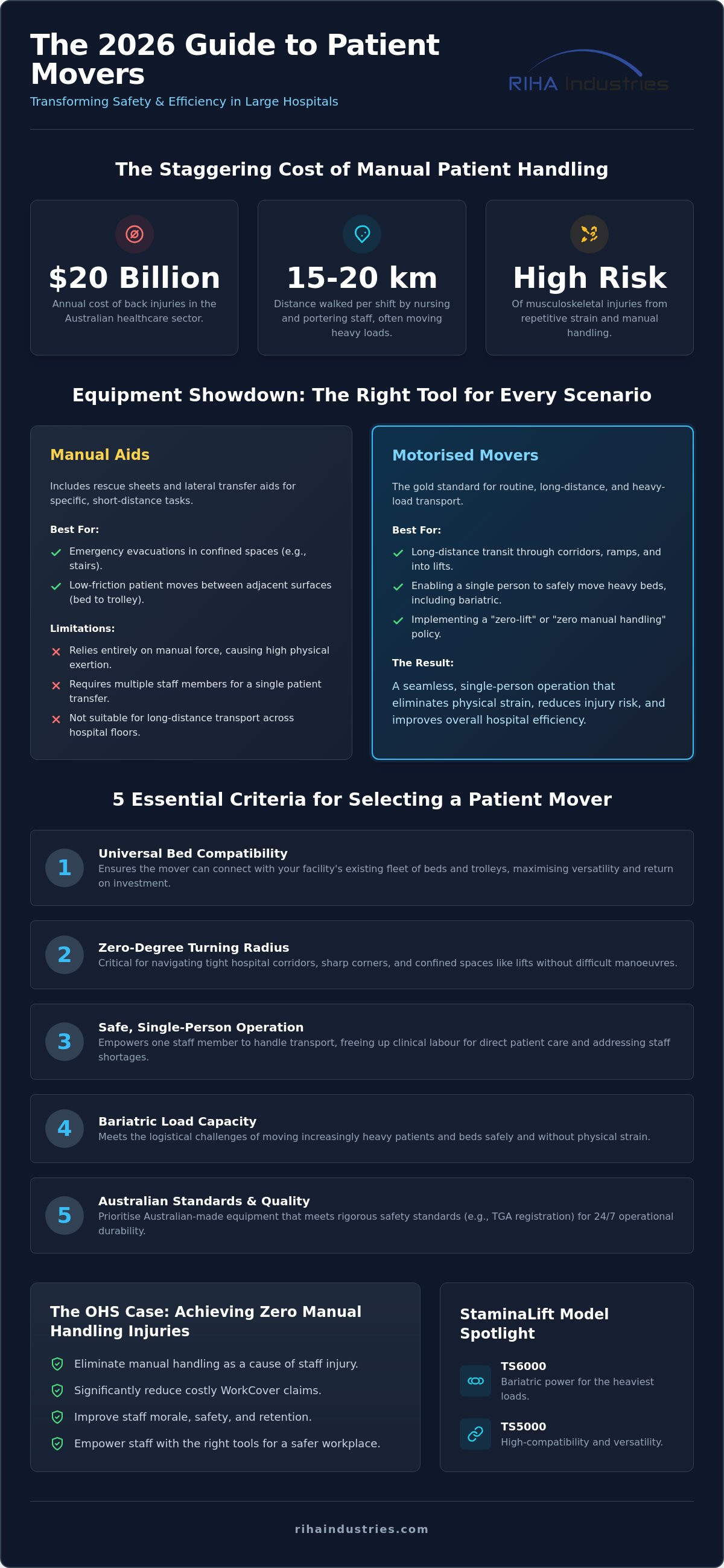
Did you know that the direct and indirect costs of back injuries in the healthcare sector are now estimated at $20 billion annually? For facility managers, this figure represents more than just a budget challenge; it reflects the immense physical strain on nursing and portering staff who often walk up to 15km per shift. You've likely seen the struggle of navigating heavy bariatric beds through tight corridors and understand the constant risk of musculoskeletal injuries that come with manual handling. Selecting a dedicated patient mover for large hospitals is the most effective way to transform these high-stakes transitions into a seamless, single-person operation.
We agree that your team's safety shouldn't be compromised by the daily demands of a busy ward. This 2026 guide will show you how to select a motorised system that offers universal compatibility with your existing equipment, ensuring your facility stays ahead of the latest safety and accessibility standards. We'll preview the technology that allows for single-user bed transfers and explain how to achieve a goal of zero manual handling injuries, providing your staff with the relief and empowerment they deserve.
Table of Contents
Defining the Patient Mover for Large-Scale Healthcare Facilities
Large-scale healthcare facilities operate as intricate, high-pressure ecosystems where every second and every movement counts. In these demanding environments, a patient mover is more than a single piece of equipment; it represents a comprehensive system designed to eliminate the physical burden of transporting people and beds across vast floorplates. To maintain a safe and efficient workflow, facility managers must distinguish between three primary categories of equipment. These include manual rescue sheets for emergency extrication, lateral transfer aids for surface-to-surface movement, and motorised bed movers for long-distance transport. Recognising the specific role of each tool is the first step toward creating a safer workplace.
The physical toll on staff in these settings is immense and often underestimated. Portering teams and nursing staff frequently walk between 15 and 20 kilometres during a single shift, often while pushing or pulling loads that exceed several hundred kilograms. This repetitive strain leads to high rates of fatigue and musculoskeletal injuries, which in turn drive up WorkCover claims and staff turnover. To combat this, modern Australian tertiary hospitals are moving toward "zero-lift" environments. This standard dictates that no staff member should be required to manually lift or pull a patient or a bed, instead relying on mechanical assistance to perform the heavy labour.
Manual vs. Motorised: When to Use Which?
While a motorised patient mover for large hospitals is the gold standard for long-distance transit, manual tools still have a place in clinical practice. Manual rescue sheets, or soft movers, are essential for rapid emergency evacuations in confined spaces where mechanical access is restricted. For moving patients between adjacent surfaces, such as from an imaging table to a trolley, air-assisted devices provide a low-friction solution that protects the patient's skin and the carer's spine. However, for routine ward transfers, motorised solutions are superior. These various Patient lift technologies ensure that staff are never forced to rely on raw physical strength to maintain hospital throughput.
The Scale Challenge in Tertiary Hospitals
The sheer size of modern hospitals presents unique ergonomic hurdles. Navigating long corridors, ascending ramps, and entering standard elevators with heavy equipment creates a high-risk environment for injuries. The increasing volume of bariatric patients further complicates these logistics, as traditional manual portering becomes nearly impossible. Implementing a motorised patient mover for large hospitals allows for a single-person operation, which is critical for managing current staff shortages. By empowering one staff member to safely move a heavy bed without assistance, hospitals can reallocate clinical labour to direct patient care while ensuring that heavy loads no longer result in long-term physical injury for the workforce. For more complex facility logistics, such as the relocation of heavy diagnostic plant or medical machinery, specialists like Silver Knight Haulage & Machineries Ltd provide the expert support needed for safe and efficient large-scale equipment movement.
Comparing Patient Mover Technologies: A Roundup for 2026
Choosing the most effective patient mover for large hospitals requires a nuanced understanding of how different technologies address specific clinical needs. While some tools excel in emergency evacuations, others are designed for the high-frequency lateral transfers seen in radiology or the long-distance portering tasks that span entire hospital campuses. For procurement teams, prioritising FDA registration and Australian-made quality ensures that the equipment meets rigorous safety standards while providing the durability needed for 24/7 operations. These technological choices form a vital component of modern hospital porter equipment strategies, directly impacting both staff retention and patient outcomes.
Soft Patient Movers and Rescue Sheets
Soft patient movers and rescue sheets are indispensable during emergency scenarios where traditional beds or trolleys cannot go. These tools are specifically designed for confined spaces, stairwells, and rapid evacuations. Typically constructed from fluid-impervious materials with reinforced handles, they allow a team to move a patient manually when mechanical options are unavailable. However, they possess significant limitations. Because they rely entirely on manual force, they require multiple staff members and involve considerable physical exertion, which increases the risk of acute injury. They are a necessary backup, but they shouldn't be the primary patient mover for large hospitals during routine daily operations.
Air-Assisted Lateral Transfer Systems
For transfers between a bed and a diagnostic table, air-assisted systems offer a sophisticated solution that prioritises patient comfort and skin integrity. These devices use a thin cushion of air to virtually eliminate friction, allowing carers to slide a patient across surfaces with minimal effort. This technology is particularly effective in surgical environments, where it helps facilities align with AORN standards and Safe Patient Handling and Mobility (SPHM) guidelines. By reducing the force required for lateral moves, these systems mitigate the risk of skin shearing for the patient and lumbar strain for the clinical team.
Motorised Bed Movers and Tugs
Motorised bed movers represent the gold standard for large-scale facilities, offering the most significant reduction in physical burden. Solutions like the StaminaLift and Easi series are engineered to handle the heaviest loads with precision. These units feature 360-degree turning circles and intuitive joystick controls, allowing a single operator to navigate complex corridors with ease. The StaminaLift Transfer System 6000, for instance, is capable of moving up to 900kg and can ascend 7-degree inclines without requiring manual pushing. For daily portering and ward transfers, these motorised systems provide the ultimate balance of safety and operational speed. You may find that integrating such technology into your facility's hospital porter equipment plan is the most effective way to eliminate manual handling risks entirely.
5 Essential Selection Criteria for Large Hospitals
Selecting the right patient mover for large hospitals involves more than just comparing motor specifications. It requires a strategic evaluation of how a single piece of equipment can bridge the gap between complex mechanical requirements and the daily physical reality of your staff. A well-chosen system doesn't just move a bed; it empowers a single porter to navigate a high-pressure environment with total confidence. To achieve this level of operational excellence, facility managers should prioritise five critical performance areas that ensure long-term reliability and staff safety.
Universal Compatibility: The device must connect seamlessly to at least 95% of your existing bed fleet, including major brands like Hillrom and Stryker. The StaminaLift TS5000 is a prime example of this versatility.
Manoeuvrability in Confined Spaces: Look for a zero-degree or 360-degree turning radius. This allows operators to navigate tight corners and standard elevators without the need for multi-point turns.
Battery Life and Charging: Full-shift reliability is non-negotiable. Systems featuring retractable charging cables and lithium battery upgrades ensure the mover is always ready when needed.
Integrated Safety Features: Modern units must include automatic braking, emergency releases, and safety lockouts to protect both the operator and the patient during transit.
Staff Ergonomics: Prioritise hands-free connection mechanisms. Eliminating the need for bending, reaching, or manual strapping is the most effective way to prevent the repetitive strain injuries often highlighted in OSHA safe patient handling programs.
Compatibility and the "One-Device" Goal
Large facilities often struggle with a fragmented fleet of beds from various manufacturers such as Hillrom and Stryker. This variety typically forces hospitals to purchase multiple specialised movers, which complicates training and maintenance. We recommend seeking a solution that can standardise your transport processes. Patented jaw systems solve this compatibility gap by adjusting to different frame types automatically. This "one-device" approach simplifies your fleet management and ensures that a patient mover for large hospitals is always compatible with the bed at hand, regardless of the ward or department.
Bariatric Capacity and Incline Performance
The increasing volume of bariatric patients presents a significant logistical challenge that standard equipment often cannot meet. Large hospitals require at least one high-capacity mover, such as the StaminaLift Transfer System 6000, which is specifically engineered to handle loads up to 900kg. Performance on ramps and non-level flooring is just as critical as raw weight capacity. Ensure the mover can maintain controlled speeds on 7-degree inclines without requiring manual assistance. Additionally, the unit should be compact enough to fit underneath the bed frame while in use. This space-saving design is essential for ensuring the entire assembly fits safely into standard hospital lifts without exceeding size constraints.
The OHS Case: Reducing Workplace Injuries to Zero
Transitioning from manual bed handling to mechanical assistance is no longer just a recommendation; it's a legal and ethical mandate for modern healthcare providers. The physical demand of moving heavy beds and bariatric patients places an unsustainable burden on staff, leading to a high incidence of musculoskeletal disorders. By implementing a dedicated patient mover for large hospitals, facility managers can align their operations with the "No Lift" guidelines set by global safety bodies like OSHA and NIOSH. This shift doesn't just protect the organisation from liability; it also highlights the importance of safe external patient care, where services like RN MEDflights offer clinical support for non-emergency international transfers on commercial airlines. Ultimately, these measures create a culture of safety where staff feel protected and valued, directly impacting long-term retention and morale.
The financial burden of manual handling injuries extends far beyond initial medical costs. Hidden expenses such as WorkCover claims, which average approximately $14,100 per incident, combined with the high cost of recruiting and training replacement nurses, can devastate a facility's budget. When you consider that replacing a single nurse can cost between $27,000 and $103,000, the investment in preventative technology becomes a clear fiscal priority. Motorised movers eliminate the peak forces required to initiate movement, ensuring that the physical "red zone" of manual pushing is entirely removed from the daily workflow.
Evidence-Based Safety Outcomes
Real-world data consistently demonstrates the transformative impact of mechanical assistance. In one large South Australian hospital, the introduction of StaminaLift patient movers saw annual injuries related to bed movement drop from 20 incidents to zero within just two years. This achievement is particularly significant for staff nearing retirement or those with existing physical limitations, as it allows them to continue their roles without the fear of career-ending strain. By calculating the total reduction in injury-related downtime and compensation premiums, healthcare facilities typically find that the return on investment for these systems is realised through significant operational savings within the first 12 to 18 months.
WHS Compliance and Risk Mitigation
Proactive risk management is essential for pre-empting manual handling audits and maintaining Work Health and Safety (WHS) compliance. Motorised equipment ensures that your facility meets the highest standards of ergonomic care, providing a documented solution to known workplace hazards. This commitment to safety is mirrored in other sectors, as seen with the specialised requirements for patient transport equipment for aged care, where mobility challenges are equally acute. Comprehensive training and certification programs ensure that every team member can operate a patient mover for large hospitals with precision, further reducing the risk of accidental injury during complex transfers. To begin your journey toward a safer, injury-free workplace, you can view our full range of compliant transport solutions at RIHA Industries.
Implementing the Right Solution: The RIHA Industries Range
Selecting the right patient mover for large hospitals is the final step in a successful safety strategy. RIHA Industries has developed the StaminaLift series to address the diverse needs of modern healthcare, from routine ward portering to high-capacity bariatric transfers. These systems aren't just tools; they're engineered solutions that empower your staff and protect your facility's operational efficiency. Alongside our flagship models, the StaminaLift 2100 Bed Mover continues to be a reliable choice for facilities requiring maximum manoeuvrability and hands-free connection in tighter spaces.
StaminaLift TS5000: The Universal Workhorse
The StaminaLift Transfer System 5000 is our flagship model, designed to be the universal workhorse of any large hospital. It achieves 95% compatibility with global hospital bed brands, allowing your team to standardise their transport processes with a single device. Its intuitive joystick control and 360-degree manoeuvrability make navigating through crowded corridors and standard elevators effortless. For a detailed look at how this system fits into your facility, refer to our StaminaLift Transfer System 5000 Buying Guide. This model ensures that no matter the bed type, your staff remain protected from the risks of manual handling.
TS6000 for Bariatric and Acute Care
When handling the most demanding acute care scenarios, the StaminaLift Transfer System 6000 provides the necessary power and control. It features a 900kg push and pull capacity, specifically engineered to move heavy bariatric beds safely. This model excels where others struggle, maintaining steady traction while navigating 7-degree inclines under a full load. It's a critical asset for hospitals that prioritise safety in their bariatric wards, ensuring that even the heaviest transitions remain a controlled, single-person operation. This level of mechanical advantage is essential for meeting the modern standards of bariatric care.
Easi series for Logistics and Facilities Management
While bed transfers are a primary concern, the logistical efficiency of a facility also depends on the movement of linen, meals, and medical equipment. The Easi Rider and Easi Mover tugs are designed to streamline these essential services. The Easi Rider, with its impressive 1500kg towing capacity, allows logistical staff to move multiple trolleys at once, reducing physical fatigue and increasing throughput. These tugs integrate seamlessly into the daily operations of a large facility, ensuring that heavy logistical loads don't result in staff injury. To see these solutions in action, you can enquire about a hands-on demonstration for your facility.
Reliability is the cornerstone of our partnership with healthcare providers. Beyond providing world-class equipment, RIHA Industries offers comprehensive preventative maintenance and global parts support to ensure your fleet remains in peak condition. By choosing a patient mover for large hospitals from our range, you're investing in a long-term solution that prioritises the well-being of your staff and the safety of your patients. Our commitment to technical excellence ensures that your facility stays ahead of regulatory requirements while maintaining a truly injury-free workplace.
Securing a Safer Future for Your Healthcare Team
The transition to a motorised environment is a fundamental necessity for protecting your workforce and streamlining hospital operations. By prioritising universal compatibility and high-capacity bariatric performance, you can ensure that every bed transfer becomes a safe, single-person task. Integrating the right patient mover for large hospitals doesn't just reduce the immediate risk of injury; it fosters a culture of empowerment and reliability that benefits staff and patients alike.
As an FDA-registered manufacturer and an awarded Top 10 Mobility Aids Provider for 2024, we're dedicated to delivering Australian-made quality that stands the test of time. Our commitment to your facility's success includes 24-hour parts shipping to ensure your fleet remains operational when it matters most. Take the first step toward achieving zero manual handling injuries by seeing our technology in action. Book a hands-on demonstration at your hospital today and discover how thoughtful engineering can transform your daily workflows into a safer, more efficient experience.
Frequently Asked Questions
What is the difference between a patient mover and a bed mover?
A patient mover is a broad term that includes various devices for transferring individuals, such as lateral aids or rescue sheets, whereas a bed mover specifically refers to motorised tugs designed to transport a patient while they remain in their hospital bed. In many tertiary facilities, a motorised patient mover for large hospitals is the preferred choice for long-distance portering. This technology handles the combined weight of the equipment and the patient, eliminating the need for manual pushing during routine ward transfers.
Will a motorised patient mover fit in standard hospital elevators?
Yes, motorised movers are specifically engineered to fit within standard hospital elevators while connected to a bed. The compact design allows the unit to slide partially under the bed frame, which ensures the total length of the assembly remains within the internal dimensions of most lift cars. This space-saving feature is vital for navigating the vertical logistics of a busy multi-storey facility without causing transport delays or blocking access for others.
How many staff members are required to operate a motorised bed mover?
Only one staff member is required to operate a motorised bed mover safely. The primary goal of this technology is to transform what was once a two-person or three-person manual task into a seamless, single-operator procedure. By using an intuitive joystick-controlled system, a single porter or nurse can manage heavy loads with total precision. This helps hospitals manage staff shortages effectively by reallocating clinical resources to direct patient care.
Are these movers compatible with bariatric beds?
Yes, specific models in the range are built to handle the unique challenges of bariatric transport. The StaminaLift Transfer System 6000 is engineered with a safe working load of 600kg and can push or pull up to 900kg, making it ideal for the heaviest bariatric and acute care beds. This ensures that even the most complex, high-weight transitions remain safe for both the patient and the operator without requiring additional manual assistance.
Can one patient mover be used for different brands of hospital beds?
Yes, universal compatibility is a core feature of our advanced transport solutions. Using a patented jaw system, a single patient mover for large hospitals like the StaminaLift TS5000 can connect to over 95% of global hospital bed brands. This allows facilities to standardise their transport processes across the entire fleet. It doesn't matter if you're using Hillrom, Stryker, or other leading manufacturers; the mover adjusts to ensure a secure and stable connection every time.
What maintenance is required for motorised patient movers?
Regular preventative maintenance is essential to ensure the longevity and safety of your motorised equipment. This typically includes periodic battery health checks, software updates, and inspections of the mechanical connection points. RIHA Industries provides dedicated preventative maintenance and repair services to help facilities keep their equipment in peak condition. Staying on top of these checks helps you avoid unplanned downtime and ensures the equipment is always ready for a shift.
Is training provided for the staff using the equipment?
Comprehensive training is always provided to ensure that your team can operate the equipment safely and effectively. We believe that proper education is the foundation of an injury-free workplace. Our training programs cover basic joystick operation, connection procedures, and techniques for navigating tight corridors or ramps. This ensures every staff member feels confident and empowered to use the system, which significantly improves the adoption rate of the technology.
Are RIHA Industries products FDA-registered?
Yes, RIHA Industries is an FDA-registered manufacturer. This registration confirms that our products meet stringent international standards for medical device safety and quality management. Choosing FDA-registered equipment provides hospital procurement teams with the assurance that they're investing in reliable, world-class technology. It reflects our commitment to being a stable, long-term partner for healthcare providers who refuse to compromise on the safety of their staff or patients.


