
StaminaLift 2100 Technical Specs: Australian Hospital Guide
- Aug 6
- 11 min read
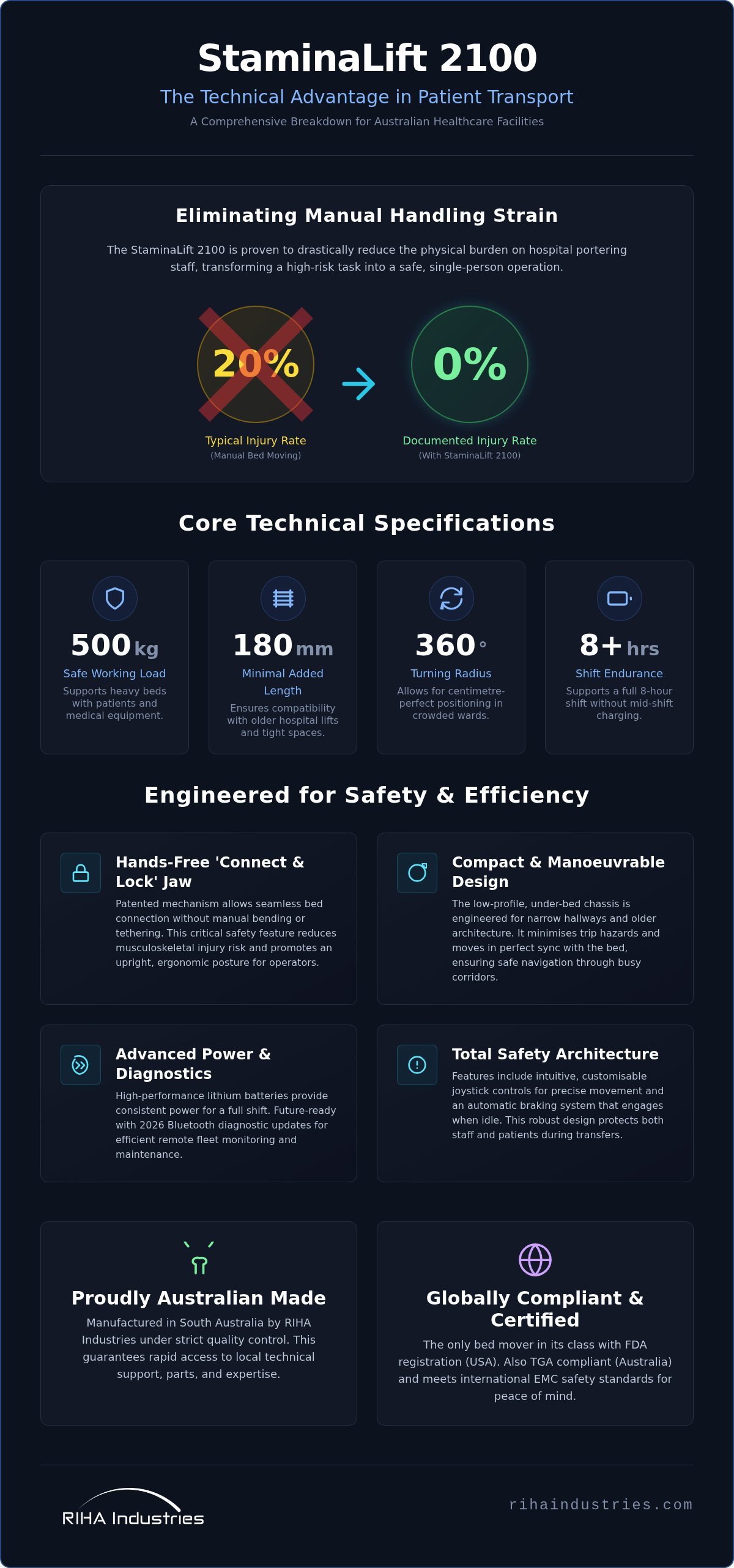
Did you know that hospital portering staff can walk up to 20 kilometres in a single shift, with a huge portion of that time spent straining to push heavy beds through cramped corridors? It's a demanding reality that often leads to avoidable manual handling injuries and long-term physical fatigue. We understand that your priority is protecting your team while ensuring patient transfers remain efficient and safe. By examining the StaminaLift 2100 technical specifications, you can see exactly how this Australian-made powerhouse has been proven to reduce bed-moving injuries from 20% to zero in documented clinical settings.
This article provides a comprehensive technical breakdown of the StaminaLift 2100 to help you verify lift compatibility and operational endurance for your facility. We'll explore the unit's 500 kg safe working load, its 360-degree turning radius for tight ward environments, and the latest 2026 Bluetooth diagnostic updates for remote fleet monitoring. From lithium battery performance to WHS compliance, this guide offers the clarity needed to integrate this reliable ally into your hospital's daily workflow.
Table of Contents
StaminaLift 2100 Overview: Engineered for Australian Healthcare Wards
Hospital environments in Australia and Hong Kong present unique challenges, from narrow corridors to varied bed frame designs. The StaminaLift 2100 serves as a motorised solution specifically engineered to address these hurdles. It's built for single-person operation, which transforms a task that previously required multiple staff members into a safe, solo endeavour. By focusing on the StaminaLift 2100 technical specifications, facility managers can ensure their equipment meets the rigorous demands of modern clinical settings while effectively eliminating the muscular strain associated with manual bed transport.
A standout feature of this unit is the patented hands-free 'connect and lock' jaw mechanism. Unlike traditional patient lift technology that might require manual bending or complex tethering, this system allows for a seamless connection to the bed frame without the operator needing to touch the bed or the mover's attachment point. This hands-free approach isn't just about convenience; it's a critical safety feature that significantly reduces the risk of musculoskeletal injuries during the initial coupling phase. It allows porters to maintain an upright, ergonomic posture at all times, which is vital for long-term workplace health and safety.
Safe Working Load (SWL) and Capacity
The StaminaLift 2100 is rated for a 500kg Safe Working Load (SWL). This capacity is intentionally chosen to accommodate standard ward beds, even when fully occupied by patients and additional medical equipment. Whether you're navigating the smooth vinyl of a theatre wing or the slightly uneven transitions of an older ward, the unit provides consistent torque and traction. It's engineered to push and pull these heavy loads effortlessly, ensuring that performance doesn't degrade when the mover reaches its maximum rated capacity on level surfaces.
FDA Registration and Global Compliance
Safety standards in healthcare are non-negotiable, and the StaminaLift 2100 stands out as the only bed mover in its class to achieve FDA registration in the United States. This registration, alongside TGA compliance in Australia, underscores the unit's reliability and safety. Every machine is manufactured in South Australia by RIHA Industries under strict quality control protocols, ensuring it meets international healthcare safety and electromagnetic compatibility (EMC) standards. This Australian-made certification isn't just a badge of pride; it guarantees that the StaminaLift 2100 technical specifications adhere to some of the most stringent engineering requirements in the global medical market, providing peace of mind for procurement officers and clinical staff alike.
Physical Dimensions and Manoeuvrability: Navigating Tight Hospital Corridors
One of the most persistent challenges in Australian healthcare facilities is the physical constraint of older building architecture. Narrow hallways and compact elevators often make powered assistance feel like a luxury that won't fit. However, the StaminaLift 2100 technical specifications reveal a machine specifically engineered to overcome these spatial barriers. By utilising a compact, under-bed design, the 2100 ensures that the motorised unit stays primarily within the existing footprint of the bed frame. Once the connection is secured, the system adds only 180mm to 200mm to the total bed length, which is a critical detail for facility managers measuring lift clearances.
This minimal extension allows the bed and mover to operate seamlessly within standard hospital lifts without the need to remove footboards or rearrange equipment. Beyond just fitting into tight spaces, the sleek, low-profile chassis serves as a vital safety feature. By housing the drive components close to the floor and beneath the bed, the design significantly reduces tripping hazards for porters and clinical staff. It creates a streamlined profile that moves in total synchronisation with the bed, making it much safer to navigate busy corridors where staff, patients, and medical carts are frequently in motion.
The 360-Degree Turning Radius Advantage
Precision is paramount when moving a patient into a small diagnostic suite or a crowded multi-share ward. The StaminaLift 2100 provides a true 360-degree turning circle, allowing the operator to pivot the bed on its own axis. This agility is powered by a central drive wheel and an intuitive joystick interface that enables centimetre-perfect positioning. Porters can guide heavy beds through doorways and around sharp corners with a level of control that manual pushing simply cannot match. To see how this agility fits into your specific workflow, you may wish to review the full StaminaLift range for detailed model comparisons.
Clearance and Gradient Performance
Hospital floor plans are rarely perfectly flat, especially when transitioning between different building wings or levels. To remain compliant with the Hazardous Manual Tasks Code of Practice, equipment must be able to handle inclines without requiring extra physical exertion from the staff. The 2100 is built with a chassis designed to clear common floor obstacles while maintaining constant traction on varied surfaces. The StaminaLift 2100 can safely navigate ramps with inclines of up to 7 degrees with a single operator while carrying its maximum rated load.
Power Systems, Battery Specifications, and Diagnostics
Reliability in a high-pressure clinical environment depends on consistent power delivery. If a bed mover fails mid-shift, the physical burden immediately returns to the portering staff, increasing the risk of fatigue and injury. The StaminaLift 2100 technical specifications include a high-capacity battery system engineered to support a full 8-hour shift, covering the extensive distances porters travel daily. To simplify the workflow, RIHA Industries integrated a charging system with a retractable cable. This 'plug-and-go' design means staff don't have to hunt for loose cables; they simply pull the cord from the unit and connect it to a standard wall outlet between tasks.
Supporting these power systems are maintenance-free drive wheels. These components are specifically designed for durability on common hospital surfaces like linoleum and tiles, providing quiet operation at a mere 65 dB. This ensures that while the 2100 is a powerful industrial tool, it remains discreet enough for use in quiet patient wards during night shifts or in recovery areas where noise minimisation is essential for patient comfort.
Battery Chemistry and Charging Cycles
While standard configurations have long been the industry benchmark, 2026 marks a significant shift with the rollout of lithium battery upgrades across the product range. These advanced power cells offer a 20% performance boost and significantly faster charging times, ensuring the unit is ready for back-to-back shifts in busy acute care settings. This evolution in power management is a key component in the effort to reduce patient-handling injuries by ensuring mechanical assistance is always available when needed. Intelligent charging software also prevents overcharging, which protects the battery's chemical integrity and extends its operational lifespan.
Bluetooth Diagnostics and Fleet Management
A primary gap in many hospital fleet management strategies is the lack of visibility into equipment health. The current version of the 2100 addresses this through new Bluetooth diagnostic updates. This wireless connectivity allows maintenance teams to monitor battery cycles and motor health in real-time using a mobile device, often without taking the machine out of service. By tracking usage history, facility managers can identify high-traffic operational peaks or pinpoint specific areas where staff might benefit from additional training on the equipment. This proactive data ensures that the fleet remains in peak condition, reducing unexpected downtime and simplifying the scheduling of preventative maintenance.
Safety Architecture and Operational Controls
The safety of both the operator and the patient serves as the central pillar of the StaminaLift 2100 design. It's not simply about moving weight; it's about doing so with absolute precision and control. Programmable joystick controls are a core component of the StaminaLift 2100 technical specifications. They allow facility managers to customise speed and acceleration settings to match the unique requirements of their wards. An automatic braking system provides an essential safety net; the moment an operator releases the joystick, the unit stops immediately. This prevents the momentum of a heavy bed from causing accidents in crowded thoroughfares.
Security and fail-safe mechanisms are equally critical in a high-traffic hospital environment. To maintain safety in public corridors, the unit features key-only operation and safety lockouts that prevent unauthorised personnel from using the machinery. In the rare event of a power interruption, dedicated emergency release mechanisms for both the jaws and the brakes ensure the bed can be transitioned to manual operation quickly. These features provide porters with the confidence that they can handle any situation, knowing the equipment is designed with multiple layers of protection.
Drive Programmes for Varied Skill Levels
Staff training is simplified through the inclusion of three distinct drive programmes: Beginner, Intermediate, and Expert. Each setting adjusts the torque and joystick sensitivity to suit the operator's experience level. The Beginner mode offers a dampened response that helps new staff build confidence without the risk of accidental wall or door frame collisions. As porters become more proficient, they can graduate to higher settings for more responsive handling. This tiered approach ensures that the StaminaLift 2100 technical specifications support a safe learning curve for all healthcare workers.
WHS Compliance and Injury Prevention
The primary goal of implementing this technology is the total elimination of manual handling risks. Documented trials in South Australian hospitals have shown that the implementation of the StaminaLift 2100 can reduce bed-moving injuries from 20% to zero. By providing motorised assistance, the unit eliminates the need for 'push-off' force, which is the leading cause of nursing back strain during patient transfers. You can discover more about how to reduce nurse back injuries by reviewing our latest handling criteria. To ensure your facility meets its duty of care, you can contact our team to discuss WHS compliance for your specific ward layout.
Integration and Maintenance: Support for the 2100 Series
The StaminaLift 2100 is engineered for longevity, serving as a stable, long-term asset for healthcare facilities across the country. Because RIHA Industries manufactures critical parts in-house in South Australia, hospitals aren't left waiting for international shipments that might delay essential repairs. This local production cycle allows for a 24-hour global shipping guarantee on replacement parts, which is vital for minimising equipment downtime in high-volume acute care wards. When reviewing the StaminaLift 2100 technical specifications, it's clear that the machine is built for the rigours of the clinical environment, featuring high-grade stainless steel components that facilitate easy cleaning and strict infection control.
Integration goes beyond the mover itself. The 2100 is designed to be compatible with a wide range of essential accessories, including oxygen bottle holders and IV poles. This ensures that the portering staff can transport the entire patient setup in a single, motorised movement without needing to detach life-support equipment or carry heavy canisters manually. It's this thoughtful engineering that transforms a simple bed mover into a comprehensive transfer system that supports the well-being of the entire healthcare team.
Maintenance and Technical Support
To ensure your equipment remains in peak condition, we provide several layers of technical support. Facilities can access an online 3D viewer that provides step-by-step guidance for in-house servicing, allowing your engineering team to perform routine checks with precision. For more complex requirements, we offer national service coverage across Australia for specialised preventative maintenance. We recommend that facility managers read our hospital bed mover repair service guide to establish best practices for fleet longevity and operational safety.
Choosing the 2100 vs. the StaminaLift 5000
Selecting the right model depends on your facility's specific infrastructure and bed fleet. The 2100 remains the preferred choice for hospitals that predominantly use Australian-made bed frames with round or square tube frames ranging from 20mm to 40mm. It's particularly ideal for older facilities with narrower lift infrastructure, where every millimetre of clearance counts. While the 2100 handles up to 500kg, facilities requiring higher weight capacities or broader compatibility with international bed brands should view the StaminaLift Transfer System 5000. Ultimately, the StaminaLift 2100 technical specifications define it as the most agile and optimised solution for the unique architectural challenges found in many local healthcare wards.
Securing the Future of Your Portering Team
The StaminaLift 2100 represents a significant leap forward in healthcare ergonomics, combining precision engineering with a deep commitment to staff well-being. By reviewing the StaminaLift 2100 technical specifications, it becomes clear that this unit isn't just a bed mover; it's a protective partner for your portering team. We've explored how its compact footprint solves the challenge of older hospital lifts, while the patented hands-free connection eliminates the primary causes of musculoskeletal strain.
Choosing an Australian-made and owned solution ensures you have access to local technical expertise and rapid parts support from an FDA-approved manufacturer. The real-world impact is undeniable, with South Australian hospital case studies reporting that injury rates dropped to zero following the implementation of these units. Protecting your staff from the physical burden of heavy bed transfers is a vital investment in the long-term health of your facility.
To see how this technology can transform your daily operations, you can request a technical data sheet or a site demonstration of the StaminaLift 2100 today. We look forward to helping you create a safer, more efficient environment for every member of your team.
Frequently Asked Questions
What is the maximum weight capacity of the StaminaLift 2100?
The StaminaLift 2100 features a Safe Working Load (SWL) of 500 kg, which is more than sufficient for standard ward beds and clinical equipment. This capacity is specifically engineered to handle the combined weight of the bed, the patient, and any attached life-support devices. By providing this robust power, the unit ensures that portering staff can move heavy loads across varied hospital floor surfaces without risking musculoskeletal strain or overexertion.
Is the StaminaLift 2100 compatible with all hospital beds?
This model is specifically optimised for Australian and Hong Kong hospital beds that feature round or square tube frames ranging from 20mm to 40mm. While it offers exceptional performance for these specific local fleets, newer models like the StaminaLift Transfer System 5000 or 6000 are available for facilities requiring broader compatibility with international bed brands or complex stretcher designs. This ensures every facility finds a solution that integrates perfectly with their existing equipment.
Does the StaminaLift 2100 fit into standard hospital lifts?
Yes, the unit is designed to fit seamlessly into standard Australian hospital lifts by adding only 180mm to 200mm to the total bed length. This compact footprint is one of the most critical StaminaLift 2100 technical specifications for facilities with older architecture. It allows porters to navigate elevators without needing to remove footboards or rearrange equipment, maintaining efficiency during urgent patient transfers while protecting the machine from collision damage.
How long does the battery last on a single charge?
The integrated battery system is engineered to last for a full 8-hour shift under normal operating conditions. Healthcare workers often cover up to 20 km in a single shift, so the 2100 is built to match that endurance. For facilities requiring even higher performance, the current 2026 rollout includes optional lithium battery upgrades that provide a 20% boost in efficiency and significantly faster charging times between shifts to keep your fleet moving.
Is the StaminaLift 2100 FDA approved?
The StaminaLift 2100 is the only bed mover in its class to be FDA-registered in the United States. It also complies with TGA standards in Australia and meets stringent international healthcare safety and electromagnetic compatibility (EMC) requirements. This high level of regulatory compliance ensures that the equipment is safe for use in sensitive clinical environments where patient safety and device reliability are paramount for long-term operational success.
What safety features are included for emergency situations?
Safety is managed through multiple fail-safe systems, including an automatic braking system that engages the moment the joystick is released. In the event of a power failure or technical fault, the unit includes manual emergency release mechanisms for both the attachment jaws and the brakes. These features allow staff to transition the bed to manual mode quickly, ensuring patient transport is never compromised during an emergency or unexpected equipment downtime.
Can the 2100 be used on hospital ramps and inclines?
The unit is rated to safely navigate ramps and inclines of up to 7 degrees while carrying its maximum 500 kg load. This capability ensures that a single operator can move heavy equipment between different building levels or through older hospital wings without additional physical help. The central drive wheel provides the necessary traction and torque to maintain control and speed on these gradients, reducing the risk of runaway equipment accidents.
What is the difference between the 2100 and the TS5000 models?
The primary difference lies in their target environments and compatibility ranges. The 2100 is the original, compact choice for Australian-made beds and facilities with narrow lift infrastructure. In contrast, the StaminaLift Transfer System 5000 offers broader compatibility with international bed brands and higher weight capacities. Reviewing the StaminaLift 2100 technical specifications helps managers decide if the agility of the 2100 is the best fit for their specific ward layout and equipment fleet.


