StaminaLift 2100: Training Guide for Healthcare Staff
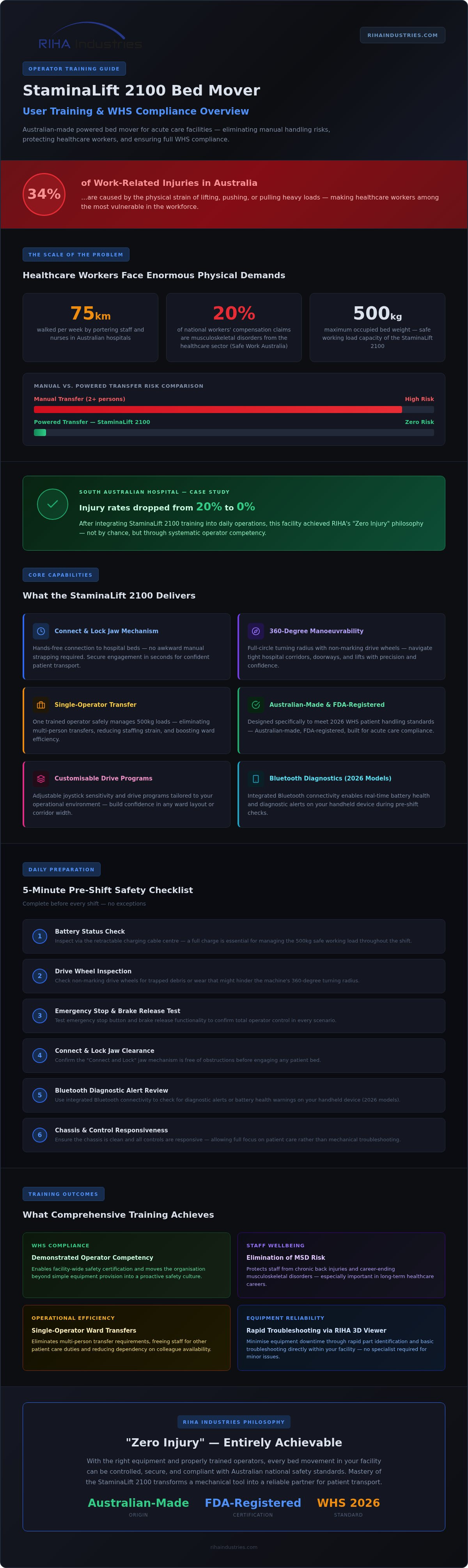
Did you know that 34% of work-related injuries in Australia are caused by the physical strain of lifting, pushing, or pulling heavy loads? In the high-pressure environment of an acute care facility, these statistics often translate into experienced staff sidelined by preventable musculoskeletal injuries. This is why comprehensive StaminaLift 2100 user training is more than just a compliance checkbox; it's a vital investment in your long-term health and operational success. You likely understand the physical toll of navigating a 500kg load through a crowded hospital corridor or the anxiety of a manual bed transfer in a tight lift.
It's a demanding task that requires more than just strength; it requires the right technology and the confidence to use it. We promise that by mastering this Australian-made bed mover, you'll eliminate manual handling risks entirely while moving patients with unprecedented speed and security. This guide provides a clear path to becoming a proficient operator, covering everything from the hands-free connection system to the precision of 360-degree manoeuvrability, ensuring you feel empowered every time you step onto the ward.
Table of Contents
The Importance of StaminaLift 2100 Training for WHS Compliance
In the fast-paced environment of an Australian hospital, portering staff and nurses often walk up to 75 kilometres per week. This isn't just about distance; it's about the cumulative strain of pushing and pulling heavy equipment across expansive floor plans. Musculoskeletal disorders (MSDs) remain a primary driver of workers' compensation claims in the healthcare sector, accounting for approximately 20% of the national total according to Safe Work Australia. The Importance of StaminaLift 2100 Training for WHS Compliance is evident when you consider these risks. Formal training ensures that every staff member understands how to transition from manual labour to precise, motorised control, effectively shielding them from the physical toll of their roles.
RIHA Industries focuses on a "Zero Injury" philosophy, a goal that is entirely achievable with the right equipment and knowledge. In a South Australian hospital case study, the implementation of the StaminaLift system saw injury rates plummet from 20% to zero. This shift wasn't accidental; it resulted from integrating StaminaLift 2100 user training into the facility's daily operations. When staff are competent, they move from being at risk to being empowered, turning a mechanical tool into a reliable partner for patient transport.
Reducing the Physical Burden on Healthcare Workers
Modern hospital beds are substantial pieces of engineering, often weighing up to 500kg when occupied by a patient. Manually moving such a load is a hazardous task that typically requires two or more people, often resulting in awkward postures and high-force exertion. The StaminaLift 2100 Bed Mover eliminates the need for these multi-person transfers. By providing motorised assistance, the machine handles the heavy lifting, allowing a single operator to navigate the ward safely. Adopting this ergonomic approach early in a career helps protect staff from the long-term wear and tear that often leads to chronic back pain and career-ending injuries.
Aligning with Australian Safety Standards
Compliance with Work Health and Safety (WHS) regulations is a legal necessity for Australian healthcare facilities. The 2100 is Australian-made and FDA-registered, designed specifically to meet the rigorous patient handling equipment selection criteria required in 2026. Effective StaminaLift 2100 user training ensures that operators can demonstrate competency, which is a key requirement for facility-wide safety certification. It moves the facility beyond simple equipment provision and into a proactive culture of safety where every bed movement is controlled, secure, and compliant with national standards.
Pre-Operational Checks and Ergonomic Setup
A successful shift in a high-pressure acute care environment begins with equipment readiness. Incorporating a five-minute daily routine into your workflow ensures the unit is primed for heavy transfers and minimises the risk of operational delays. This preparation is a cornerstone of effective StaminaLift 2100 user training, as it transitions the operator from a passive user to a proactive guardian of ward safety. Start by checking the battery status at the retractable charging cable centre; a full charge is essential for managing the 500kg safe working load throughout the day. Next, inspect the non-marking drive wheels for any trapped debris or signs of wear that might hinder the machine's signature 360-degree turning radius.
Engaging with the machine's physical condition daily prevents minor issues from escalating into service interruptions. Ensuring the chassis is clean and the controls are responsive allows you to focus entirely on patient care rather than mechanical troubleshooting. If you notice any irregularities during these initial checks, contacting RIHA Industries for preventative maintenance ensures your equipment remains a reliable asset for years to come.
The Daily Safety Checklist
Before engaging with a patient bed, you must verify that all safety systems are fully operational. Test the emergency stop button and the brake release functionality to ensure you have total control in every scenario. It's also vital to confirm the "Connect and Lock" jaw mechanism is clear of obstructions. For 2026 models, use the integrated Bluetooth connectivity to check for diagnostic alerts or battery health warnings on your handheld device. These Pre-Operational Checks and Ergonomic Setup procedures are designed to mitigate the risks associated with hazardous manual tasks before they even begin.
Ergonomics for the Operator
The StaminaLift 2100 is engineered to adapt to the human form, not the other way around. When setting up the machine, position the joystick so your wrist remains in a neutral, relaxed alignment. This simple adjustment prevents the repetitive strain injuries often associated with long-term equipment use. If you're facing a long-distance transfer across a large facility, deploy the fold-up ride-on platform to reduce foot fatigue. For shorter, precision movements in tight spaces, the unit can be easily adjusted for walk-behind operation. Tailoring the reach and height to your specific physical requirements ensures that StaminaLift 2100 user training results in a comfortable, fatigue-free experience.
Mastering the Hands-Free Connection and Steering
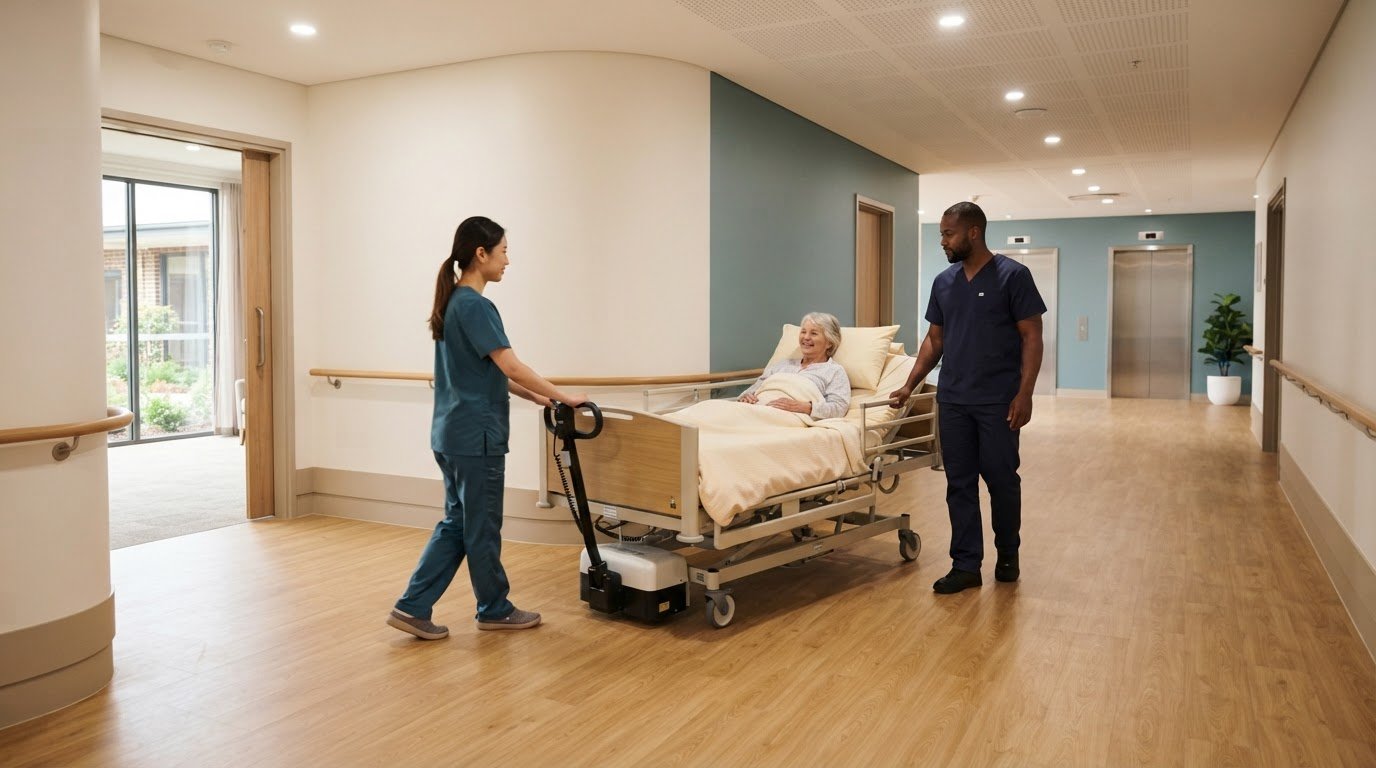
The "Connect and Lock" jaw mechanism is the defining feature of the StaminaLift 2100. It's an automated system that secures the machine to various bed frames without the need for manual strapping or physical intervention. During StaminaLift 2100 user training, mastering this connection is your first step toward a safer and more efficient workday. By eliminating the need to bend, kneel, or adopt awkward postures to secure a load, the hands-free advantage directly addresses the root causes of workplace strain. You simply drive the unit toward the bed, aligning the jaws with the castor wheels, and let the technology handle the physical connection.
This hands-free advantage isn't just about speed; it's about professional longevity and staff well-being. When you aren't forced to crouch under a bed frame or struggle with manual hooks, you maintain a neutral posture and significantly reduce the risk of acute injury. This automated approach ensures that the machine does the heavy lifting, allowing you to focus entirely on the patient's comfort and the path ahead. It's a shift from physical exertion to precision control, empowering you to manage 500kg loads with minimal effort.
The Secure Connection Sequence
To initiate a transfer, approach the bed at a slow, controlled pace. Use the fingertip controls to activate the jaw mechanism, ensuring they wrap securely around the castor housing. Before you begin the move, always confirm the visual lock indicator on the control panel. This verification step is a core component of StaminaLift 2100 user training, providing peace of mind that the connection is stable and secure. One of the most practical benefits of this system is its compact profile; the 2100 only adds between 180mm and 200mm to the total bed length. This minimal footprint is essential when entering standard hospital lifts or navigating crowded corridors where every millimetre of space is precious.
Precision Steering in Tight Spaces
The true power of this machine lies in its 360-degree turning radius. This capability allows you to rotate a bed within its own length, a feat that's virtually impossible with manual pushing. When you're manoeuvring busy hospital porter equipment through narrow doorways or around sharp theatre corners, use small, deliberate joystick movements. Implementing these advanced steering techniques is part of a broader commitment to Maintenance, Troubleshooting, and Certification within modern healthcare facilities. You'll need to account for the "swing" of the bed's far end when cornering. By leading the turn early and utilising the machine's pivot point, you can guide even the largest acute care beds through confined spaces with total confidence and zero physical exertion.
Advanced Drive Programs and Environmental Navigation
Every healthcare facility has unique layouts, from narrow corridors to steep ramps. Professional StaminaLift 2100 user training includes mastering the machine's internal software, which offers three distinct drive programs. These settings allow the machine to grow with the operator, ensuring that a trainee feels just as secure as a seasoned porter. Beyond skill levels, the machine is designed for the sensitive acoustics of a hospital. It operates at a quiet 65 dB, ensuring that patient recovery and rest remain undisturbed even during high-volume bed movements at night.
Selecting the Right Drive Program
The Beginner mode is specifically designed to dampen acceleration and braking, providing a forgiving learning curve for new staff. It's the ideal setting for those getting used to the machine's power and response times. As confidence grows, operators can transition to Intermediate or Expert modes, which increase joystick responsiveness for faster, more efficient transfers during peak periods. Switching between these programs is a simple, menu-driven process that can be performed between shifts. This flexibility allows a single unit to be safely shared across a diverse team with varying levels of experience. This level of customisation ensures that the machine never feels unpredictable, regardless of who is behind the controls.
Navigating Ramps, Lifts, and Different Floor Surfaces
Moving a 500kg load up a ramp requires more than just raw power; it requires controlled torque and reliable braking. The StaminaLift 2100 is engineered to maintain steady momentum on inclines of up to 7 degrees, preventing the bed from rolling back or surging forward unexpectedly. Entering and exiting standard hospital elevators is equally seamless, thanks to the unit's compact footprint and precise steering. When you transition from hard, polished floors to heavy-duty ward carpeting, the machine's drive system handles the change in rolling resistance without losing momentum. This ensures a smooth ride for the patient and a stress-free experience for the porter. If you're ready to upgrade your facility's transport standards and protect your staff, contact RIHA Industries to discuss a tailored implementation plan.
Maintenance, Troubleshooting, and Certification
Maintaining the operational integrity of your equipment is just as critical as mastering its daily use. A well-maintained machine is a safe machine. Staff should be equipped to identify common battery or connection alerts immediately to prevent shift disruptions. To facilitate this, the RIHA 3D viewer is available for in-house part identification, allowing your facility's technical team to visualise components for minor servicing or part replacement. Regular preventative maintenance isn't just about avoiding equipment downtime; it's a core component of OHS compliance that ensures the 500kg safe working load is always handled with absolute precision and security.
Troubleshooting and Bluetooth Diagnostics
The 2026 models provide real-time diagnostic feedback via integrated Bluetooth connectivity. This feature allows operators to interpret battery health or connection alerts directly on a handheld device before a shift even begins. If you encounter a rare total power failure, you must be competent in using the manual emergency jaw and brake release to move the unit safely. While basic checks are handled in-house, knowing when to call for a professional hospital bed mover repair service is essential for the long-term reliability of your fleet. RIHA Industries supports this through 24-hour shipping for parts, ensuring that your equipment remains on the ward where it's needed most.
Achieving Training Certification
Formal operator certification through RIHA Industries validates that your portering team has reached a gold standard of competency. A successful assessment covers the entire spectrum of StaminaLift 2100 user training, from pre-operational safety checks to advanced precision steering in high-pressure acute care zones. Because healthcare environments are dynamic and new staff frequently join the team, periodic refresher courses are a best practice for maintaining a zero-injury workplace. Mastered skills on the 2100 also provide a solid foundation for transitioning to more specialised equipment. This includes the StaminaLift Transfer System 5000 for universal bed compatibility or the bariatric StaminaLift Transfer System 6000 for higher weight requirements. This structured certification path ensures your staff remain the most capable and protected professionals in the field.
Empowering Your Team for a Safer Healthcare Future
Mastering the StaminaLift 2100 is about more than learning new controls; it's about fundamentally changing the way your facility approaches staff safety and operational efficiency. By integrating comprehensive StaminaLift 2100 user training, you move closer to a zero-injury workplace while ensuring that heavy transfers are handled with precision. From the hands-free "Connect and Lock" system to the advanced drive programs, this technology allows your staff to navigate tight corridors and inclines without the physical burden of manual handling. You're not just moving beds; you're protecting the professional longevity of your entire team.
As an official Australian-made solution used by major metropolitan and rural hospitals, we provide more than just equipment. We offer a long-term partnership backed by a guaranteed response to support enquiries within 24 hours. This ensures that your facility remains operational and your staff feel supported at every turn.
Book a hands-on training session or demonstration for your team today to see how we can help you protect your most valuable asset: your people. We look forward to helping you create a safer, more efficient environment for both your staff and your patients.
Frequently Asked Questions
How long does it take to train a new staff member on the StaminaLift 2100?
Most staff members can achieve basic operational competency within a single shift. However, a comprehensive StaminaLift 2100 user training program typically involves a combination of theoretical knowledge and practical, hands-on demonstration. This ensures porters and nurses are fully comfortable with the "Connect and Lock" jaw mechanism and precise steering before they move patients. Mastery of advanced navigation in high-pressure acute care environments usually follows after several successful transfers under supervision.
What is the maximum weight the StaminaLift 2100 can safely move?
The StaminaLift 2100 is engineered with a safe working load (SWL) of 500kg. This capacity is specifically designed to handle standard hospital beds even when occupied by a patient and additional medical equipment. For facilities requiring higher weight limits, we offer the TS6000 model, which can transport nearly one ton. It's essential that staff understand these limits to ensure the machine maintains its 360-degree manoeuvrability and braking efficiency during every patient transfer.
Can the StaminaLift 2100 be used on steep hospital ramps?
Yes, the unit is rated to navigate inclines of up to 7 degrees while under a full 500kg load. The advanced control software ensures that the machine maintains steady torque and controlled braking on these gradients, preventing any unexpected surging or rolling. During your initial StaminaLift 2100 user training, we recommend you practise ramp navigation to build confidence in managing the machine's power and momentum across different floor levels and surfaces throughout the facility.
Does the 2100 Bed Mover require a special license to operate in Australia?
No formal government driver's license is required to operate the 2100 Bed Mover in Australia. However, under Australian WHS regulations, employers must ensure that all staff are properly trained and deemed competent before using powered equipment. RIHA Industries provides formal operator certification that serves as proof of competency. This internal certification ensures that your facility remains compliant with workplace safety standards while protecting staff from the risks associated with hazardous manual tasks.
What should I do if the battery runs flat while moving a patient bed?
If the battery runs flat during operation, you can utilise the manual emergency jaw and brake release systems. These features allow you to disconnect the machine from the bed and move the unit manually to a charging station. To prevent this scenario, the 2100 features Bluetooth connectivity for real-time battery monitoring. Staff are encouraged to check the battery status at the retractable charging cable centre before starting a shift to ensure uninterrupted service.
Is the StaminaLift 2100 compatible with bariatric hospital beds?
The StaminaLift 2100 is ideally suited for standard Australian-manufactured beds and stretchers with a total weight of up to 500kg. While it can connect to many frames, it isn't specifically designed for heavy-duty bariatric loads. For patients and beds exceeding 500kg, we recommend the StaminaLift Transfer System 6000. The TS6000 is our dedicated bariatric model, capable of moving nearly one ton of weight safely through acute care environments and up steep ramps.
How often should staff undergo refresher training for bed movers?
We recommend that staff undergo refresher training at least every 12 to 24 months, or whenever new software updates are implemented. Periodic sessions ensure that portering teams maintain their precision steering skills and stay updated on the latest safety protocols. Regular training also helps identify any bad habits that may have developed over time, ensuring that your facility continues to meet its goal of zero manual handling injuries across all departments and wards.
Can I operate the StaminaLift 2100 with one hand?
Yes, the 2100 is designed for intuitive, one-handed operation via its programmable joystick controls. This ergonomic design allows the operator to maintain a clear line of sight and use their free hand for other tasks, such as opening doors or managing patient charts. The machine's 360-degree turning radius is easily controlled with minimal physical effort, making it a far safer alternative to the traditional two-person manual push required for heavy hospital beds.