
StaminaLift 5000 vs 6000: Choosing the Right Bed Mover for Your Facility in 2026
- 5 hours ago
- 11 min read
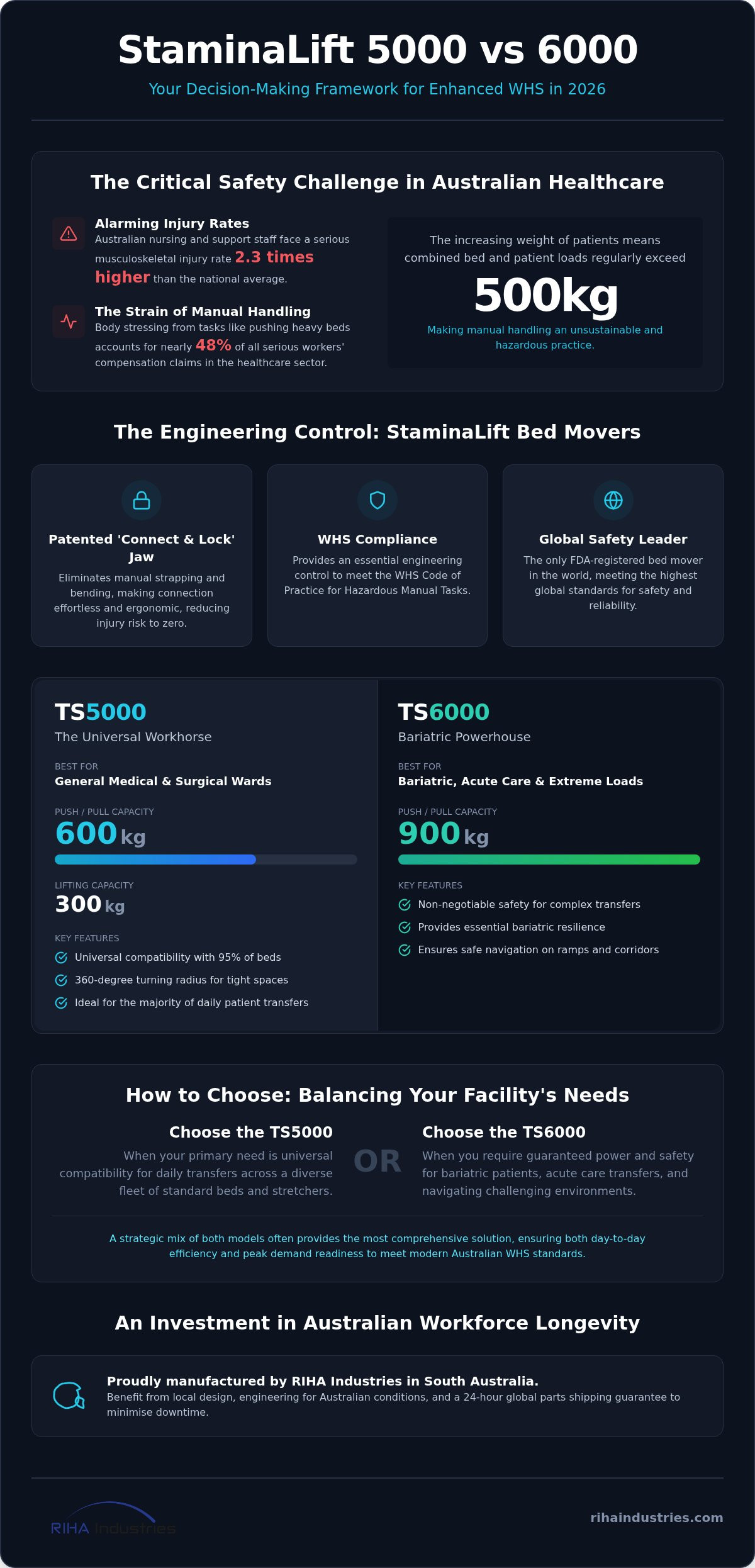
Did you know that Australian nursing and support staff face a frequency rate of serious musculoskeletal injuries 2.3 times higher than the national average? With body stressing accounting for nearly 48% of all serious workers' compensation claims in healthcare, the physical toll of manual bed transfers has become a critical safety concern. You've likely seen your team struggle to navigate heavy bariatric beds through tight corridors or up seven-degree ramps, risking their health with every push. It's a stressful reality for facility managers who want to protect their staff while maintaining operational flow.
Choosing the right engineering control is the most effective way to eliminate these hazards and meet your WHS obligations. This article provides a clear decision-making framework for the StaminaLift 5000 vs 6000 to help you identify the ideal solution for your facility in 2026. We will compare the universal versatility of the TS5000 against the specialised bariatric power of the TS6000. You'll gain a thorough understanding of how these South Australian-made movers reduce injuries to zero while ensuring long-term reliability and compatibility for your diverse equipment fleet.
Table of Contents
Choosing Between the StaminaLift 5000 and 6000 in 2026
As we move into 2026, Australian healthcare logistics are being redefined by an ageing workforce and a significant increase in patient weight. With nearly 67% of Australian adults now living with overweight or obesity, the physical demands placed on nurses and porters have reached a tipping point. Manual handling is no longer a sustainable practice when beds and patients combined regularly exceed 500kg. Staff safety is non-negotiable. Deciding on the StaminaLift 5000 vs 6000 isn't just a procurement choice; it's a strategic investment in workforce safety and operational resilience. The central challenge for ward managers is balancing the need for universal compatibility across diverse bed fleets with the high-capacity power required for bariatric care. As the only FDA-registered solution in the market, the StaminaLift range provides the technical confidence required for high-stakes clinical environments.
The Critical Role of Powered Bed Movers
Providing a motorised assistive device for bed transfers is now a standard requirement under the WHS Code of Practice for Hazardous Manual Tasks. When staff are forced to manually push heavy beds through narrow corridors or up ramps, the risk of body stressing injuries increases exponentially. These injuries account for almost half of all serious compensation claims in the healthcare sector. Motorised transport significantly improves staff retention by extending the career longevity of experienced nurses who might otherwise leave the profession due to chronic physical strain. Both the TS5000 and TS6000 utilise a patented connect and lock jaw system. This technology eliminates the need for staff to bend down, use straps, or manually align the mover, making the connection process effortless and ergonomic. While the TS5000 serves as the versatile workhorse for standard ward beds, the TS6000 provides the necessary reinforcement for extreme loads.
StaminaLift: An Australian Engineering Success Story
While many healthcare solutions are imported, the StaminaLift range is proudly manufactured by RIHA Industries in Edinburgh North, South Australia. This local presence ensures that facilities receive equipment designed for the specific rigours of Australian clinical environments. Being the only FDA-registered bed mover in the world, these systems meet the highest global standards for safety and reliability. RIHA’s commitment to engineering sustainability means these machines are built for durability, supported by a 24-hour global shipping guarantee for parts. Choosing an Australian-made solution provides peace of mind that support and maintenance are always within reach, ensuring your facility's fleet remains operational for years to come. This local support model is essential for minimising downtime in busy metropolitan and regional hospitals alike.
The StaminaLift TS5000: The Universal Workhorse for Australian Wards
The StaminaLift TS5000 has earned its reputation as the most popular powered transfer solution in Australia. It's designed to be the versatile foundation of a facility’s fleet, particularly in general medical and surgical wards where equipment diversity is high. One of its most significant advantages is its universal compatibility. It integrates seamlessly with 95% of globally available hospital beds and stretchers, ensuring that your investment isn't limited to a single brand or model. By providing a standard interface for almost any bed in your facility, the TS5000 simplifies training and ensures that staff always have the right tool for the job.
With a 300kg lifting capacity and 600kg push/pull performance, it handles the vast majority of daily patient transfers with ease. This mechanical assistance is vital for preventing Work-related musculoskeletal disorders that frequently sideline nursing and portering staff. The patented connect and lock jaw system ensures a secure attachment every time, removing the need for manual strapping or awkward positioning. This reliability is why many facilities consider it the baseline when weighing up the StaminaLift 5000 vs 6000 for their general ward requirements.
Manoeuvrability in Confined Clinical Spaces
Navigating narrow corridors, busy elevators, and shared wards requires exceptional precision. The TS5000 features a 360-degree turning radius, allowing it to pivot on its own axis. Its sleek, low-profile design ensures it fits under the bed frame, maintaining a compact footprint that doesn't obstruct clinical workflows. Single-person operation is simple. The intuitive joystick control gives the operator complete mastery over movement without physical exertion, even when navigating the most challenging clinical layouts. This ease of use empowers staff, turning a strenuous two-person task into a safe, efficient one-person operation.
Standard Features and Lithium Upgrades
Operational efficiency is further enhanced by the optional lithium battery upgrade. This allows the unit to maintain high performance throughout double shifts with faster charging times and longer life cycles. To ensure patient comfort isn't compromised, the TS5000 operates at a quiet 65 dB, which is essential for maintaining a calm recovery environment. For a deeper look at procurement considerations, read our StaminaLift Transfer System 5000: The Definitive Buying Guide for Australian Hospitals. If you're ready to improve safety across your facility, you can explore our full range of transfer systems to see how they integrate with your current bed fleet.
The StaminaLift Transfer System 6000: Powering Through Bariatric and Acute Care Challenges
The StaminaLift Transfer System 6000 is engineered for the most demanding acute care environments where standard equipment reaches its physical limits. While general wards find the TS5000 sufficient for daily tasks, bariatric departments require a significantly higher threshold of mechanical assistance. When comparing the StaminaLift 5000 vs 6000, the most striking difference lies in the raw power available to the operator. The TS6000 boasts a 450kg lift capacity and a massive 900kg push/pull performance. This capability is essential because standard bed movers often struggle or fail when tasked with moving nearly a tonne of combined patient and equipment weight. Attempting to use underpowered equipment for bariatric transfers leads to motor strain and, more importantly, a loss of controlled movement that puts both staff and patients at risk.
Safety is further reinforced by the machine’s performance on gradients. The TS6000 maintains a seven-degree incline rating even under full load, ensuring that ramps and uneven flooring don't become hazardous obstacles. This level of engineering provides the protective ally staff need when navigating the high-stakes environment of an acute care facility. It transforms a potentially dangerous manual task into a controlled, predictable process.
Bariatric Safety and Risk Mitigation
Protecting your workforce from life-altering injuries is the primary goal of any bariatric equipment strategy. Traditionally, moving a bariatric patient required two or even three porters to manage the inertia and steering of the bed. The TS6000 changes this dynamic by allowing a single operator to perform the same task with total confidence. This model is specifically engineered to accommodate the wider footprints of Hill-Rom and Stryker bariatric bed frames, ensuring a secure connect and lock regardless of the equipment brand. By implementing this level of engineering control, facilities can realistically target a zero-injury workplace in their most physically demanding wards.
Advanced Controls for Heavy Loads
Managing nearly a tonne of weight requires sophisticated feedback and control systems to maintain precision. The TS6000 features programmable joystick controls, allowing the facility to customise speed and acceleration settings to match specific operator preferences or ward layouts. Modern diagnostic features are integrated through Bluetooth connectivity, providing real-time battery monitoring and system health reports to maintenance teams. To ensure total peace of mind, the unit includes automatic braking and an emergency jaw release mechanism. These safety features ensure that the operator always remains in command, even in the unlikely event of a power interruption or system fault.
Direct Comparison: Determining Your Facility’s Requirements
Selecting the correct powered transfer solution requires a precise understanding of your ward’s daily operations. While both models share the same intuitive controls and 360-degree manoeuvrability, the decision regarding StaminaLift 5000 vs 6000 usually comes down to 'Average Load' versus 'Peak Load' requirements. Average load refers to the weight of your most frequent transfers, whereas peak load accounts for your heaviest bariatric patients or the steepest gradients on your facility's transit routes. The TS5000, with its 600kg push/pull capacity, is perfectly suited for high-volume general wards. In contrast, the TS6000 is designed for the high-stakes environment of bariatric care, where pushing nearly a tonne (900kg) requires significant mechanical reinforcement. To assist in this process, our 2026 Hospital Bed Mover Procurement Guide provides a deeper dive into fleet planning and technical specifications.
Which Model for Which Ward?
General Medical and Surgical wards typically find the TS5000 to be the most efficient choice because it handles 95% of standard hospital beds with ease. ICU and dedicated Bariatric wards require the TS6000 as a non-negotiable safety asset to manage the extreme loads that standard movers cannot safely accommodate. Emergency Departments often benefit from a mixed fleet strategy. This approach ensures that staff can respond to any incoming patient weight without delay, regardless of the bed type used for admission. The inclusion of the Jaw System 300 further expands compatibility, allowing both models to securely grip an even wider range of specialised bariatric frames and stretchers that may have unusual wheel configurations.
Total Cost of Ownership and ROI
Beyond the initial purchase, the true value of a bed mover lies in its ability to reduce workers' compensation premiums and staff turnover. Body-stressing injuries are the leading cause of lost productivity in Australian healthcare. Implementing an engineering control like the StaminaLift series can reduce these injury rates to zero in documented cases. RIHA’s in-house manufacturing in Edinburgh North means that even older fleets receive long-term support, avoiding the planned obsolescence often seen with imported equipment. The 3D-viewer-assisted maintenance system allows rural hospitals to troubleshoot issues in real-time with expert guidance, ensuring that a single faulty component doesn't sideline a critical safety tool. This local support infrastructure is a key differentiator when evaluating the long-term viability of your investment. To ensure your facility is equipped for the demands of 2026, you can request a personalised equipment demonstration today.
Investing in Workforce Longevity with RIHA Industries
Partnering with RIHA Industries represents a strategic commitment to the long-term health and safety of your healthcare workforce. As an Australian-owned and operated manufacturer, RIHA provides a level of accountability and direct technical support that imported brands simply cannot match. This local expertise is especially valuable when navigating the procurement of the StaminaLift 5000 vs 6000, as it ensures your facility receives equipment tailored to the specific rigours of Australian clinical environments. Our mission centres on improving the lives of caregivers by removing the physical burden of bed transfers, transforming a high-risk task into a safe, controlled process. For more detailed insights on equipment selection, explore our guide on How to Reduce Nurse Back Injuries: Patient Handling Equipment Selection Criteria for 2026.
National Service and Global Support
RIHA Industries supports facilities nationwide from our primary manufacturing centre in Edinburgh North, South Australia. We provide a 24-hour guarantee on response times and global parts shipping, ensuring that your fleet remains operational without the delays often associated with international supply chains. To assist with facility planning, we offer 3D models and AR tools that allow ward managers to visualise equipment integration before purchase. Beyond the initial sale, our team provides comprehensive preventative maintenance and repairs to ensure ongoing OHS compliance. Regular servicing not only extends the life of your machines but also provides the documented evidence of risk mitigation required by modern safety regulations.
Next Steps: Organise a Clinical Trial
Building a business case for motorised bed movers requires clear evidence of both safety improvements and financial returns. We provide a dedicated ROI calculator that helps you quantify the cost of staff injuries versus the investment in engineering controls, making it easier to present a compelling case to your board. The most effective way to determine the right fit for your ward is to organise an on-site clinical trial. Whether you are testing the TS5000 for general ward utility or the TS6000 for bariatric resilience, our specialists provide full staff training to ensure your porters and nurses feel empowered by the technology. By trialling these systems in your specific environment, you can witness first-hand how smarter mobility solutions protect your most valuable asset: your people.
Securing the Future of Your Clinical Workforce
Protecting your staff from musculoskeletal injuries is both a legal and moral imperative that requires the right engineering controls. By understanding the functional distinction between the StaminaLift 5000 vs 6000, you can ensure your facility is equipped to handle both standard ward flow and the increasing demands of bariatric care. The TS5000 offers unmatched universal compatibility for the vast majority of hospital beds, while the TS6000 provides the heavy-duty 900kg push/pull power required for acute environments and gradients.
As a proudly Australian-made and owned manufacturer, RIHA Industries is dedicated to reducing workplace injuries to zero. Our FDA-registered systems are engineered for long-term reliability and seamless integration into busy clinical workflows. Don't let preventable injuries sideline your experienced nursing and portering teams. You can organise a clinical demonstration of the StaminaLift series at your facility to see how we can empower your staff and improve operational safety. We look forward to helping you build a safer, more resilient environment for your caregivers and patients alike.
Frequently Asked Questions
Can the StaminaLift 5000 handle bariatric hospital beds?
It depends on the combined weight of the bed and the patient. The TS5000 is rated for a 300kg lift and 600kg push/pull capacity, which covers most standard medical and surgical beds. However, for dedicated bariatric frames where the total load exceeds these limits, the TS6000 is the safer choice. When comparing the StaminaLift 5000 vs 6000, the TS6000 is specifically engineered for these heavy-duty bariatric requirements.
What is the maximum weight capacity of the StaminaLift 6000?
The StaminaLift TS6000 is designed to move nearly one tonne of weight with precision. It features a safe working load capacity of 450kg for lifting and 900kg for push/pull operations. This high threshold ensures that even the heaviest bariatric beds can be transported safely through clinical corridors and up ramps with a gradient of up to seven degrees. This power makes it a critical asset for acute care wards.
Are both the TS5000 and TS6000 models FDA-registered?
Yes, both models in the StaminaLift range are FDA-registered, reflecting our commitment to global safety standards. This registration is a testament to the rigorous engineering and quality control processes maintained at our South Australian manufacturing facility. Whether you choose the StaminaLift 5000 vs 6000, you are investing in a medical device that meets strict regulatory requirements for safety, reliability, and performance in high-stakes hospital environments.
Will these bed movers fit inside a standard Australian hospital elevator?
Both models are designed with a compact footprint to ensure they fit within standard Australian hospital lifts and elevators. Because the unit tucks neatly under the bed frame, it doesn't significantly increase the overall length of the bed during transport. The 360-degree turning radius allows the operator to pivot the unit on its own axis, making it much easier to navigate the tight confines of elevator lobbies and internal corridors.
Can a single person operate the TS6000 when moving a 900kg load?
Yes, the TS6000 is specifically engineered to allow a single operator to move a 900kg load with total control. The intuitive joystick interface manages the heavy lifting and propulsion, removing the physical strain that usually requires multiple porters. This single-person operation is a key benefit of the StaminaLift range, as it helps facilities optimise their staff resources while maintaining a high standard of safety and efficiency during transfers.
What is the battery life of the StaminaLift series during a standard shift?
The battery systems are designed to support a full clinical shift under normal operating conditions. For facilities with extremely high transfer volumes or double shifts, we offer an optional lithium battery upgrade. This upgrade provides faster charging times and a longer overall life cycle, ensuring the unit is always ready for use. Reliable power management is essential for maintaining operational flow in busy emergency departments and acute care wards.
Do RIHA Industries provide training for hospital staff on these models?
RIHA Industries provides comprehensive on-site clinical training to ensure your staff are confident and competent in using the equipment. Our training programmes focus on safe connection techniques, manoeuvring in tight spaces, and understanding the different capabilities when comparing the StaminaLift 5000 vs 6000. This hands-on support is vital for ensuring that your facility achieves the documented reduction of workplace injuries to zero while empowering your nursing and portering teams.
Are replacement parts for the StaminaLift range kept in stock in Australia?
Yes, all replacement parts are manufactured and stocked at our Edinburgh North facility in South Australia. Because we are a local manufacturer, we can offer a 24-hour guarantee on part shipping to minimise equipment downtime. This local support infrastructure is a significant advantage over imported brands, as it ensures that your facility's fleet remains operational and compliant without waiting for international shipments or specialised overseas technicians.


