The True Cost of Manual Bed Handling in Australian Healthcare: A 2026 Analysis
Did you know that the healthcare and social assistance sector now accounts for nearly 20% of all serious workers' compensation claims across Australia? With the 2023–24 period seeing a 5.5% rise in total claims, the true cost of manual bed handling has become an unavoidable financial burden for facility managers and nursing directors. You're likely all too familiar with the immense strain that back injuries and staff burnout place on your daily operations and patient flow. It's a challenge that demands a shift from reactive injury management to proactive, engineered protection.
In this 2026 analysis, we'll uncover the hidden financial and physical tolls of traditional bed moving while showing how motorised solutions, such as the StaminaLift and Easi series, can safeguard your staff and your bottom line. You'll gain a clear framework to calculate the return on investment for motorised movers and discover practical ways to reduce musculoskeletal injuries among your team. By aligning your facility with modern Australian WHS standards, you can transform a high-risk task into a seamless, efficient process that supports both your carers and your budget.
Table of Contents
The Hidden Toll of Manual Bed Handling in Australian Healthcare
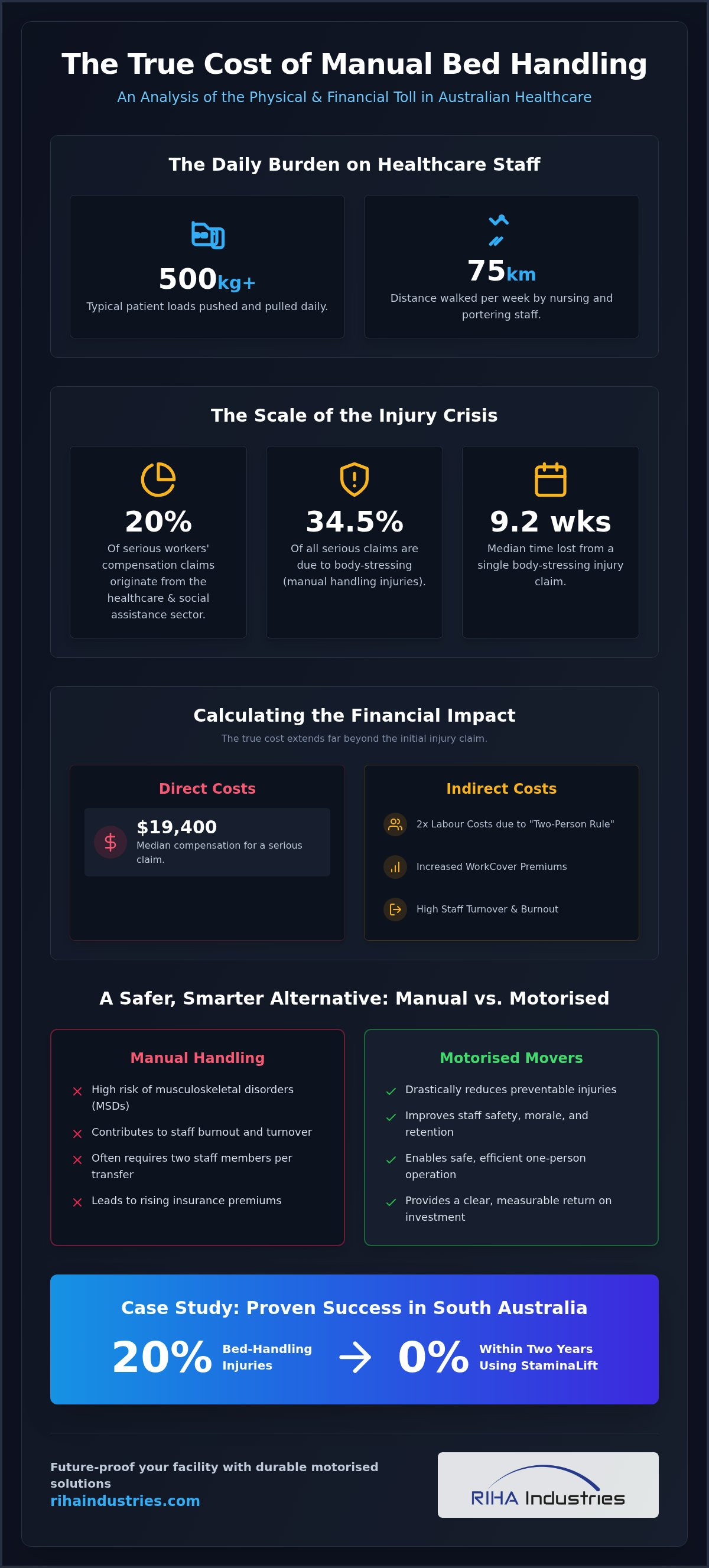
Manual bed handling involves the sustained physical exertion required to transport beds, stretchers, and heavy trolleys across a healthcare facility. It isn't just about the act of moving; it's about the cumulative strain on a carer's body over many shifts. While the initial sticker price of a manual bed may appear lower than its motorised counterparts, this figure is a poor indicator of the true cost of manual bed handling. Facility managers often overlook the long-term expenses tied to physical fatigue and injury. In the Australian context, this issue is exacerbated by an ageing nursing workforce and the rising prevalence of bariatric cases, which require staff to move loads reaching 500kg on a daily basis.
The physical demand is staggering. Nursing and portering staff often walk up to 75km per week while navigating heavy equipment through tight corridors. This constant movement happens in high-pressure environments where speed is essential. By prioritising mechanical assistance, hospitals align themselves with fundamental patient safety principles. These guidelines ensure that both the patient and the carer remain protected during every transfer, reducing the risk of accidents during ward movements.
Musculoskeletal Disorders (MSDs) in Nursing and Portering
Serious body-stressing claims represent 34.5% of all serious workers' compensation claims in Australia. For healthcare staff, the most common injuries include lower back strains, shoulder impingement, and wrist injuries. These aren't always the result of a single catastrophic event. Instead, they often stem from "micro-traumas" caused by the repetitive pushing and pulling of heavy loads. Over time, these small injuries degrade a worker's physical health, leading to prolonged absences. Safe Work Australia data from 2023–24 shows that body-stressing claims result in a median of 9.2 weeks of lost time, which significantly disrupts hospital staffing levels and patient care continuity.
The Impact on Staff Retention and Burnout
Calculating the total cost of manual bed handling requires an understanding of how physical fatigue leads to staff turnover. Physical strain is a primary driver for early retirement among experienced nurses who can no longer meet the heavy demands of the role. When a workplace feels hazardous or physically exhausting, burnout follows quickly. The emotional cost of witnessing a colleague suffer a career-ending injury can dampen morale across an entire ward. By investing in protective technology, facilities do more than just save money; they create a culture of safety. This supportive environment is essential for attracting and retaining top-tier talent in a competitive healthcare market. A safe ward is a stable ward.
Calculating the Financial Impact: Beyond the Injury Claim
Many procurement teams focus on the initial purchase price of equipment, yet the true cost of manual bed handling is primarily found in operational overheads. A significant portion of this expenditure stems from the "Two-Person Rule," where safety protocols necessitate two porters or nurses for a single manual transfer. This effectively doubles the labour cost for every patient movement. When you multiply this by hundreds of transfers per week, the financial drain on a hospital's operating budget becomes substantial. These costs are often siloed in different departments, making the total impact difficult to see without a dedicated analysis.
WorkCover Premiums and Insurance Hikes
Direct costs like medical expenses and rehabilitation are only the tip of the iceberg. According to Safe Work Australia, the median compensation for a serious body-stressing claim in 2023–24 was $19,400. However, the long-term financial tail is much longer. High injury frequencies lead to increased WorkCover premiums, creating a persistent tax on the facility's budget. Manual tasks in healthcare often result in chronic back injuries that require years of management. Contrast this with the experience of a large South Australian hospital that utilised StaminaLift technology; they successfully reduced bed-handling injuries from 20% to zero within two years, protecting their staff and their insurance ratings.
Indirect costs are equally damaging. When a nurse or porter is injured, the facility must fund the recruitment and training of replacement staff, often relying on expensive agency labour to fill the gap. This turnover disrupts the stability of care teams and adds thousands of dollars in administrative overhead for every single injury claim.
Lost Productivity and Operational Bottlenecks
Inefficiency creates its own set of costs. Manual handling is physically taxing, leading to slower transfer times and increased fatigue as a shift progresses. This slowdown contributes to "bed blocking" in emergency departments, where patients cannot be moved to wards because the transport process is delayed. By implementing motorised equipment like the StaminaLift 5000, facilities enable single-person operation for even the heaviest beds. This change immediately recovers lost minutes and improves hospital throughput. When staff aren't exhausted by the physical demands of their roles, they work more accurately and safely. You can explore how these motorised solutions streamline facility operations while protecting your most valuable asset: your people.
Manual vs. Motorised Handling: A Comparative ROI Analysis
When evaluating the shift from manual to motorised equipment, the focus often rests on the initial capital expenditure. However, a professional ROI analysis reveals that the cost of manual bed handling is a compounding expense that far outweighs the price of technology. Motorised solutions represent a one-time investment that mitigates years of unpredictable injury claims and labour inefficiencies. By transitioning to a motorised fleet, facilities move from a reactive financial model to one of stability and controlled growth.
A critical factor in this analysis is the reduction of Full-Time Equivalent (FTE) requirements. In a manual environment, safety protocols often demand two staff members for every patient transfer. Motorised bed movers, such as the StaminaLift 2100 or 5000, allow for single-person operation, effectively doubling the productivity of your portering team. This change doesn't just save money; it resolves the staffing bottlenecks that often lead to delayed ward transfers and emergency department congestion.
The ROI Framework for Hospital Administrators
To calculate a true return, administrators must look at the number of beds moved per day against staff hourly rates. Modern lithium battery systems offer a 20% performance boost over older battery technologies, allowing for more transfers per charge and less downtime. When you factor in the prevention of work-related musculoskeletal disorders, the payback period for a StaminaLift system is often remarkably short. It is an investment in the physical longevity of your workforce that pays dividends in reduced absenteeism and improved morale.
Sustainability and Maintenance Costs
Durability is the cornerstone of long-term ROI. Choosing Australian-made equipment ensures that your facility isn't left waiting for international shipping during a breakdown. RIHA Industries provides 24-hour parts shipping across the country, which significantly reduces equipment downtime. The integration of Bluetooth diagnostics allows for real-time health checks, enabling your team to identify wear before a failure occurs. For older fleets, the availability of 3D-printed spare parts ensures that your motorised movers remain operational for a decade or more, maximising the value of every dollar spent on procurement. This proactive approach to maintenance is always more cost-effective than reactive repairs.
Implementing a Safer Handling Strategy: A Manager’s Checklist
Transitioning from a manual environment to an automated one requires more than just a purchase order; it demands a structured change management strategy. While the cost of manual bed handling justifies the investment, a successful rollout depends on precise facility audits and staff buy-in. Managers should begin by mapping the specific physical challenges of their wards to ensure the chosen technology solves real-world problems rather than adding complexity. A phased approach allows for a smoother transition and immediate safety wins in high-pressure areas.
Risk Assessment and Equipment Compatibility
Assess your facility for high-risk zones where injuries are most likely to occur. Ramps, carpeted corridors, and bariatric units represent the greatest physical burden for staff. During this audit, evaluate your existing bed fleet for compatibility. The StaminaLift 5000 is designed to fit 95% of global hospital beds, which allows you to standardise your transport process without replacing your entire bed inventory. For specialised bariatric wards, consider the StaminaLift Transfer System 6000, which provides the additional power needed to move extreme loads safely. Exceptional 360-degree manoeuvrability is essential for older Australian hospitals with narrow hallways and tight turning circles, ensuring that motorised movers don't create new bottlenecks in patient flow.
Training, Certification, and Change Management
Staff resistance is a common hurdle when introducing new technology. Overcome this by engaging your team in hands-on demonstrations early in the process. When porters and nurses feel how easily a motorised mover handles a 500kg load, the value proposition becomes personal. Regular competency checks and formal certifications ensure that your facility remains compliant with Australian WHS standards. You can learn more about how to reduce nurse back injuries with proper equipment to refine your internal safety protocols and selection criteria.
Develop a procurement plan that targets the highest-risk areas first. This approach allows you to demonstrate immediate success in injury reduction before scaling the solution facility-wide. By focusing on the wards with the highest transfer volumes, you'll see a rapid decline in fatigue-related incidents. If you're ready to begin your facility audit, you can request a consultation with our technical team to identify the most effective motorised solutions for your specific site layout.
Future-Proofing Your Facility with StaminaLift Solutions
As healthcare facilities evolve to meet the demands of an ageing population and rising patient weights, the need for reliable, high-performance mobility equipment becomes a priority. Eliminating the long-term cost of manual bed handling requires more than just a temporary fix; it necessitates a commitment to engineering excellence. RIHA Industries provides this stability through the StaminaLift series, a range of solutions designed to transform the safety profile of any clinical environment. By investing in proven technology, you shift your facility's trajectory from one of rising injury risks to one of operational precision and staff empowerment.
The StaminaLift Advantage: TS5000 and TS6000
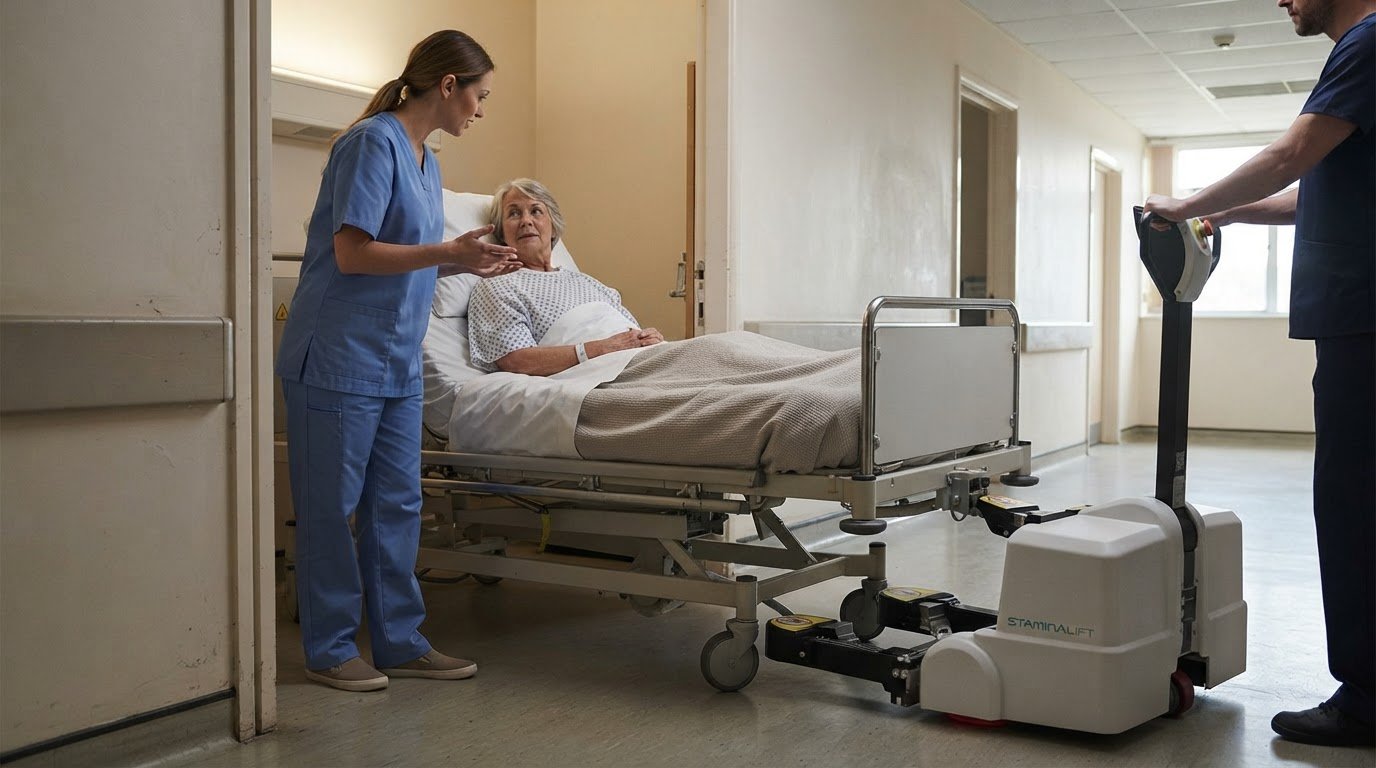
The StaminaLift Transfer System 5000 and 6000 represent the pinnacle of protective engineering in the hospital mobility sector. These systems are FDA-registered and Australian-made, which ensures they meet the most rigorous international quality standards while supporting local industry. A primary advantage is their patented attachment mechanism, providing universal compatibility with 95% of global hospital beds. Safety is embedded in every movement, with features like automatic braking and emergency release systems that protect both the carer and the patient during transfers. Whether you're moving a standard ward bed or a complex bariatric load, these systems provide the mechanical confidence your team needs to work without fear of injury.
Beyond Beds: The Easi Rider and Easi Mover Tugs
The logistical challenges of a modern hospital extend far beyond patient transfers to include the movement of linen, meals, and heavy medical equipment. The Easi series, featuring the Easi Rider and Easi Mover tugs, addresses these diverse needs by allowing a single operator to transport up to 1500kg safely. The Easi Rider offers a ride-on solution for long-distance transfers across large campuses, while the Easi Mover provides a compact, walk-behind design perfect for busy corridors and standard lifts. These tugs are essential for reducing the cumulative cost of manual bed handling and general equipment transport, ensuring that every department benefits from reduced physical strain.
Every facility has unique operational requirements that standard equipment might not fully address. RIHA Industries offers extensive customisation options, from theatre table clamps to integrated oxygen bottle holders, ensuring the equipment integrates seamlessly into your specific clinical workflow. Our mission is to improve the lives of healthcare professionals by providing tools that make their work safer and more efficient. If you're ready to see how these solutions can protect your staff, you can enquire about a hands-on demonstration for your facility to experience the StaminaLift difference firsthand.
Securing Your Workforce and Your Bottom Line
The evidence is clear: the cost of manual bed handling isn't just a line item in a budget; it's a profound physical and operational burden that hospitals can no longer afford to ignore. By shifting to motorised solutions, facilities move from a state of constant risk to one of controlled efficiency. We've seen this transformation firsthand, most notably in a large South Australian hospital where bed-handling injuries were reduced from 20% to zero within just two years. This level of safety isn't an aspiration; it's a tangible result of choosing the right technology.
As a proudly Australian-made and owned manufacturer, RIHA Industries provides FDA-registered equipment that integrates seamlessly into your daily workflow. Whether you're managing bariatric transfers or routine ward movements, our systems provide the protection your staff deserve. It's time to replace physical strain with mechanical precision. Calculate your facility’s ROI with the StaminaLift ROI Tool and take the first step toward a safer, more sustainable future for your healthcare team. You have the power to transform your workplace into a centre of excellence where safety and efficiency go hand in hand.
Frequently Asked Questions
What is the most common injury associated with manual bed handling?
Lower back and shoulder strains are the most frequent injuries reported by healthcare professionals. These often arise from the cumulative micro-trauma of pushing heavy loads over many years. Safe Work Australia data indicates that body-stressing claims result in a median lost time of 9.2 weeks. By addressing the cost of manual bed handling through mechanical assistance, facilities can significantly reduce these high-frequency musculoskeletal disorders and protect their nursing staff.
How much weight can a single porter safely push without motorised assistance?
While guidelines vary, a single staff member should generally not exceed a push force of 20kg to initiate or maintain movement. However, a standard hospital bed with a patient can weigh over 500kg, requiring far more force to navigate carpeted surfaces or ramps. This discrepancy is why manual handling is so hazardous. Motorised equipment removes this physical burden entirely, ensuring that staff never have to exceed safe exertion limits during patient transport.
Does the StaminaLift 5000 work with all types of hospital beds?
The StaminaLift 5000 is compatible with 95% of global hospital beds and stretchers. Its patented jaw mechanism allows it to connect securely to a wide variety of castor types and frame designs. This universal compatibility means your facility can standardise its transport protocols without the need to replace existing bed fleets. It's a versatile solution that integrates easily into diverse clinical environments, from emergency departments to intensive care units.
How does motorised handling equipment impact patient safety during transport?
Motorised equipment improves patient safety by providing a smoother, more controlled transport experience. Manual handling often involves jerky movements or sudden stops that can be distressing to patients with fragile conditions. Features like automatic braking and controlled acceleration ensure that the bed remains stable at all times. By reducing the physical fatigue of the carer, the system allows them to focus more on the patient's well-being during the journey.
What is the typical lifespan of a motorised bed mover in a busy hospital?
You can expect a StaminaLift bed mover to last 10 years or longer when supported by a regular preventative maintenance schedule. Because these units are Australian-made, they are built to withstand the rigours of a 24/7 hospital environment. The availability of 3D-printed spare parts and local technical support ensures that even older models remain operational. This durability is a key factor in reducing the long-term cost of manual bed handling across your facility.
Can motorised movers be used on ramps and inclines?
Yes, motorised movers like the StaminaLift series are specifically engineered to handle ramps and inclines safely. They provide the necessary torque to move heavy loads up slopes that would be impossible for a single person to manage manually. The automatic braking systems also ensure that the bed remains under control while descending, preventing runaway situations. This capability is essential for older Australian facilities where ramps are often part of the internal layout.
Are there specific Australian WHS regulations for manual handling in healthcare?
The Work Health and Safety (WHS) Act 2011 is the primary legislation governing manual handling in Australia. It mandates that employers must eliminate or minimise the risks associated with hazardous manual tasks. Safe Work Australia provides specific codes of practice for the healthcare sector, emphasising the use of mechanical aids to prevent body-stressing injuries. Compliance with these standards is a legal requirement and a fundamental part of providing a safe clinical workplace.
How much does it cost to maintain a fleet of motorised bed movers?
The cost of maintenance is significantly lower than the expense of a single major injury claim. RIHA Industries offers preventative maintenance and repairs to keep your fleet in peak condition. Regular servicing typically involves battery health checks, castor inspections, and software updates. By investing in proactive care, facilities avoid the high costs of emergency repairs and equipment downtime, ensuring that their motorised movers provide a reliable return on investment.