
2026 Guide: Safe Patient Handling for Large Hospitals
- 11 minutes ago
- 12 min read
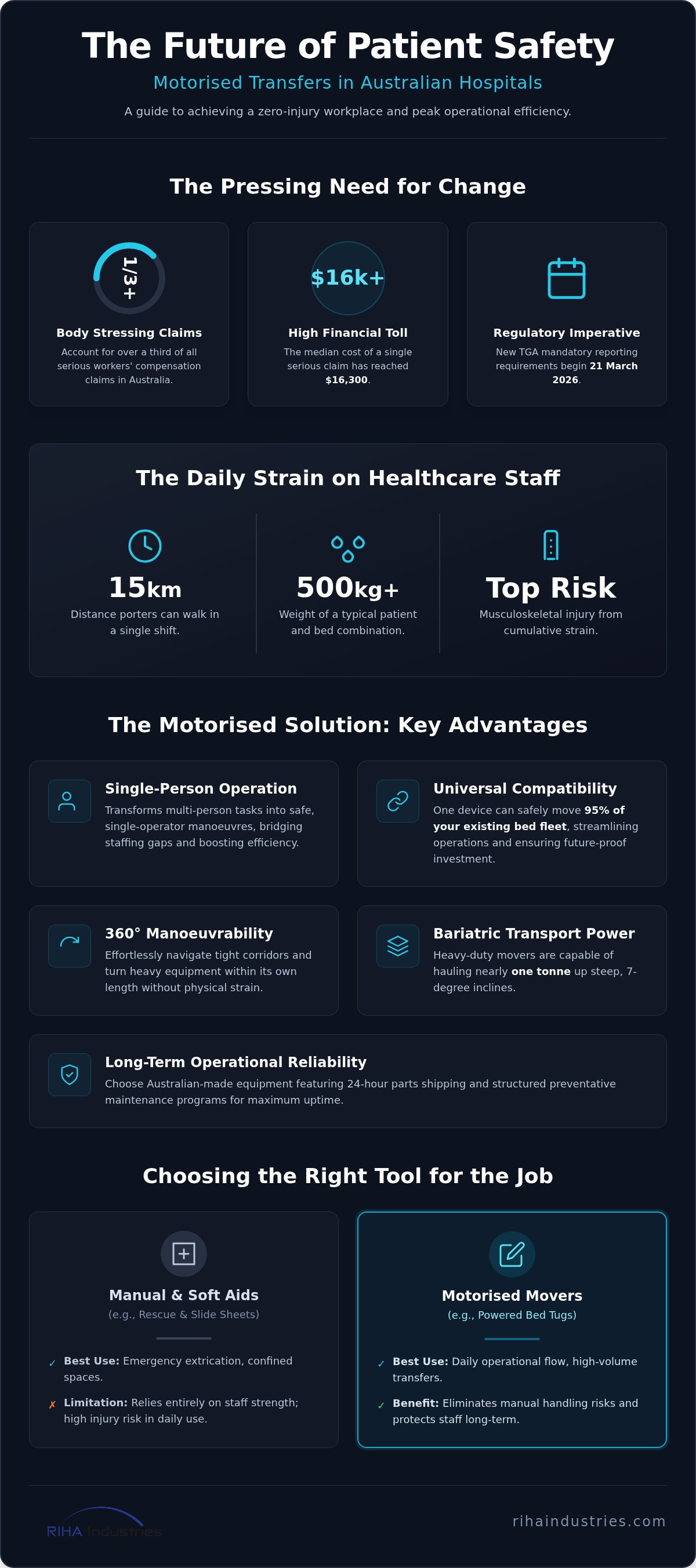
Did you know that body stressing accounts for over a third of all serious workers' compensation claims in Australia? With the median cost of a single claim now reaching $16,300, the physical and financial toll on our healthcare system is simply unsustainable. As large-scale facilities face new TGA mandatory reporting requirements starting March 21, 2026, the search for effective patient transfer solutions for hospitals has moved from a facility goal to a regulatory imperative.
You've likely seen your ward staff struggle to navigate heavy bariatric beds through narrow corridors or manage the immense physical strain of manual equipment transport. It's a high-stakes environment where the safety of your nursing and portering team is just as vital as the care of your patients. We understand that you need a way to protect your staff without compromising on operational efficiency.
This guide explores how adopting motorised technology can help you achieve a zero-injury workplace while ensuring single-person operation across your entire fleet. We'll examine how to select future-proof systems that offer universal compatibility, allowing your facility to streamline operations and integrate seamlessly with 95% of all current hospital beds. By the end of this article, you'll know how to choose equipment that eliminates manual handling risks and supports a safer, more productive clinical environment.
Table of Contents
Navigating the Scale: Why Large Hospitals Require Motorised Patient Movers
Comparing Patient Mover Technologies: From Soft Slings to Powered Tugs
5 Critical Selection Criteria for Large-Scale Healthcare Facilities
The OHS Imperative: Reducing Manual Handling Injuries to Zero
Implementing the StaminaLift Solution: Engineering a Safer Future
Navigating the Scale: Why Large Hospitals Require Motorised Patient Movers
In the context of a sprawling tertiary facility, a patient mover isn't merely a sling or a hoist. It's a high-performance motorised system designed to transport occupied beds and heavy equipment across vast distances. While traditional aids focus on lifting, modern patient transfer solutions for hospitals focus on horizontal mobility, ensuring that the sheer scale of a campus doesn't become a barrier to care. These systems serve as the mechanical backbone of the hospital, moving patients between wards, theatres, and imaging departments with precision.
Porters and ward staff in Australian hospitals often walk up to 15km during a single shift. When you add the requirement to push 500kg bed-and-patient combinations, the physical demand exceeds safe human limits. Manual handling isn't just difficult; it's a legacy practice that no longer fits the operational needs of modern healthcare. The physical reality of the job has outpaced the capacity of manual labour, making the adoption of powered assistance a necessity for facility managers.
Historically, many facilities viewed motorised aids as specialty equipment reserved for bariatric patients or emergency extrication. Today, the perspective has shifted significantly. These systems are now essential operational mobility tools used for every transfer, from routine ward moves to critical transport between theatre and the ICU. We're seeing a transition where hospitals move away from basic rescue aids toward integrated mobility systems that prioritise the long-term health of the workforce.
The Physical Toll on Porters and Nursing Staff
Musculoskeletal injuries are the silent crisis of the ward. Pushing heavy loads through long corridors and up ramps creates a cumulative strain that leads to long-term joint and back issues. Motorised movers act as a Protective Ally for your team, particularly for an ageing workforce that possesses invaluable clinical experience but requires mechanical support to stay on the front lines. This commitment to staff well-being is a core component of the broader patient safety discipline, as fatigue and injury directly impact the quality of care provided. By removing the physical burden, you allow staff to focus their energy on patient interaction rather than mechanical exertion.
Scaling Efficiency in Tertiary Care
Efficiency in a tertiary centre is measured by ward turnaround times and the flow of patients through the facility. When a transfer requires two or three staff members to physically shove a bed into a lift, the entire system slows down. Motorised patient transfer solutions for hospitals transform these high-effort tasks into single-operator manoeuvres. This allows your team to manage peak admission periods with ease, reducing fatigue and improving staff retention. When one person can safely do the work of three, your facility gains the flexibility to reallocate resources where they are needed most, ensuring that patient flow remains steady even during the busiest shifts.
Comparing Patient Mover Technologies: From Soft Slings to Powered Tugs
Selecting the right equipment requires a clear understanding of the distinction between emergency extrication and daily operational flow. Not all patient transfer solutions for hospitals serve the same purpose. While some tools are designed for the frantic pace of an emergency evacuation, others are engineered to sustain the high-volume movement of a 500-bed facility. Choosing the wrong category of equipment often leads to under-utilised machinery or, worse, a continuation of staff injury rates.
Manual and Soft Transfer Solutions
Soft movers, rescue sheets, and slide sheets remain essential components of a hospital's safety kit. Their primary value lies in emergency extrication, such as removing a patient from a confined space or facilitating helicopter transfers where weight and space are critical. They are lightweight, portable, and require no power source. This makes them ideal for the 'worst-case scenario' where mechanical systems might be inaccessible.
However, these tools have significant limitations in a high-volume tertiary environment. They rely entirely on the physical strength and technique of the clinical team. Using manual sheets for routine ward transfers over long distances is a primary cause of musculoskeletal strain. The CDC highlights the critical need for preventing handling injuries by implementing mechanical assistance wherever possible. In a modern hospital, manual solutions should be viewed as secondary tools for specific crisis moments rather than a primary method for horizontal transport.
Motorised Bed Movers and Tugs
The true workhorses of the modern ward are motorised systems that take the physical burden off the operator. The StaminaLift Transfer System 5000 represents the peak of this technology. It provides a universal connection to 95% of hospital beds, allowing a single porter to move heavy loads with fingertip control. By using a motorised system, the risk of back injury is virtually eliminated because the machine handles the inertia required to start, stop, and turn the bed.
Beyond bed transfers, facilities must also manage the movement of linen, meals, and heavy medical equipment. Powered tugs are designed for these specific logistical tasks. For example, the Easi Mover is specifically engineered for compact spaces and narrow lifts. It provides the power of a larger tug but with a smaller footprint, making it ideal for older hospital wings with tighter corridors. You can explore our full range of Australian-made movers to determine which system best suits your facility's unique architectural layout.
When deciding between walk-behind and ride-on systems, consider the 'zone' of operation. Walk-behind units offer superior precision in crowded Emergency Departments or busy ICU bays. Ride-on systems are better suited for long-haul transport across large campuses, where speed and reducing staff fatigue over several kilometres are the top priorities. Matching the technology to the specific zone ensures your investment delivers the highest possible return in safety and efficiency.
5 Critical Selection Criteria for Large-Scale Healthcare Facilities
Selecting the right patient transfer solutions for hospitals involves more than comparing motor wattage. In a tertiary facility, the equipment must serve as a seamless extension of the operator. It's about ensuring that every piece of technology meets the rigorous demands of a 24/7 clinical environment. To achieve this, facility managers should evaluate five essential pillars: universal compatibility, high-precision manoeuvrability, bariatric capacity, integrated safety mechanisms, and advanced diagnostics.
Large hospitals typically manage diverse bed fleets from multiple manufacturers. Investing in a mover that only works with one brand creates logistical bottlenecks. Instead, look for systems like the StaminaLift TS5000, which offers a 95% compatibility rate across almost all global bed brands. This versatility ensures that your porters don't waste time searching for a specific device during a critical transfer. High-performance movers also need to handle significant weight. The StaminaLift TS6000, for instance, can transport nearly one tonne up a 7-degree incline, providing the power needed for bariatric care and complex equipment transport.
Safety is the non-negotiable foundation of any procurement decision. Modern units must feature automatic braking systems that engage the moment the operator releases the controls, preventing runaway loads on ramps. Emergency jaw release mechanisms are equally vital, allowing for immediate manual disconnection if required. To maintain these safety levels, integrated Bluetooth diagnostics and battery monitoring provide real-time data to maintenance teams. This proactive approach aligns with OSHA safe patient handling standards, ensuring that the equipment remains reliable and staff remain protected from mechanical failure.
Universal Compatibility and Patented Hitching
The "one-device" goal is the gold standard for large-scale facilities. The TS5000's benchmark compatibility is achieved through patented hitching technology that connects to the bed's castor housing rather than the frame. This is crucial for modern bed designs that often feature plastic shrouds or unique wheelbases that block traditional attachment points. Tool-free coupling allows for rapid response, ensuring that staff can secure a load in seconds without needing mechanical expertise or additional accessories.
Manoeuvrability in Tight Wards and Lifts
Hospital corridors are often crowded with equipment, making a compact footprint essential. Effective patient transfer solutions for hospitals should add less than 200mm to the overall length of the bed. This ensures the entire combination fits inside standard hospital lifts without difficulty. A zero-degree turning radius is equally important; it allows the operator to pivot the bed within its own length. This level of control is vital when navigating tight corners or positioning a patient in a crowded ICU bay, where every centimetre of space is critical.
The OHS Imperative: Reducing Manual Handling Injuries to Zero
The financial burden of workplace injuries in the healthcare sector is staggering. With musculoskeletal disorders accounting for over half of all serious claims in Australia, the median cost of $16,300 per claim represents only the tip of the iceberg. When you factor in the 9.2 weeks of median time lost for body-stressing injuries, the operational impact on a large hospital becomes clear. Transitioning to motorised patient transfer solutions for hospitals is no longer just a matter of convenience; it is a critical OHS imperative.
Evidence of this transformation is found in a South Australian hospital that once faced high injury rates among its portering staff. By implementing motorised bed movers across the facility, the organisation reduced manual handling injuries from 20% to zero within just two years. This wasn't simply a technical upgrade. It was a cultural shift that empowered staff with Smarter Mobility Solutions, replacing physical exhaustion with mechanical precision. When staff feel protected by their equipment, morale improves and the psychological stress of potential injury is lifted.
WHS Compliance and Risk Mitigation
Aligning your procurement process with a robust patient handling equipment selection criteria framework is the first step toward long-term risk mitigation. Modern WHS standards require facilities to eliminate hazardous manual tasks wherever reasonably practicable. Motorised movers address the most dangerous aspect of bed transport: the 'push-pull' forces required to overcome inertia and navigate ramps.
By utilising hands-free connection technology, these systems eliminate the need for porters to bend, strap, or manually couple the mover to the bed. This reduces the risk of musculoskeletal disorders (MSDs) significantly. When the machine handles the physical connection and the initial momentum, the operator is protected from the primary causes of joint and ligament strain. This level of automation ensures that compliance is built into the daily workflow rather than relying on perfect staff technique.
The Long-Term ROI of Staff Safety
While the initial investment in motorised equipment is a consideration, the long-term return on investment (ROI) far outweighs the cost of inaction. Using an ROI calculator often reveals that the price of just two or three avoided WorkCover claims can cover the cost of a new unit. However, the 'hidden costs' of manual handling are even more substantial. High injury rates lead to increased absenteeism and lower staff retention, forcing hospitals to rely on expensive agency staff to fill gaps.
Motorised patient transfer solutions for hospitals extend the working life of experienced clinical staff by reducing the physical toll of their daily duties. This is particularly vital for an ageing workforce. You can contact RIHA Industries to discuss how an integrated fleet of Australian-made movers can secure your facility's operational future while protecting your most valuable asset: your people.
Implementing the StaminaLift Solution: Engineering a Safer Future
Engineering a safer future requires moving beyond theory and into the strategic deployment of high-performance hardware. In Australian tertiary centres, where the pace is relentless and clinical demands are high, the implementation of patient transfer solutions for hospitals must be both robust and versatile. RIHA Industries provides a tiered approach to this challenge, ensuring that every department, from high-turnover Emergency Departments to specialised intensive care units, has the exact mechanical support it needs to maintain a zero-injury environment.
The StaminaLift TS5000: A Universal Standard
The StaminaLift TS5000 serves as the universal workhorse for large hospital fleets. Being Australian-made and FDA-registered, it meets the highest global standards for medical equipment and reliability. One of its most appreciated features in a clinical setting is its operational quietness. At just 65 dB, it's roughly as quiet as a normal conversation, ensuring patient comfort isn't compromised during critical night-time transfers or ward moves. Modern facilities also benefit from its integrated Bluetooth connectivity. This allows your maintenance teams to perform proactive battery monitoring and remote diagnostics, ensuring the fleet remains operational without unexpected downtime.
Specialised Solutions for Bariatric and Logistics Teams
Acute care environments often face the most demanding transport tasks, particularly when managing bariatric patients. The StaminaLift TS6000 is engineered specifically for these heavy-duty challenges, providing the power to move loads of nearly one tonne. This capacity is a necessity for modern hospitals that must navigate bariatric beds and complex life-support equipment up 7-degree inclines without risking staff injury. When the machine handles the immense inertia of these loads, the physical burden on the clinical team is completely removed.
For logistics teams managing the constant flow of meal and linen trolleys across massive campuses, the Easi Rider ride-on tug offers superior efficiency for long-distance porting. It reduces the physical exhaustion of porters who would otherwise walk several kilometres between buildings during a single shift. To ensure 24/7 reliability, these systems are backed by a dedicated hospital bed mover repair service. This preventative maintenance framework, supported by 24-hour parts shipping from our South Australian facility, ensures your patient transfer solutions for hospitals continue to perform at peak efficiency throughout their entire lifecycle.
By integrating these specialised tools into your facility's workflow, you create a seamless mobility ecosystem. This approach doesn't just solve a transport problem; it transforms the way your staff interact with their environment, making the hospital a safer place for both carers and patients alike.
Securing the Future of Hospital Mobility
Transitioning from manual handling to motorised systems is the most effective way to eliminate workplace injuries in large-scale healthcare. By adopting patient transfer solutions for hospitals that offer 95% compatibility with global bed brands, you ensure your facility is prepared for any operational challenge. This strategic shift protects your staff from the physical toll of walking 15km shifts while moving heavy loads; it allows them to focus on clinical excellence rather than mechanical exertion.
The results of this investment are proven. One South Australian hospital saw manual handling injuries drop from 20% to zero within two years of implementation. Our FDA-registered and Australian-made equipment is designed to be a Protective Ally for your team, providing the reliability needed in high-stakes environments. It's time to empower your porters and nursing staff with technology that works as hard as they do.
Ready to see the difference in your own wards? Request a hands-on demonstration of the StaminaLift range at your facility today. We're here to help you build a safer, more efficient future for your healthcare community.
Frequently Asked Questions
What is the difference between a patient mover and a bed mover?
A patient mover is a broad category that includes manual aids like rescue sheets and slings, while a bed mover is a specific motorised device designed for horizontal transport. Manual aids are typically used for lifting or short-distance emergency extrication. In contrast, motorised movers focus on operational efficiency and reducing the physical strain of long-distance ward transfers. Both are essential components of modern patient transfer solutions for hospitals.
Can one patient mover fit all types of hospital beds in our facility?
Yes, the StaminaLift TS5000 is engineered to be compatible with 95% of all hospital beds globally. This universal capability is achieved through a patented hitching system that connects to the castor housing rather than the bed frame. This design allows a single device to manage diverse fleets without the need for additional tools, ensuring seamless integration across multiple departments and different ward types without delay.
How much weight can a motorised patient mover handle on a ramp?
The heavy-duty StaminaLift TS6000 can transport loads of nearly one tonne up a 7-degree incline without requiring any manual assistance. This high capacity is vital for managing bariatric beds and complex life-support equipment during transfers between specialised units. For standard ward beds, our TS5000 model provides ample power to navigate hospital ramps safely while maintaining complete control through its automatic braking system and intuitive steering.
Is special training required for staff to operate a motorised bed mover?
Staff require minimal training to operate our motorised movers because the controls are designed to be intuitive and ergonomic. Most porters and nurses can master the 360-degree manoeuvrability and hitching process within a single orientation session. We provide comprehensive on-site training to ensure every operator feels confident using the equipment, focusing on safe navigation through tight corridors and the effective use of the automatic safety features.
How does a motorised mover impact WorkCover claims in large hospitals?
Implementing motorised patient transfer solutions for hospitals has a direct and significant impact on reducing WorkCover claims. By eliminating the high-risk push-pull forces that lead to musculoskeletal injuries, facilities can see dramatic results in staff safety. For example, a South Australian hospital successfully reduced its manual handling injury rate from 20% to zero within two years of introducing our motorised bed movers to their daily fleet operations.
What maintenance is required for motorised hospital movers in 2026?
Maintenance in 2026 is streamlined through integrated Bluetooth diagnostics that allow for proactive monitoring of battery health and motor performance. We recommend a structured preventative maintenance schedule to ensure long-term reliability and 24/7 operational readiness for your facility. Our Australian-based service team provides 24-hour parts shipping, ensuring that any necessary repairs are completed quickly to minimise equipment downtime and maintain a smooth patient flow.
Can motorised movers be used in standard hospital lifts?
Yes, our motorised movers are specifically designed to fit within standard hospital lifts alongside the bed and the operator. The StaminaLift TS5000 adds less than 200mm to the overall length of the bed, ensuring the entire combination remains compact enough for confined spaces. Its zero-degree turning radius also allows for easy positioning once inside the lift, facilitating smooth and efficient transfers between different levels of the hospital.
Are StaminaLift products FDA-registered for use in international facilities?
Yes, all StaminaLift products are FDA-registered and manufactured in Australia to meet the highest international quality and safety standards. This registration confirms that our equipment complies with rigorous performance requirements for medical devices used in clinical settings. Whether you are managing a local ward or an international tertiary facility, you can rely on our systems to provide world-class safety and durability during every patient transfer.


