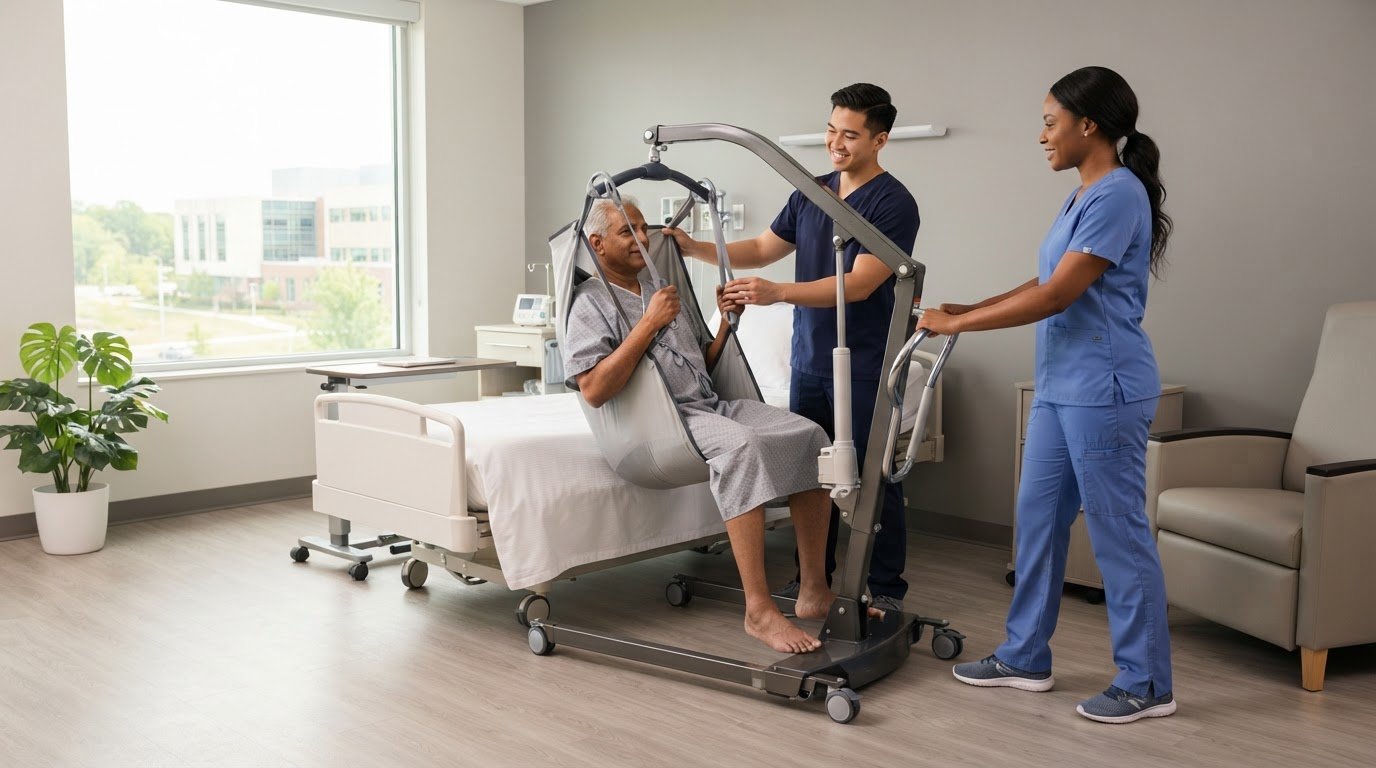
Australian Standards for Powered Bed Movers: The 2026 OHS Compliance Guide
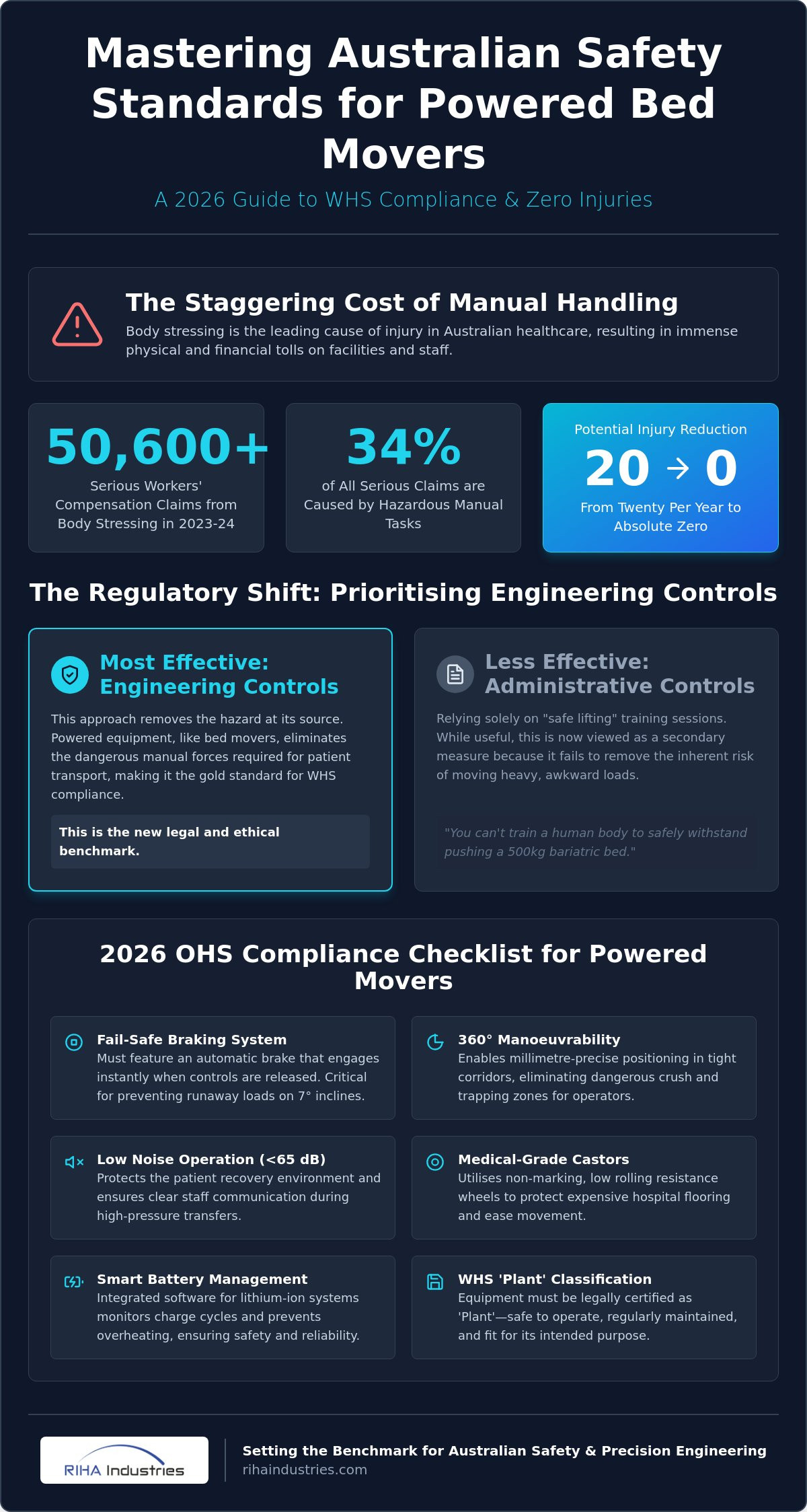
What if a single equipment choice could reduce your facility's manual handling injuries from twenty per year to absolute zero? In 2023-24 alone, body stressing accounted for over 50,600 serious workers' compensation claims across Australia, leaving healthcare leaders to grapple with the immense physical and financial toll of staff burnout. You likely recognise that relying on manual labour is no longer sustainable, yet navigating the intricate Australian standards for powered bed movers can feel like an overwhelming task amidst shifting state and federal regulations.
We understand the pressure to justify equipment costs while prioritising the safety of your nursing teams. This guide is designed to help you master the complex 2026 WHS landscape, ensuring your facility meets the highest safety benchmarks for motorised patient transfer. We will explore the latest Safe Work Australia guidelines, the industry transition toward "No Lift" policies, and the engineering controls required to eliminate musculoskeletal risks once and for all.
Table of Contents
The Australian Regulatory Framework for Powered Bed Movers
Compliance begins with a clear understanding of the legislative hierarchy. While the WHS Act 2011 provides a harmonised foundation across most jurisdictions, state-specific bodies like WorkSafe Victoria or SafeWork NSW manage the practical oversight of healthcare facilities. Under these laws, motorised hospital equipment is classified as 'Plant'. This means that any equipment used to move patients is legally required to be safe to operate, maintained regularly, and fit for its intended purpose. Failure to meet these definitions can leave a facility vulnerable to both regulatory fines and civil litigation.
Safe Work Australia plays a pivotal role by developing the national codes of practice that define how we manage hazardous manual tasks. By 2026, the focus has shifted decisively away from administrative "safe lifting" sessions toward robust engineering controls. This evolution acknowledges a simple truth; you can't train a human body to safely withstand the repetitive force required to push a bariatric bed. Adhering to the latest Australian standards for powered bed movers isn't just a box-ticking exercise. It's a fundamental legal safeguard for your staff and your organisation.
The Hierarchy of Control in Australian Healthcare
In the clinical environment, the hierarchy of control provides a roadmap for risk mitigation. While we can't eliminate the need to transport patients, we can eliminate the manual force required to do so. Engineering controls, such as the StaminaLift 2100 Bed Mover, represent the gold standard because they remove the hazard at the source. Administrative controls, like manual handling training, are now viewed as secondary measures. Statistics from 2023-24 show that body stressing still causes over 34% of serious claims, proving that even the best-trained staff remain vulnerable when mechanical assistance is absent.
Primary Duty of Care and Legal Liability
Hospital executives and board members, defined as 'Officers' under the Act, hold a proactive duty of care. They must ensure the facility has the resources to eliminate risks so far as is reasonably practicable. Given that powered movers can reduce bed-moving injuries from twenty per year to zero, failing to provide such equipment makes it difficult to argue that you've met this standard. Beyond the risk of prosecution, non-compliance often results in soaring WorkCover premiums and a damaged reputation that makes staff retention difficult. Investing in equipment that meets Australian standards for powered bed movers is a strategic decision that protects both the clinical team and the facility's financial health.
The 2026 OHS Compliance Checklist for Hospital Equipment
Adhering to the Australian standards for powered bed movers involves more than just purchasing a motorised unit; it requires a rigorous alignment between mechanical features and safety outcomes. By 2026, the benchmark for compliance has shifted toward equipment that actively prevents human error through intelligent engineering. This starts with the braking system. A compliant mover must feature an automatic fail-safe mechanism that engages the moment the operator releases the controls. This is critical for preventing runaway loads on the 7-degree inclines common in many Australian facility ramps, where an emergency stop must be both intuitive and instantaneous.
Spatial safety is another primary concern in the Model Code of Practice for Hazardous Manual Tasks. Equipment must demonstrate 360-degree manoeuvrability to navigate tight ward corridors without creating "trapping" or "crush" zones for the operator. This agility ensures that staff can position heavy beds with millimetre precision, reducing the need for manual corrective shunts. Additionally, compliance extends to the acoustic environment. Modern standards mandate noise levels remain below a 65 dB threshold. This protects the recovery environment for patients and ensures that staff can communicate clearly during high-pressure transfers without being drowned out by mechanical hum.
Physical Equipment Audit Points
A thorough safety audit should examine the interface between the machine and the facility floors. High-quality movers utilise non-marking, medical-grade castors that protect expensive hospital flooring while providing low rolling resistance. Battery safety is equally vital; look for lithium-ion systems with integrated management software that monitors charge cycles and prevents overheating. From an ergonomic perspective, joystick controls should allow for a neutral wrist position to eliminate the risk of repetitive strain injuries. If you are unsure if your current fleet meets these benchmarks, reviewing our latest range of compliant movers can provide a clear point of comparison.
Documentation and Operational Compliance
Legal safety doesn't end with the hardware; it must be supported by a robust administrative trail. Facilities are required to maintain a comprehensive hospital bed mover maintenance program to ensure every fail-safe remains operational over the long term. This documentation should be paired with Safe Work Method Statements (SWMS), particularly for high-risk bariatric transfers where loads can exceed 500kg. Finally, ensure your facility keeps updated competency-based training records. These documents prove that every operator has been assessed on the specific unit they use, providing a vital layer of protection for the organisation in the event of an OHS audit.
Meeting the 'Reasonably Practicable' Standard for Heavy Loads
Under the WHS Act, the term 'reasonably practicable' is the legal yardstick for every procurement decision. It requires facilities to balance the degree of risk against the cost and availability of ways to eliminate that risk. When you consider the physics of modern healthcare, the risk is undeniable. Pushing a 500kg bed up a 7-degree incline generates forces that far exceed safe manual handling limits. Coupled with the cumulative strain of staff walking up to 15km per day on hard hospital floors, the likelihood of musculoskeletal injury becomes a statistical certainty rather than a possibility.
A landmark trial in a South Australian hospital provided the evidence needed to redefine these benchmarks. By integrating motorised assistance, the facility saw bed-moving injuries drop from 20 per year to zero within just 24 months. This outcome demonstrates that meeting Australian standards for powered bed movers is the only reliable way to fulfil the primary duty of care. Beyond physical force, compliance also involves secondary risks; for instance, ensuring the electrical safety of power-assisted beds and movers is maintained to prevent trip hazards or equipment failure during transit. These movers don't just protect the back; they safeguard the entire operational flow of the ward.
Calculating the ROI of Safety Compliance
Financial justifications for motorised fleets often focus on the upfront capital, yet the true cost of inaction is far higher. With the median compensation payout for musculoskeletal injuries reaching $24,300 and requiring nearly 13 weeks of time off work, a single avoided claim can significantly offset equipment costs. Using an ROI calculator helps facilities factor in the hidden expenses of agency replacement labour and the loss of experienced nursing staff who might otherwise face early career burnout due to physical strain. Reducing staff turnover is a significant benefit, as it preserves the institutional knowledge vital for high-quality patient care.
Bariatric Transfer and Specialist Equipment
The surge in bariatric admissions presents a unique challenge that manual labour cannot solve safely. For these high-stakes transfers, equipment like the StaminaLift Transfer System 6000 is essential. These units are engineered to handle loads approaching one tonne, providing the controlled torque needed to navigate ramps and lifts safely. By ensuring your equipment is rated for maximum patient weights, you maintain compliance with Australian standards for powered bed movers while giving your team the confidence to perform their duties without fear of injury. This level of precision engineering empowers staff to manage even the most complex transfers with ease and dignity.
Implementing a Motorised Equipment Strategy for Long-Term Safety
Transitioning your facility to a motorised model is a multi-stage journey that requires both clinical buy-in and technical precision. Adhering to Australian standards for powered bed movers involves more than just the initial purchase; it's about creating a sustainable ecosystem of safety that evolves with your facility's needs. A successful implementation begins with a facility-wide audit to identify high-risk zones where manual handling is most prevalent. Once these zones are mapped, trailing high-compatibility units like the StaminaLift Transfer System 5000 allows staff to experience the immediate reduction in physical exertion firsthand.
Standardisation is the next critical pillar. By choosing movers that offer 95% compatibility across your existing bed fleet, you reduce the complexity of staff training and ensure that help is always available regardless of the ward. This operational consistency must be backed by a structured bed mover maintenance service schedule. Modern systems now utilise Bluetooth diagnostics, which allow facility managers to monitor battery health and usage patterns in real time. This data is invaluable for identifying when additional training might be required or when a unit is due for a preventative check-up before a fault occurs. If you're ready to start your audit, you can contact our team for a professional assessment of your current fleet.
Integration with Existing Hospital Assets
Modern movers must do more than just push; they must integrate seamlessly with a diverse range of assets, including theatre tables and stretchers. Universal hitching systems are essential for ensuring that a single mover can handle various equipment types without requiring multiple attachments. Space optimisation is equally important. Choosing movers that fit compactly underneath beds when connected ensures that corridors remain clear and the unit doesn't become a trip hazard. For facilities with older assets, retrofitting with modern safety attachments can be a cost-effective way to bring the entire fleet up to current OHS benchmarks.
Preventative Maintenance as a Compliance Shield
A 'break-fix' mentality is a significant risk to OHS compliance. When a motorised unit is out of service, staff often revert to manual handling, which is when injuries are most likely to occur. Ensuring 24-hour parts availability and a rapid response time is vital for safety continuity. Implementing a formal StaminaLift maintenance plan serves as a legal shield, proving that the facility has taken every reasonably practicable step to maintain engineering controls. This proactive approach ensures that your safety investment continues to protect your team and your reputation for years to come.
RIHA Industries: Setting the Benchmark for Australian Safety
At the heart of RIHA Industries lies a mission to empower healthcare professionals by removing the physical burden of patient transport. Based in Edinburgh North, South Australia, our team combines precision engineering with a deep empathy for the daily challenges faced by nursing and portering staff. We don't view ourselves simply as manufacturers; we act as a protective ally for facilities striving to reach the highest Australian standards for powered bed movers. By designing and building our equipment locally, we maintain total control over the quality and reliability of every component that leaves our floor.
This dedication to excellence has positioned RIHA as a global leader in the field. Our equipment is the only FDA-registered bed mover on the market, a distinction that reflects our commitment to international safety benchmarks while remaining grounded in the specific requirements of Australian wards. Every unit features advanced automatic braking, intuitive emergency releases, and whisper-quiet operation to ensure that safety never comes at the expense of patient comfort. When you choose an Australian-made solution, you're investing in a product that has been rigorously tested against the most demanding Australian standards for powered bed movers.
The StaminaLift and Easi Series Advantage
The StaminaLift Transfer System 5000 serves as the versatile workhorse of the fleet, offering 95% compatibility with hospital beds and theatre tables. For logistical tasks, the Easi Rider and Easi Mover are specifically designed to optimise porter efficiency when transporting linen or meal trolleys. Because we are the original manufacturers, we can provide custom modifications for unique theatre tables or specialist equipment that off-the-shelf distributors simply cannot match. This flexibility ensures that no hazardous manual task is left unaddressed within your facility.
National Service and Support
Maintaining safety continuity requires more than just high-quality hardware; it demands a reliable support network. We provide 24-hour shipping for critical parts to ensure your equipment remains operational when it's needed most. For remote and rural facilities, our 3D-viewer assisted maintenance programme allows your local technicians to perform precise repairs with expert guidance. We invite you to contact RIHA Industries today to organise an on-site WHS audit and equipment demonstration, allowing your team to experience the relief of motorised transfer firsthand.
Securing Your Facility's Future with Compliant Transfer Solutions
Mastering the 2026 regulatory shift requires more than just updated training manuals; it demands a commitment to engineering out the risks of manual handling. By aligning your fleet with the latest Australian standards for powered bed movers, you transform the clinical environment from a site of potential injury into a space of safety and efficiency. This transition protects your most valuable asset, your staff, from the cumulative strain of heavy patient transfers and the physical burnout associated with long shifts on hard floors.
RIHA Industries provides the precision engineering needed to achieve these goals. As a South Australian owned and operated manufacturer, we offer FDA-registered technology that is proven to reduce manual handling injuries to zero in clinical settings. Our local expertise ensures your equipment is perfectly suited for Australian ward designs and national regulatory requirements. You don't have to navigate these complex safety landscapes alone.
Book a WHS Compliance Audit and Equipment Demo with RIHA Industries today to see how we can support your facility. Let's work together to create a workplace where physical burnout is a thing of the past and every staff member returns home safe.
Frequently Asked Questions
What are the specific OHS requirements for hospital bed movers in Australia?
Current regulations require that bed movers be classified as "Plant" under the WHS Act, meaning they must be fit for purpose and maintained to ensure safety. Key Australian standards for powered bed movers include the presence of automatic fail-safe braking, emergency stop buttons, and 360-degree manoeuvrability to prevent crush injuries. These features ensure that the equipment remains under total control even when navigating the steep inclines found in many facility ramps.
How does motorised equipment help in meeting the WHS Hierarchy of Control?
Motorised movers act as a high-level "Engineering Control" by replacing manual force with mechanical torque. This approach is far more effective than administrative controls, such as manual handling training, because it removes the physical hazard at the source. By automating the push-pull forces required for patient transport, facilities can effectively eliminate the risk factors that lead to musculoskeletal disorders and chronic staff burnout.
Are hospital bed movers required to be FDA-registered for use in Australia?
FDA registration is not a legal requirement for use within Australian jurisdictions, though it serves as a powerful indicator of global safety and quality. RIHA Industries produces the only bed mover on the market with this registration, providing an extra layer of assurance for facility managers. While local compliance with the WHS Act is the primary mandate, FDA oversight reflects a level of engineering excellence that exceeds standard domestic benchmarks.
What is the maximum weight a single porter should push manually according to OHS guidelines?
Safe Work Australia does not specify a maximum weight limit in kilograms; instead, it focuses on the risk factors of the task. However, pushing a standard hospital bed, which can weigh over 500kg when occupied, is widely recognised as a hazardous manual task that exceeds safe limits for a single person. Using motorised assistance ensures your facility meets the "reasonably practicable" standard by providing a safe alternative to high-force manual labour.
How often should hospital patient transfer equipment undergo preventative maintenance?
To remain compliant with Australian standards for powered bed movers, equipment should undergo a formal preventative maintenance check at least every six to twelve months. Regular servicing ensures that critical safety features, such as the automatic braking and battery management systems, remain fully operational. Maintaining a detailed service log is also essential for protecting the facility's legal standing during an OHS audit or WorkCover investigation.
Can motorised tugs like the Easi Rider be used on hospital ramps and inclines?
The Easi Rider is specifically engineered to handle the 7-degree inclines and ramps commonly found in Australian healthcare facilities. These units provide the necessary torque to move heavy linen and meal trolleys safely without the risk of the load running away. The integrated braking systems ensure that the unit remains stationary on a slope the moment the operator releases the controls, providing total security during transit.
What training is required for staff to operate a StaminaLift bed mover safely?
Staff must complete competency-based training that is specific to the unit they are operating, such as the StaminaLift 2100 or 5000 models. This training should cover hitching procedures, emergency stop protocols, and spatial awareness when navigating tight corridors. Facilities are required to keep updated records of these assessments to prove that every operator has demonstrated the skills necessary to use the motorised equipment without risk to themselves or others.
How do I calculate the Return on Investment (ROI) for motorised hospital equipment?
A comprehensive ROI calculation should factor in the direct costs of workers' compensation claims, which have a median payout of $24,300 for musculoskeletal injuries. You should also include the indirect costs of agency replacement labour, lost productivity during the 12.9-week median recovery period, and the expense of recruiting new staff due to physical burnout. Often, avoiding just one or two serious injuries can completely offset the capital investment of a motorised fleet.