Bariatric Patient Transfer Policy: 2026 Australian Guide
What happens when a transfer decision changes between shifts, or the equipment available can’t support the planned move? The consequences can affect a patient’s comfort and dignity while exposing staff to avoidable manual-handling risks. A bariatric patient transfer policy should make the next safe step clear without reducing a person to a weight or measurement.
Staff need practical guidance, not a general reminder to “use safe handling practices”. Each transfer involves its own clinical needs, mobility, environment and equipment, so one method won’t suit every situation. Consistent decisions depend on a clear process for assessment, communication and escalation.
This guide sets out an adaptable policy framework for routine transfers and changing needs, including what to document and how to match a planned method to equipment capability and local requirements. It also clarifies the role of powered bed movers: they move beds, but don’t lift or transfer patients between surfaces. The result is a more consistent approach that supports patient dignity and safer work for healthcare staff.
Table of Contents
Bariatric Transfer Policy: Protecting Dignity and Safety
A clear facility framework helps staff plan transfers consistently while responding to each person’s clinical needs, preferences and circumstances. A bariatric patient transfer policy sets out how transfers are assessed, planned, carried out, communicated and reviewed. It should support sound clinical judgement, not replace an individual assessment or require the same method for every patient.
Patient transfer means moving a person between surfaces or locations using an assessed method and appropriate assistance or equipment. Moving a bed or trolley is a separate task: a powered bed mover transports the bed, not the patient from one surface to another. Keeping this distinction clear helps staff select the right procedure and equipment for each task.
What should a bariatric patient transfer policy achieve?
The policy should give staff a shared process for assessing the person and task, choosing a suitable method, communicating the plan and responding if circumstances change. It should also make responsibilities clear: who completes the assessment, who coordinates the transfer and how staff escalate concerns under local procedures.
Safety and dignity belong in the same plan. Staff should explain what will happen, seek the person’s consent and participation where possible, and consider comfort, privacy and clinical needs alongside worker safety. Bariatric status alone doesn’t determine a transfer method. Current mobility, condition, ability to follow instructions and the specific task all inform the decision.
Where does the policy apply in an Australian facility?
Define the policy’s reach across relevant wards and departments, acute-care settings, staff roles and transfer situations. Include routine moves, transfers between care areas and handovers where the plan must follow the patient. If transport beyond the facility is in scope, distinguish the clinical transfer plan from vehicle and transport arrangements. A bariatric ambulance is one specialised transport context.
Keep organisation-wide principles consistent, then document local details separately. A ward may have different equipment, access constraints or escalation contacts from another site. Staff need a practical way to find the procedures that apply where they’re working, rather than relying on memory or assumptions carried over from another unit.
Organisation-wide: set common expectations for assessment, communication, dignity, documentation and review.
Site-specific: identify available equipment, local work procedures, relevant contacts and escalation pathways.
Policy owners should align the framework with current state or territory WHS/OHS requirements and the facility’s clinical guidance, then review it when procedures, equipment or service arrangements change. This keeps the document useful in practice while leaving clinical decisions grounded in the patient’s current assessment.
The Essential Components of a Bariatric Patient Transfer Policy
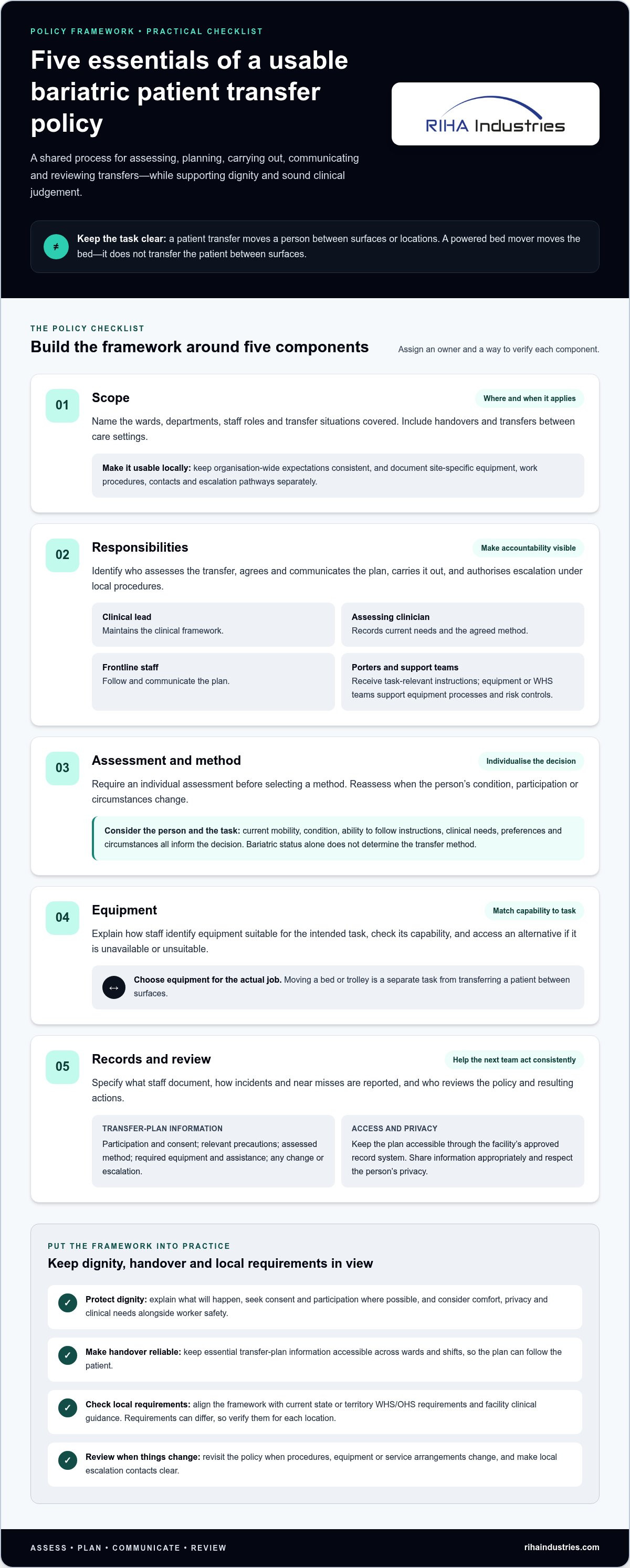
A usable policy turns broad safety principles into responsibilities staff can follow. Build it as a checklist, then assign an owner and a way to verify each component. The framework should cover:
Scope: name the wards, departments, staff roles and transfer situations covered, including handovers and transfers between care settings.
Responsibilities: identify who assesses the transfer, agrees and communicates the plan, carries it out, and authorises escalation under local procedures.
Assessment and method: require an individual assessment before selecting a transfer method, with reassessment if the person’s condition, participation or circumstances change.
Equipment: explain how staff identify suitable equipment, check its capability for the intended task and access an alternative if it is unavailable or unsuitable.
Records and review: specify what staff document, how incidents and near misses are reported, and who reviews the policy and resulting actions.
Use jurisdiction-specific sources when setting requirements. Australian WHS/OHS arrangements and facility clinical guidance can differ across states and territories, so policy owners should verify current requirements for each location rather than assume a single procedure applies everywhere. International material, such as the CDC Safe Patient Handling and Mobility resource, can inform general thinking about safe handling, but it isn’t a substitute for Australian or local requirements.
Roles, communication and transfer documentation
Make accountability visible. A clinical lead can maintain the clinical framework; the assessing clinician records the person’s current needs and agreed method; frontline staff follow and communicate the plan; porters receive task-relevant instructions for movements they perform; and equipment or WHS teams support equipment processes and risk controls. State who can pause a transfer and who must be involved when staff need to escalate.
Records should give the next team enough information to act consistently: the person’s participation and consent, relevant precautions, the assessed method, required equipment and assistance, and any change or escalation. Keep the transfer plan accessible through the facility’s approved record system. Share information appropriately and respect the person’s privacy.
Training, equipment and policy review
Training should prepare staff for the procedures and equipment used at their site. Set out how staff learn approved methods, demonstrate competency and receive updates when equipment or local procedures change. Link equipment checks, maintenance and fault reporting to the facility’s existing systems, with clear responsibility for taking unsuitable equipment out of use under local processes.
Review the policy after an incident or near miss, a change in a person’s needs that exposes a procedural gap, or a change to equipment capability or local requirements. Record the review outcome, assign follow-up actions and communicate revisions to affected teams. For organisations mapping powered bed movement separately from patient transfer, RIHA’s patient-transfer equipment offers a relevant equipment reference point.
How to Decide on a Bariatric Patient Transfer Method
A repeatable decision pathway helps staff select a method for the person and task in front of them, rather than relying on habit or a single measurement. Build the pathway into the bariatric patient transfer policy, and make clear that staff must pause if the situation no longer matches the documented plan.
Assess the person. Consider current mobility, ability and willingness to participate, communication needs, pain, clinical condition and any precautions. Ask about the person’s preferences and explain the options in an accessible way.
Define the task. Identify the starting point, destination and movement required. Repositioning or moving from a bed to a chair differs from transporting a patient while they remain in bed. Each task needs its own assessment and approved method.
Check the environment. Inspect access, available space and the route, including doorways, turning areas, floor surfaces, slopes or ramps. Consider whether staff can position and use the selected equipment safely throughout the movement.
Match method and equipment. Follow approved local procedures and check that equipment is suitable for the person, task and environment. Consider relevant body dimensions and equipment compatibility alongside other assessment findings, not as a substitute for them.
Confirm and communicate. Ensure the people involved understand their roles, the agreed method and any precautions. Record the plan and identify when it needs to be reviewed.
What should a person-centred transfer assessment consider?
Assess what the person can do now, not only what they could do at an earlier assessment. Changes in pain, alertness, clinical condition or confidence may affect safe participation. Ask what helps the person feel comfortable and supported, and take account of communication preferences. Document who contributed to the decision, the relevant findings and the circumstances that should prompt a reassessment.
Measurements can help determine whether a person and equipment are compatible, but weight alone can’t establish the right method. Consider the full fit between the person, the equipment’s intended use and the movement required. If a dimension or other essential information is unknown, resolve that uncertainty through local clinical processes before proceeding.
How should staff match the method to the task and environment?
Plan the route before movement begins. Equipment that can be positioned beside a bed may still be unsuitable if a narrow doorway or tight turn prevents safe access. Check the surface and any ramp or slope, and account for the space needed to position the equipment and staff. Transporting a bed is a separate task from transferring a patient between surfaces.
Stop if the patient’s condition changes, the route is obstructed, the expected staff aren’t available or the required equipment is missing, damaged or unsuitable. Reassess the person, task and environment, then follow the facility’s escalation procedure if the original plan can’t be carried out safely. Don’t improvise a different method without the appropriate clinical decision and local authorisation.
How to Put the Policy into Practice Across Shifts and Wards
A policy only supports safer, more consistent care if staff can use it during a busy shift. Give implementation a clear sequence, with an owner responsible for moving each stage forward. A practical rollout for a bariatric patient transfer policy can include:
Consult: involve clinical leads, frontline staff, porters, equipment teams and WHS representatives. Ask where handovers, equipment access or local procedures could create gaps.
Approve: confirm the policy through the organisation’s governance process, including clinical and WHS review as appropriate.
Prepare: check that each site has access to the procedures, equipment information, escalation contacts and training required to apply the policy.
Communicate and train: explain what changes, where staff can find the policy and how local approved methods are taught and assessed.
Roll out and review: introduce the policy across relevant teams, gather feedback and use audits and reports to identify improvements.
Plan for operational differences between wards and sites. A procedure may be approved organisation-wide, but a team still needs to know which equipment is available locally, who to contact if it’s unavailable, and how to confirm the route is suitable before a move. Include these checks in the rollout rather than assuming staff will fill in the gaps themselves.
How can teams make the transfer plan usable during a shift?
Use one concise format that staff can locate through the facility’s approved record system. Standard fields can capture the agreed method, relevant precautions, equipment or assistance needed, the person’s preferences, who contributed to the plan and what change should trigger review. Keep the information accessible to relevant teams while following privacy and information-sharing procedures.
Make handover an active step, not just a transfer of paperwork. Ask staff to communicate changes in condition, location, participation or equipment availability, and update the plan through the appropriate clinical process. For example, if a move to another ward changes the available equipment or route, the receiving team should know the plan needs review before proceeding.
How should a facility check whether its policy is working?
Use several measures, since a single indicator won’t show whether staff can apply the policy consistently. Review incident and near-miss reports alongside staff feedback, training records and audits of whether assessments and transfer plans are documented and accessible. Look for practical barriers too, such as recurring equipment access problems or confusion about escalation responsibilities.
Assign an owner to review findings, record actions and communicate any procedure changes to affected teams. Revisit the policy when audits reveal recurring gaps, incidents highlight unclear steps, or operational needs change. This creates a learning cycle without assuming that introducing a policy alone will produce a particular outcome. For facilities reviewing powered bed movement and equipment upkeep as part of implementation, explore RIHA’s bed-mover and maintenance solutions.
Where Bariatric Bed Movers Fit in a Patient Transfer Policy
A transfer policy should identify bed movement as a separate operational task, not confuse it with moving a patient between surfaces. A powered bed mover transports a bed, including an occupied bed where the procedure and equipment are suitable. It doesn’t lift a patient from a bed to a chair or replace equipment selected for a clinical patient transfer. Keeping these tasks distinct helps staff choose the right procedure, equipment and escalation pathway.
Bed transfer versus patient transfer: why the distinction matters
Consider two different movements: assisting a patient from a bed to a chair, and transporting an occupied bed along a corridor. The first is a patient transfer between surfaces and needs an assessed clinical method. The second moves the bed through the facility and needs a bed-moving procedure that considers the bed, route and equipment. Each task has its own purpose and risk considerations, so staff should follow the facility-approved process rather than treating one device as suitable for both.
Patient-transfer aidsUsed to assist a person during a transfer or repositioning task, as set out in the assessed clinical plan. The method and equipment depend on the person, task and local procedure.
Powered bed moversUsed to move a bed. Local procedures should define the intended bed-moving task, route checks and equipment limits. A bed mover isn’t a patient lift.
How to include bed-mover capability in policy
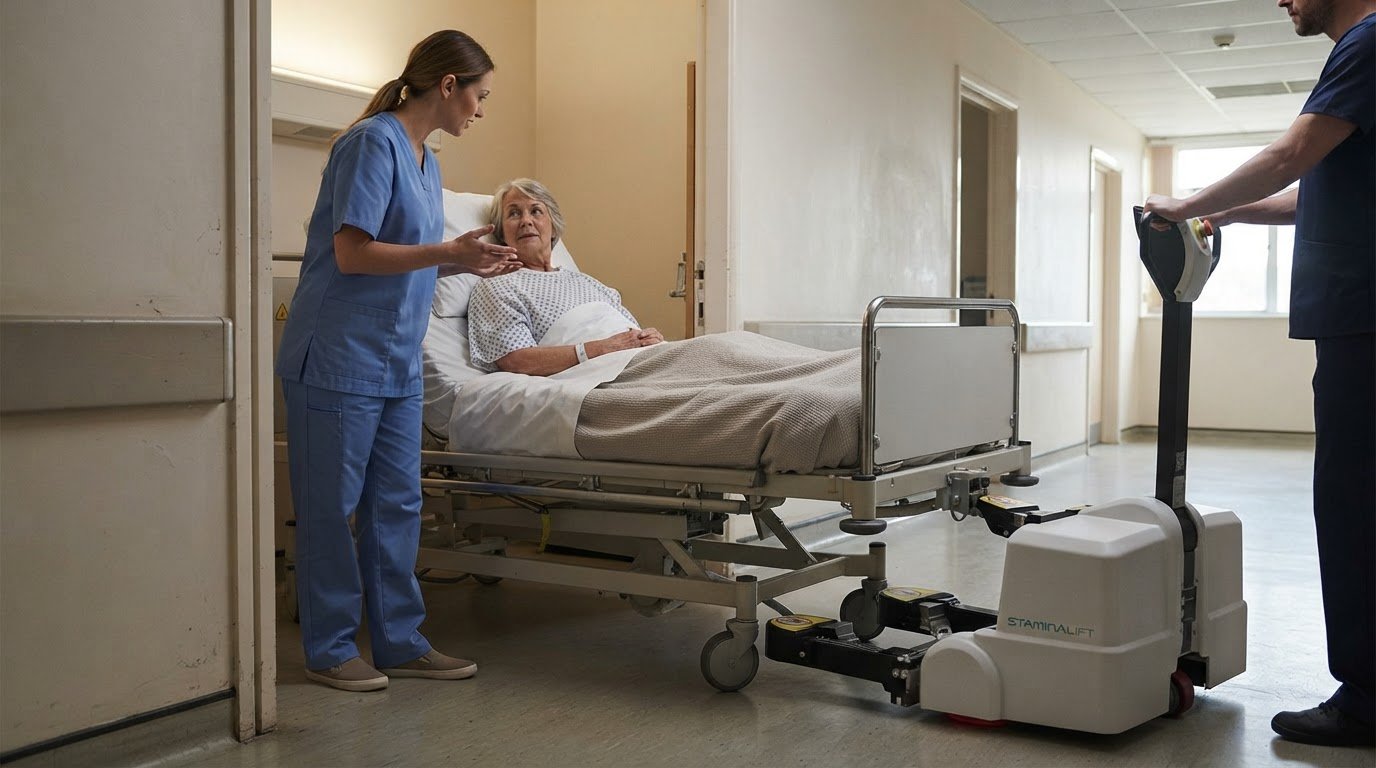
List the bed-mover model in local equipment procedures alongside its intended task and manufacturer-stated limits. Staff need to distinguish the equipment’s capacity for lifting the bed from its capacity for pushing or pulling it. For example, RIHA’s StaminaLift Transfer System 6000 is designed for bariatric and acute-care beds, with a stated capacity of 450 kg lift and 900 kg push or pull. These figures describe different operations and shouldn’t be combined or treated as patient-transfer capacity.
Procedures should also direct staff to check that the bed and intended movement fit the equipment’s stated capability, and to follow local steps if the route or equipment isn’t suitable. Set out how staff access the bed mover, report faults and arrange maintenance through the facility’s existing processes. RIHA manufactures Australian-made equipment and provides preventative maintenance and repair services for its specialised transfer systems.
For procurement planning, the hospital bed mover procurement guide can help facilities consider bed-moving requirements, while the patient handling equipment selection criteria resource addresses equipment selection for patient-handling tasks. Use each within its proper scope: a bed mover supports bed transport, while clinical transfer decisions remain governed by the facility’s approved patient assessment and procedures.
Turn the policy into a practical next step
Use your next policy review to test how the procedure works in real conditions. Walk through a planned transfer with representatives from clinical teams, portering and equipment support. Can staff find the current plan, identify the correct equipment and know what to do if the route or circumstances change? A short, structured review can expose gaps before they become routine workarounds.
Then assign an owner to address the findings and schedule a follow-up check. This keeps the bariatric patient transfer policy connected to day-to-day practice as staffing, equipment and care needs evolve. For bed movement, consider how a suitable powered solution fits your facility’s operational requirements and maintenance planning.
Explore RIHA’s bariatric bed-moving solutions and take a practical next step towards supporting your teams with equipment suited to the task. RIHA’s StaminaLift bed movers and preventative maintenance and repair services support facilities managing bed movement and equipment upkeep. Clear procedures and considered equipment choices can help build a more consistent, dignified approach to care.
Frequently Asked Questions
What should a bariatric patient transfer policy include?
A bariatric patient transfer policy should set out who makes transfer decisions, what information is recorded and how staff respond when the plan can’t be followed. Include version control so teams can identify the current procedure, plus a clear way to access it during a shift. For example, a staff member covering another ward should be able to locate the local escalation contact without relying on informal advice.
Is patient weight enough to decide how a bariatric transfer should be carried out?
No. Weight is one consideration, not a complete transfer assessment. A person’s ability to participate, current symptoms, body dimensions and the equipment available can all affect the appropriate method. For example, two people with the same weight may have different mobility, pain or clinical precautions. Staff should base the decision on the person’s present needs and the specific task, following the facility’s approved process.
Can one staff member carry out a bariatric patient transfer?
Only if the individual assessment, approved method and local procedure support a single staff member for that task. The decision shouldn’t be based on convenience or staffing pressure. Consider the person’s participation, the equipment instructions and whether the staff member can complete the planned movement safely. If the plan calls for additional assistance and it isn’t available, pause and follow the facility’s escalation process rather than proceeding alone.
How often should a bariatric patient transfer plan be reviewed?
Review it whenever the person’s needs or the transfer circumstances change, and at the intervals set by the facility’s clinical procedures. A change in mobility, pain, alertness, destination or available equipment may make an existing plan unsuitable before its next scheduled review. Record the review and communicate any amendment to relevant teams, so staff don’t rely on an outdated copy or an earlier handover.
What should staff do if the planned transfer equipment is unavailable?
Pause the transfer and notify the responsible clinician or local escalation contact. Don’t substitute equipment or use a different method simply because it’s nearby; the alternative must be suitable for the person and task under facility procedures. Staff should also report equipment faults through the organisation’s process, so it can be assessed and addressed. Resume only when an appropriate plan and required resources are in place.
Does a bariatric bed mover transfer a patient between a bed and a chair?
No. A bed mover transports a bed; it doesn’t transfer a person from a bed to a chair. That bed-to-chair movement is a clinical patient-transfer task and needs a method selected under the person’s assessed care plan. A bed mover has a separate role in moving the bed through a facility. Keeping these functions distinct helps prevent staff from treating bed-moving equipment as a patient lift.
How can a healthcare facility assess whether its bariatric transfer policy is working?
Check whether staff can find and follow the current procedure, then compare records with what happens in practice. For example, audit a sample of transfer documentation for completed assessments, clear plans and recorded reviews. Consider incident and near-miss reports alongside staff feedback, training records and recurring equipment or access issues. Use the findings to assign specific improvements, then check whether those actions have been completed and communicated.