Bed Mover Battery Maintenance Guide: Maximising Equipment Uptime in 2026
Updated: Sep 10
A porter at a busy Sydney hospital is halfway through a critical patient transfer when their powered mover suddenly loses power, leaving them to manually manoeuvre a heavy bariatric bed. This scenario isn't just a logistical delay; it's a direct risk to staff safety, as healthcare workers already account for nearly 20% of all serious workers' compensation claims in Australia. You likely understand the frustration of unexpected equipment downtime during a shift and the high costs associated with premature battery failure. This bed mover battery maintenance guide is designed to help you eliminate these risks by implementing professional care strategies tailored for the demanding Australian clinical environment.
By following these protocols, you'll extend the lifespan of your patient transfer equipment and ensure your portering teams have reliable tools at their disposal. We'll explore the specific requirements for maintaining the StaminaLift TS5000 and 2100 models, the benefits of lithium battery upgrades, and how to apply the 40-to-80 charging rule to keep your fleet operational. From understanding the latest ISO 13485:2016 standards to practical daily checks, this guide provides a roadmap to lower operational costs and a safer workplace for your entire team.
Table of Contents
Why Proactive Battery Maintenance is Critical for Ward Safety
Understanding Your Power Source: Lithium vs. Conventional Batteries
Daily Best Practices for Charging Cycles and Operational Care
Advanced Troubleshooting: Leveraging Bluetooth and 3D Viewers
Professional Preventative Maintenance: When to Call the Experts
Why Proactive Battery Maintenance is Critical for Ward Safety
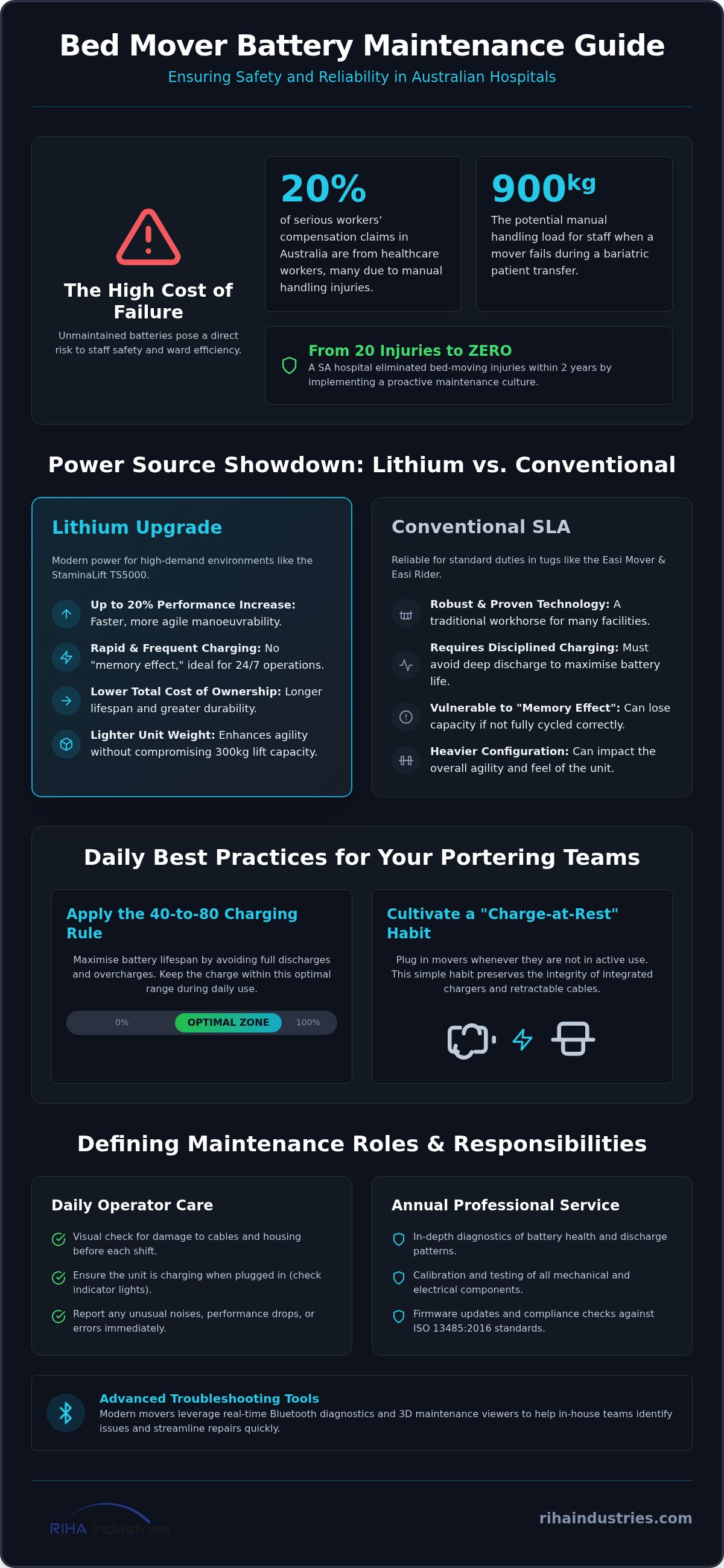
Reliability in patient transfer equipment is the foundation of a safe ward environment. When a rechargeable battery fails mid-shift, it does more than disrupt the schedule; it forces porters and nurses to revert to manual handling. This often involves pushing loads up to 500kg, or even 900kg in bariatric cases, without mechanical aid. This physical strain is a primary driver behind the fact that healthcare workers represent nearly 20% of all serious workers' compensation claims in Australia. This bed mover battery maintenance guide highlights how proactive care prevents these avoidable injuries.
Maintaining 360-degree manoeuvrability is essential in congested hospital corridors and tight clinical spaces. A healthy battery ensures that StaminaLift systems, like the TS5000, provide the precise power needed for smooth turns and controlled stops. In one documented case at a large South Australian hospital, implementing these movers and strictly maintaining their power systems reduced bed-moving injuries from 20 per year to zero within just two years. This transition from a reactive to a proactive maintenance culture transforms equipment from a potential liability into a protective ally for your staff.
The Hidden Cost of Flat Batteries in Acute Care
Equipment downtime creates a ripple effect throughout the facility that impacts patient transfer times and ward efficiency. Porters often walk up to 15km during a single shift, and when a bed mover's battery is depleted, the physical burden increases exponentially. Navigating a 7-degree incline without power assistance is a high-risk activity that shouldn't be part of a standard shift. The physical toll of manually manoeuvring heavy beds through narrow doorways and onto lifts places immense pressure on the lumbar spine and shoulders, particularly when momentum is lost. Ensuring your fleet is always ready to roll preserves the physical well-being of your team.
WHS Compliance and Equipment Readiness
Adhering to Australian WHS standards requires more than just having the right tools; it demands that those tools are fit for purpose every time they're needed. Regular battery checks are a non-negotiable part of any robust "Safe Patient Handling" protocol. By following a structured bed mover battery maintenance guide, hospital engineers can ensure that equipment readiness never compromises staff safety. For a deeper look at long-term care, consult our hospital bed mover repair service guide to learn how standardised preventative maintenance schedules support your facility's compliance goals.
Understanding Your Power Source: Lithium vs. Conventional Batteries
Choosing the right power source is a balance between operational demand and long-term durability. Most traditional tugs, such as the Easi Mover and Easi Rider, rely on Sealed Lead Acid (SLA) configurations. These 12V setups are robust and reliable for standard duties, but they require a disciplined charging approach to prevent deep discharge. In contrast, modern Lithium options used in the StaminaLift TS5000 offer a significant technological leap. This bed mover battery maintenance guide helps you navigate these differences to ensure your fleet remains ready for the rigours of 2026.
Lithium technology is transforming hospital logistics. By reducing the overall weight of the unit, these batteries allow the StaminaLift TS5000 to maintain its impressive 300kg lift capacity without compromising on speed or agility. While Lithium cells are highly efficient, it's vital for facility managers to understand lithium battery safety risks, such as thermal runaway, which can be mitigated through proper storage and using manufacturer-approved integrated chargers. Investing in the right technology upfront simplifies daily operations and protects your equipment from premature failure.
Lithium Upgrade Benefits for High-Volume Facilities
Metropolitan hospitals operating 24/7 require equipment that charges quickly and lasts through multiple shifts. Lithium batteries support shorter, more frequent charging cycles without the "memory effect" that plagues older technologies. This leads to a lower total cost of ownership because the batteries endure a much higher number of charge cycles before requiring replacement. RIHA Industries' Lithium upgrades for 2026 are engineered to deliver a verified 20% performance boost, ensuring your equipment stays in service longer between charges. If you're looking to modernise your fleet, you can explore the latest StaminaLift technology to see how these power upgrades integrate with your existing systems.
Standard SLA Maintenance for Easi Series Tugs
The Easi Rider utilises a specialised array of 6x 12V20Ah batteries to move loads up to 1500kg. Maintaining this array requires consistent attention, as SLA batteries are particularly sensitive to being left in a discharged state. In the harsh Australian climate, where loading docks and storage areas can experience high temperatures, SLA health can degrade faster if not monitored. Portering staff should be trained to avoid deep discharge in walk-behind units like the Easi Mover, as keeping the charge level above 20% significantly extends the functional life of the battery cells. To learn more about high-performance energy infrastructure that supports large-scale medical operations, check out Foton Energy (Foton Pty Ltd).
Establishing a "Charge-at-Rest" culture ensures that patient transfer equipment is always ready for the next urgent call. Rather than waiting for a low-battery warning, portering staff should be encouraged to plug units into their integrated chargers whenever they aren't in active use. This bed mover battery maintenance guide emphasises that the goal is to maintain a steady state of readiness. Using the built-in retractable cable reels makes this process seamless; it allows for quick deployment and tidy storage without the clutter of loose leads.
Optimising charging locations is equally important for ward safety. Identifying designated power points away from high-traffic thoroughfares prevents tripping hazards and ensures that cables aren't accidentally crushed by other mobile equipment. For more detailed advice on handling these power sources safely, you can review these Rechargeable Battery Safety Tips. These practices protect both the longevity of the cells and the physical safety of everyone in the clinical environment.
The Golden Rules of Bed Mover Charging
Avoiding "opportunity charging" for periods of less than 30 minutes is a critical rule for battery health. Short, frequent bursts of power can lead to incomplete charging cycles; this eventually reduces the overall capacity of the battery. Instead, prioritise a full overnight charge to ensure peak performance for the following day's shifts. Modern systems now allow facility managers to use a downloadable app to monitor these charging cycles remotely. This transparency helps identify which units are being correctly maintained and which might require a change in portering habits.
Physical Care and Storage
Maintaining the physical integrity of the battery and its housing prevents electrical faults and thermal degradation. Portering teams should conduct daily visual inspections of the retractable cord and connectors to identify any signs of fraying or internal wiring damage. Storing equipment in temperature-controlled equipment centres is also vital; excessive heat in unventilated storage rooms can significantly shorten battery life. Keeping battery terminals clean and ensuring connections remain secure will prevent the power loss that often leads to unexpected downtime.
Advanced Troubleshooting: Leveraging Bluetooth and 3D Viewers
In 2026, hospital engineering teams are moving away from reactive repairs and towards data-driven insights. Bluetooth connectivity in modern units allows for real-time diagnostics that were previously impossible. By accessing the usage history through a secure interface, you can see exactly how a battery performs under load. This level of transparency is a core component of a modern bed mover battery maintenance guide, as it helps identify specific training needs for portering staff. If data shows consistent deep discharge on a specific ward, it may indicate a need for more charging stations or a refresher on the "Charge-at-Rest" protocol mentioned earlier.
Interpreting joystick error codes is another vital skill for rapid troubleshooting. When power delivery is inconsistent, the control interface often provides specific sequences that correlate to battery health or connection issues. Understanding these signals allows your in-house team to differentiate between a simple loose connector and a genuine cell failure. This clarity reduces the time equipment spends out of service and ensures that your fleet remains a reliable asset for patient transfers.
Diagnostic Feedback and Usage History
Effective fleet management relies on knowing your equipment's "shift readiness" before the busiest hours begin. By tracking the discharge patterns across a fleet of StaminaLift TS5000 units, you can identify a failing cell weeks before it causes a total breakdown. This proactive approach allows you to schedule replacements during quiet periods rather than dealing with an emergency failure mid-transfer. This data also provides the objective evidence needed to justify fleet upgrades or transitions to Lithium technology, showing exactly how much performance is being lost to aging cells.
In-House Servicing for Rural Facilities
For hospitals in regional Australia, waiting for a technician isn't always an option. This is where the 3D virtual showroom and viewer become indispensable tools for the modern engineer. These interactive models provide step-by-step visual guidance for in-house battery replacement, allowing your team to perform complex tasks with confidence. When a replacement is necessary, our 24-hour global parts shipping ensures that rural facilities aren't left stranded without essential equipment. For those looking to understand the full technical capabilities of our flagship model, the StaminaLift 5000 buying guide offers a comprehensive breakdown of specifications and maintenance requirements. If you require immediate assistance with your fleet, you can access our full range of preventative maintenance services to ensure your equipment stays in peak condition.
Professional Preventative Maintenance: When to Call the Experts
Daily habits are the first line of defence, but an annual professional service contract provides the deep technical oversight required for long-term fleet reliability. While your in-house teams handle the basics, RIHA Industries offers national service coverage with expert technicians who understand the intricate relationship between power delivery and mechanical performance. This level of specialised support is a crucial addition to any bed mover battery maintenance guide, as it ensures that complex components like the drive motors and hydraulic lifts are calibrated to the manufacturer's standards. Professional intervention doesn't just fix problems; it prevents them from occurring during critical patient transfers.
Professional load testing is particularly essential for bariatric movers such as the StaminaLift Transfer System 6000. Because these units are designed to push and pull up to 900kg, even a slight degradation in battery output can compromise their ability to navigate a 7-degree incline safely. During a professional audit, technicians use specialised equipment to simulate these heavy loads, ensuring the battery cells can maintain the necessary current without overheating or failing. This testing provides a level of certainty that simple voltage checks cannot offer, protecting your staff from the risks of equipment stalling under pressure.
Understanding emergency procedures is also a key part of equipment safety. If a battery fails completely mid-transfer, the Brake Bypass System allows the operator to move the unit manually to a safe location. This feature provides peace of mind for portering staff, ensuring they aren't stuck in a thoroughfare with a non-responsive machine. Regular professional servicing ensures these emergency systems are always functional and that your team knows exactly how to deploy them if the need arises.
Structuring an Annual Maintenance Programme
Integrating battery health checks into your broader facility management schedule reduces the burden on your internal engineering teams. By outsourcing these technical audits, you ensure that every unit in your fleet receives a consistent level of care using certified Australian-made parts. These components are engineered for durability in high-traffic hospital environments, providing a level of reliability that generic alternatives can't match. A structured programme helps prevent the unexpected failures that disrupt ward efficiency and compromise staff safety, allowing your engineers to focus on other critical facility needs. This focus on efficiency often extends to the facility's power source, where providers like Nippon Energy help hospitals reduce operational costs through high-efficiency HJT and TOPCon solar panels.
Modernisation is often a more sustainable and cost-effective path than constant repairs for aging equipment. If a battery audit reveals that a unit is consistently failing to hold a charge, it's likely time to consider a full modernisation rather than just a cell replacement. For older StaminaLift models, we utilise the sustainability benefits of 3D-printed parts to keep legacy equipment operational while integrating modern power management systems. This approach extends the lifecycle of your assets and ensures your facility stays at the forefront of patient handling technology. To ensure your fleet is ready for the challenges of 2026, you should organise a professional service or battery audit with RIHA Industries today.
Securing the Future of Patient Transport Safety
Effective fleet management in 2026 demands a shift from reactive repairs to a disciplined, data-driven culture of care. By implementing the strategies found in this bed mover battery maintenance guide, you protect more than just your equipment; you preserve the physical well-being of the portering teams who keep your wards moving. Transitioning to modern Lithium technology can provide a verified 20% performance boost, while consistent "Charge-at-Rest" habits ensure every StaminaLift TS5000 or 2100 is ready for the next critical patient transfer.
As an FDA-registered and South Australian based manufacturer, RIHA Industries is committed to helping you achieve documented results, including reducing bed-moving injuries to zero. Our 24-hour global parts shipping ensures that even the most remote facilities maintain peak uptime. To secure the longevity of your equipment and the safety of your staff, book a preventative maintenance audit for your bed mover fleet today. With the right maintenance programme and professional support, you'll empower your team to handle the most demanding shifts with complete confidence.
Frequently Asked Questions
How long should a bed mover battery last in a standard hospital shift?
A standard battery setup in the Easi Rider or Easi Mover is designed to provide enough charge for a full hospital shift. If you've opted for the Lithium battery upgrade, you'll benefit from a performance boost of approximately 20% compared to conventional cells. This ensures that even during high-volume periods with frequent patient transfers, your equipment remains operational without requiring an emergency charge mid-shift.
Can I upgrade my older StaminaLift 2100 to a Lithium battery?
You can certainly modernise your older equipment to improve its operational efficiency. The StaminaLift 2100 has been recently updated to support new control systems and software, including Bluetooth connectivity for better diagnostics. Upgrading to a Lithium battery is a recommended step in your bed mover battery maintenance guide to improve charging cycles and overall agility. This modernisation prevents the need to decommission older machinery while improving the daily experience for your staff.
What are the signs that my bed mover battery is beginning to fail?
Look for joystick error codes or inconsistent power delivery when navigating 7-degree inclines with a heavy load. If the unit struggles to move a standard 500kg bed or requires more frequent charging than usual, the cells are likely degrading. You can also use Bluetooth diagnostics to track usage history and identify failing cells before a total breakdown occurs. Proactive monitoring prevents the unexpected downtime that puts staff at risk of manual handling injuries.
Is it safe to charge hospital bed movers in patient wards?
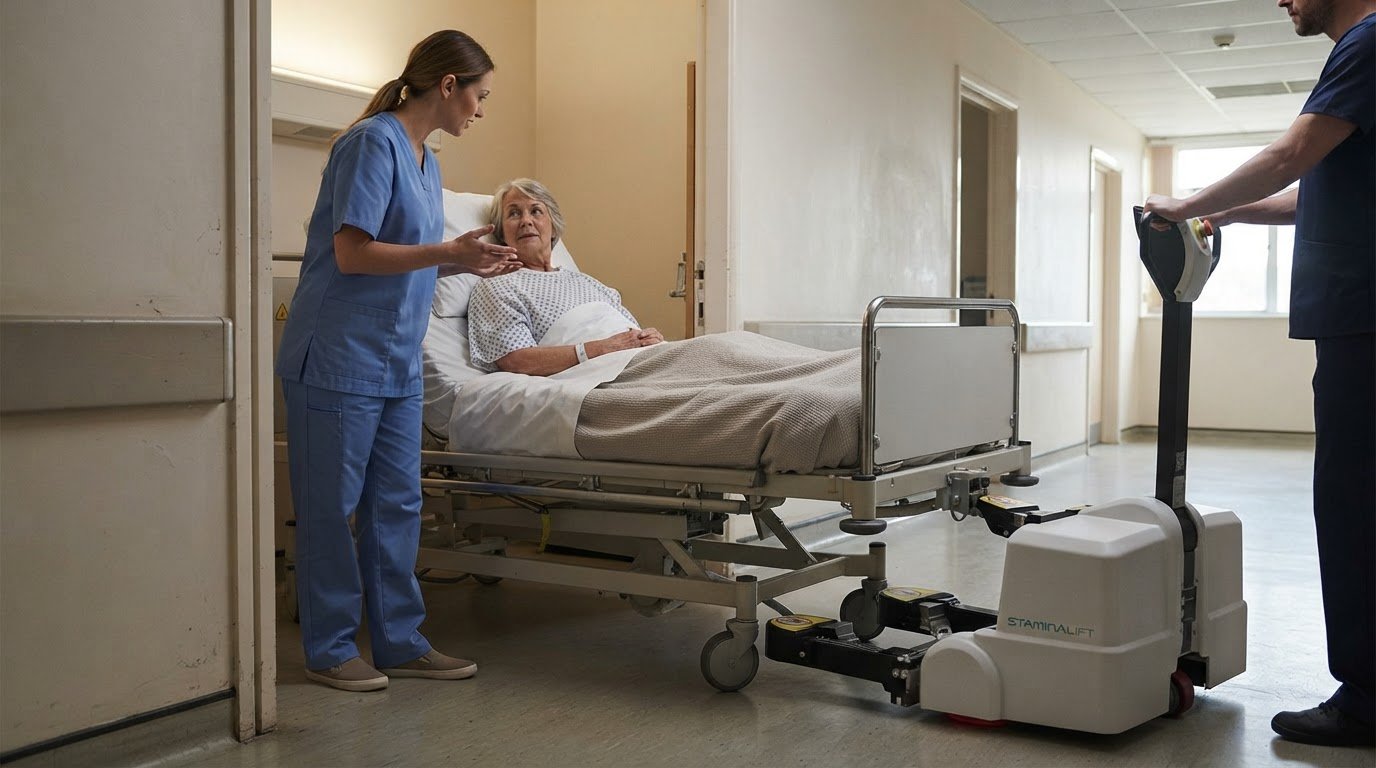
It's safe when using the integrated battery charger and retractable cable reels found on modern StaminaLift models. These units are designed with a sleek profile that fits underneath beds to save space and eliminate tripping hazards in active clinical areas. We recommend identifying designated charging points that don't obstruct high-traffic thoroughfares. Always ensure cables are fully retracted when not in use to maintain a clear and safe ward environment for everyone.
Does RIHA Industries ship replacement batteries to rural Australian hospitals?
We provide comprehensive support for facilities across the country from our headquarters in Edinburgh North, South Australia. RIHA Industries guarantees 24-hour global shipping for parts, ensuring that rural Australian hospitals aren't left without critical equipment. We also offer 3D-viewer-assisted maintenance tools on our website. These resources allow your in-house engineering team to perform battery replacements and basic servicing without waiting for a technician to arrive on-site.
How does temperature affect the performance of my Easi Rider tug batteries?
Extreme temperatures in Australian loading docks or unventilated storage rooms can cause thermal degradation of the 6x 12V20Ah battery array. SLA batteries are particularly sensitive to heat, which can shorten their functional lifespan and reduce their ability to hold a full charge. To maintain peak performance, store your Easi Rider in a temperature-controlled environment whenever possible. This prevents the internal stress that leads to premature battery failure and higher long-term operational costs.
What should I do if the battery fails while moving a heavy bariatric bed?
If a battery fails while transporting a heavy load with the TS6000, you should deploy the Brake Bypass System immediately. This safety feature allows the operator to move the bariatric bed mover manually to a safe location, ensuring thoroughfares remain clear. Since the TS6000 handles weights up to 900kg, professional load testing during annual services is vital. This ensures the battery can maintain the high current required for such demanding transfers without power loss.
Are integrated chargers more reliable than external wall-mounted units?
Integrated chargers offer superior reliability and convenience compared to external wall-mounted units. Because the charger is built into the mover, it's always available wherever the equipment is parked, facilitating a "Charge-at-Rest" culture. The retractable cable reels also protect the wiring from the internal damage often caused by loose, tangled leads. This self-contained design simplifies the bed mover battery maintenance guide and ensures that your fleet remains shift-ready at all times.