Bed Mover Return on Investment: Buy vs Lease in 2026
The lower monthly payment isn’t automatically the better-value choice. A sound bed mover return on investment comparison looks beyond the upfront price to lifecycle costs and the effect of bed movements on staff time and wellbeing.
If it’s difficult to turn daily bed moves and staff effort into a clear business case, start with your facility’s operating data. A purchase decision is more useful when it is supported by measurable evidence rather than assumptions. Gather practical inputs such as beds moved per day, staff hourly rates and equipment costs, then include applicable maintenance and repair costs in your assessment.
This article explains how to compare buying with leasing using consistent assumptions, assess operational and workforce impacts alongside financial costs, and identify the records to gather before evaluating a bed mover. RIHA’s ROI calculator helps organise key facility-specific inputs, but it does not promise savings. The aim is a clearer, evidence-based view of value for your hospital.
Table of Contents
Bed mover return on investment: what should a hospital measure?
A useful bed mover return on investment assessment starts with a specific question: which operational or workforce outcome is the facility seeking to improve, and over what period? ROI compares measurable benefits with investment costs across that period. A common calculation expresses net benefit as a proportion of investment cost. Its usefulness depends on the quality of the inputs and assumptions.
Three measures help frame the decision, but they answer different questions. ROI compares measured benefits with costs over the selected period. Payback period estimates how long it takes for benefits to equal the initial investment. Total cost of ownership considers costs across the equipment lifecycle, rather than focusing only on its purchase price. Use the measures together, not as substitutes for one another.
ROI compares measured benefits with investment costs over a defined period; payback period estimates how long it takes for those benefits to match the initial outlay.
The decision horizon matters. A short evaluation may capture immediate workflow changes but miss longer-term costs or outcomes. Bed movement volumes, routes, shift patterns and staffing arrangements also shape what a powered bed mover may change. Define the period and scope before comparing options so the assessment reflects the work the equipment is intended to support.
Which operational problem is the investment intended to address?
Establish a baseline before estimating benefits. Record how often beds move, the routes involved, who completes each task and how staffing varies across shifts. Note where manual handling pressure occurs and where bed movements compete with other staff responsibilities or contribute to delays.
Separate observed information from assumptions. Movement logs and roster records can provide facility data. Estimates about future task time or staffing changes should be labelled and validated. This makes it easier for decision-makers to see what the case demonstrates and what still needs to be tested.
What counts as a benefit in a bed mover ROI case?
Track operational inputs such as staff time spent moving beds, task distribution across roles and equipment use. RIHA’s ROI calculator uses beds moved per day, staff hourly rates and equipment costs to organise facility-specific inputs. For background on the performance measure, see Understanding Return on Investment (ROI).
Include workforce safety in the assessment. Record bed-moving injuries and relevant safety observations, but don’t automatically convert a change into a financial saving. Report the evidence plainly, including the measurement period and how outcomes were recorded. This lets leaders consider operational and workforce impacts alongside financial results without assigning unsupported monetary values.
How to calculate bed mover ROI with facility-specific data
A clear model makes the decision easier to explain and review. Start with verified operating information, state what’s assumed and compare scenarios on the same basis. This keeps the bed mover return on investment assessment connected to your facility’s workload rather than a generic example.
Core inputs for a bed mover ROI model are beds moved per day, facility-verified staff hourly rates and equipment costs. RIHA’s ROI calculator helps organise these inputs for a facility-specific assessment. Use it to structure information, not as a promise of a particular result.
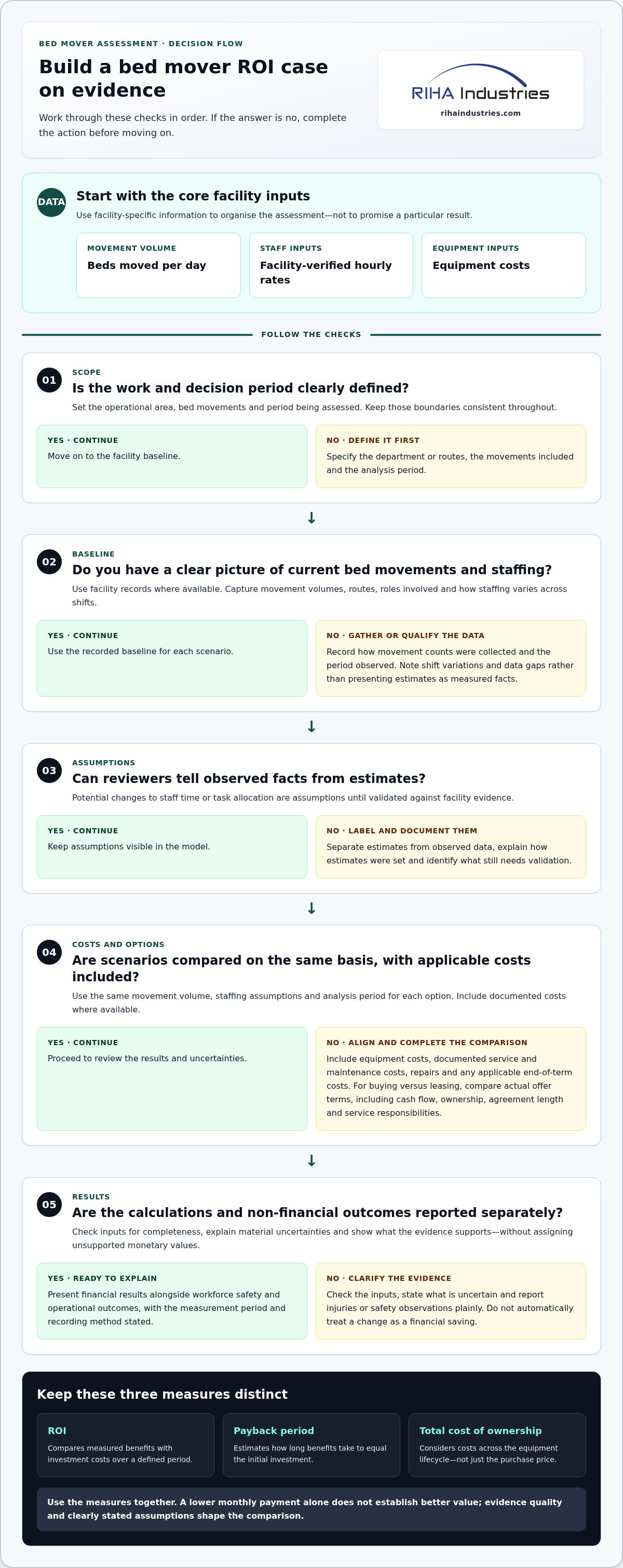
Build the assessment in a consistent sequence:
Define the scope. Specify the operational area, bed movements and decision period included. Keep the boundaries consistent throughout.
Gather baseline data. Record daily bed movement volumes, relevant staffing arrangements and the hourly rates used in the model.
Set and document assumptions. Note estimates, such as expected changes to staff time or task allocation, and distinguish them from observed facility data.
Compare scenarios. Apply the same movement volume, staffing assumptions and analysis period to each option. Include equipment costs and documented service or maintenance costs where available.
Review the results. Check that inputs are complete, explain material uncertainties and show financial calculations separately from outcomes that haven’t been assigned a dollar value.
Gather baseline data before modelling
Start with a defined unit of work, such as bed movements in a particular department or across a specified group of routes. Use facility records where available and state how the movement count was collected. A figure from a limited observation period may not represent every shift, so record the period and any known variations.
Use staff hourly rates verified by your facility and identify which roles contribute to the task. If records don’t provide a complete picture, document the gap rather than treating an estimate as a measured fact. Keep the analysis period and assumptions visible so reviewers can understand how the model was built.
Compare like-for-like scenarios
Use one consistent baseline for each scenario. If movement volume, staffing inputs or the decision horizon changes between options, the comparison may reflect those differences rather than the equipment choice. Keep the underlying assumptions aligned, then vary only the factors the scenario is intended to test.
Include equipment costs and any documented service or maintenance costs that apply to the analysis period. If a cost or outcome can’t be quantified reliably, label it instead of filling the gap with an unsupported estimate. Present workforce outcomes, such as recorded injury trends or changes in task allocation, alongside the financial results but in a separate section.
Use RIHA’s bed mover ROI calculator to organise core facility inputs, then review the assumptions behind your comparison before presenting it to decision-makers.
Buying vs leasing a bed mover: compare the full decision
A purchase and a lease can create different cash-flow and ownership outcomes. Comparing only the upfront amount with a regular payment gives an incomplete picture. For a defensible bed mover return on investment assessment, model each option using the same bed movement volume, staffing assumptions and analysis period. Then compare the costs and responsibilities documented for each option.
Lease conditions vary. Use the actual offer terms rather than assumed industry defaults, and record any details that affect the facility’s costs or obligations.
The table is a framework, not a substitute for the contract. If an offer doesn’t specify a cost or responsibility, don’t treat it as included or assign it a value. Keep documented terms separate from estimates, and make gaps visible to reviewers.
When a purchase scenario may suit the facility
Consider whether the facility values ownership and control over how the equipment is used. Build the scenario from the documented purchase cost and lifecycle costs available to decision-makers, including relevant maintenance and repair considerations. Compare those costs across the same period used for the lease model. Ownership may suit the facility’s operational preferences, but it isn’t automatically less expensive over time.
When a lease scenario may suit the facility
A lease scenario lets decision-makers examine the payment profile and contractual responsibilities without assuming what the agreement contains. Review the actual term, payment schedule, ownership position, service provisions and return conditions. Compare any included services with the facility’s documented maintenance requirements, and show separate costs in the model. Don’t assume a lease includes servicing or a particular end-of-term option.
Consider broader procurement factors alongside the financial comparison. For equipment and lifecycle planning, RIHA Industries’ bed mover information can help frame the next discussion.
Account for lifecycle costs, staff outcomes and evidence
A realistic bed mover return on investment assessment looks beyond the initial equipment cost. Set out each cost category separately so decision-makers can see what is documented, what is estimated and what remains uncertain across the chosen analysis period.
Initial equipment cost: Record the documented purchase or agreement cost relevant to the scenario.
Operating costs: Include facility-recorded costs associated with using the equipment, where available.
Servicing and repairs: Include documented maintenance and repair costs, and note who is responsible for them.
End-of-term costs: For an applicable agreement, record any specified return, removal or other end-of-term charges.
Preventative maintenance and repairs are part of lifecycle planning because they affect the costs a facility needs to consider during equipment use. Use actual records or documented terms where possible. Don’t assume a particular service cost or equipment lifespan. RIHA provides preventative maintenance and repair support for powered bed movers. Its hospital bed mover repair service guide offers further context for considering maintenance within an equipment plan.
Measure workforce outcomes without overstating financial savings
Financial calculations won’t capture every outcome that matters to staff and patients. Track bed-moving injuries and relevant workforce indicators using the facility’s own records, alongside operational measures such as task allocation. State the measurement period and recording method. Report outcomes separately if their financial value hasn’t been established.
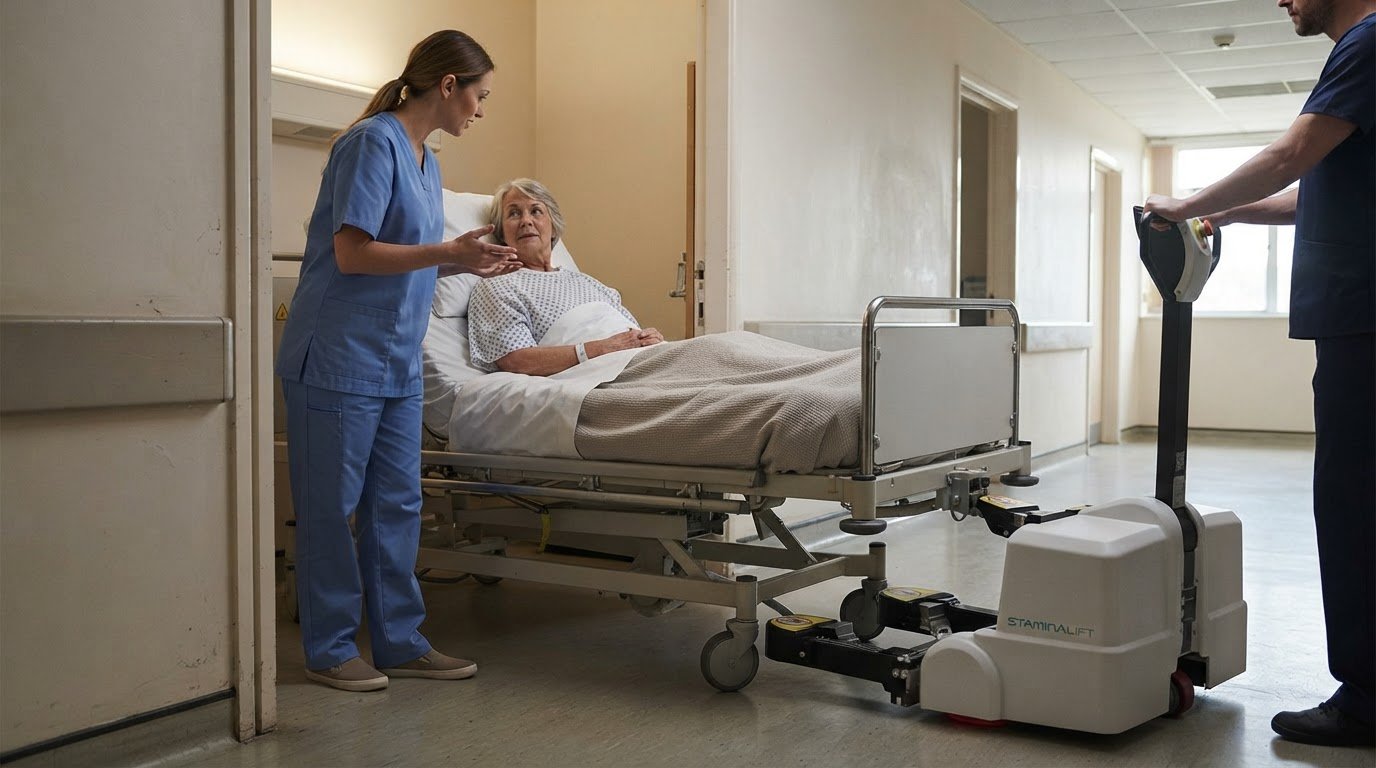
A large South Australian hospital case study reports that injuries from moving beds fell from 20 per year to zero within two years of implementing StaminaLift. This is the reported result at one hospital, not a forecast or promised outcome for another facility. Local staffing, workflows and implementation conditions differ, so use your own baseline and follow-up evidence to assess workforce impacts.
Safety and staff wellbeing remain important decision factors even when they aren’t assigned a monetary value. Present them beside the financial analysis rather than converting them into assumed savings. This gives decision-makers a fuller view without overstating what the numbers show.
Include service and equipment longevity in the model
Where available, gather maintenance records, repair history and information on equipment downtime. These details help show how servicing needs have affected operations and which costs are supported by evidence. If the facility lacks historical records, state that limitation and treat any estimate as an assumption, not a known cost.
Check which assumptions could materially change the comparison, such as usage levels, maintenance responsibilities or the period being assessed. Keep them visible so reviewers can understand how results might shift if conditions differ. RIHA’s preventative maintenance and repair support can form part of a facility’s lifecycle planning. The assessment should still reflect documented requirements and actual scenario terms.
For a lifecycle discussion grounded in your equipment needs, explore RIHA’s preventative maintenance and repair support.
Turn the bed mover ROI assessment into a practical next step
A useful assessment turns facility data into a decision that leaders can review, question and act on. Summarise the operational need, the options assessed and the evidence behind each estimate. Keep the case balanced: financial results matter, but safety and workflow outcomes also help decision-makers understand what the investment is intended to address.
Before internal review, bring these inputs together:
Baseline movements: bed movement volumes, routes and the operational area covered.
Staff inputs: relevant roles, staffing arrangements and facility-verified hourly rates.
Equipment costs: documented purchase or lease costs, plus applicable servicing, repair and end-of-term costs.
Analysis assumptions: the decision horizon, estimates used and any gaps in the available records.
Prepare a clear investment case for internal review
Keep the decision document concise. State the problem, the measured baseline, the scenarios compared and the assumptions that shape the result. Label verified figures, estimates and qualitative workforce outcomes separately. This makes the evidence easier to interpret and helps prevent an estimate from being mistaken for a recorded result.
Present calculated financial results alongside operational and safety information, such as changes in task allocation or recorded bed-moving injuries. Don’t convert workforce outcomes into savings unless the facility has a supported method for doing so. For product evaluation alongside the financial case, consider how a StaminaLift system’s battery-powered operation, joystick controls and patented attachment mechanism fit the facility’s bed-moving tasks.
Use a facility-specific assessment to determine next steps
Use RIHA’s ROI calculator to organise documented inputs, including beds moved per day, staff hourly rates and equipment costs. Treat the calculator as a way to structure a facility-specific assessment, not as a guarantee of savings or a predetermined result. Review the assumptions and outputs against local records before sharing them with decision-makers.
StaminaLift is a battery-powered bed mover with joystick controls, a patented attachment mechanism and compatibility with nearly any bed, stretcher or trolley. RIHA was recognised as Top Hospital Bed Movers and Accessories Manufacturer 2025 by MedTech Outlook. This recognition is a trust signal, not evidence of a particular facility’s ROI. That case still depends on its own usage, costs and outcome data.
RIHA supplies powered bed movers and provides preventative maintenance and repairs. Once your facility has organised its evidence, explore RIHA’s bed mover solutions as a practical next step in evaluating equipment and ongoing support.
Move from analysis to a confident decision
Turn your assessment into a practical decision pathway. Share the findings with people who understand daily workflows and those responsible for budgets and equipment planning. Their perspectives can help identify assumptions that need validation and the evidence needed to proceed, revise the scope or gather more data.
A bed mover return on investment assessment is most useful when it informs ongoing review, not just a one-off approval. Agree how the facility will track equipment use, operational changes and workforce outcomes after implementation. This gives your team a basis for comparing actual experience with the original assumptions and refining future equipment decisions.
RIHA Industries supplies powered bed movers and supports hospitals with preventative maintenance and repairs. Explore RIHA’s bed mover solutions to consider options for your facility.
With clear evidence and a shared decision process, your team can take the next step with greater confidence while keeping staff wellbeing in view.
Frequently Asked Questions
What is the difference between bed mover ROI and payback period?
ROI assesses an investment’s benefits against its costs across a selected period, while payback period estimates how long it takes for cumulative benefits to match the initial investment. They answer different questions, so a bed mover return on investment review should state its timeframe and assumptions. A decision paper might show the ROI assessment for its chosen horizon and separately note when the initial outlay could be recovered. Report unpriced safety and workforce outcomes separately.
Can a bed mover ROI calculation include benefits that are not expressed in dollars?
Yes. Report non-financial outcomes alongside the financial calculation, while keeping the categories distinct. A facility might track staff feedback about manual handling, confidence with bed-moving tasks or workflow changes using its own records and a consistent method. For example, a short staff survey could ask the same questions before and after a change. Don’t turn injury or wellbeing outcomes into dollar savings unless there’s a defensible, documented basis.
How often should a hospital review its bed mover ROI assumptions?
Review the model when a material input changes, such as bed movement volumes, staffing arrangements, equipment costs or the facility’s service approach. A hospital can also set a regular review point to compare actual operating information with the original assumptions. Keep the initial version, date each revision and explain what changed. This helps reviewers distinguish a change in facility conditions from a change in the method used to assess value.
What should a hospital do if it does not have complete baseline data?
Start with the information the facility can reliably collect, then define a simple recording method to fill the most important gaps. For example, staff could log bed movements in one ward, noting the date, route and roles involved. Mark incomplete fields and avoid substituting unsupported averages. If the sample doesn’t reflect different shifts or work areas, gather more observations before relying on it for a recommendation.
Does a lower upfront payment necessarily mean a better bed mover investment?
No. A lower initial payment describes only the cash required at the start, not the full cost or value of an option. Compare the actual agreement terms, ownership position, payment schedule, service responsibilities and any end-of-term conditions across the same assessment period. Keep expected usage consistent between scenarios. A payment that fits the current budget may still involve obligations or costs that change the overall comparison.
Can a facility use one hospital’s injury-reduction result to forecast its own ROI?
No. The reported result is specific to one hospital and shouldn’t be used as a forecast for another facility. In a large South Australian hospital, injuries from moving beds fell from 20 per year to zero within two years of implementing StaminaLift. Another facility should compare its own baseline and later records, noting differences in workflows, staff arrangements and how incidents are recorded.
Why should maintenance be considered when assessing a bed mover investment?
Maintenance matters because service needs and repairs can affect lifecycle planning and equipment availability. Review facility maintenance records, repair history and documented service responsibilities relevant to the option being assessed. RIHA provides preventative maintenance and repair support for bed movers. Keep documented requirements distinct from estimates, and record operational impacts separately where they haven’t been assigned a supported financial value.