
Best Equipment for Moving Heavy Patients: Facility Guide
What is the best equipment for moving heavy patients? It depends on the task. Repositioning or transferring a person calls for patient-handling equipment, while moving an occupied bed or a loaded trolley is a different job. Confusing these functions can leave staff with unnecessary physical demands and patients without the right support.
Safe, secure movement matters, but equipment also needs to suit the people and the space it will serve. Bed dimensions, corridors, ramps, turning areas and everyday workflows all affect whether a solution is practical.
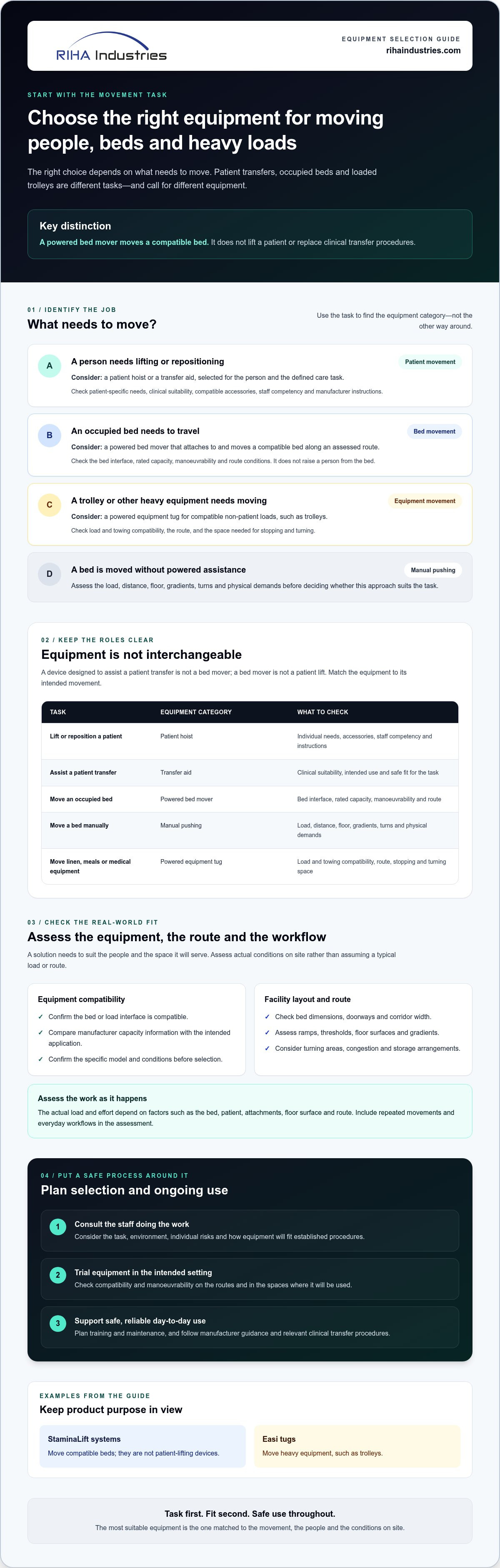
This guide compares patient-lifting equipment with powered bed movers and equipment tugs, so you can identify the categories suited to different tasks. It also explains how to assess capacity, compatibility, manoeuvrability and safe operation before procurement. StaminaLift systems move compatible beds, they are not patient-lifting devices. Easi tugs move heavy equipment, such as trolleys. Start with the movement task to make a more informed choice that supports safe handling and reliable day-to-day workflows.
Table of Contents
Best equipment for moving heavy patients: start with the task
Staff safety, patient comfort and dependable transfers are shared priorities in healthcare facilities. Begin by identifying what needs to move: a person during a transfer, an occupied bed travelling between locations, or another heavy load. These are distinct tasks, and equipment designed for one shouldn’t be assumed to do another.
A powered bed mover attaches to a compatible bed and assists with moving it. It doesn’t lift the patient or replace clinical transfer procedures. Keeping this distinction clear helps you shortlist suitable equipment and avoid relying on a powered mover for a task it isn’t designed to perform.
Patient lifting equipment versus powered bed movers
Hoists and transfer aids support specific patient movement tasks. A patient lift, for example, is designed to help move a person. The appropriate equipment and procedure depend on the individual’s needs and the facility’s assessment. A patient lift is not a bed mover.
A powered bed mover, by contrast, connects to and moves a compatible bed. It may help staff guide an occupied bed along a corridor, but it doesn’t raise a person from the bed or replace the clinical steps required for a transfer. Understanding these roles is central to choosing the best equipment for moving heavy patients and related equipment.
When does a facility need a powered mover?
A powered mover may be worth assessing where staff regularly move beds between wards, negotiate tight corridors or make repeated bed movements as part of daily workflows. A loaded bed can create substantial pushing demands, but the actual load and effort depend on the bed, patient, attachments, floor surface and route. Assess the conditions on site instead of assuming a typical load.
Check whether the mover is compatible with the beds in use, can manoeuvre through doorways and turning areas, and suits the planned route. Ramps, thresholds, congestion and storage arrangements can all affect practical use. Compare the manufacturer’s capacity information with the intended application, and confirm the specific model and conditions before selecting equipment.
A powered mover is only one part of a safe movement workflow. Consider the task, environment and individual risks together. Consult staff who perform the work and assess how the equipment would fit established procedures. For a broader framework, review these patient handling equipment selection criteria. A task-first approach helps distinguish when a patient transfer aid is needed and when powered bed movement may be more practical.
Compare equipment types for patient transfers, beds and heavy loads
The best equipment for moving heavy patients depends on what needs to move and how. A device that assists with a patient transfer isn’t interchangeable with a powered bed mover or a tug for a trolley. Use this comparison to identify the relevant category, then confirm it suits your facility’s tasks and conditions.
Equipment for lifting or repositioning a patient
Hoists and transfer aids serve specific patient movement tasks. They aren’t general-purpose substitutes for one another. Selection needs to account for the person’s needs, the task, staff competency and the equipment manufacturer’s instructions. For questions about clinical suitability, consult qualified clinicians and relevant equipment suppliers. The CDC’s Safe Patient Handling and Mobility (SPHM) information provides further context on risks associated with manual patient handling.
Equipment for moving beds and heavy loads
A powered bed mover assists with moving a compatible bed. It doesn’t lift a patient or perform a patient transfer. Manual pushing may remain part of a workflow, but repeated routes or demanding conditions are reasons to assess the physical effort and consider whether powered assistance is appropriate. Assess the actual bed and route rather than relying on assumptions about load or ease of movement.
Equipment tugs have a separate purpose: moving compatible heavy non-patient loads, such as linen, meal or medical-equipment trolleys. They aren’t patient-transfer devices. RIHA’s Easi Rider and Easi Mover are equipment tugs, while StaminaLift systems move compatible beds. For further purchasing considerations, see the hospital bed mover procurement guide. Facilities assessing powered bed movement can also review RIHA’s powered bed movers and equipment tugs.
How to assess capacity, compatibility and manoeuvrability
Choosing the best equipment for moving heavy patients means assessing the movement task, equipment and route, not relying on a powered mover’s headline capacity. A bed mover must connect securely to the bed it will move; a tug must suit the trolley or other load. Match the rated capacity to the specific task and the manufacturer’s stated conditions of use. A lifting rating and a push-or-pull rating aren’t interchangeable.
Check equipment compatibility and rated capacity
Start by documenting the equipment staff need to move. Record bed, stretcher or trolley makes and models, wheel dimensions, attachment points and features that could affect connection or clearance. Use these details to confirm compatibility with the manufacturer or supplier. A general compatibility percentage can’t confirm whether a particular item in your facility will fit.
Next, compare the exact model’s ratings with the intended application. The stated ratings for the StaminaLift Transfer System 5000 are 300 kg lift and 600 kg push or pull. For the Transfer System 6000, they are 450 kg lift and 900 kg push or pull. These are separate model ratings, not patient weight limits. Confirm the applicable rating, operating conditions and specifications for the planned use before procurement.
Include staff competency and individual patient-handling risks in the wider assessment. The U.S. Department of Veterans Affairs’ Bariatric Safe Patient Handling and Mobility Guidebook offers further planning context for facilities considering the needs of larger patients. It doesn’t replace local clinical assessment or equipment instructions.
Test the actual route and operating environment
Walk the route with the equipment configuration under consideration. Check narrow corridor turns, doorways, lift entry and exit, thresholds, ramps or gradients, and the space available at bed storage positions. A mover that fits a straight corridor may still be impractical where turns are tight or access is restricted.
During an on-site assessment, consider turning space, visibility, controls, braking, charging arrangements and what staff should do if normal operation is interrupted. Check the manufacturer’s information for operating and emergency procedures. Assess noise or potential floor impacts where these matter to the facility. A trial on representative routes can reveal constraints that measurements alone may miss.
For Australian facilities, check current hazardous manual task guidance from Safe Work Australia and the relevant state or territory regulator. Document the task, environment and chosen controls, then confirm staff can operate the equipment competently and within its instructions. This approach helps match equipment to real workflows rather than assumptions about capacity or manoeuvrability.
Plan safe implementation, training and ongoing support
Equipment can support safer movement, but it doesn’t replace risk assessment, safe work procedures or competent operation. A considered rollout helps staff understand where a device fits, how to use it within its limits and what to do if something goes wrong. Treat implementation as an ongoing process, not a one-off purchase.
Build a practical trial and training plan
Assess the movement tasks and routes, then involve the people who know them best: nurses, porters, maintenance staff and facility managers. Trial shortlisted equipment under controlled conditions using representative beds or trolleys, loads and routes. Check connections, manoeuvring, stopping and storage, and record access or workflow issues before deciding whether the equipment is suitable.
Before routine use, document who is authorised to operate the equipment, what training they need and which operating limits apply. Include the manufacturer’s instructions, pre-use checks, charging arrangements and steps for escalating faults or unexpected movement. Review the plan with staff after the trial and update local procedures as needed. The best equipment for moving heavy patients supports a reliable workflow only when people understand its role and limitations.
Include maintenance and service in procurement
Ask prospective suppliers about preventative maintenance, repairs, replacement-parts availability and service coverage. Confirm what applies to the specific model and your facility. Check that staff can access current operating manuals, fault-reporting instructions, relevant diagnostics and approved servicing resources. Establish responsibility for routine checks, battery condition and reporting equipment that appears damaged or isn’t working as expected. Follow the manufacturer’s maintenance instructions rather than setting unsupported inspection intervals.
After implementation, review usage, reported faults, near misses and incidents alongside staff feedback. These checks can highlight route problems, training gaps or maintenance needs, but can’t guarantee injuries will be eliminated. Australian work health and safety requirements can vary by jurisdiction, so check current guidance from Safe Work Australia and the relevant state or territory regulator.
For practical planning, use this hospital bed mover maintenance guide to consider ongoing care as part of procurement. If you’re assessing powered bed movers or preventative maintenance and repairs, discuss your equipment requirements with RIHA Industries.
When a powered bed mover may suit your facility
A powered bed mover may be worth considering if staff move beds repeatedly, the beds are compatible with the mover, and a task assessment identifies a practical need for powered assistance. It can support movement along an assessed route, but it won’t lift a patient or replace clinical transfer procedures. Compatibility, user training, operating limits and maintenance all need to be part of the decision.
The best equipment for moving heavy patients depends on the movement involved. For lifting or transferring a person, assess patient-handling equipment separately. For moving a compatible bed, consider a bed mover; for heavy equipment loads such as trolleys, consider an equipment tug.
Match RIHA equipment to the movement task
RIHA Industries’ StaminaLift systems are powered bed movers, not patient-lifting devices. The StaminaLift Transfer System 5000 may suit a facility’s bed-moving workflow if the specific bed configuration is compatible. RIHA states that this model is compatible with 95% of hospital beds, but that general figure doesn’t confirm fit for an individual bed. Check the connection and application-specific ratings with the manufacturer before selection.
The StaminaLift Transfer System 6000 may be considered for assessed bed-moving requirements in bariatric or acute-care settings. Confirm the model’s ratings and operating conditions for the intended application rather than assuming suitability from the setting alone. Easi Rider and Easi Mover are equipment tugs for heavy non-patient loads, such as trolleys. They don’t lift or transfer patients.
RIHA is an Australian manufacturer and provides national service coverage in Australia. As part of procurement, confirm the service arrangements relevant to your location and equipment, including available preventative maintenance and repair support.
Prepare for a facility-specific discussion
Before discussing options, gather bed and trolley makes and models, attachment details, route information, movement frequency and feedback from the staff who perform the work. Include constraints such as narrow turns, thresholds, ramps, lift access and storage. These details keep the discussion focused on the actual task and the conditions the equipment must handle.
Ask RIHA whether a practical demonstration can be arranged for your equipment and routes, and clarify training, maintenance, repair and parts arrangements before procurement. Confirm the demonstration’s availability and scope directly. For a discussion about equipment for your facility, discuss equipment for your facility.
Make your next equipment decision with confidence
The best equipment for moving heavy patients starts with a clear distinction: equipment for transferring a person serves a different purpose from a powered mover for a bed or an equipment tug. Match the device to the movement task, then check compatibility, capacity and the route it must travel. Include staff input, training and ongoing maintenance so the equipment can support a safe, dependable workflow.
RIHA Industries manufactures powered bed movers and equipment tugs in Australia and provides national service coverage. The StaminaLift Transfer System 5000 is stated to be compatible with 95% of hospital beds, but each bed configuration still needs to be checked. RIHA also offers preventative maintenance, repairs and staff training; confirm the current service scope when discussing your requirements.
Prepare details about your beds, routes and movement needs, then discuss equipment for your facility. A careful, task-specific review can help your team move forward with greater clarity and confidence.
Frequently Asked Questions
What is the best equipment for moving heavy patients?
The best equipment depends on whether the task is transferring a person, moving an occupied bed or transporting another heavy load. Patient hoists and transfer aids support specific patient movement tasks, while powered bed movers assist with compatible beds and equipment tugs move loads such as trolleys. Assess patient needs, equipment compatibility, capacity, route conditions and staff training before choosing. Seek clinical advice about patient-transfer suitability.
Can a powered bed mover move a patient in a hospital bed?
Yes. A powered bed mover can assist with moving an occupied bed if the bed configuration is compatible and the intended use fits the manufacturer’s ratings and instructions. The mover moves the bed, not the patient independently. It doesn’t lift someone from the bed or replace clinical transfer procedures. Before use, confirm the combined load, route conditions, connection and operating requirements with the manufacturer.
What is the difference between a patient hoist and a bed mover?
A patient hoist is designed to assist with moving a person during a defined care task, subject to clinical assessment and manufacturer instructions. A bed mover attaches to a compatible bed and assists with moving it along a route. It doesn’t lift a person from the bed. The categories aren’t interchangeable, so select equipment according to the movement task and consult qualified clinicians about clinical suitability.
How do I choose equipment for moving heavy beds safely?
Start by identifying the beds, load, movement frequency and routes involved. Record bed makes and models, wheel dimensions and attachment details, then confirm compatibility and application-specific capacity with the manufacturer. Assess corridors, turns, thresholds, ramps and lifts in the facility. Include staff consultation, user training, operating procedures, maintenance and fault reporting in the plan. A powered mover supports, but doesn’t replace, risk assessment and safe work practices.
How much weight can a hospital bed mover move?
Capacity depends on the model and movement application. RIHA states that the StaminaLift Transfer System 5000 is rated for 300 kg lift and 600 kg push or pull, while the Transfer System 6000 is rated for 450 kg lift and 900 kg push or pull. These ratings are separate and aren’t patient weight limits. Confirm the current model specifications, conditions of use and applicable rating with the manufacturer.
Can one staff member operate a powered bed mover?
Some powered bed movers, including StaminaLift systems, are designed for single-person operation. Whether one staff member can perform a particular movement safely depends on the equipment model, bed compatibility, route, load, operating procedure and facility risk assessment. Staff need appropriate instruction and must follow manufacturer guidance. Confirm staffing requirements for your use case rather than assuming single-person operation is suitable in every situation.
What should healthcare facilities check before buying patient-moving equipment?
Define the movement task first: patient transfer, occupied-bed movement or transport of another load. Then check equipment compatibility, manufacturer-rated capacity, route access, manoeuvrability, controls and operating instructions. Involve staff who will use or maintain the equipment, and consider training, charging, maintenance, repairs and replacement-parts arrangements. Trial the equipment under controlled conditions where possible, and verify current local work health and safety guidance before finalising the plan.
Does RIHA equipment lift patients?
No. RIHA’s StaminaLift systems move compatible beds; they aren’t patient-lifting devices and don’t replace hoists or clinical transfer procedures. Easi Rider and Easi Mover are tugs for heavy equipment loads, such as trolleys, not for lifting or transferring people. A StaminaLift model’s stated lift rating relates to its specified equipment application, not a patient’s weight. Confirm the intended use and model ratings with RIHA before selection.


