Calculating Patient Handling Equipment ROI Guide
What if the strongest case for patient handling equipment isn’t a headline savings figure, but a clearer picture of what happens across an entire shift? Calculating ROI on patient handling equipment can be challenging when reduced staff effort and smoother workflows are hard to quantify, while purchase, training and servicing costs may sit in different budgets. A credible decision starts with your facility’s own baseline, not a broad promise of savings.
This guide shows how to build a transparent, facility-specific ROI case that weighs labour, safety, workflow and whole-of-life costs. The aim isn’t to assume a guaranteed saving, but to make the inputs and assumptions clear enough for finance, procurement and clinical teams to assess together.
We’ll look at practical measures such as beds moved per day, staff time and hourly rates, alongside equipment fit, utilisation, training and ongoing maintenance. You’ll also see how to compare options consistently, so decision-makers can understand both the investment and the operational value it may deliver in your facility.
Table of Contents
What does ROI on patient handling equipment actually measure?
Patient-handling equipment ROI compares the measurable benefits of an investment with its costs over a defined period. It’s a facility-specific estimate of the financial value associated with using equipment, compared with the investment required over that period. It’s an estimate, not a promise of savings: the result depends on local movement volumes, staffing, equipment use and the benefits your facility can substantiate.
Start with a baseline, such as current bed movements, staff time and the number of people involved in each task. Compare it with a clearly defined future scenario, using consistent assumptions and a stated timeframe. The general Return on investment concept provides the financial framework, but your facility’s data gives the calculation meaning. This makes calculating ROI on patient handling equipment more useful than relying on a broad, vendor-wide savings claim.
ROI, payback period and whole-of-life cost: what is the difference?
These measures answer different questions. ROI expresses net benefits as a percentage of the investment, helping assess the return relative to the amount invested. Payback period estimates how long it takes for net benefits to recover the initial investment. Annual net benefit shows estimated benefits minus costs in a particular year, supporting budget planning.
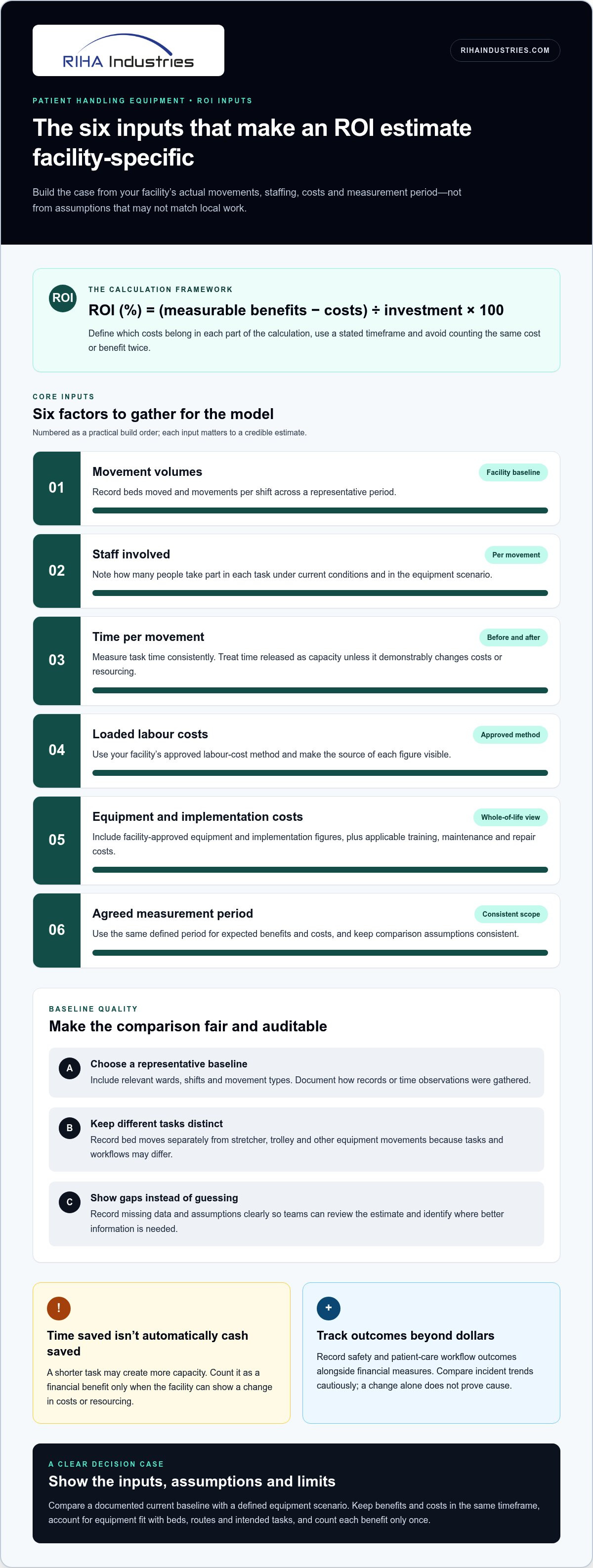
Total cost of ownership considers the costs of using equipment across its life, not only the purchase price. Depending on the facility’s records, this may include training, servicing and repairs. A general formula is ROI (%) = (measurable benefits − costs) ÷ investment × 100. Define which costs sit in each part of the calculation, and avoid counting the same cost twice.
Why manual handling and workforce outcomes belong in the business case
Repeated bed movements can draw staff time and effort away from other work. If equipment changes how a task is completed, record the actual difference in time, staffing and workflow under local conditions. A reduction in task time may create more capacity, but it isn’t automatically a cash saving. Count it as a financial benefit only when the facility can show how that capacity changes costs or resourcing.
Track safety and patient-care workflow alongside financial measures. These outcomes help clinical and operational teams understand the broader case, even where they can’t be reliably converted into dollars. Avoid unsupported movement-distance figures, such as daily or weekly kilometres, unless their source and relevance to your facility are verified. For practical criteria to assess equipment fit and use, see our patient handling equipment selection criteria.
Inputs for Calculating Patient Handling Equipment ROI
A reliable estimate depends on inputs that reflect actual work, not ideal conditions. At a minimum, a facility-specific ROI estimate needs movement volumes, staff involved, time per movement, loaded labour costs, equipment and implementation costs, and an agreed measurement period. Keep the source and assumptions for each figure visible so teams can review and update them.
How to establish a reliable manual-handling baseline
Choose a representative period that captures relevant wards, shifts and movement types. Record beds moved, movements per shift, staff involved in each movement and the time taken. Keep bed moves separate from stretcher, trolley and other equipment movements, as their tasks and workflows may differ.
Use operational records, time observations or other facility data consistently, and note gaps rather than filling them with guesses. Document how the baseline was gathered and any assumptions before comparing it with an equipment scenario. This makes the calculation easier to audit and helps teams identify where better data is needed.
Which investment and operating costs belong in the model?
Enter equipment and implementation costs using facility-approved figures, then list ongoing costs separately. Depending on the proposed setup, the model may need to account for training, planned maintenance, repairs and other recurring expenses. Use the same time period for expected benefits and costs, and avoid treating the purchase figure as the only investment.
Procurement decisions also affect whether equipment fits the facility’s beds, routes and intended tasks. Our hospital bed mover procurement guide outlines considerations that can help teams define the equipment option being costed. For safety context, OSHA’s Safe patient handling programs resource discusses workplace injury risks and related financial considerations. Use your own incident records and approved costing method for the ROI model.
How to quantify time, staffing and safety outcomes responsibly
Measure staff time per movement before and after a workflow change, then assess whether time released becomes usable capacity. Reduced task time doesn’t necessarily mean a cash saving. Record the operational effect separately unless it demonstrably changes expenditure or resourcing. Count each benefit only once, rather than valuing the same time saving under several headings.
Track incidents and restricted duties using consistent internal definitions and reporting periods. Compare trends cautiously: a change after equipment is introduced doesn’t, on its own, prove the equipment caused it. Clear records help clinical, finance and procurement teams distinguish measured outcomes from assumptions. As you shape the equipment scenario, explore RIHA bed movers and tugs as options to assess against your facility’s requirements.
How do you calculate ROI on patient handling equipment step by step?
A transparent calculation connects day-to-day handling activity with costs and measurable benefits over the same analysis period. When calculating ROI on patient handling equipment, keep the scope narrow enough to check, and make every assumption visible to both clinical and finance teams.
Step-by-step: turn operational data into a transparent calculation
Define the scope. Name the ward, equipment option, movement type and analysis period. Compare like with like.
Set the baseline. Use facility records to establish movement volumes, staff time and staffing for the tasks in scope.
Enter investment and operating costs. Include facility-entered equipment and implementation costs, plus relevant training, maintenance and repair costs. Keep one-off and recurring costs distinct.
Estimate measurable benefits. Use documented changes in labour time or other outcomes, and count only benefits the facility can support with evidence.
Test assumptions. Recalculate using cautious utilisation and benefit assumptions, then record what changes the result.
For the chosen period, calculate net benefits as total measurable benefits minus included costs. Then apply: ROI (%) = net benefits ÷ investment × 100. Label each input with its source, time period and calculation method. Treat recurring costs consistently across the analysis period, and don’t include them in both the net-benefit calculation and investment denominator. This lets another reader reproduce the result rather than rely on a headline percentage.
How to handle injury reduction without overstating the case
Keep recorded injury changes separate from projected avoided costs. Incident trends can be affected by reporting practices, staffing changes and other safe-work initiatives, so a change after equipment is introduced doesn’t prove the equipment caused it. A CDC-hosted study discusses safe patient handling programmes and return on investment within 1-4 years; treat this as research context, not a promised result for your facility.
What an illustrative ROI example should include
Use placeholders, not assumed prices or savings. Set out the equipment investment as [E], implementation and training as [I], annual operating costs as [O], and measured annual benefit as [B]. State how staff time contributes to [B], and include it only if the released time creates usable capacity or a substantiated cost change.
For a multi-year analysis, show how you treat recurring costs and benefits over the selected period. Present a central estimate beside a conservative scenario with lower utilisation or more modest measured benefits. If injury-related benefits are included, identify them as estimates and explain the evidence and assumptions behind them. Don’t describe them as guaranteed equipment savings.
How should you compare ROI scenarios and test your assumptions?
Scenario analysis shows how the result may change if real-world use differs from your estimate. A useful ROI comparison tests the assumptions that matter most, while keeping the scope, analysis period and baseline consistent. Compare the current manual-handling approach with powered equipment and any alternative equipment under consideration. Change only assumptions you can explain, such as expected movements, time saved, staffing costs, equipment uptime or maintenance needs.
Build conservative, expected and higher-use scenarios
Use a conservative case to reflect lower utilisation or smaller time savings, an expected case based on the best available facility evidence, and a higher-use case only where there’s a clear rationale. Keep the baseline fixed so differences between scenarios are easy to trace. These are projections, not confirmed outcomes before implementation.
Apply the same cost categories and calculation method to each scenario. If maintenance needs or equipment availability are uncertain, show how the estimate changes rather than quietly treating an optimistic assumption as fact. This makes calculating ROI on patient handling equipment more useful for decision-making by showing a range of plausible outcomes, not a single figure with false certainty.
Compare equipment fit as well as financial return
A favourable estimate matters only if the equipment can work in the intended environment. Assess bed compatibility, required load capacity, turning space and the routes used for movement. Check these practical factors across the same tasks and wards included in the financial comparison.
Likewise, treat one-person operation as an assumption to validate against local staffing, task design and safe-work procedures, not an automatic reduction in labour costs. The StaminaLift 5000 buying guide can help inform equipment considerations alongside your facility’s requirements.
Prevent double-counting and false precision
Released staff time shouldn’t be counted both as a labour saving and as increased throughput unless evidence shows both benefits occur independently. Keep injury-related costs separate from time savings, and distinguish observed incident data from projected changes. Where inputs are uncertain, present a range or scenario rather than an overly precise prediction.
Use the scenario results to guide the next step: explore RIHA bed movers and tugs as equipment options to assess against your facility’s workflows and assumptions.
How can RIHA help turn an ROI estimate into a practical equipment decision?
An ROI estimate becomes more useful when it’s connected to the movement tasks, equipment and operating conditions in your facility. RIHA’s ROI calculator organises key inputs, including beds moved per day, staff hourly rates and equipment costs. Its output is an estimate based on the information entered, not a guarantee of savings or payback. Use it alongside your assumptions about utilisation, staffing, training and ongoing maintenance.
RIHA designs and manufactures Australian-made bed movers and tugs, including StaminaLift and Easi equipment. Match the movement task to a suitable option, then assess compatibility and how the equipment will work on your routes. The StaminaLift Transfer System 5000 is compatible with 95% of hospital beds. The StaminaLift Transfer System 6000 is designed for bariatric and acute care beds, while Easi Rider and Easi Mover tugs move heavy equipment such as linen and meal trolleys. These distinctions help keep your ROI estimate grounded in operational fit as well as financial assumptions.
What to include in an equipment assessment with RIHA
Bring together movement volumes, the types of equipment being moved, routes, staffing patterns and practical constraints such as turning space or access. Record the beds and other equipment involved so the assessment can distinguish bed-moving tasks from stretcher, trolley or other movements. The aim is to identify which tasks align with a bed mover or tug, rather than assume one option fits every movement.
Use the same operational criteria your team applies to the wider decision. Our patient handling equipment selection criteria can help structure that review alongside your facility-specific ROI inputs.
How service, training and maintenance affect long-term value
Purchase and implementation are only part of the picture. Include staff training, preventative maintenance and repair planning when considering whole-of-life value, as these affect how equipment is incorporated into daily work and maintained over time. RIHA provides national service coverage in Australia, a relevant consideration for facilities planning ongoing support across their operations.
For practical maintenance considerations, refer to the hospital bed mover maintenance guide. Include applicable servicing and repair inputs in the same analysis period as the expected benefits, rather than assessing the initial equipment cost alone.
A simple next-step checklist for decision-makers
Bring finance, procurement, clinical and facilities representatives together to review the same assumptions.
Record the baseline, selected scenario, analysis period and success measures before implementation.
Identify which equipment and movement tasks are in scope, and note uncertainties that need follow-up.
Use the facility’s inputs to prepare questions for a relevant equipment assessment.
With shared assumptions and clear measures, teams can assess both projected value and practical requirements. Discuss an ROI assessment with RIHA as a next step in evaluating equipment for your facility’s bed-moving needs.
Build an ROI case your whole team can trust
Calculating ROI on patient handling equipment is most useful when it reflects your facility’s actual movements, staffing and operating conditions. A clear baseline, consistent cost inputs and realistic scenarios help finance, procurement and clinical teams assess value together. Consider staff capacity, safety and workflow alongside financial measures, and include training and maintenance when weighing whole-of-life costs.
RIHA’s ROI calculator uses beds moved per day, staff hourly rates and equipment costs to organise a facility-specific estimate. Treat the result as a planning aid, not a guaranteed saving or payback. RIHA’s Australian-made bed movers and tugs, national Australian service coverage, preventative maintenance and repair support can also inform your assessment of ongoing operational needs.
Bring your baseline, assumptions and success measures together, then discuss an ROI assessment for your facility with RIHA. A transparent, practical case is a strong foundation for choosing equipment that supports safer, more efficient work.
Frequently Asked Questions
How do you calculate ROI on patient handling equipment?
Calculate ROI by dividing net benefits by the investment, then multiplying by 100. First define the equipment, movement tasks and analysis period; then use facility data to estimate measurable benefits and include relevant investment and operating costs. Keep assumptions traceable and compare the result with a conservative scenario. The percentage is an estimate based on those inputs, not a guaranteed return.
What costs should be included when calculating equipment ROI?
Include the equipment investment and applicable implementation costs, then account for operating expenses over the selected period. Depending on the facility and equipment, these may include staff training, preventative maintenance and repairs. Use costs recorded or approved by your organisation, and apply the same period to costs and benefits. Separating one-off investment from recurring costs helps prevent omissions and double-counting.
Can patient handling equipment reduce staff injury costs?
It may help reduce physical demands associated with handling tasks, but any effect on injuries or related costs must be measured rather than assumed. Track incidents and restricted duties using consistent internal definitions and reporting periods, and compare results with the baseline. Changes may also reflect staffing, reporting practices or other safety initiatives, so don’t attribute every difference to equipment or count projected injury savings as certain.
How do you measure time savings from a bed mover?
Observe comparable bed movements before and after introducing the mover, recording task duration, staff involved and movement type. Use a representative set of shifts and repeat observations where practical. Multiply the measured time difference by the facility’s movement volume to estimate time released, then assess whether it becomes usable capacity or changes resourcing. Time saved isn’t automatically a cash saving, so report the operational effect separately unless a cost change is evidenced.
What is the difference between ROI and payback period?
ROI expresses net benefits as a percentage of the investment over a stated period. Payback period estimates how long it takes for net benefits to recover the initial investment. ROI helps compare return relative to investment, while payback helps assess the time taken to recoup the outlay. Both rely on clear facility inputs, and neither should be treated as a guaranteed result.
How can a hospital compare patient handling equipment options fairly?
Compare each option over the same period and for the same wards, movement types and baseline workload. Apply consistent methods to labour costs, utilisation, training, maintenance and expected task time. Also assess operational fit, including compatibility with relevant equipment, routes and staffing patterns. Show conservative and higher-use scenarios with assumptions visible, so teams can see how the result changes without mistaking projections for confirmed outcomes.
Does RIHA provide an ROI calculator for patient handling equipment?
Yes. RIHA’s ROI calculator uses beds moved per day, staff hourly rates and equipment costs to organise a facility-specific estimate. Enter your own figures and review the assumptions alongside local workflow, utilisation and whole-of-life costs. The calculator is a planning aid, not a guarantee of savings or payback. Its estimate is most useful when finance, procurement and clinical teams review the inputs together.