Electric Bed Mover Safety Guide for Healthcare Teams
A safe bed move is decided before the equipment starts moving. Even a capable electric bed mover needs a team that knows its roles, checks the equipment and controls the route. Effective electric bed mover safety protocols cover the whole task, not just the controls. If staff are unsure what to inspect, how to assess ramps or when to stop and escalate, a clear, repeatable procedure can make each move more consistent.
Safe transport depends on preparation, communication and sound judgement in the moment. This guide sets out practical steps healthcare teams can use before, during and after a move, including pre-use checks, operator responsibilities, route planning and responses to hazards such as collisions or confined spaces. It also explains why staff training, model-specific operating limits, compatible attachments and ongoing maintenance belong in the protocol. The aim is a shared approach that helps staff move beds with greater control and confidence while keeping patient and team safety at the centre.
Table of Contents
Electric bed mover safety protocols: why every healthcare facility needs a clear process
Build an electric bed mover protocol around checks, limits and clear roles
Use a step-by-step protocol to prepare the route and move a hospital bed
Respond to faults, emergencies and near misses without improvising
Make electric bed mover safety protocols part of training and equipment planning
Electric bed mover safety protocols: why every healthcare facility needs a clear process
A facility-approved protocol turns safe bed movement into a consistent process rather than a judgement call made in a busy corridor. It should set out the steps for preparation, operation and follow-up, including who can operate the equipment, how hazards are managed and what to do if conditions change. Align the procedure with current local work health and safety (WHS) guidance, the facility’s risk assessment and the instructions for the specific mover model.
Keep the risks distinct. Patient and bed safety includes maintaining appropriate care, keeping lines and attached equipment clear, and reaching the destination without disruption. Mover and operator safety includes correct attachment, controlled operation and avoiding unnecessary physical strain. Route and bystander safety covers obstacles, other people and the space needed to manoeuvre. A move can affect all these areas at once, so the protocol needs to address them together.
Consider how the factors interact: a heavy load leaves less margin for an uneven threshold, while a tight turn makes a secure attachment and clear view especially important. An operator who hasn’t been trained on that model may not recognise when the route or load is beyond the equipment’s documented limits. The protocol should make clear that movement stops if a safe, controlled move can’t be maintained.
Which risks should the protocol control?
Include unintended movement, loss of control, poor attachment and collisions with people or equipment in busy corridors. Assess route-specific hazards such as ramps, thresholds, tight turns and restricted visibility before setting off. Address patient-care risks, including interference with lines, alongside staff handling risks and hazards to the mover or nearby equipment. If the route or conditions change, pause and reassess instead of continuing by assumption.
Who is responsible for safe bed movement?
Facility procedures should assign clear responsibilities. The operator checks the equipment and route, confirms the attachment and follows the model instructions. A supervising manager oversees authorisation, training and consistent application of the procedure. Maintenance staff manage inspection, servicing and fault reporting in line with facility processes. Only trained, authorised staff should operate the mover. Everyone involved should know who can stop a move and how to escalate a concern.
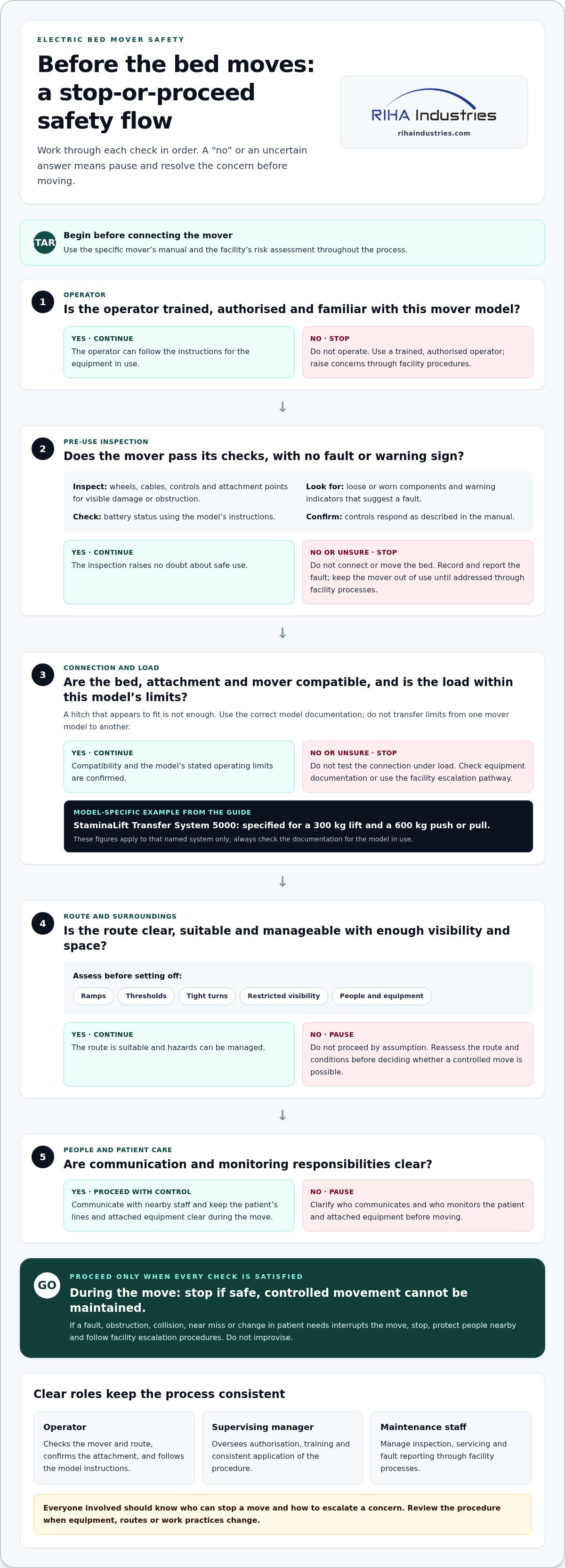
Build the procedure around practical questions staff can answer before moving:
Is the operator authorised and familiar with this mover model?
Are the bed, attachment and mover compatible, and is the load within the model’s stated limits?
Is the route clear and suitable, with enough visibility and space to manoeuvre?
Who is communicating with nearby staff and monitoring the patient and attached equipment?
What is the facility’s response if a fault, obstruction or change in patient needs interrupts the move?
Use the applicable model manual for operating limits, checks and emergency procedures, and connect those instructions to the facility’s local risk assessment. This keeps the protocol grounded in the equipment actually in use and the conditions staff face on site. Review the procedure when equipment, routes or work practices change, so the written steps remain usable across teams and shifts.
Build an electric bed mover protocol around checks, limits and clear roles
A consistent pre-use process helps staff catch problems before connecting or moving a bed. Make electric bed mover safety protocols specific to the equipment in use, and assign responsibility for completing checks, authorising operation and reporting faults. A checklist should support the applicable model manual and facility risk assessment, not replace them.
What should operators check before connecting a mover?
Before each use, inspect the mover and the intended connection point. Look for visible damage, loose or worn components, and warning indicators that suggest a fault. Confirm battery status and that the controls respond as described in the manual. Don’t connect equipment if a check raises doubt.
Look over wheels, cables, controls and attachment points for visible damage or obstruction.
Check battery status and warning indicators using the model’s instructions.
Confirm the selected hitch or attachment is designed for the bed or transfer device.
Check that the mover and bed are compatible before making the connection.
Record and report faults through the facility’s equipment process, and keep the mover out of use until the concern is addressed under that process.
A hitch that appears to fit isn’t enough. If compatibility is uncertain, stop and refer to the equipment documentation or facility escalation pathway rather than testing the connection under load.
How should facilities set roles and operating limits?
Document who authorises staff to use each mover, who completes and records pre-use checks, and who receives equipment fault reports. Operators should be trained and authorised for the specific equipment. Supervisors should ensure the procedure is followed, while maintenance personnel manage faults and servicing through established facility processes.
Set limits using the correct model documentation, including rated load and permitted gradient. Don’t transfer figures from one model to another. For example, the StaminaLift Transfer System 5000 is specified for a 300 kg lift and a 600 kg push or pull. The StaminaLift Transfer System 6000 is specified for a 450 kg lift and a 900 kg push or pull. These figures apply to different operations and models, so staff should use the applicable manual and account for the bed, attachment and load as directed there.
Include a clear stop-work rule: don’t connect or operate the mover if it’s damaged, compatibility is uncertain, a warning appears, or the load or gradient is outside approved limits. Secure the situation, report the concern and follow the facility’s escalation process. No one should be expected to improvise around a fault or an unclear operating limit.
Equipment-specific instruction helps turn written checks into consistent practice. RIHA provides staff training for its bed movers and transfer systems, supporting facilities as they establish clear, model-based procedures. Equipment-specific bed mover training can form part of the facility’s approach to authorisation and refresher learning.
Use a step-by-step protocol to prepare the route and move a hospital bed
A defined sequence helps staff move a bed with control from the starting point to its destination. Electric bed mover safety protocols should cover the route, patient-related equipment, communication and the final parking position. Staff should follow the facility’s procedures and the mover’s instructions throughout.
A safe route check confirms that the path and destination are clear, visible and suitable for the bed, mover and planned movement.
How should staff prepare the bed and route?
Start by confirming the destination and checking the whole route before connecting the mover. Look beyond obvious obstacles: doorways, lift access, corners, thresholds and ramps can all affect clearance or control. Prepare the bed and manage patient lines or attached equipment according to clinical procedures. If the route can’t be made suitable, pause and plan an alternative rather than setting off and hoping to manage.
Assess the destination. Confirm it is ready to receive the bed and that there is space to approach, turn and park as planned.
Clear and assess the route. Remove avoidable obstacles and consider doors, lifts, corners, thresholds, ramps, visibility and expected traffic. Follow facility procedures for any route feature that may affect safe movement.
Prepare the bed and patient-related equipment. Set up the bed as required by clinical procedures. Secure or monitor lines and attached equipment so they’re managed throughout the journey.
Attach the mover. Use the compatible attachment for the bed or transfer device and connect it as directed in the model instructions. Don’t proceed if the connection is uncertain.
Test the controls. Check their response in accordance with the applicable manual and facility procedure before beginning the move.
Move with communication. Tell nearby staff that the bed is moving, maintain a controlled pace and keep the route and patient-related equipment under observation.
Park and secure the equipment. Position the bed at the destination, then secure the bed and mover as directed by the equipment instructions and local procedures.
What should happen while the mover is in motion?
Keep communication clear between the operator and nearby staff, particularly at doorways, corners and shared corridors. Avoid rushing to keep up with workflow. The operator should maintain control and a view of the route. If visibility is restricted, congestion develops or someone enters the path, stop movement when it’s safe to do so and reassess.
Stop and reassess if the bed shifts, an obstacle appears, a line or attached item becomes difficult to manage, or control feels uncertain. Don’t try to force the bed through a tight turn or across a route feature that no longer appears manageable. Follow the facility’s escalation procedure if a safe path can’t be restored.
At the destination, confirm the bed is positioned as intended before disconnecting or leaving the equipment. Use the model instructions and local procedures for parking and securing. Don’t assume the same steps apply to every mover. A deliberate final check helps the team finish the move without leaving an avoidable hazard for the next person using the space.
Respond to faults, emergencies and near misses without improvising
A clear response protects the patient, staff and others nearby when a bed mover stops or behaves unexpectedly. Make the sequence part of your electric bed mover safety protocols: stop movement, protect people, follow the model-specific emergency instructions and escalate through the facility’s process. Don’t force a stalled mover, attachment or bed to continue. An improvised response can introduce further risk, particularly when the cause of the fault is unknown.
What should staff do if the mover stops or behaves unexpectedly?
Use a calm, consistent response. The operator should stop movement and alert nearby staff, while those present protect the patient and keep others clear of the immediate area. Avoid pulling, pushing or manually releasing a connection unless the relevant model instructions and facility procedure direct that action.
Stop the movement using the method specified for that equipment, then keep the area as safe as conditions allow.
Attend to the patient and nearby people in line with clinical procedures. Check whether the bed, lines or attached equipment need immediate attention.
Follow the model’s emergency instructions. If an emergency jaw, brake or other release procedure is required, use only the steps documented for that specific mover. Procedures can differ between models.
Escalate the concern to the designated supervisor or maintenance contact and report what happened through the facility’s equipment process.
Keep the mover out of service until the fault has been assessed and the facility’s authorised process permits its return to use.
If the mover stops during a journey, don’t assume the issue is a flat battery or a simple obstruction. Secure the situation first, then use the documented procedure and escalation pathway. Staff shouldn’t troubleshoot beyond their training or bypass a safety control to complete the transfer.
How should facilities learn from incidents and near misses?
Record near misses as well as incidents that cause harm or equipment damage. A concise, factual account gives the facility useful information for review without relying on memory after a busy shift. Include:
The mover’s model or equipment identity, and the bed or attachment involved.
Where the event happened, including relevant route conditions such as a threshold, ramp, tight turn or obstruction.
What staff observed, what actions they took and whether the patient or others needed assistance.
Any warning indicators, visible damage or control behaviour noted at the time.
Relevant clinical, safety and maintenance staff can review the account to identify contributing factors and decide whether a practical change is needed. The issue may relate to the route, communication, training, attachment or equipment condition. Use findings to refine procedures or staff instruction where appropriate, then share updated guidance with affected teams so it can be applied consistently.
Reliable fault assessment and planned equipment care support this process. Arrange preventative maintenance and repair support to manage bed mover concerns through an established equipment-care pathway.
Make electric bed mover safety protocols part of training and equipment planning
A written procedure is useful only if staff can apply it during a real move and the equipment remains suitable for its intended use. Make electric bed mover safety protocols part of induction, supervised practice, equipment checks and scheduled review. A shared framework also helps teams maintain consistent expectations across shifts, even when staff use different models or work in different clinical areas.
How can a facility embed the protocol in staff training?
Training should be practical and specific to the mover and its instructions. Have staff demonstrate connection, control checks, controlled movement and stopping under supervision. Assess their understanding against facility policy and the applicable product instructions, including how to recognise when to pause and escalate rather than continue. Provide refresher training when equipment, procedures or responsibilities change.
Use a simple responsibility framework to make the protocol part of routine work:
Training: Supervisors organise equipment-specific instruction and assess staff readiness under facility policy.
Checks: Authorised operators complete and record required checks, and report faults through the facility’s process.
Operation: Trained staff follow the relevant manual, facility procedure and approved limits during each move.
Review: Relevant managers and maintenance staff review faults, near misses and equipment records, then update procedures or training where useful.
Keep instructions accessible where staff need them, and ensure each shift knows how to find the correct model manual. This reduces reliance on informal handovers or remembered steps, especially when an operator is using equipment they don’t handle every day.
How can RIHA equipment and support fit the facility plan?
Equipment planning should begin with the facility’s assessed tasks, bed and transfer-device compatibility, operating environment and model-specific limits. RIHA’s range includes the StaminaLift 2100 Bed Mover and the StaminaLift Transfer System 5000 and 6000. Select and document equipment against its intended use, then build its specific instructions into staff training and local procedures. RIHA provides staff training, preventative maintenance and repair support to help facilities implement their equipment plans and manage the equipment lifecycle.
Facilities considering the TS5000 can use the StaminaLift 5000 buying guide to inform equipment planning. For ongoing care, the hospital bed mover repair service guide can help frame maintenance as a planned part of the equipment lifecycle rather than a response only after a fault.
Keep service and inspection records with the equipment’s identity, checks, reported faults and maintenance actions. Reviewing these records alongside staff feedback can help facilities spot recurring issues, clarify responsibilities and decide whether training or procedures need adjustment. The result is a protocol that stays connected to daily practice as equipment and team needs evolve.
Put your safety protocol into practice
Make the next step manageable: assign someone to coordinate a facility review of your current procedure, then agree how staff will use it in day-to-day work. A protocol should be easy to find, clear enough to follow under pressure and practical for the spaces where beds are moved. Invite staff to flag confusing steps or recurring barriers, so the procedure can be refined as equipment and working conditions change.
Use electric bed mover safety protocols as a living part of your team’s approach, not just a document stored away after approval. A consistent process supports clearer decisions, shared expectations and a more confident response when a move doesn’t go to plan.
For facilities planning their equipment and support approach, explore RIHA Industries bed mover and patient transfer solutions. Take the next step towards a practical routine that supports both staff and patients.
Frequently Asked Questions
What should be included in an electric bed mover safety checklist?
Include checks that confirm the mover is ready for the specific task, not just generally operational. Alongside battery status, visible condition and control response, record the equipment identity and check that the chosen attachment suits the bed. Confirm the bed and load sit within the limits for that model and operation. A completed checklist should also make it easy to note defects and show whether the mover is cleared for use.
Who should be allowed to operate an electric bed mover in a hospital?
Only staff authorised by their facility and trained on the relevant equipment should operate it. A general understanding of powered equipment isn’t a substitute for learning that mover’s controls, attachment method and stop procedure. Facility managers should define how authorisation is granted and recorded, including what happens if someone hasn’t used the model recently. If an operator is unsure of a step, they should pause and seek direction before connecting or moving a bed.
Can one staff member safely move a hospital bed with an electric bed mover?
Some bed movers are designed for single-person operation, but that doesn’t mean every move is suitable for one staff member. The operator must be trained, and the bed, attachment, route and task must fit the equipment instructions and facility risk assessment. For example, a route with restricted visibility or complex patient equipment may call for additional staff support under local procedures. Don’t treat operator numbers as a substitute for assessing the move.
What should staff do if an electric bed mover stops during a transfer?
Stop the transfer and make the immediate area safe before attempting any further action. Attend to the patient and nearby people in line with clinical procedures, then use only the emergency steps in that mover’s manual. Don’t force the attachment or try an unfamiliar release. Notify the designated supervisor or maintenance contact, document the fault and keep the unit out of service until it has been assessed and cleared through the facility’s process.
How often should electric bed movers be inspected and maintained?
Follow the inspection and servicing schedule in the applicable model documentation and the facility’s equipment-management procedure. Complete the required pre-use checks, and arrange planned maintenance at the intervals specified for the equipment. A fault, unusual behaviour or damage should prompt reporting and assessment rather than waiting for the next scheduled service. Keep records of checks, repairs and return-to-service decisions so maintenance staff can review the equipment’s history and outstanding issues.
Are electric bed movers safe to use on hospital ramps?
They may be suitable only when the specific mover’s instructions permit the ramp’s gradient and the complete move remains within approved limits. Assess the slope, load, surface, route clearance and visibility before proceeding. Don’t assume a mover’s ability to travel on one incline applies to every model or load. If the gradient is unknown, exceeds the documented limit or feels difficult to control, stop and follow the facility’s alternative transport or escalation procedure.
What training do staff need before using a powered bed mover?
Staff need practical instruction for the particular model and its approved attachments, followed by assessment against facility procedures. Training should cover connection, control response, movement in representative spaces, stopping and what to do if operation becomes uncertain. Include how to check model-specific limits and where to find emergency instructions. RIHA provides product training and certification, which facilities can incorporate into operator authorisation and refresher training when equipment or procedures change.