
Electric Tug for Medical Equipment: The 2026 Reference Guide for Hospital Logistics
- 3 days ago
- 12 min read
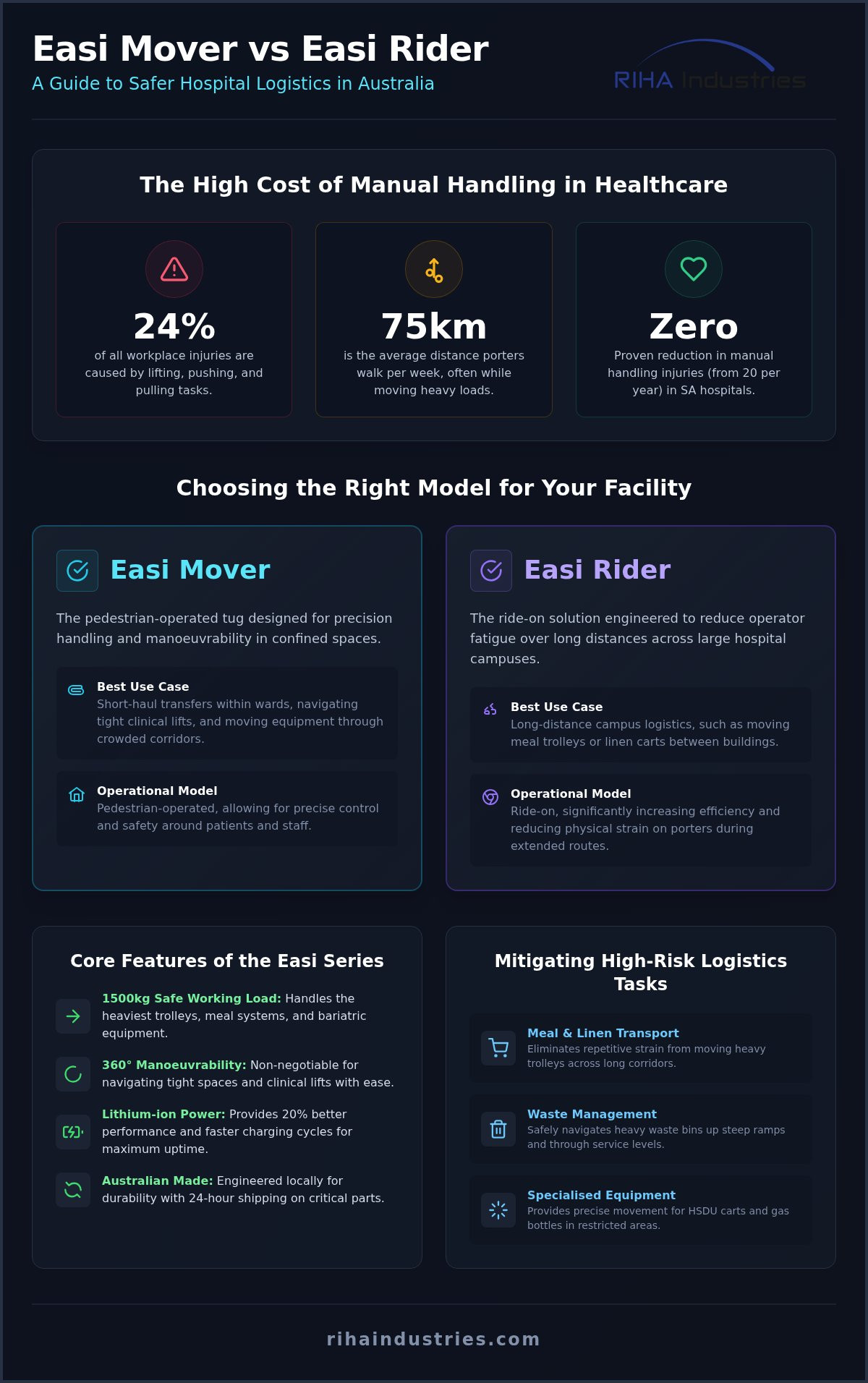
Did you know that lifting, pushing, and pulling tasks account for 24% of all workplace injuries across Australia? In a high-pressure clinical environment, these physical demands often lead to chronic back injuries for nurses and porters who must manoeuvre heavy equipment through tight lifts and up steep ramps. Choosing the right mechanical assistance is no longer just a matter of convenience; it's a critical safety requirement for your facility. When evaluating the Easi Mover vs Easi Rider, it's essential to understand how each Australian-made tug addresses these specific ergonomic challenges while maintaining 360-degree manoeuvrability in crowded wards.
We understand that your primary goal is to protect your staff while keeping equipment transfers efficient and seamless. This 2026 reference guide reveals how integrating powered tugs can reduce manual handling injuries from 20 per year to zero, as proven in major South Australian hospitals. You'll learn about the technical specifications of the Easi series, the importance of local parts support, and how to select the ideal model to streamline your hospital's unique logistics workflow.
Table of Contents
The Evolution of Hospital Logistics: Why Electric Tugs are Essential in 2026
Easi Mover vs Easi Rider: Technical Reference for Medical Tugs
Evaluating Compatibility: Hitches, Weight Capacities, and Manoeuvrability
Operational Safety and WHS Compliance in Australian Healthcare
RIHA Industries: Leading the Way in Australian-Made Medical Tug Solutions
The Evolution of Hospital Logistics: Why Electric Tugs are Essential in 2026
An electric tug for medical equipment is a battery-powered pedestrian or ride-on device designed to move heavy wheeled loads with minimal physical effort from the operator. Deciding between the Easi Mover vs Easi Rider requires a clear understanding of the modern clinical environment. By 2026, the Australian healthcare sector has seen a marked shift in how logistics are managed. The old method of porters and nurses manually pushing heavy carts is being phased out in favour of motorised assistance. This isn't just about speed; it's about managing a 2026 landscape where rising patient volumes and the increasing frequency of bariatric care mandate a safer approach to movement.
The physical toll on staff is often underestimated by those outside the logistics department. Hospital porters typically walk up to 15km per shift, which accumulates to a staggering 75km every single week. When those kilometres involve pushing heavy linen or meal trolleys, the cumulative strain on the lower back and shoulders is immense. Whether you're comparing the Easi Mover vs Easi Rider, the goal remains the same: reducing the physical burden on your team. Relying on staff to "push through" the pain is no longer a sustainable Work Health and Safety (WHS) strategy. Instead, facilities are integrating advanced material-handling equipment (MHE) to bridge the gap between human capability and operational demand.
Identifying High-Risk Logistics Tasks
Certain movements within a hospital are notorious for causing injury. Identifying these tasks is the first step toward creating a safer work environment:
Meal and Linen Transport: Moving heavy trolleys across long facility corridors causes repetitive strain and fatigue.
Waste Management: Navigating heavy waste bins and clinical containers through basement levels and steep ramps.
Specialised Equipment: Precisely moving HSDU carts and gas bottles in tight spaces where manual control is difficult.
Understanding how to reduce porter back injuries is essential for any facility manager looking to improve workplace safety through mechanical intervention.
The ROI of Motorised Logistics
The financial impact of a single musculoskeletal injury claim in an Australian hospital can be astronomical when you consider medical costs, legal fees, and the expense of hiring agency staff to cover the gap. Efficiency gains are also immediate, as one operator can safely perform tasks that once required two people to push and steer. The true return on investment for a motorised tug is found in the significant reduction of staff absenteeism and the long-term retention of experienced porters who are no longer forced into early retirement by physical strain.
Easi Mover vs Easi Rider: Technical Reference for Medical Tugs
Selecting the right tool for hospital logistics requires a careful balance between spatial constraints and transport distance. Both the Easi Mover and Easi Rider are engineered with a 1500kg Safe Working Load (SWL), ensuring they can handle the heaviest logistics trolleys, meal delivery systems, and bariatric equipment found in modern healthcare facilities. While their towing capacity is identical, their operational application differs significantly based on the layout of your facility. When comparing the Easi Mover vs Easi Rider, the decision typically rests on whether your porters are navigating short-haul ward transfers or long-distance campus logistics.
Powering these advancements is a significant shift toward Lithium-ion battery technology. This transition provides 20% better performance over traditional deep-cycle gel batteries and supports faster charging cycles. This means your fleet stays on the floor for longer periods, reducing the need for mid-shift swaps and ensuring that equipment is always ready for urgent transfers. If you're looking to upgrade your facility's fleet, exploring Australian-made logistics solutions can provide the durability and local support your team needs to maintain peak efficiency.
Easi Mover: Precision Handling for Wards
The Easi Mover is a compact, walk-behind tug designed specifically for high-traffic clinical areas. Its small footprint makes it the preferred choice for navigating busy ward corridors and sterile clinical spaces where precision is paramount. Safety remains a core focus of this design. The 'Back Off Button' serves as a critical fail-safe, instantly reversing the unit if it makes contact with the operator. This prevents porters from being pinned against walls or other equipment in tight spaces. For more detailed information on these walk-behind units, you can refer to our Easi Mover technical guide. It is perfectly suited for pharmacy trolleys, sterile supply carts, and bariatric wheelchairs where the operator needs to remain close to the load for maximum control.
Easi Rider: Efficiency for Long-Distance Transport
In large metropolitan hospitals where corridors can stretch for kilometres, the Easi Rider offers a ride-on solution that prioritises staff well-being. By allowing the operator to stand on a stable platform, it eliminates the fatigue associated with walking long distances between separate hospital wings or buildings. Despite its ride-on capability, it retains a 360-degree turning circle, which allows it to manoeuvre effortlessly in tight lift lobbies and narrow hallways. Integrating these units into daily linen and catering workflows ensures that your team stays fresh and productive throughout their entire shift, effectively reducing the risk of musculoskeletal strain over time.
Evaluating Compatibility: Hitches, Weight Capacities, and Manoeuvrability
One of the most persistent frustrations in hospital logistics is the "Universal Compatibility" challenge. Most facilities house a diverse fleet of assets, ranging from modern theatre tables to decades-old HSDU carts. When choosing between the Easi Mover vs Easi Rider, the physical connection to these loads is just as important as the motor's power. A tug is only as effective as its hitch; if the connection isn't secure or requires complex manual adjustment, the safety benefits are compromised. Effective logistics requires a system that bridges the gap between the machine and the asset without creating new risks for the operator.
Manoeuvrability is another non-negotiable factor, particularly in older Australian hospitals featuring narrow corridors and heritage lift layouts. A 360-degree turning radius allows the operator to pivot the load within its own length. This level of precision ensures that heavy equipment can be positioned exactly where it's needed without the need for multiple shunt manoeuvres. To protect the hospital's hygiene standards and floor aesthetics, these units are equipped with non-marking tyres. This prevents unsightly scuffs on polished ward floors while maintaining the necessary grip for safe transport across different surfaces.
Safety on inclines is managed through automatic electromagnetic braking systems. These systems are specifically rated to hold a full 1500kg load on a 7-degree ramp, providing an essential fail-safe if the operator releases the controls. This level of control is vital for basement-level waste management and transporting goods between facility levels where ramps are the only path. The braking system engages instantly, ensuring the load remains stationary and secure even in high-traffic public areas.
The Science of the Hitch: Pin vs. Adjustable
The method of attachment varies based on the trolley frame. Pin hitches remain the standard for many meal and linen trolleys, typically utilising 22mm stainless steel pins for a robust and reliable connection. However, specialised medical equipment often features irregular round or square tube frames that don't accommodate a standard pin. Patented adjustable hitches solve this by using foot-operated systems that secure frames ranging from 20mm to 40mm. Whether you deploy the Easi Mover vs Easi Rider, the effectiveness of the unit relies on this science of the connection. For facilities prioritising absolute ergonomics, electric adjustable hitches offer push-button height control, which eliminates the need for porters to bend down during the hitching process.
Navigating Gradients and Narrow Spaces
Moving a 1500kg load up a 7-degree ramp requires significant torque and a stable centre of gravity. The engineering behind the Easi series ensures that the tug effectively 'disappears' under the load. This compact, space-saving design reduces the overall footprint of the combined unit, which is essential for avoiding tripping hazards in public-facing areas. When assessing your facility's specific needs, it's helpful to view these tools within the broader context of hospital porter equipment to ensure every logistics constraint is addressed with precision.
Operational Safety and WHS Compliance in Australian Healthcare
Meeting the 2026 Australian criteria for 'Safe Work' is no longer a matter of choice; it's a regulated obligation for every healthcare facility. The transition to updated Codes of Practice in 2026 means that managing manual handling risks is now a mandatory standard rather than a recommendation. When evaluating the Easi Mover vs Easi Rider, safety features like programmable lockout controls are vital. These systems prevent unauthorised personnel from operating the equipment in public-facing hospital areas, ensuring that only trained porters can initiate a transfer. Additionally, keeping the hospital environment peaceful is a priority for patient well-being. These units operate at a quiet 65 dB, ensuring that essential logistics don't disturb patient recovery or clinical consultations.
Bluetooth connectivity provides a sophisticated layer of oversight that was previously unavailable in traditional material handling. By monitoring equipment utilisation, facility managers can identify specific wards where staff might need additional training or where equipment is being underused. This data-driven approach ensures that your investment is being utilised safely across the entire facility. If you're looking to align your facility with the latest safety standards, you can request a safety compliance consultation to review your current logistics workflow and identify potential risks before they lead to injury.
Smart Fleet Management and Diagnostics
Real-time battery monitoring via the dedicated mobile app prevents the 'dead-on-floor' scenarios that can stall critical transfers in a busy ward. This transparency allows for proactive charging schedules rather than reactive troubleshooting. Whether your team prefers the walk-behind or ride-on model, the choice between Easi Mover vs Easi Rider often comes down to the specific diagnostic data provided by the fleet management system. For facilities in rural or remote areas, the inclusion of 3D-viewer diagnostic tools is a game-changer. It allows local engineers to perform in-house servicing with remote assistance from South Australian experts, ensuring that a minor technical issue doesn't lead to weeks of downtime.
Cleaning and Infection Control
Infection control is a cornerstone of clinical safety. The Easi series utilises high-grade stainless steel components to ensure longevity and hygiene in sterile environments. High IP ratings are standard, making the equipment suitable for 'wet' areas such as hospital kitchens or waste bays where spills are common. Safe washdown procedures are clearly defined, allowing staff to maintain strict hygiene standards without the risk of damaging sensitive electronics. This focus on durability ensures that the equipment remains a reliable, sanitary part of the hospital's infrastructure for years to come.
RIHA Industries: Leading the Way in Australian-Made Medical Tug Solutions
Choosing a logistics partner is about more than just selecting a machine; it's about securing a long-term commitment to staff safety and operational reliability. RIHA Industries provides a distinct advantage through direct engagement with our manufacturing facility in Edinburgh North, South Australia. This local presence allows for a level of customisation that global distributors simply cannot match. Because "off-the-shelf" solutions rarely account for the unique dimensions of specialised theatre tables or HSDU carts, our engineering team works directly with facility managers to ensure every asset in the hospital can be moved safely. This bespoke approach transforms complex physical challenges into streamlined, repeatable workflows.
Sustainability and equipment longevity are core pillars of our manufacturing philosophy. We utilise advanced CAD design and 3D printing technologies to produce precision components, often allowing us to keep older medical equipment operational for longer by creating custom hitching interfaces. This focus on durability protects your capital investment while reducing environmental waste. The results of this engineering-first approach are tangible. In one major South Australian hospital, the implementation of our powered transfer solutions helped reduce manual handling injuries from 20 per year to zero within just two years. It's a proven record of success that provides peace of mind to hospital executives and frontline porters alike.
The Easi Rider and Easi Mover Difference
When evaluating the Easi Mover vs Easi Rider, you're investing in certified Australian-made quality that meets the rigorous demands of both government and private hospital procurement. Every unit in the Easi series is engineered with a 1500kg towing capacity, providing the raw power needed to move heavy medical loads without straining the operator. Our commitment to high-stakes performance is best seen in systems like the StaminaLift Transfer System 6000. In real-world clinical settings, these systems allow a single operator to move nearly a tonne of equipment up a gradient with total control, replacing the multi-person teams previously required for such high-risk tasks.
Maintenance and Long-Term Support
Operational downtime is a significant risk in a 24-hour clinical environment. To mitigate this, we provide 24-hour shipping for spare parts across Australia and New Zealand, ensuring that your fleet remains on the ward rather than in the workshop. Our preventative maintenance programmes are designed to identify wear and tear before it leads to equipment failure, maintaining the reliability of your logistics chain. For detailed guidance on keeping your fleet in peak condition, you can refer to our hospital bed mover repair service guide. By combining local manufacturing with proactive support, we ensure that your facility remains a safe, efficient environment for both staff and patients.
Future-Proofing Your Hospital Logistics Workflow
Modernising your facility's approach to equipment transport is a significant step toward protecting your most valuable asset: your staff. By transitioning from manual handling to motorised assistance, you align your operations with the highest safety standards while significantly improving ward efficiency. Selecting the right tool, whether through a comparison of the Easi Mover vs Easi Rider, ensures that your porters and nurses can navigate complex hospital layouts without the risk of chronic injury. This strategic investment not only meets current WHS obligations but also builds a more resilient and sustainable logistics framework for the years ahead.
As a certified Australian-made and FDA-registered manufacturer, RIHA Industries is dedicated to providing the engineering excellence required in high-stakes clinical environments. Our systems have already helped facilities achieve a zero-injury track record in SA hospitals, proving that thoughtful design can solve the most demanding physical challenges. To see how these solutions can be tailored to your specific equipment and floor plan, request a custom demonstration of our Easi Series tugs today. We look forward to helping you create a safer, more empowered workplace for your entire team.
Frequently Asked Questions
Do I need a special licence to operate an electric tug in an Australian hospital?
No, you don't need a specialised heavy machinery or forklift licence to operate these units. Use of this equipment typically falls under internal Work Health and Safety (WHS) competency training. Most facilities require a short practical induction to ensure staff are familiar with the controls, safety fail-safes, and hitching procedures before they begin moving loads in public areas.
Can one electric tug be used for different types of trolleys and theatre tables?
Yes, versatility is a core feature of the Easi series. While standard pin hitches are used for many linen and meal trolleys, patented adjustable hitch systems allow a single unit to secure various frame shapes and sizes. This flexibility is a major advantage when comparing the Easi Mover vs Easi Rider for a facility that manages a diverse fleet of medical assets.
How long does the battery last on a standard hospital portering shift?
A single charge is engineered to last a full eight-hour shift under normal operating conditions. The transition to Lithium-ion technology has significantly improved runtime and reduced charging intervals. Staff can monitor the battery status in real-time via a mobile app, which helps prevent equipment from being left in corridors with insufficient power to complete a transfer.
Are electric tugs safe to use on hospital ramps and steep inclines?
Yes, these units are specifically designed to manage gradients safely. They feature automatic electromagnetic braking systems that engage the moment the operator releases the controls, holding the load securely on the ramp. This provides a critical safety buffer when navigating basement waste bays or moving heavy equipment between multi-level facility buildings.
What is the difference between a walk-behind and a ride-on tug for hospital use?
The primary difference relates to the transport distance and the level of precision required. Walk-behind models offer the highest level of manoeuvrability in tight clinical spaces and wards. Ride-on models are designed for long-distance logistics across large metropolitan campuses, as they eliminate the fatigue associated with walking several kilometres during a shift.
How do I maintain an electric tug in a rural healthcare facility?
Maintenance is managed through a combination of remote diagnostics and local support. Bluetooth connectivity allows our engineers to troubleshoot issues via a mobile app, often identifying a fix without a site visit. Because the equipment is Australian-made, spare parts are shipped from the South Australian facility within 24 hours to minimise downtime in regional areas.
Can electric tugs be used to move bariatric equipment and heavy waste bins?
Yes, both models are rated to move loads up to 1500kg. This capacity is more than sufficient for bariatric beds, large clinical waste containers, and heavy HSDU carts. Using a powered tug for these heavy loads ensures that staff are not exposed to the high-risk forces that often lead to musculoskeletal injuries during manual handling.
What happens if the battery dies while the tug is connected to a load?
If the power is lost, the automatic braking system engages immediately to keep the load stationary and secure. This prevents the equipment from rolling, even on a gradient. For emergency recovery, a manual brake release is available to authorised technicians, allowing the unit to be safely moved to a charging station by a secondary tug or manual team.


