
Electric Tugs for Hospital Trolleys: 2026 Handling Guide
- 4 days ago
- 11 min read
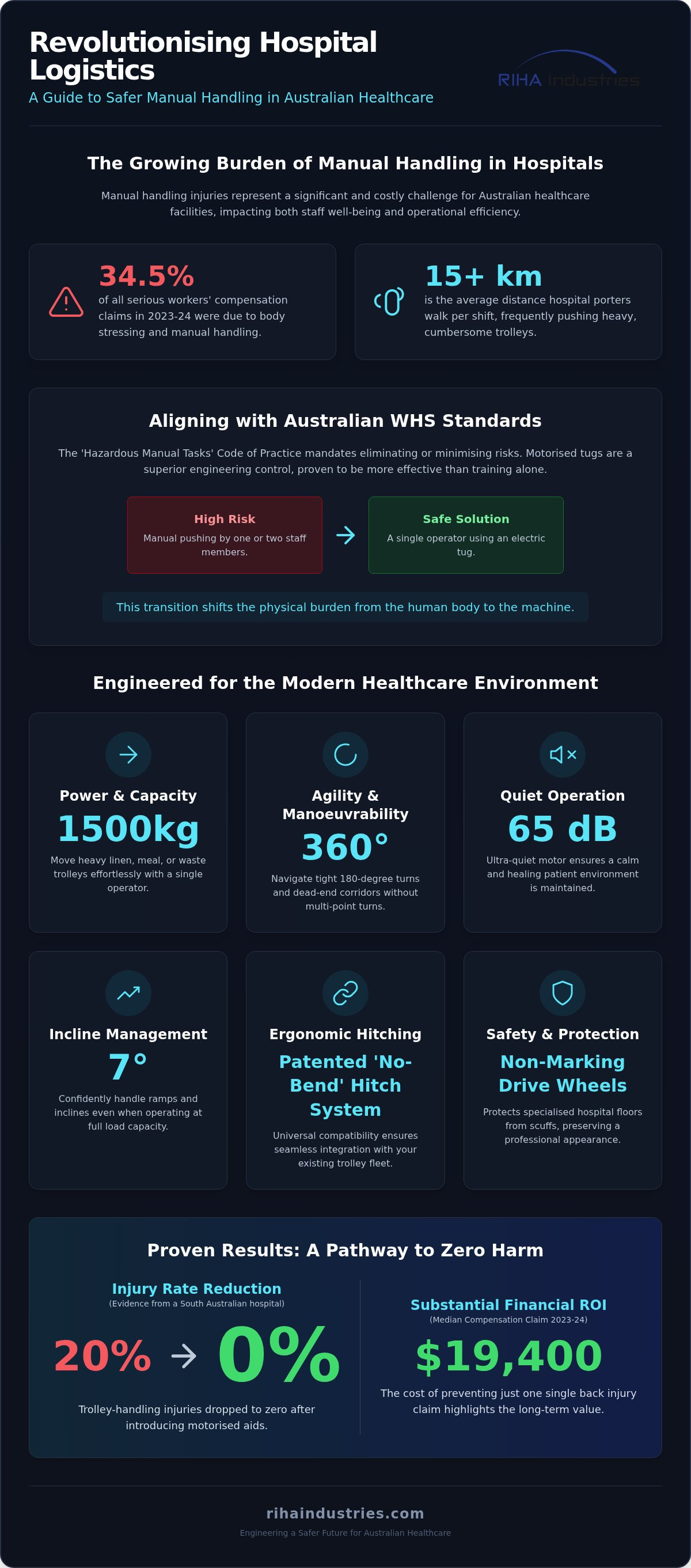
Did you know that body stressing and manual handling injuries accounted for 34.5% of all serious workers' compensation claims in Australia during the 2023-24 period? Within the healthcare sector, these statistics represent more than just numbers; they reflect the daily physical strain on porters who often walk over 15 kilometres per shift while pushing heavy loads. We understand that navigating bulky linen or meal deliveries through narrow corridors and tight 180-degree turns is a constant challenge for your team. It's a high-stakes environment where staff safety and operational efficiency must coexist without compromise.
This 2026 handling guide demonstrates how implementing a specialised electric tug for hospital trolleys can eliminate manual strain and ensure your facility remains fully compliant with the latest WHS Code of Practice. By choosing the right motorised assistance, you can empower a single staff member to move heavy equipment safely and effortlessly. We'll examine the latest engineering controls, from 360-degree manoeuvrability to patented hitch systems that integrate seamlessly with your existing fleet, providing a clear pathway to a safer and more productive workplace.
Table of Contents
The Growing Burden of Manual Handling in Australian Hospitals
The logistical demands of a modern Australian healthcare facility are immense. Hospital porters are the backbone of internal operations, frequently walking up to 15 kilometres per shift while navigating heavy linen, meal, or clinical waste trolleys through high-traffic zones. When you consider that some of these loads weigh up to 1500kg, the physical toll becomes clear. Manually pushing such weights in a high-pressure environment is no longer just a physical challenge; it's a significant liability that impacts long-term staff health.
Musculoskeletal disorders (MSDs) represent the "silent cost" of hospital logistics. These injuries lead to high rates of staff absenteeism and burnout, placing additional strain on an already stretched workforce. Relying on traditional manual pushing methods fails to meet modern safety benchmarks, as the force required to initiate and stop heavy movement often exceeds safe limits. This is where material-handling equipment, such as a specialised electric tug for hospital trolleys, becomes a vital investment in staff well-being and operational continuity.
Australian WHS Standards and Porter Safety
The Safe Work Australia "Hazardous Manual Tasks" Code of Practice provides clear guidance for healthcare employers. It emphasises that businesses have a legal duty to eliminate or minimise risks as far as is reasonably practicable. Motorised tugs are classified as a high-level engineering control, which is far more effective than administrative controls like lifting technique training. By implementing an electric tug for hospital trolleys, facilities can transition from high-risk two-person operations to a safe, one-person task. This shift ensures that the physical burden is handled by the machine rather than the human frame, directly aligning with national safety standards.
Case Study: Reducing Injury Rates to Zero
Evidence from a South Australian hospital highlights the impact of thoughtful engineering, where injury rates related to trolley handling dropped from 20% to zero following the introduction of motorised aids. The long-term ROI of preventing even a single back injury claim is substantial, considering the median compensation for body-stressing claims in 2023-24 reached $19,400. To understand how these safety principles apply across different clinical roles, you can read more on how to reduce nurse back injuries through strategic equipment selection.
Key Features of a High-Performance Electric Tug for Trolleys
Precision is the defining characteristic of effective hospital logistics. While the primary objective is to minimise manual handling injuries in Australian hospitals, the success of any mechanical aid depends on how well it integrates into the clinical environment. A high-performance electric tug for hospital trolleys must balance robust towing power with the sensitivity required in a space dedicated to healing and recovery.
A 360-degree turning radius is non-negotiable for porters navigating the complex layouts of modern medical centres. This level of agility allows for seamless movement in dead-end corridors and tight storage bays without the need for dangerous multi-point turns. Noise management is another critical factor. By operating at a verified 65 dB, these motorised units remain quiet enough to pass through patient wards without causing disruption. Additionally, safety lockouts are essential to prevent unauthorised use in public thoroughfares, while smart battery systems ensure the equipment remains operational for the duration of a demanding shift.
Manoeuvring in Tight Clinical Spaces
The physical footprint of a tug determines its utility in daily operations. Equipment must be compact enough to enter standard hospital lifts alongside the operator and the load without compromising safety. Beyond flat surfaces, these units are engineered to manage ramps and 7-degree inclines under full safe working loads. This capability ensures that heavy meal or laundry trolleys move smoothly between different facility levels. To protect the integrity of specialised hospital floors, non-marking drive wheels are utilised, preventing unsightly scuffs and maintaining the professional appearance of the facility.
Smart Technology and Diagnostics
Modern engineering has transformed simple towing machines into intelligent assets. Integrated Bluetooth connectivity allows facility managers to access real-time battery monitoring and usage history. This data-driven approach is particularly useful for identifying specific training needs within portering teams, ensuring that the fleet is utilised to its full potential. Operator safety is further enhanced by the "Back Off Button" feature, which provides an immediate physical failsafe by reversing the unit's direction upon contact. You can see these safety features in action by reviewing our range of certified Australian-made tugs designed for the healthcare sector.
Comparing the Easi Rider and Easi Mover for Hospital Logistics
The logistics of a large-scale medical campus differ significantly from those of a compact local clinic. Selecting an appropriate electric tug for hospital trolleys requires a strategic assessment of your facility's physical layout and the frequency of transport routes. While both models in the Easi series share a robust 1500kg safe working load and a quiet 65 dB operating volume, their functional design serves distinct operational needs. Choosing the right unit isn't just about power; it's about matching the equipment to the porter's daily workflow.
Addressing hazardous manual handling in hospitals often starts with reducing the sheer physical exertion required of staff. For porters who regularly cover vast distances between buildings, the Easi Rider is the preferred choice. Conversely, for ward-based tasks where space is at a premium, the Easi Mover provides the necessary precision. Both units empower staff to handle bariatric transport and heavy medical equipment with a single operator, ensuring that physical limitations never dictate operational capacity.
Easi Rider: The Solution for Long-Distance Porting
When distribution routes for linen and meal trolleys span across large metropolitan campuses, staff fatigue becomes a primary concern. The Easi Rider features an integrated ride-on platform, allowing porters to travel with the load rather than walking alongside it. This design is particularly effective for reducing the cumulative strain of 15km shifts. By eliminating the physical effort of walking while towing, hospitals can maintain high logistical throughput without compromising the well-being of their team. For a deeper look at optimising these workflows, our hospital porter equipment guide provides additional insights into fleet management and efficiency.
Easi Mover: Precision for Lifts and Small Wards
In high-pressure environments like emergency departments or intensive care units, agility is the most valuable asset. The Easi Mover is a compact walk-behind unit designed for short-haul, high-precision transfers. Its heavy-gauge steel construction ensures it can handle 1500kg loads with ease. Because it has a smaller footprint, it's the ideal choice for navigating busy ward corridors and entering standard hospital lifts. This model empowers a single staff member to execute complex 180-degree turns and navigate tight storage bays safely, ensuring that heavy loads never require manual pushing or pulling. It provides the perfect balance of power and control for the most confined clinical spaces.
Selecting the Right Hitch for Linen, Meal, and Waste Trolleys
The efficiency of an electric tug for hospital trolleys is often determined by the quality of its connection point. Many facility managers face the universal challenge of managing a mixed fleet of equipment, where linen, meal, and waste trolleys come from various manufacturers with differing frame heights and designs. Without a versatile attachment system, a motorised tug loses its primary benefit, as staff may still be forced to manually adjust or stabilise the load. Our patented hitch technology addresses this gap by ensuring seamless compatibility with 95% of existing hospital equipment, effectively removing the need for manual bending or awkward strapping.
Stability is the most critical factor when securing a load for transport. A secure, locked connection ensures that heavy trolleys remain under total control, especially when navigating the 7-degree inclines common in hospital service ramps. Beyond standard applications, customisation plays a vital role in clinical safety. Tailored hitch modifications are often essential for specialised equipment, such as theatre tables or heavy-duty waste bins, to ensure the centre of gravity remains stable during transit. For facilities looking to standardise their handling procedures, you can view our full range of specialised hitching solutions designed for Australian healthcare environments.
Pin Hitches vs. Adjustable Hitches
Selecting the correct mechanical interface depends on your specific trolley fleet. The 22mm stainless steel Pin Hitch is a reliable workhorse, specifically engineered for the high-frequency demands of linen and store trolleys. For facilities with a more diverse range of equipment, foot-operated adjustable hitches provide the necessary flexibility to secure both round and square frames ranging from 20mm to 40mm. These systems also offer rotation options of 55 or 75 degrees. This specific range of motion is what allows the operator to maintain maximum cornering precision in tight corridors without the trolley "tracking" wide and hitting walls.
The Electric Adjustable Hitch Advantage
The introduction of the electric adjustable hitch represents a significant leap in ergonomic safety. By utilising push-button height adjustment, porters can align the tug with the trolley hitch point without any physical exertion. This feature is particularly valuable in high-volume environments where staff connect and disconnect loads dozens of times per shift. It eliminates the risk of "hitch-up" injuries, which often occur when an operator attempts to manually lift or shift a heavy trolley to meet a fixed hitch height. By automating the connection process, you ensure that an electric tug for hospital trolleys remains a true zero-strain solution for every member of your portering team.
Implementing RIHA Industries Solutions for a Safer Facility
Selecting a specialised electric tug for hospital trolleys is the first step toward a safer workplace, but long-term success relies on a robust support framework. RIHA Industries provides a distinct advantage through its certified Australian-made status, ensuring that quality control remains stringent and specific to local healthcare standards. Because manufacturing occurs in South Australia, facilities benefit from 24-hour parts shipping, effectively eliminating the lengthy downtime often associated with imported equipment. This reliability ensures that your logistical fleet remains operational when patient care demands are at their peak.
Calculating the return on investment (ROI) for motorised tugs extends beyond the initial procurement cost. By transitioning from two-person to one-person operations for heavy loads, hospitals can significantly reduce labour costs and reallocate staff to high-priority clinical tasks. When you factor in the avoided costs of workers' compensation claims and the reduction in staff absenteeism, the financial benefits become undeniable. A single avoided back injury can save a facility tens of thousands of dollars, making the shift to engineering controls both a safety and a fiscal priority.
Building a culture of safety requires more than just providing equipment; it involves comprehensive staff training and certification. We work alongside your portering teams to ensure every operator feels confident navigating busy hospital thoroughfares. This proactive approach to training reduces the risk of accidental damage and ensures that the safety features of the Easi series, such as the safety lockouts and Bluetooth diagnostics, are utilised to their full potential.
National Support and Maintenance
Maintaining a 24/7 logistical operation requires a responsive service partner. RIHA Industries offers national service coverage to ensure that preventative maintenance is carried out with minimal disruption to hospital workflows. For rural or remote facilities where immediate on-site visits may be challenging, we provide an innovative online 3D viewer. This tool allows in-house maintenance teams to visualise internal components and troubleshoot issues with precision. For more detailed guidance on keeping your fleet in peak condition, you can explore our hospital bed mover repair service guide.
Taking the Next Step: Demos and Trials
Every clinical environment has unique architectural challenges, from varying floor surfaces to specific lift dimensions. We believe that hands-on trials in your actual hospital environment are essential for selecting the right equipment. To assist with the procurement process, we also offer Augmented Reality (AR) tools that allow you to visualise how the equipment fits within your storage bays and corridors before it even arrives on-site. Taking this step ensures that your investment is perfectly matched to your facility's needs. Contact RIHA Industries for a site assessment and demo to begin the transition toward a zero-injury workplace.
Future-Proofing Your Facility with Advanced Handling Solutions
Prioritising the safety of portering staff is a hallmark of a world-class healthcare facility. By replacing manual exertion with a specialised electric tug for hospital trolleys, you do more than just meet WHS compliance; you empower your team to perform their roles with precision and relief. Whether your logistics demand the long-distance efficiency of a ride-on platform or the compact agility of a walk-behind unit, the right engineering choice ensures that heavy loads don't translate to physical strain.
RIHA Industries stands as a stable, long-term partner for Australian hospitals. As a Certified Australian-made and FDA-registered manufacturer, we've helped facilities achieve a proven injury reduction from 20% to zero. This transition to motorised assistance is a practical, high-impact investment in your most valuable asset: your people. We're dedicated to supporting your journey toward a safer, more efficient clinical environment through thoughtful engineering and reliable national support.
Explore the Easi Series Electric Tugs for Hospital Logistics and take the first step toward a safer workplace today.
Frequently Asked Questions
How much weight can an electric hospital tug pull?
Both the Easi Rider and Easi Mover possess a verified safe working load of 1500kg. This substantial capacity empowers a single staff member to move heavy clinical waste, meal, or linen loads that would otherwise require multiple porters. By using an electric tug for hospital trolleys, you ensure that even bariatric equipment is handled within safe limits, directly reducing the risk of musculoskeletal injuries during high-volume shifts.
Do electric tugs require a special licence to operate in hospitals?
Operating an electric tug doesn't require a formal driver's licence; however, comprehensive site-specific training is essential for WHS compliance. We provide detailed operator certification to ensure your team understands the safety lockouts and emergency stop features. This training focuses on precision manoeuvring in high-traffic wards, ensuring that every porter can navigate tight spaces while maintaining a calm, healing environment for patients.
Will an electric tug fit inside a standard hospital lift?
Yes, our equipment is specifically engineered with a compact footprint to ensure it fits within standard hospital lifts. The Easi Mover, in particular, is designed to enter elevators alongside the operator and a full-sized trolley. This allows for seamless vertical logistics across large metropolitan campuses, ensuring that heavy loads never need to be decoupled or pushed manually when transitioning between different floor levels.
Are these tugs compatible with different brands of trolleys?
Universal compatibility is a core feature of our design, with patented hitch systems that connect to 95% of existing hospital equipment. Whether your facility uses diverse brands for linen, meal, or waste management, our adjustable hitches provide a secure, stable connection. This versatility ensures that a single electric tug for hospital trolleys can service your entire fleet, eliminating the need for expensive trolley modifications or manual strapping.
How long does the battery last on a standard portering shift?
The smart battery systems are designed to support a full 8 to 12 hour portering shift on a single charge. Integrated Bluetooth diagnostics allow facility managers to monitor battery health and usage history in real-time, ensuring that units are ready for the next rotation. This reliability is crucial for maintaining logistical throughput in busy clinical centres where equipment downtime can disrupt essential patient services.
Can the tug be used on ramps and inclines?
Both the Easi Rider and Easi Mover are rated for safe operation on inclines and service ramps up to 7 degrees. The motorised drive system provides consistent power on the ascent and controlled, electromagnetic braking on the descent. This ensures that a 1500kg load remains stable and under the operator's total control, preventing the dangerous "runaway" scenarios often associated with manual trolley handling on slopes.
What is the difference between a ride-on and a walk-behind tug?
The primary difference lies in the operator's position and the intended travel distance. The Easi Rider includes a ride-on platform, making it the ideal solution for long-distance transport across large campuses to reduce staff walking fatigue. The Easi Mover is a compact walk-behind unit, offering maximum manoeuvrability and precision for shorter transfers within congested wards, emergency departments, or tight storage areas where space is limited.
How do I maintain an electric tug in a 24/7 facility?
Maintaining 24/7 reliability involves a combination of preventative maintenance and responsive national support. RIHA Industries provides comprehensive service coverage across Australia, including 24-hour shipping for critical spare parts to minimise downtime. For facilities in regional areas, we offer an online 3D viewer to assist in-house teams with servicing, ensuring that your logistical fleet remains in peak condition for every shift.


