
Ergonomic Assessment for Hospital Porters: A Practical Australian Checklist
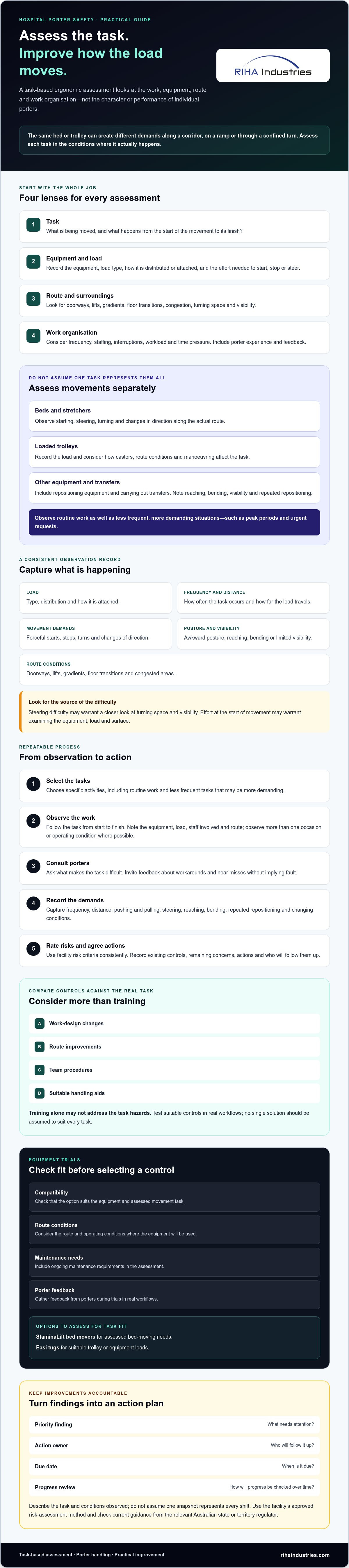
The safest porter solution may not be a better pushing technique. It may be changing how the load moves. An ergonomic assessment for hospital porters starts with the task, because the same bed or trolley can place different demands on staff along a long corridor, on a ramp or through a confined turn.
Repeated trips with beds, trolleys and varied equipment can make force, awkward posture and route conditions difficult to manage. Managers also need a consistent way to observe work without blaming individual workers. A practical, task-based checklist helps teams record what happens, involve porters in identifying risks and compare controls against real operating conditions.
This guide explains how to assess common porter tasks, record load and environmental factors, and prioritise improvements. It also covers equipment trials, including how to check compatibility, route conditions, maintenance needs and porter feedback before selecting a control. The result is an action plan that can be reviewed over time, without assuming one solution suits every task.
Table of Contents
What an ergonomic assessment for hospital porters should examine
An ergonomic assessment for hospital porters is a structured review of how tasks, equipment, routes and work organisation interact, so risks can be identified and practical improvements considered. It examines the demands of the work, not the performance or character of individual workers. Ergonomics is concerned with the fit between people and their work, as outlined in Ergonomics.
This differs from a product demonstration, which shows how particular equipment operates, and from an incident investigation, which examines a specific event. An assessment can inform either, but it starts by understanding the job as it is actually done. In Australia, Safe Work Australia’s model guidance on hazardous manual tasks can help frame the review. Check current guidance from the relevant state or territory regulator for local requirements and terminology.
Which porter tasks belong in the assessment?
Include the range of routine movement tasks, such as moving beds and stretchers, handling trolleys, repositioning equipment and carrying out transfers. Assess each task separately. A bed may be difficult to start or steer, while a trolley may be affected by its load, castors or route. The same porter can face different physical demands across these jobs.
Observe both typical work and less frequent, more demanding situations, including peak periods and urgent requests. Record what happens during the task, not just what a written procedure says should happen. Note:
Load type and how it is distributed or attached.
How often the task occurs and the travel distance.
Forceful starts, stops, turns or changes of direction.
Awkward postures, reaching or limited visibility.
Route features such as doorways, lifts, gradients, floor transitions and congested areas.
These details help identify whether the challenge comes from the load, the route, the equipment or how the work is organised. For example, difficulty steering may call for a closer look at turning space and visibility, while effort at the start of a movement may warrant examining the equipment, load and surface.
Who should contribute to the assessment?
Involve porters, supervisors, facilities staff and relevant WHS or ergonomics advisers. Porters can identify difficult manoeuvres, workarounds, fatigue points and near misses that may not be obvious during a brief observation. Ask when and where the task becomes harder, and invite feedback without assigning blame. A workaround can signal that the task or environment needs attention.
For broader context on porter responsibilities and equipment, see the hospital porter equipment guide. Use that context to inform observation, while grounding decisions in the specific tasks and routes at your facility.
How to assess porter handling tasks: a step-by-step checklist
A consistent process helps managers compare tasks fairly and turn observations into practical action. Use your facility’s approved risk-assessment method, and check current guidance from the relevant Australian state or territory regulator. The steps below provide a repeatable structure for an ergonomic assessment for hospital porters.
Select the tasks. Choose specific activities to review, such as moving a bed, steering a loaded trolley or repositioning equipment. Include routine work and less frequent tasks that may be more demanding.
Observe the work. Follow the task from start to finish, noting the equipment, load, number of staff involved and route taken. Where possible, observe more than one occasion or operating condition.
Consult porters. Ask what makes the task difficult and how workload, interruptions, staffing or time pressure affect it. Invite workers to describe workarounds and near misses without implying fault.
Record the demands. Capture frequency, travel distance, pushing and pulling, steering, reaching, bending and repeated repositioning. Note forceful starts or stops, awkward postures and changes in conditions.
Rate the risks and agree actions. Apply the facility’s risk criteria consistently, document existing controls and remaining concerns, then decide what action is needed and who will follow it up.
Assessment findings should describe the task and the conditions observed, not assume that one snapshot represents every shift. A trolley moved along a clear corridor may present different demands from the same trolley manoeuvred through a congested area or over a floor transition. Record those differences rather than relying on a single observation.
What should observers record during a shift?
Use a simple record for each task: equipment and load, route, frequency, staff involved, movement demands and conditions at the time. Note where porters push, pull, steer, reach, bend or reposition equipment. Ask how interruptions or time pressure change the sequence, pace or staffing. Record the specific point where extra effort or an awkward manoeuvre occurs, rather than relying on a general description such as “hard to move”. These details help distinguish a recurring exposure from an occasional challenge and give the team a clearer basis for choosing controls.
How should a facility rank and document findings?
Use the facility’s approved assessment method and explain its rating criteria so different observers apply them consistently. Record the risk rating alongside existing controls, unresolved concerns, an action owner and target date. Set review triggers, such as a route change, new equipment or a reported near miss, so the assessment stays relevant. OSHA’s US safe patient handling program offers related healthcare guidance, but Australian facilities should refer to applicable local guidance. For related equipment evaluation considerations, see patient handling equipment selection criteria.
If the findings point to a potential powered-mover use case, review RIHA bed movers and equipment tugs as options to assess against the task, route and porter feedback.
Compare ergonomic controls before choosing porter equipment
Once the assessment identifies where effort or awkward movement occurs, compare controls against that specific task. Options may include changing how work is scheduled or organised, improving routes, agreeing team procedures, or trialling a handling aid. Training can support a safe system, but it shouldn’t be the only response where the task or environment continues to create a hazard.
Use the table to structure discussion, not as a substitute for your facility’s risk-assessment process. The UK Health and Safety Executive’s Manual Handling Assessment Charts (MAC) tool offers another practical reference for assessing manual handling, but Australian facilities should check current local guidance and apply their own approved method.
When might a powered mover be worth assessing?
Repeated bed movements, observed effort or challenging routes may indicate a potential control opportunity, not an automatic equipment decision. Check the mover against the facility’s beds, clearances, turning areas and lift access. Include porter feedback in any trial, and consider safe operation, charging, storage, maintenance and what happens if the equipment isn’t available.
When is a tug or another control more appropriate?
First distinguish bed movements from towing linen, meal, stores or medical-equipment trolleys. For a tug, verify that the hitch suits the trolley frame and assess gradients, turns and manoeuvring needs. Don’t assume one machine can serve every equipment category. For a structured procurement process, see the hospital bed mover procurement guide.
The best option is the one that addresses the demands recorded in the ergonomic assessment for hospital porters and works in the actual environment. Compare controls through a task-based trial, then review staff feedback and any remaining concerns before deciding whether the approach is suitable.
Turn assessment findings into a practical improvement plan
An assessment only leads to safer work when findings become actions that someone can progress and review. For each priority, record the proposed change, the person responsible, a target date, the resources needed and how the facility will check whether the action is working. For example, a finding about difficult bed movements through a particular route might lead to a route review or a controlled equipment trial. Include porter feedback in the follow-up so the team can assess whether the proposed change addresses the problem observed.
Choose indicators that relate to the task and can be tracked consistently. These might include reported discomfort, handling incidents, delays associated with the task and equipment downtime. Consider the context behind any change rather than treating one indicator as proof that a control has succeeded or failed. Review findings after incidents or worker feedback, and whenever workflows, staffing, equipment or routes change.
How can a hospital trial controls responsibly?
Before a trial begins, define the tasks, intended users, routes, success measures and safety oversight. Test the control in representative conditions, including relevant turns, thresholds or busy periods, and observe usability, manoeuvrability, compatibility and effects on workflow. Gather feedback from different shifts and users. Record problems and changes needed, then review the evidence before deciding whether to extend or adapt the trial.
Where the trial involves a powered mover, check the intended load and connection, route access, storage, charging and maintenance arrangements. A trial should assess how the equipment works within the whole task, not simply whether it can move a load under ideal conditions.
What should the assessment record include?
Keep the task description, consultation notes, observations, risk ratings and agreed controls together so decision-makers can follow the reasoning. Add the action owner, target date, resources, progress checks and review date. Where equipment is involved, record relevant checks, training needs and maintenance responsibilities. Ask the facility’s WHS adviser or relevant regulator about applicable recordkeeping expectations.
Use the review to close the loop: check whether actions were completed, whether the control is being used as intended and whether concerns remain. If the task or conditions have changed, update the assessment and plan rather than relying on an old record. This keeps an ergonomic assessment for hospital porters connected to day-to-day work and supports continual improvement.
If your findings identify a suitable powered-mover use case, discuss RIHA equipment options and servicing as part of your facility’s next assessment or trial.
Match assessment findings with RIHA’s hospital mobility options
Equipment selection should follow the task assessment and porter consultation, not come first. If findings point to repeated bed movements as a suitable use case, RIHA’s StaminaLift systems, including the StaminaLift 2100 Bed Mover and StaminaLift Transfer System 5000 and 6000, may be options to evaluate. The TS5000 is compatible with 95% of hospital beds, while the TS6000 is designed for bariatric and acute care beds. For suitable trolley or other equipment loads, Easi Rider and Easi Mover tugs are separate options, designed to move equipment weighing up to 1500kg. The right choice depends on the specific load, route and workflow. Equipment alone doesn’t remove every risk.
Build procurement checks around the conditions porters actually encounter. Confirm that the proposed model and attachments suit the facility’s beds or trolley frames, then consider corridor widths, turning clearances, ramps and lift access. Include porter preferences and operating arrangements, as well as servicing and maintenance needs. RIHA states its equipment is Australian-made and has national service coverage, which facilities may consider alongside their operational and procurement requirements. These details are relevant to evaluation, not a guarantee of a particular safety outcome.
What should a facility verify during a product demonstration?
Ask about arranging a demonstration using representative beds or loads and the routes identified in the assessment. Where practical, include relevant attachments, corridors, turns, ramps and lift access. Invite porters who perform the task to assess the controls, handling, visibility and their confidence using the equipment. Confirm the proposed model, compatibility and safety functions directly with RIHA, and clarify servicing arrangements before drawing conclusions from the trial.
Record what the demonstration shows against the original task requirements. Note any access limitations, difficult manoeuvres, workflow changes or user concerns. A product that performs well in an open space may still need further evaluation on a confined route or with a different load.
How can a facility move from assessment to implementation?
Share the documented task requirements and trial findings with procurement, WHS and operational stakeholders before deciding how to proceed. If a control is selected, plan user familiarisation, assign responsibility for maintenance and set a post-implementation review. Check whether the equipment is being used for its assessed purpose and whether the task or conditions have changed. Feed any new concerns back into the facility’s assessment and action plan.
To discuss the assessed task and ask about a suitable product demonstration, discuss your hospital’s porter mobility requirements with RIHA. Sharing the load, route and workflow details can help keep the conversation grounded in the findings of your ergonomic assessment for hospital porters.
Take the next step towards safer porter movement
A practical ergonomic assessment for hospital porters gives your team a clearer basis for deciding what to improve: observe the task and route, listen to porters, then compare controls against the demands recorded. Keep the plan active by assigning actions and reviewing outcomes when work conditions change.
If the assessment identifies a suitable equipment use case, match the solution to the movement. RIHA’s StaminaLift bed movers are designed to assist with bed movement, while Easi tugs address other suitable equipment loads. Checking compatibility, porter feedback and operating arrangements helps keep selection grounded in your facility’s needs. RIHA states its mobility equipment is Australian-made and has national service coverage, and offers preventative maintenance and repairs.
Discuss your hospital’s porter mobility requirements with RIHA and share the task findings that will help inform the conversation. With a considered assessment and a plan your team can revisit, you can take practical steps towards safer, more manageable equipment movement.
Frequently Asked Questions
What does an ergonomic assessment for hospital porters include?
An ergonomic assessment for hospital porters reviews the tasks, loads, equipment, routes and work organisation that shape physical demands. It combines observation with porter consultation, considers existing controls and records actions for follow-up. Include routine work as well as less frequent, demanding tasks, such as moving equipment during a busy period or along a difficult route. A facility’s WHS adviser can help align the method with local procedures and applicable state or territory guidance.
Who can carry out an ergonomic assessment in a hospital?
The appropriate assessor depends on the task, the facility’s procedures and the complexity of the risks. A WHS professional or ergonomics specialist may lead the assessment, while porters, supervisors and facilities staff contribute essential knowledge of the work and equipment. Involve the people who perform the tasks and those responsible for operations. Check with the relevant state or territory regulator about any applicable competency or regulatory requirements before setting local procedures.
How often should hospital porter tasks be assessed?
There isn’t one review interval that suits every porter task. Revisit an assessment when routes, loads, staffing, equipment or work methods change, and after a relevant incident or worker concern. A facility may also schedule reviews through its WHS processes. Set the timing according to the task’s risks and operational changes, and check current state or territory guidance and internal procedures for applicable review and documentation expectations.
What risks should an assessment look for when porters move beds?
Assess the force and frequency involved, including starting, stopping, steering and turning the bed. Observe posture, travel distance and route features such as gradients, floor transitions, tight spaces and lift access. Consider the actual bed and load, and ask porters about difficult movements, fatigue and workarounds. Don’t infer the task’s overall risk from one observation or a product specification alone. Conditions and demands can vary between routes and shifts.
Can powered equipment eliminate manual handling risks for hospital porters?
No single piece of powered equipment automatically removes every manual handling risk. A suitable mover may reduce some physical demands, but its effectiveness depends on the task, load, route and users. Assess compatibility and operating conditions, and plan for familiarisation, maintenance and any work that remains manual. Trial the equipment with porters in representative conditions, then review feedback and outstanding concerns. A purchase should support, not replace, a broader safe system of work.
Should a hospital use a bed mover or a tug for porter tasks?
Choose according to the load and movement being assessed. A bed mover is for suitable bed-moving tasks, while a tug may suit compatible trolleys or other equipment. Before comparing options, check the load, attachment, route, turning space, gradients, lift access and workflow. Confirm the intended use and compatibility with the manufacturer, then trial the proposed equipment with the porters who will operate it. Don’t assume one machine suits every equipment category.
Which Australian WHS rules apply to hospital porter assessments?
Applicable WHS laws and regulator guidance depend on the state or territory where the hospital operates. Consult the relevant jurisdictional regulator and your facility’s WHS adviser for current requirements, guidance and recordkeeping expectations. A general checklist can help structure observations, but it isn’t legal advice or a substitute for local procedures. Document the tasks assessed, worker consultation, identified controls and follow-up actions in line with your facility’s processes.


