
Ergonomic Patient Transport: 2026 Guide for Health Teams
Updated: Oct 22
Reducing strain during patient transport starts not only with lifting technique, but also with choosing the right way to move a bed or load. Staff routinely push and pull heavy beds and equipment through tight, busy clinical spaces, where awkward turns, thresholds and sudden stops can add to physical strain. Ergonomic patient transport equipment covers different tools: a powered bed mover isn’t the same as a tug for linen or meal trolleys.
Health teams need equipment that is safe and practical in real working conditions. The challenge is matching it to the load, route, existing bed or trolley configuration, and the people who’ll operate it. A product description alone rarely shows how a unit will manoeuvre around corners, through doorways or during routine docking.
This guide explains how to assess transport equipment by task, compatibility and staff needs. You’ll learn how to distinguish patient-carrying equipment from powered movers, evaluate manoeuvrability and controls, and plan for training, safe work procedures and ongoing maintenance. It also explains how RIHA Industries’ StaminaLift bed movers and Easi tugs support different transport tasks, helping teams make a practical, fit-for-purpose decision while keeping safe work practices in place.
Table of Contents
What Is Ergonomic Patient Transport Equipment, and What Does It Move?
Ergonomic patient transport equipment is designed to make moving patients or heavy healthcare loads more manageable by reducing the physical effort required from staff. The term covers different equipment types, and they don’t all carry a patient. Some support or transport a person; others provide powered assistance to move a bed or trolley.
A bed mover moves a compatible bed; a patient lift raises or transfers a person. That distinction matters when choosing equipment for a particular task. A powered bed mover doesn’t lift a patient from the bed, and a tug for equipment loads isn’t a patient transport device.
Patient-carrying equipment and powered movers do different jobs
Stretchers and patient transport trolleys are designed to carry or support a patient during movement. Patient lifts have a different role, assisting with raising or transferring a person, as described in this overview of the Patient lift. By contrast, a powered bed mover connects to a compatible bed and supplies propulsion while staff guide it. A tug moves equipment loads, such as linen or meal trolleys, rather than patients.
Why ergonomics matters in day-to-day transport work
Repeated pushing, pulling and manoeuvring can place physical demands on staff, particularly when loads are heavy or the route requires frequent turns and stops. The effort involved depends on more than the load. Floor surfaces, thresholds, turning space, distance and how often the movement is repeated all affect the task.
Powered assistance supplies propulsion, helping staff guide movement rather than provide all the force themselves. The result depends on a suitable match between the mover, the bed or trolley configuration, the route and the people using it. A unit that attaches securely but is difficult to manoeuvre in a tight corridor may not suit the movement pattern staff face each day.
Ergonomic design can make transport more manageable, but it doesn’t remove the need for safe work procedures. Staff still need to follow the equipment’s operating instructions, use the correct attachment and controls, and consider the route before moving a load. Observe routine transfers and equipment movements to identify where effort builds up, such as starting a heavy bed, negotiating a doorway or making repeated trips between departments.
Start by identifying whether the task is to carry or transfer a patient, move a compatible bed, or tow an equipment load. Then assess the equipment against the actual loads, routes and workflows, rather than assuming one solution will suit every transport task.
How Ergonomic Patient Transport Equipment Reduces Effort
A powered mover supplies the force needed to start and maintain movement, so staff can focus on guiding the load instead of providing all the propulsion themselves. The mover connects to compatible equipment through an attachment, and the operator uses the controls specified for that model. This changes the physical demands of a task, but the result still depends on the load, route and correct operation.
Powered assistance changes the effort required, not the need for operator judgement. Staff must still assess the path, control the movement and respond to people or obstacles in the way.
Connection, controls and manoeuvrability
A secure connection helps transfer the mover’s force to the bed or other compatible equipment. RIHA’s patented hitch options support different equipment configurations, rather than relying on one hitch for every bed or trolley. Check the attachment against the actual equipment and ensure staff can connect and release it as directed.
Assess the complete route, not just movement along a straight corridor. During a practical demonstration, observe how the unit handles tight turns, doorways and lifts, and whether the operator can maintain a clear view of the load. Consider the controls and speed settings available on the specific model. The movement should be manageable in the spaces staff use every day.
Safety features support, but don’t replace, safe operation
RIHA equipment includes model-specific safety features such as automatic braking and safety lockout controls. These features support controlled use, but don’t replace operating instructions or facility procedures. Staff training should cover the model’s controls, attachment method and safe response if movement needs to stop.
Limits vary by model and task. Before moving a load, use the operating instructions to understand the applicable load capacity, gradient limits and other operating conditions. Don’t assume a rating for one type of movement applies to another. During assessment, consider how staff will check the connection, position themselves to guide the load and manage the route without rushing.
Plan a demonstration around a representative task. Use the bed or trolley configuration staff work with, and include the tightest turns, thresholds or lift access on the usual route. Observe whether the connection remains secure, the operator can control the movement confidently, and the equipment can stop as intended. These checks reveal practical fit that a feature list alone can’t show.
Choosing RIHA’s bed movers and equipment tugs starts with the task and compatible load, followed by an assessment of controls, route handling and staff training. This keeps equipment safeguards in perspective and supports consistent use alongside established safe work procedures.
Which Ergonomic Transport Equipment Fits Each Healthcare Task?
The right choice depends on what needs moving and how the task happens in your facility. A stretcher carries a patient; a powered bed mover moves a compatible bed; an equipment tug moves a trolley or other load. Treating these as interchangeable can leave staff with equipment that doesn’t suit the task, connection or route.
When a powered bed mover is the relevant option
Choose a bed mover for a task that involves moving a bed, rather than carrying or lifting a patient. The StaminaLift range moves compatible beds and patient transport devices. The StaminaLift Transfer System 5000 is compatible with 95% of hospital beds. This is a model-specific compatibility figure, not a guarantee of fit for every bed. Assess the actual bed configuration and attachment requirements before choosing a setup.
The StaminaLift 2100 Bed Mover and StaminaLift Transfer System 6000 are also designed for bed-moving tasks. Treat each as a specific model, not a general-purpose solution for all transport work. Match the model to the bed, route and required movement, and use its operating information to understand applicable ratings and limits.
When an equipment tug is a better task match
For meal, linen and store trolleys, an equipment tug may be more appropriate than a bed mover. RIHA’s Easi Rider and Easi Mover are tugs for equipment loads, not patient carriers. They can move loads up to 1,500 kg, with the suitable rating depending on the specific tug and trolley setup, including the hitch used.
Operator position also affects how a tug fits the workflow. The Easi Rider is a ride-on tug, while the Easi Mover is walk-behind. Consider the space available to manoeuvre and the visibility needed along the route. The different operating formats aren’t interchangeable, so assess them against the task and staff routines.
One product won’t safely cover every movement simply because it’s powered. Separate patient-carrying tasks from bed movement and equipment towing, then compare the load, connection and route for each. This task-based approach makes ergonomic patient transport equipment easier to assess without confusing a mover with a patient-carrying or patient-lifting device.
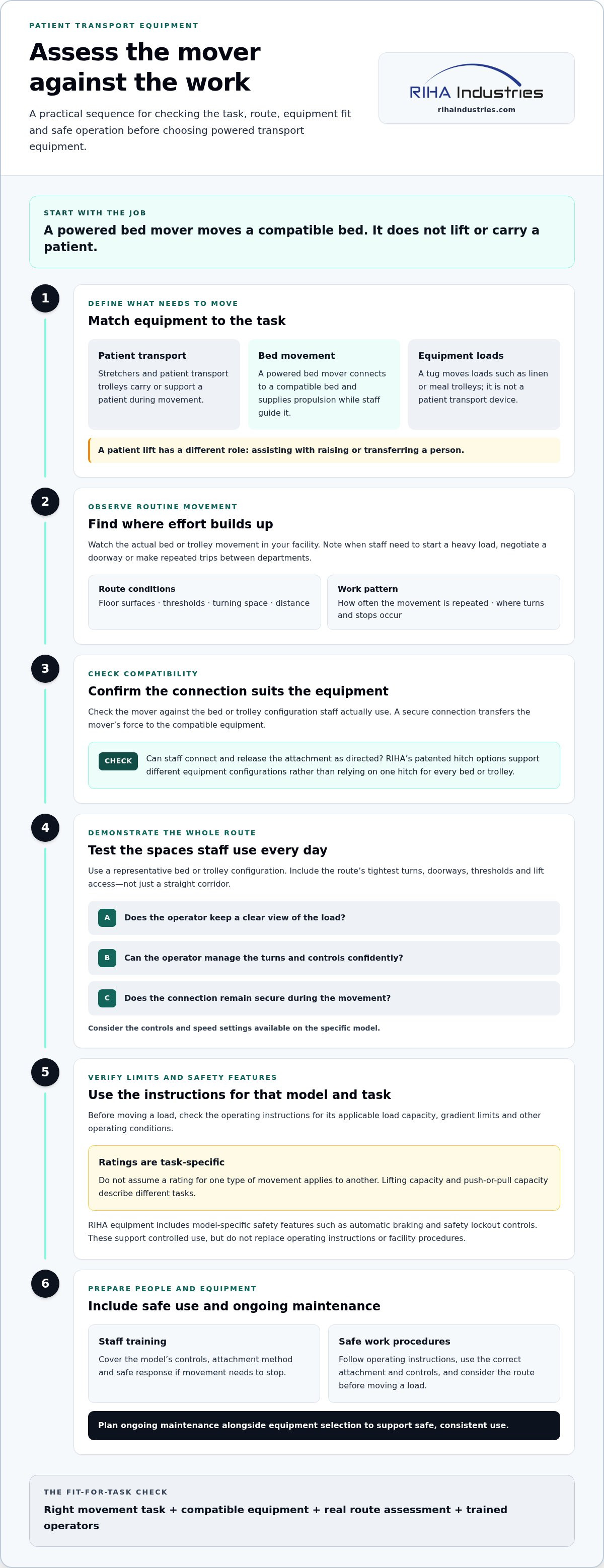
How to Assess Ergonomic Transport Equipment at Your Facility
A structured assessment helps health teams choose equipment that fits real work, rather than an idealised route or a single load. Involve the staff who perform the movements, facility engineering and procurement early. Together, they can document day-to-day requirements, identify compatibility issues and plan support across the equipment’s working life.
Map the movement task before comparing equipment
Observe routine movements in the areas where they happen. Record what is moved, how often, who moves it and where it travels. Keep patient transfers separate from bed moves and trolley or equipment movements, as each task calls for a different equipment type.
Define the task and load. Note whether the movement involves a patient-carrying device, a bed or an equipment trolley. Record the usual load and any variation staff encounter during normal work.
Trace the route. Walk the full journey with staff. Note gradients, thresholds, tight turns, corridor widths, lift dimensions and points where the load must stop or change direction.
Observe the equipment in use. Record the bed frame, wheelbase or trolley configuration staff actually use, along with how they connect, guide and park it. A demonstration with a different setup may not reflect the task.
Check practical fit. Assess attachment compatibility and whether the equipment can manoeuvre through the route and fit available storage or charging locations. Include people who understand the facility’s beds, trolleys and physical environment.
Plan for people and procedures. Involve operators in assessing controls and handling routines. Identify the training, handover and local operating procedures needed for consistent use.
Include ongoing support. Consider maintenance access, servicing arrangements and parts support as part of the lifecycle assessment. Procurement and facility engineering can weigh these requirements alongside task fit.
Check fit, training and support requirements
Compatibility depends on the specific equipment combination. Compare the proposed mover’s attachment with the actual bed frame or trolley hitch, and assess how the setup works within staff routines. Where possible, trial it on the usual route with representative equipment and involve the people who’ll operate and maintain it. This can reveal pinch points, awkward connections or parking constraints before implementation.
Training should cover model-specific controls, connection and release, operating limits and what staff should do if a movement needs to stop. Set out locally appropriate procedures, including how equipment is stored and kept ready for use. Include preventative maintenance and repair support in the plan so upkeep is considered from the outset, not only after a fault occurs.
For Australian workplaces, Safe Work Australia’s Model Code of Practice: Hazardous Manual Tasks provides guidance on managing hazardous manual task risks. Model codes are not automatically law in every jurisdiction, so consult the relevant WHS regulator and local requirements when applying guidance to your facility.
Use your assessment findings to narrow equipment choices by task, load, route, compatibility and support needs. RIHA’s bed movers and tugs can be assessed against your facility’s requirements as part of planning a fit-for-purpose transport setup.
RIHA Ergonomic Transport Solutions: Match the Equipment to the Work
Once your facility has mapped the movement task, route and equipment configuration, compare solutions against those practical needs. RIHA Industries designs and manufactures Australian-made StaminaLift bed movers and Easi equipment tugs for healthcare environments. These are powered movers, not patient-lifting devices: the StaminaLift range moves compatible beds, while Easi tugs move equipment loads.
Match the StaminaLift and Easi ranges to distinct movement needs
For bed movement, consider the StaminaLift model against the beds and transport devices used in your facility. The StaminaLift Transfer System 5000 is compatible with 95% of hospital beds. Its stated capacity is 300 kg for lifting and 600 kg for pushing or pulling. The StaminaLift Transfer System 6000 is rated for a 450 kg lift and 900 kg push or pull. Keep these ratings distinct and assess the relevant movement for your task. The StaminaLift 2100 Bed Mover is another option in the bed-moving range.
For equipment loads, the Easi Rider and Easi Mover are tug options for items such as meal, linen and store trolleys. They can move loads up to 1,500 kg, with the suitable rating depending on the specific tug and trolley setup. The models have different operating formats, so include staff interaction and trolley configuration in your assessment rather than assuming one setup suits every workflow.
For further model-level purchasing detail, consult the StaminaLift 5000 buying guide. It can complement your facility assessment by focusing attention on the specific bed-moving model and its application.
Plan implementation and ongoing equipment support
Equipment fit is only one part of implementation. RIHA provides training, preventative maintenance and repairs for its specialised equipment, supporting teams as they put new equipment into use and plan ongoing care. Include operator handover and maintenance responsibilities in your implementation plan, alongside your facility’s procedures.
For in-house servicing and part replacement, RIHA’s online 3D viewer provides a practical visual resource. RIHA also provides national service coverage in Australia and ships parts worldwide within 24 hours. Include these support arrangements in lifecycle planning alongside compatibility with your existing setup.
For broader procurement considerations, use the hospital bed mover procurement guide. If your team is weighing a wider range of handling needs, patient handling equipment selection criteria adds further context. Both can help organise your questions around task fit, staff use and ongoing support.
When comparing options, bring the relevant bed or trolley configuration, route details and movement task to a facility-specific discussion or demonstration with RIHA. This keeps the assessment focused on how the equipment fits your working environment.
Put your transport assessment into practice
Turn your observations into a clear brief: identify the movement that places the greatest demand on staff, note the equipment and route involved, and capture the practical requirements operators have raised. This gives your team a focused basis for evaluating options and planning how a suitable solution could fit into everyday work.
For teams considering ergonomic patient transport equipment, a facility-specific discussion can connect those requirements with the right type of powered assistance. Bring the bed or trolley configuration, route conditions and staff needs into the conversation so the assessment stays grounded in your actual environment. RIHA Industries can discuss its Australian-made StaminaLift bed movers and Easi equipment tugs, along with training and ongoing support.
Discuss ergonomic transport equipment for your facility with RIHA Industries and take a considered next step towards more manageable transport tasks for your team.
Frequently Asked Questions
Is ergonomic patient transport equipment suitable for every healthcare facility?
No. Suitability depends on the facility’s transport tasks, equipment fleet, routes and ability to train operators and maintain the equipment. A service with frequent bed movements through narrow corridors has different needs from a site that mainly shifts lightweight trolleys over short distances. Map the tasks first, then assess whether powered assistance fits the work and can be incorporated into local procedures without creating access or storage issues.
Can ergonomic transport equipment be used with existing hospital beds?
Compatibility depends on the mover’s attachment and the individual bed design. Differences in frames, wheelbases and components can affect how a connection fits. Assess compatibility using the bed models staff actually move, rather than assuming a mover will work with every bed in the fleet. Record any exceptions so staff know which configurations suit the equipment.
How much weight can a powered patient transport mover handle?
Capacity varies by model and movement type. The StaminaLift Transfer System 5000 is rated for a 300 kg lift and 600 kg push or pull; the StaminaLift Transfer System 6000 is rated for a 450 kg lift and 900 kg push or pull. These ratings describe different functions, so don’t treat them as interchangeable. Easi Rider and Easi Mover are equipment tugs that can move loads up to 1,500 kg.
What happens if a powered mover loses battery charge during a shift?
Stop and follow the instructions for that model; don’t assume a flat battery allows safe manual pushing or towing. Battery-failure procedures differ between machines. The Easi Rider has a brake-bypass system that allows it to be moved if its battery is flat, but this should be used only as directed. Include battery checks and a plan for an interrupted movement in staff training and local procedures.
Does ergonomic transport equipment eliminate manual handling risks?
No. Powered equipment can change the effort involved, but staff still need to manage risks such as awkward positioning, sudden stops, poor visibility and obstacles along the route. A mover won’t remove the need to check a doorway or keep a clear path before moving a bed. Review the whole task, including how equipment is attached, operated and parked, and maintain facility procedures and training.
How often should healthcare transport equipment be inspected?
Follow the inspection and servicing schedule in the manufacturer’s instructions, as there isn’t one interval that applies to every model and use pattern. Staff can also check equipment before use for visible damage, a secure attachment and controls that respond as expected. If a fault or unusual behaviour appears, take the equipment out of service according to local procedures and arrange an assessment before it’s used again.