Hospital Bed Mover Maintenance Plan: The 2026 Australian Healthcare Guide
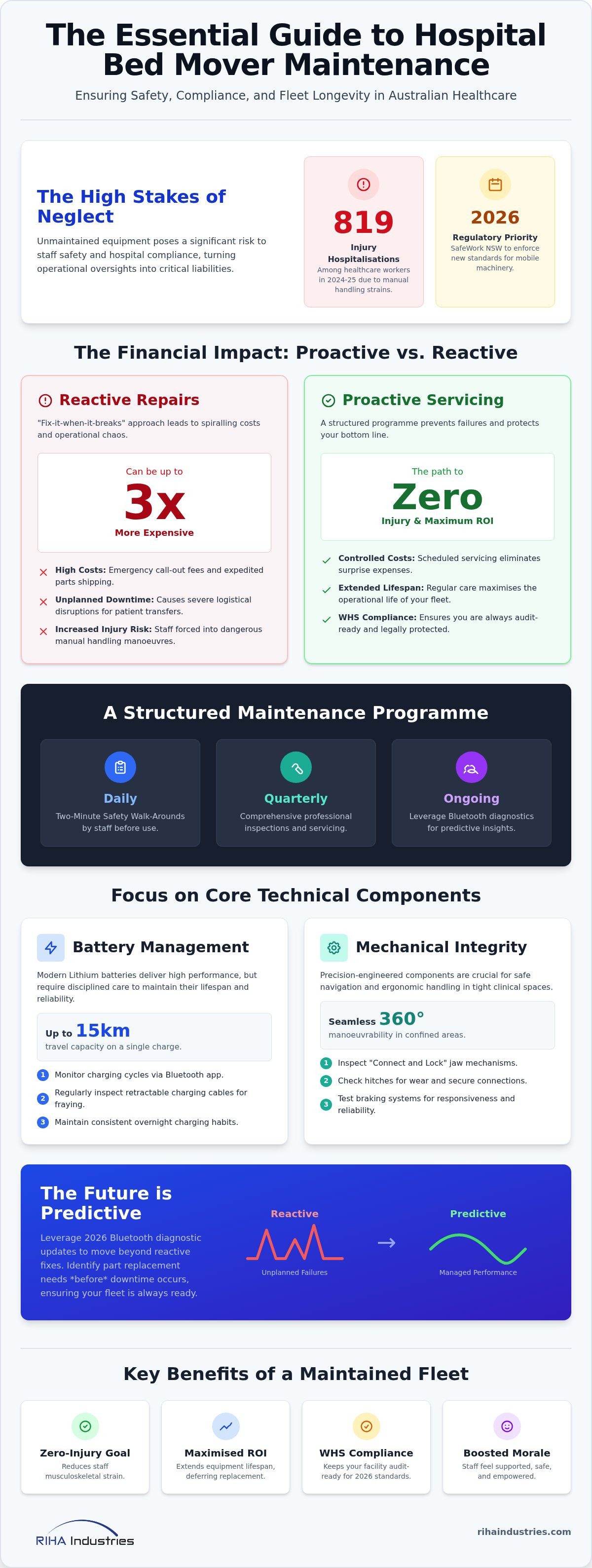
In 2024-25, there were 819 injury hospitalisations among Australian healthcare workers, a figure that highlights the persistent physical strain of manual handling in clinical environments. While motorised equipment has significantly reduced these risks, the reliability of your fleet is only as strong as your hospital bed mover maintenance plan. With SafeWork NSW making mobile plant and machinery a regulatory priority for 2026, the gap between a well-maintained mover and a failing unit is no longer just an operational headache; it's a significant legal and safety liability.
You likely understand that reactive repairs are far more expensive than scheduled servicing, yet finding the time to document every check can feel overwhelming during a busy shift. This guide will show you how to build a robust maintenance framework that ensures WHS compliance, reduces staff injuries, and extends the life of your motorised fleet. We'll explore the transition from traditional servicing to predictive maintenance using the latest Bluetooth diagnostics and 3D-printed components to keep your facility audit-ready and your team safe.
Table of Contents
The Strategic Necessity of a Hospital Bed Mover Maintenance Plan
A comprehensive hospital bed mover maintenance plan serves as a vital safeguard for both your facility’s budget and its people. In the high-stakes environment of Australian healthcare, equipment reliability is the thin line between a smooth patient transfer and a reportable workplace incident. As SafeWork NSW designates mobile plant and machinery a regulatory priority for 2026, the demand for rigorous medical equipment management has never been higher. Transitioning from a reactive "fix-it-when-it-breaks" mindset to a structured preventative programme is the only way to ensure your facility remains audit-ready and operationally sound.
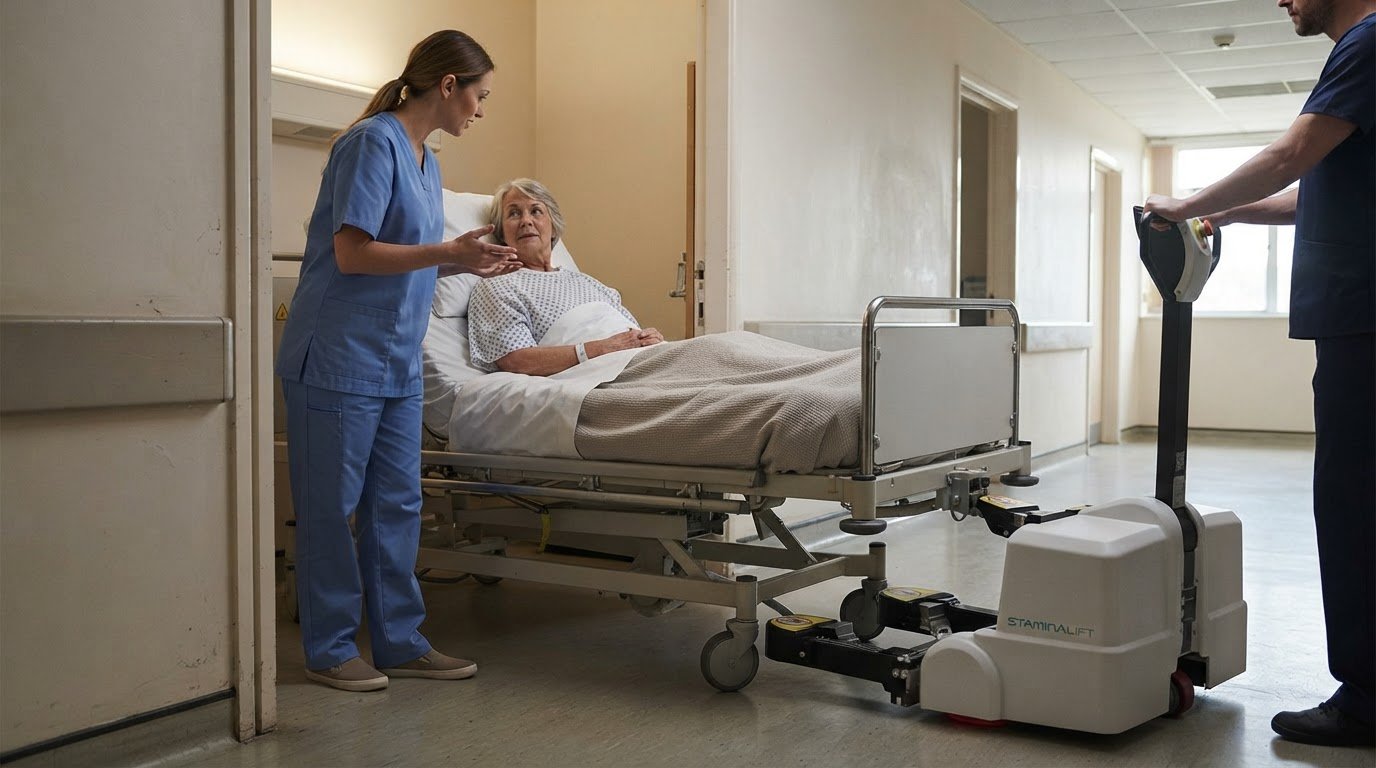
The financial argument for this shift is undeniable. Industry benchmarks indicate that reactive repairs can be up to three times more expensive than planned servicing. This disparity stems from emergency call-out fees, expedited shipping for parts, and the logistical chaos caused by unplanned downtime. By prioritising a "Zero-Injury" goal, powered movers like the StaminaLift Transfer System 5000 don't just move beds; they protect your bottom line by preventing the high costs associated with workers' compensation claims and staff absenteeism.
Reducing Musculoskeletal Risks through Reliability
When a motorised mover fails mid-shift, the physical burden doesn't simply vanish. Staff are often forced into dangerous manual handling manoeuvres to complete a transfer, instantly increasing the risk of back and shoulder injuries. These moments are often preceded by "near-miss" mechanical failures, such as a slight loss in traction or a sluggish battery, which a proactive plan would have identified and rectified. Beyond physical safety, reliable equipment has a profound psychological impact. Nurses and porters who trust their tools feel empowered and supported. This sense of safety directly improves staff retention and morale in an increasingly demanding sector.
Financial ROI of Proactive Fleet Management
Maximising the return on investment for your motorised transfer fleet requires a long-term perspective on care. Consistently maintaining units like the StaminaLift 2100 can significantly extend their operational lifespan, deferring the need for capital-heavy replacements. To justify maintenance budget allocations, facility managers should consider the following factors:
Downtime costs: Compare the operational impact of a unit being out of service for days versus a scheduled two-hour quarterly check.
Preventative savings: Identifying worn tyres or loose hitches early avoids the risk of catastrophic motor failure.
WHS Compliance: Effective documentation prevents the substantial fines associated with non-compliance under the 2026 Australian Codes of Practice.
Utilising tools like the RIHA ROI calculator helps quantify these benefits. It proves that a well-maintained fleet is a strategic asset that supports both clinical excellence and financial stability.
Core Technical Components Requiring Regular Servicing
To maintain the operational excellence of your motorised fleet, your hospital bed mover maintenance plan must focus on the specific high-wear components that define performance. Unlike general facility equipment, specialised movers like the StaminaLift Transfer System 6000 rely on precision engineering to safely navigate tight clinical spaces. Neglecting these core technical elements doesn't just lead to downtime; it compromises the ergonomic safety of your entire nursing team.
Battery Management and Charging Infrastructure
The shift toward advanced Lithium battery technology has revolutionised the travel capacity of modern movers, with many units now capable of covering 15km on a single charge. However, this performance is contingent on disciplined charging habits and infrastructure care. Maintenance teams should use the integrated Bluetooth app to monitor charging cycles, which helps predict battery degradation before it impacts shift performance. It's also vital to inspect retractable charging cables for fraying or loose connections. These small electrical faults are often the root cause of charging failures and can present significant safety hazards if left unaddressed. Consistent overnight charging remains the gold standard for preserving long-term battery health and ensuring every unit is ready for a full day of patient transfers.
Mechanical Integrity: Jaws, Hitches, and Braking
The patented "Connect and Lock" mechanism is the heart of the StaminaLift series, providing the secure grip needed for 360-degree manoeuvrability. Regular inspections of the Jaw System 300 are essential to verify alignment and grip strength across varying bed frame designs. Mechanics should also clear debris from non-marking drive wheels, as trapped grit can score facility floors and reduce traction over time. This simple cleaning step prevents expensive floor repairs and ensures the drive system operates at peak efficiency.
Equally critical is the automatic braking system. This safety feature must engage instantly when the joystick is released to prevent uncontrolled movement on inclines or in busy corridors. Testing the emergency brake release system ensures that, in the rare event of a power failure, the unit can be safely moved manually. If your team notices any lag in response or a reduction in grip strength, it's wise to schedule professional preventative maintenance and repairs to restore the unit to factory specifications and maintain your WHS compliance standards.
Smart Technology: Bluetooth Diagnostics and Predictive Maintenance
The integration of digital intelligence is fundamentally changing how facilities manage their motorised assets. A modern hospital bed mover maintenance plan no longer relies solely on the calendar; it now draws from real-time data to transition from preventative to predictive care. By using diagnostic feedback to identify wear patterns, maintenance managers can order critical components weeks before a part actually fails. This foresight ensures that equipment like the StaminaLift 2100 remains in constant service, supporting the "Zero-Injury" goals of the facility without the interruption of unplanned repairs.
Leveraging Bluetooth for Fleet Insights
Bluetooth connectivity provides a window into the daily life of every mover in your fleet. Usage history data reveals the specific operational burden on each unit, allowing teams to distinguish between overworked movers in high-traffic emergency departments and under-utilised units in elective surgery wings. When a fault does occur, diagnostic codes can be shared with technicians remotely to troubleshoot the issue before they set foot on-site. This level of remote transparency reduces equipment "no-fault-found" service calls by ensuring the technician arrives with the exact tools and parts required. The data also serves as a powerful training tool; if the app shows a pattern of improper charging, it identifies a clear opportunity for staff education to preserve battery longevity.
3D Printing and Part Longevity
Supporting rural Australian healthcare facilities requires innovative solutions to overcome the tyranny of distance. Through 3D-assisted servicing and CAD modelling, RIHA Industries can provide remote support that keeps regional fleets operational. We utilise ABS-carbon fibre to create durable, precision-engineered components that match the strength of original parts. This approach is a key pillar of engineered sustainability, allowing us to manufacture custom replacements for discontinued machinery that other vendors might consider obsolete. By choosing to repair and modernise rather than decommission, facilities can significantly reduce their environmental footprint while protecting their initial capital investment. This commitment to part longevity ensures that even older models continue to provide the 360-degree manoeuvrability and safety that clinical staff depend on daily.
Your Step-by-Step Preventative Maintenance Schedule
Adopting a structured hospital bed mover maintenance plan is no longer just an operational recommendation; it's a regulatory necessity. As of July 1, 2026, Australian Codes of Practice are admissible in legal proceedings as evidence of what is reasonably practicable for workplace safety. With SafeWork NSW prioritising mobile plant and machinery through 2027, your maintenance schedule must be documented, repeatable, and thorough. A well-executed plan ensures that your fleet remains a reliable tool for injury prevention rather than a compliance risk.
Daily and Weekly Portering Checklists
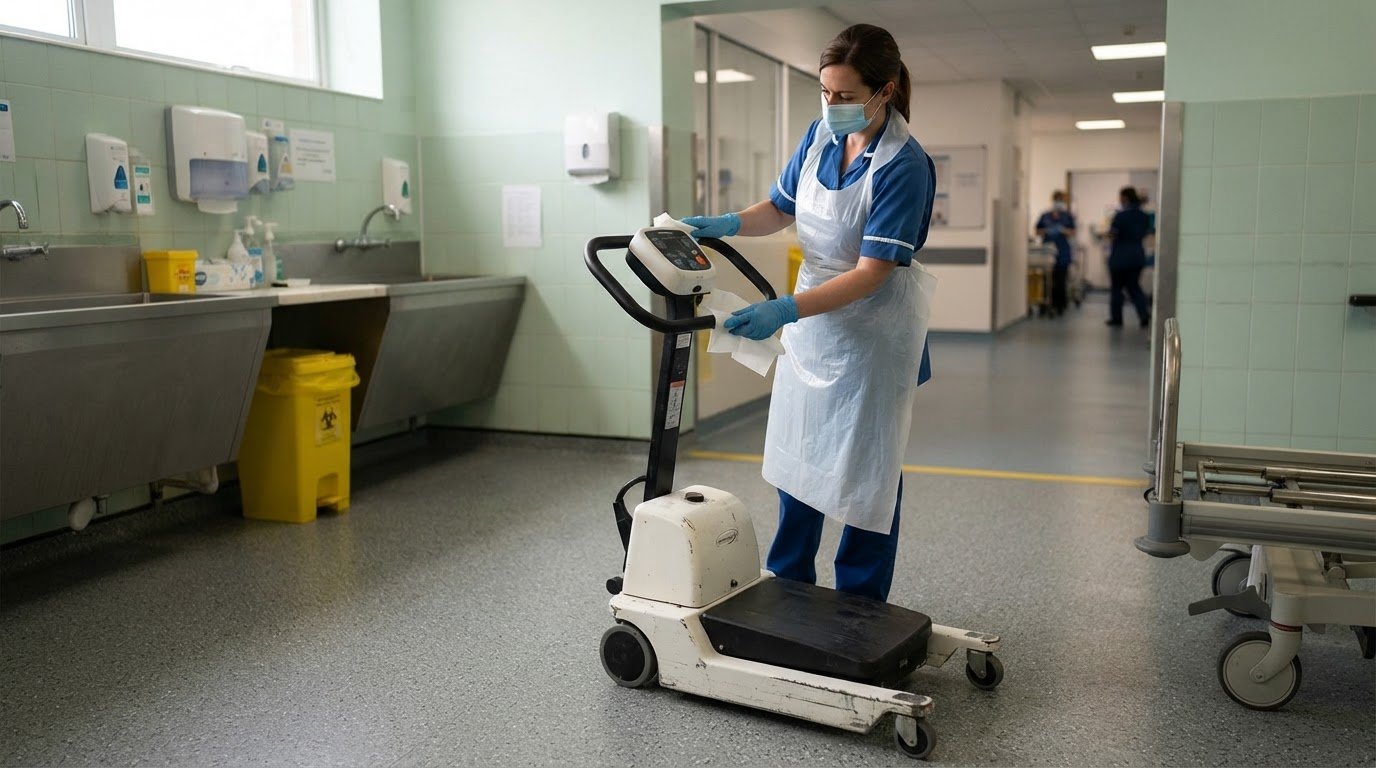
Safety begins with the operator. A two-minute visual inspection before every shift can identify minor issues before they escalate into clinical incidents. Porters should perform a safety walk-around to verify the integrity of the joystick and the emergency stop button. On the Easi Mover, it's critical to test the "Back Off Button" to ensure the anti-crush safety mechanism is fully functional. Accessories such as oxygen bottle holders and IV pole attachments must be checked for secure fastening to prevent items becoming dislodged during transit. Finally, high-touch surfaces require daily cleaning with approved disinfectants to maintain infection control standards without degrading the equipment's interface.
Quarterly and Annual Professional Servicing
While daily checks catch surface-level issues, quarterly inspections by qualified technicians dive into the mechanical heart of the machine. These sessions focus on deep-cycle battery health and essential firmware updates via Bluetooth, particularly for the StaminaLift 2100. Technicians should lubricate all pivot points and the patented adjustable hitches that allow for universal bed compatibility. To ensure the fleet can handle the rigours of modern facility design, load testing should be conducted on gradients up to 7 degrees. This confirms the motor and braking systems can safely manage full-capacity transfers on ramps and inclines.
Special attention must be reserved for the StaminaLift Transfer System 6000. Designed to move nearly one-ton bariatric loads, the TS6000 requires rigorous inspection of its reinforced load-bearing components. The sheer force involved in bariatric transport means that even slight misalignments in the jaw system can lead to significant wear. An annual comprehensive audit provides a full mechanical strip-down and safety re-certification, ensuring your facility remains audit-ready. To protect your staff and maintain your equipment's warranty, you should organise professional preventative maintenance and repairs with an authorised service provider.
Professional Servicing and Support: The RIHA Advantage
Partnering with an Australian manufacturer provides a level of responsiveness that third-party distributors simply cannot match. When you integrate RIHA Industries into your hospital bed mover maintenance plan, you gain access to a national network of expert technicians who understand the specific ergonomic challenges of the local healthcare sector. This direct relationship ensures that your equipment is serviced by the same people who designed and built it, maintaining the highest standards of safety and mechanical integrity. Reliability is our primary promise.
Service Contracts and In-House Support
Predicting annual expenditure is easier when you secure a bed mover service contract, which provides budget certainty and priority support. To empower your on-site engineering teams, we offer an online 3D viewer that simplifies basic in-house part replacement and routine servicing. This digital tool bridges the gap between mechanical complexity and practical maintenance. For complex technical issues, our direct engagement model ensures you aren't stuck in a communication loop with a middleman. We also provide comprehensive staff training and certification programmes, ensuring your team can operate and care for the equipment with confidence. If your facility uses unique theatre tables or specialised waste bins, our engineering team can design custom modifications, such as tailored hitches and clamps, to ensure universal compatibility across your entire ward.
Global Reach, Local Expertise
Downtime in a clinical setting is more than an inconvenience; it's a risk to staff safety. Our 24-hour global parts shipping guarantee is designed to minimise these windows of vulnerability by getting essential components to your facility as quickly as possible. This rapid dispatch is especially vital for rural Australian healthcare facilities that may feel isolated from traditional service hubs. By utilising remote diagnostics and our Australian-based support desk, we can assist regional teams in keeping their StaminaLift Transfer System 5000 at peak performance without waiting days for a technician to travel. Choosing Australian-made equipment gives you the peace of mind that comes from rigorous local quality control and a partner who is deeply invested in the long-term health of your facility's transfer fleet. We don't just sell machinery; we provide a stable, long-term safety solution.
Securing the Future of Your Clinical Transfer Fleet
Prioritising equipment reliability is a direct investment in the health and longevity of your nursing and portering teams. By transitioning from reactive repairs to a predictive hospital bed mover maintenance plan, your facility can leverage Bluetooth diagnostics and 3D-printed sustainability to eliminate unplanned downtime. This strategic shift doesn't just satisfy 2026 WHS audit requirements; it fosters a culture of safety where staff feel empowered by the tools they use every day. Reliability isn't just a technical goal; it's a commitment to care.
RIHA Industries remains your dedicated partner in this mission. As an FDA-registered manufacturer of award-winning, certified Australian-made equipment, we provide national service coverage across all Australian states to ensure your fleet never falters. Our team is ready to help you transition your facility toward a zero-injury workplace through precision engineering and unmatched technical support. To take the next step in protecting your staff and your assets, organise a professional maintenance audit for your facility today. It's time to transform your patient transport logistics into a stable, long-term asset.
Frequently Asked Questions
How often should a hospital bed mover be serviced in a high-volume facility?
Quarterly professional inspections are the standard recommendation for high-volume environments where equipment is in constant use. While daily checks catch immediate issues, a quarterly schedule ensures that high-wear components like drive wheels and hitches are assessed before they compromise safety. This frequency is a core part of a robust hospital bed mover maintenance plan, preventing the significantly higher costs of reactive repairs and keeping your fleet operational through busy shifts.
Can my internal engineering team perform maintenance on StaminaLift movers?
Yes, your internal engineering team can perform basic maintenance and part replacements using our online 3D viewer and diagnostic tools. We provide technical support and documentation to empower your on-site staff with the knowledge they need. However, for complex mechanical overhauls or to maintain full warranty protection, we recommend engaging our authorised technicians for annual comprehensive audits. This approach combines local convenience with manufacturer-level expertise for long-term equipment reliability.
What are the most common causes of powered bed mover failure?
Battery degradation and debris accumulation in the drive system are the primary causes of equipment downtime. Improper charging habits can shorten the lifecycle of Lithium batteries, while floor grit trapped in the wheels can reduce traction and strain the motor. Regular cleaning and disciplined charging protocols mitigate these risks. Identifying these patterns early through a structured hospital bed mover maintenance plan ensures that minor wear doesn't lead to catastrophic mechanical failure.
Do I need a different maintenance plan for bariatric movers like the TS6000?
The StaminaLift Transfer System 6000 requires more frequent and rigorous inspections of its reinforced load-bearing components due to the extreme forces involved in moving nearly one-ton loads. While the core schedule remains similar to standard units, the jaw system and braking mechanisms need closer scrutiny for alignment and grip strength. Ensuring these high-capacity units are tested on gradients up to 7 degrees is vital for maintaining bariatric safety standards and staff well-being.
How does Bluetooth connectivity help with equipment maintenance?
Bluetooth connectivity allows maintenance teams to access real-time diagnostics, including battery health and motor performance, directly from a mobile app. This technology enables a shift toward predictive maintenance, where you can identify potential failures before they occur. It also provides usage history, helping you decide which units need servicing based on actual work performed rather than just the date. This data-driven approach reduces "no-fault-found" service calls and improves fleet ROI.
What should be included in a daily safety checklist for porters?
A daily checklist should focus on high-touch controls and immediate safety features. Porters should perform a two-minute walk-around to inspect the joystick, emergency stop, and the "Back Off Button" on the Easi Mover. Checking that oxygen bottle holders are secure and that the charging cable is free of fraying is also essential. These simple visual checks ensure the equipment is safe for both the operator and the patient before any transfer begins.
Is it possible to get replacement parts for older, discontinued bed mover models?
Yes, RIHA Industries utilises CAD modelling and 3D printing with ABS-carbon fibre to create precision-engineered parts for discontinued machinery. This commitment to engineered sustainability allows you to extend the life of older fleets rather than decommissioning them prematurely. We provide 24-hour global parts shipping to ensure that even legacy models remain operational and safe. This approach protects your capital investment while maintaining high standards of clinical manoeuvrability across the ward.
How does regular maintenance impact WHS compliance in Australian hospitals?
Adherence to a structured maintenance plan provides the essential documentation required for WHS audits under the 2026 Australian Codes of Practice. Since SafeWork NSW has made mobile machinery a regulatory priority through 2027, having a verifiable service history is a critical legal safeguard. Regular maintenance reduces the risk of staff musculoskeletal injuries from manual handling, helping your facility achieve "Zero-Injury" goals and avoiding the substantial fines associated with non-compliance.