
Hospital Bed Mover Price: A 2026 Investment and ROI Guide for Australian Healthcare
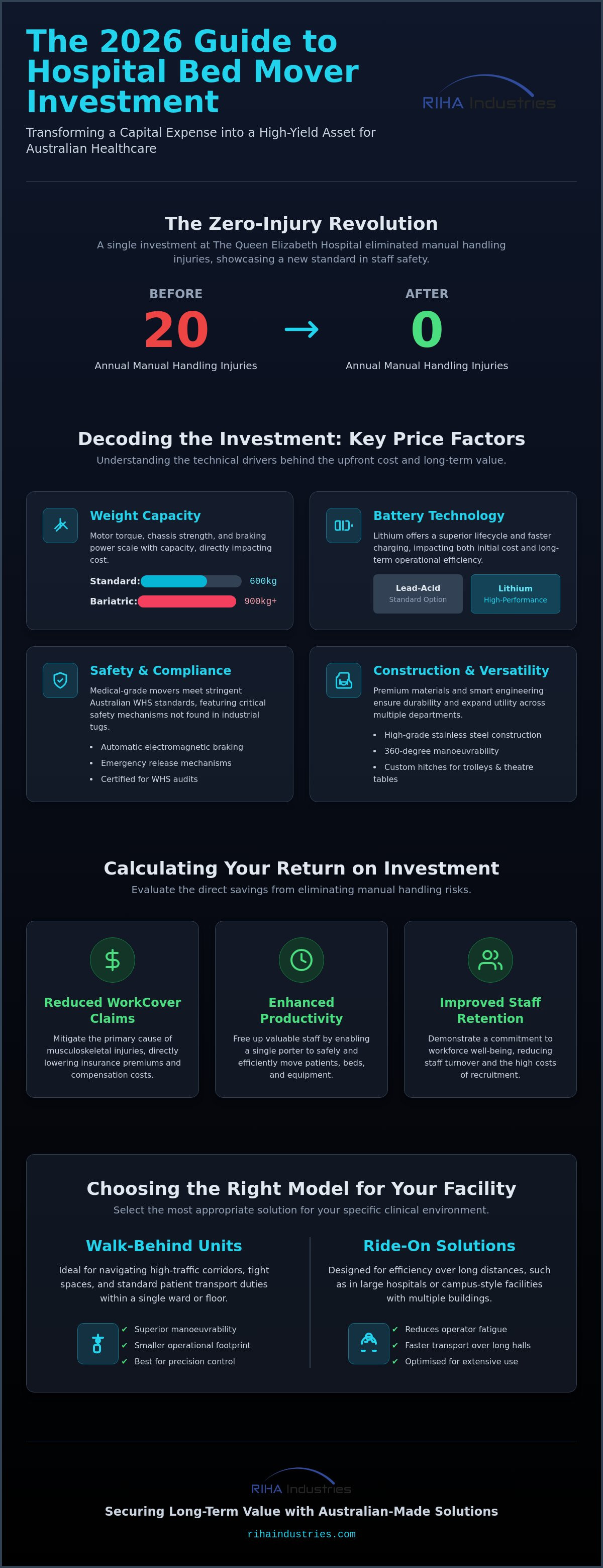
Did you know that introducing motorised bed movers at The Queen Elizabeth Hospital in South Australia reduced manual handling injuries from 20 per year to exactly zero? This remarkable outcome highlights why facility managers across the country are shifting their focus from simple procurement to long-term risk mitigation. You likely already recognise the heavy strain that rising WorkCover claims and chronic staff shortages place on your portering teams. It is a complex challenge that impacts both your annual budget and the physical well-being of your frontline carers.
In this guide, we'll explore the current hospital bed mover price landscape for 2026 and demonstrate how these tools transform from a capital expense into a high-yield investment. You'll discover the specific factors that influence cost, such as universal hitch compatibility and weight capacity. We also provide a clear framework to help you calculate a compelling ROI based on reduced staff turnover and the elimination of manual handling risks. This article provides the evidence you need to build a robust business case that prioritises both operational efficiency and the safety of your workforce.
Table of Contents
Understanding the Investment: Why Hospital Bed Mover Pricing Varies
Key Factors Influencing the Purchase Price of Powered Movers
Calculating ROI: The Cost of Manual Handling vs. Motorised Efficiency
Choosing the Right Model for Your Facility’s Budget and Needs
Securing Long-Term Value with RIHA Industries and StaminaLift
Understanding the Investment: Why Hospital Bed Mover Pricing Varies
When evaluating a hospital bed mover price, it is essential to view the equipment as a foundational component of your facility's Work Health and Safety (WHS) strategy. These units are not merely convenience items; they are sophisticated pieces of patient handling equipment designed to mitigate the high-force loads that lead to chronic musculoskeletal injuries. The pricing you encounter reflects a tiered approach to engineering precision, battery longevity, and safety certifications. While entry-level tugs might suit smaller, low-traffic clinics, specialised systems like the StaminaLift series are built for the rigorous, 24/7 demands of high-volume tertiary hospitals. Opting for Australian-made equipment often yields superior long-term value. This choice ensures you have direct access to local technical support and immediate parts availability, which helps you avoid the costly operational downtime often associated with international supply chains.
The Baseline: Standard vs. Heavy-Duty Capacity
Weight capacity serves as a primary driver of cost because it dictates the motor torque, chassis reinforcement, and braking power required for safe operation. A standard mover capable of handling 600kg is typically sufficient for general ward duties. However, the increasing demand for bariatric care necessitates heavy-duty solutions like the StaminaLift Transfer System 6000, which is engineered to manage loads up to 900kg. Investing in higher-capacity units ensures your fleet remains versatile and prepared for any patient demographic. This foresight prevents equipment strain and significantly extends the operational lifespan of your investment. Matching your facility's specific patient profile to the correct equipment tier is a critical step in budget optimisation.
Regulatory Compliance and Safety Standards
The total hospital bed mover price is also influenced by the level of regulatory compliance and built-in safety technology. High-quality movers undergo extensive testing to achieve FDA registration and meet stringent Australian safety standards. Unlike generic industrial tugs, medical-grade movers include essential safety features such as automatic electromagnetic braking and emergency release mechanisms. These systems protect both staff and patients during transport through high-traffic corridors or when navigating slight inclines. Selecting equipment that meets these rigorous standards ensures your facility remains compliant with WHS audits. It also provides a clear, evidence-based foundation for your risk management protocols, proving that your safety measures are backed by world-class engineering.
Key Factors Influencing the Purchase Price of Powered Movers
Understanding the specific technical drivers behind a hospital bed mover price allows facility managers to make informed decisions that balance upfront expenditure with long-term reliability. The engineering choices made during manufacturing directly impact how easily a single staff member can navigate a 400kg load through a crowded corridor. High-grade stainless steel construction, for instance, offers superior durability and infection control compared to plastic-heavy alternatives. This material choice ensures the equipment survives the inevitable bumps of a high-traffic environment. Sophisticated manoeuvrability features, such as 360-degree turning circles and intuitive joystick controls, further differentiate premium models. These elements provide the tactile feedback and precision required to prevent collisions and reduce operator fatigue. Customisation also plays a role, with specialised clamps for theatre tables or unique trolley hitches allowing a single unit to serve multiple departments. This versatility ensures your investment provides maximum utility across the entire facility.
Battery Systems and Charging Infrastructure
The choice between standard lead-acid and high-performance lithium batteries is a significant factor in the overall hospital bed mover price. While lithium upgrades require a higher initial investment, they offer a vastly superior lifecycle with faster charging and lower weight. This weight reduction makes the unit itself easier to handle when not under load. Integrated chargers featuring retractable cables are another critical inclusion. They eliminate trip hazards in busy wards and ensure the unit is always ready for use. Modern systems now incorporate Bluetooth battery monitoring, allowing maintenance teams to track health data remotely and replace cells before an operational failure occurs. This proactive approach significantly reduces long-term maintenance overheads.
Universal vs. Specific Hitching Mechanisms
Universal compatibility is a vital technical feature for managing a diverse equipment fleet. While a "one-size-fits-all" hitch is often a myth, patented attachment mechanisms can now securely fit approximately 95% of global hospital beds and stretchers. This versatility aligns with the ANMF manual handling guidelines, which emphasise equipment that supports nurses in performing duties safely without complex manual adjustments. Hands-free connection systems further drive efficiency in high-volume environments. They allow porters to transition between different bed types without needing multiple specialised movers, effectively reducing the total number of units required for your facility.
If you're looking to standardise your fleet with a solution that bridges the gap between mechanical power and human safety, you can explore the technical specifications of our latest Australian-made models.
Calculating ROI: The Cost of Manual Handling vs. Motorised Efficiency
Justifying the initial hospital bed mover price requires a shift from viewing equipment as a capital expense to recognising it as a high-yield risk management tool. Facility managers can utilise the RIHA Industries ROI calculator to bridge this gap, inputting specific local variables to reveal tangible savings. The most immediate impact is found in the 'Single Person Operation' model. Traditionally, moving a modern hospital bed with a patient requires two staff members to manage the weight and steerage. By empowering a single porter or nurse to perform the same task safely, you effectively halve the labour cost of every transfer across the hospital. This efficiency is not just about speed; it is about protecting your most valuable asset: your people.
The True Cost of Staff Injuries
In the Australian healthcare sector, body stressing from manual handling remains a leading cause of serious workers' compensation claims. Data from 2023-24 shows that a single manual handling claim in New South Wales or Victoria averages between $15,000 and $40,000 in direct costs. These figures only account for the immediate claim and do not include the "hidden" expenses that erode your budget. When a skilled staff member is sidelined by a back injury, you face the high cost of agency staff hire and the administrative burden of retraining replacement personnel. Furthermore, chronic injury rates lead to decreased ward morale and higher turnover. Implementing motorised movers acts as a protective shield, often reducing bed-moving injuries to zero and stabilising your WorkCover premiums.
Labour Productivity and Throughput
Efficiency gains extend far beyond the reduction of injury claims. A case study involving Australian private hospitals estimated that a single powered bed mover could save approximately $60,000 per year simply by removing the need for a second staff member to assist with moves. This freed-up capacity allows your portering team to complete more transfers in less time. Faster bed turnaround is a critical factor in improving Emergency Department flow and reducing patient wait times. For a deeper look at how these efficiency statistics translate into daily ward operations, you can consult the StaminaLift Transfer System 5000 buying guide. By investing in the right technology, you ensure that physical limitations never become a bottleneck for clinical care.
Reducing the physical burden of the job also plays a vital role in staff retention, particularly for an ageing nursing workforce. When you provide tools that eliminate the need for heavy pushing and pulling, you empower your staff to work longer, healthier careers. This long-term stability is a key component of the return on investment that a standard spreadsheet might overlook, yet it is essential for maintaining a high standard of patient care.
Choosing the Right Model for Your Facility’s Budget and Needs
Selecting the ideal equipment involves more than just comparing a hospital bed mover price on a spreadsheet. It requires a deep understanding of your facility's architectural constraints, patient demographics, and portering workflows. A high-traffic metropolitan hospital will have vastly different requirements compared to a regional aged care centre. By matching the technical capabilities of a unit to the specific challenges of your ward, you ensure that the investment delivers maximum utility. Whether you require a compact unit for narrow corridors or a heavy-duty system for bariatric transfers, the choice should always prioritise the safety and comfort of both the operator and the patient.
StaminaLift TS5000 vs. TS6000
The StaminaLift Transfer System 5000 serves as the flagship solution for general acute care, offering 95% compatibility with global bed brands. It is the workhorse of the industry, providing the perfect balance of power and precision for standard ward duties. For high-acuity environments where bariatric care is frequent, the StaminaLift Transfer System 6000 is the necessary choice. Engineered to manage one-ton loads, the TS6000 provides the extra torque and reinforced chassis required for extreme weight transfers. While the investment for the TS6000 is higher, its ability to safely manage bariatric patients justifies the cost by eliminating the extreme injury risks associated with manual bariatric handling.
Compact Solutions for Aged Care and Rural Wards
Smaller facilities often face unique challenges, such as tight turning circles in older buildings and multi-purpose staff roles. The StaminaLift 2100 Bed Mover is a cost-effective and highly manoeuvrable choice that excels in these confined spaces. In settings where staff must also transport various trolleys and clinical equipment, the Easi Mover provides a versatile walk-behind tug solution. If your facility covers large campuses with long transport corridors, the Easi Rider ride-on solution can significantly reduce staff fatigue. You can find more targeted advice in our guide to aged care patient transport equipment.
Budgeting should also account for departmental accessories. Items such as oxygen bottle holders, extended racks, and stand-on platforms for porters can be integrated to streamline specific workflows. Before finalising any purchase, we strongly recommend a hands-on trial. Testing a unit in your own corridors with your specific bed fleet is the only way to truly verify compatibility and staff acceptance. To ensure you select the most effective solution for your team, you can book a comprehensive facility demonstration with our clinical specialists.
Securing Long-Term Value with RIHA Industries and StaminaLift
Investing in motorised equipment is a decision that should yield benefits for a decade or more. While the initial hospital bed mover price is a key factor in procurement, the true cost of ownership is determined by the availability of local support and spare parts. When you choose Australian-made equipment, you eliminate the logistical vulnerabilities associated with international supply chains. There are no six-week delays for a specific circuit board or motor component. Instead, you benefit from a local inventory that ensures your fleet remains operational. This proximity allows for 24-hour response times, which is a critical requirement for facilities where equipment downtime directly impacts patient flow and staff safety. Protecting your investment also involves rigorous training and certification programmes. By ensuring every porter and nurse is confident in operating the machinery, you reduce the risk of accidental damage and ensure the technology is used to its full ergonomic potential.
Maintenance and Service Contracts
Regular servicing is the most effective way to prevent costly emergency repairs and extend the life of your equipment to 10 years or beyond. Our Preventative Maintenance and Repairs programmes are designed to identify wear and tear before it leads to a breakdown. Because we manufacture our components in-house, we can continue to support older machines long after other brands would have decommissioned them. For our partners in regional and rural areas, we provide a specialised 3D-viewer tool. This allows facility maintenance teams to receive remote technical support and identify part requirements with precision, ensuring that distance never compromises the safety of your healthcare environment.
The RIHA Industries Guarantee
The decision to engage directly with the manufacturer rather than through a third-party distributor ensures you receive the most competitive hospital bed mover price alongside expert technical knowledge. This direct relationship fosters a commitment to Engineering Sustainability, where we prioritise the long-term availability of parts and the durability of our designs. We see ourselves as a protective ally for your staff, dedicated to providing reliable solutions that stand the test of time. Our goal is to ensure that your facility remains a safe, efficient workplace for every member of the care team. This long-term partnership provides the stability needed to manage complex healthcare environments with confidence.
Contact RIHA Industries for a tailored quote and ROI analysis to see how we can support your facility's safety goals.
Transforming Facility Safety into a Strategic Advantage
Navigating the nuances of a hospital bed mover price requires a focus on the long-term health of both your budget and your workforce. As we have explored, the transition from manual handling to motorised assistance is not merely an equipment upgrade; it is a commitment to a safer clinical environment. By choosing solutions from an FDA-Registered Manufacturer that is Certified Australian-Made, you ensure that your facility benefits from world-class engineering and immediate local support. The evidence is clear: when facilities implement these systems, they don't just reduce risk; they can eliminate bed-moving injuries entirely, as seen in major South Australian hospital case studies.
You now have the framework to evaluate models based on weight capacity, battery technology, and hitch versatility. This knowledge empowers you to build a business case that prioritises operational flow and staff well-being. To see how these figures apply to your specific ward requirements, you can Request a Personalised ROI Calculation and Quote. We look forward to helping you create a more sustainable and injury-free future for your entire healthcare team.
Frequently Asked Questions
How much does a hospital bed mover typically cost in Australia?
The hospital bed mover price in Australia is determined by the specific engineering requirements of your facility, such as weight capacity and battery type. Entry-level tugs for general portering sit at a lower tier, while heavy-duty systems designed for acute care represent a more significant capital investment. We recommend evaluating these costs alongside the potential savings from reduced injury claims and improved staff efficiency to understand the true value.
Do I need different movers for different brands of hospital beds?
No, you don't necessarily need multiple movers if you select a unit with a universal hitch. Modern systems like the StaminaLift series are designed to be compatible with 95% of global bed brands. This versatility allows a single unit to service a diverse fleet of beds and stretchers across various departments. It simplifies your fleet management while reducing the total number of units required for your facility.
What is the expected lifespan of a StaminaLift bed mover?
With a dedicated preventative maintenance programme, a StaminaLift unit typically has an operational lifespan of 10 years or more. These machines are built with high-grade materials to withstand the constant demands of a busy clinical environment. Regular servicing is the most effective strategy to protect your hospital bed mover price investment and ensure the equipment remains a reliable, long-term asset for your care team.
Can one person safely operate a motorised bed mover on a ramp?
Yes, motorised movers are specifically designed to allow a single operator to manage heavy loads on inclines safely. Features like automatic electromagnetic braking and high-torque motors provide the precise control needed to prevent runaway situations. This capability is a primary driver of operational ROI, as it removes the need for a second staff member to assist during transfers on ramps or uneven ward floors.
Are there government grants or subsidies for purchasing safety equipment?
Various state-based authorities, such as SafeWork or WorkCover, occasionally offer incentives or rebates to help businesses implement safety equipment that reduces manual handling risks. While larger hospitals usually fund these through capital expenditure budgets, smaller facilities should check with their state's safety regulator for current grant availability. Investing in engineered solutions is a recognised way to lower workers' compensation premiums over time.
How often do the batteries need to be replaced in a powered tug?
Battery lifespan depends on the technology used and the intensity of daily ward use. Standard lead-acid batteries typically require replacement every two to three years to maintain peak performance. In contrast, high-performance lithium batteries can last five years or longer. Implementing a regular charging routine and using integrated monitoring tools will help you maximise the life of your power cells and avoid unexpected downtime.
Is a bariatric bed mover necessary for every ward?
Not every ward requires a specialised bariatric unit, but having at least one high-capacity mover like the StaminaLift Transfer System 6000 is recommended for facilities with bariatric patient pathways. Standard wards usually find that a unit with a 600kg capacity meets their daily needs. Assessing your specific patient demographic helps determine the most efficient mix of standard and heavy-duty equipment for your fleet.
What is the lead time for delivery and staff training in Australia?
Being Australian-made, our lead times are significantly shorter than those of imported equipment that may be subject to global shipping delays. Delivery and initial staff training can often be organised within a few weeks of order finalisation. This rapid turnaround ensures your facility can begin realising the safety and efficiency benefits of your motorised fleet without the long wait times associated with international supply chains.


