
Hospital Bed Mover Repair Service: A Preventative Maintenance Guide for 2026
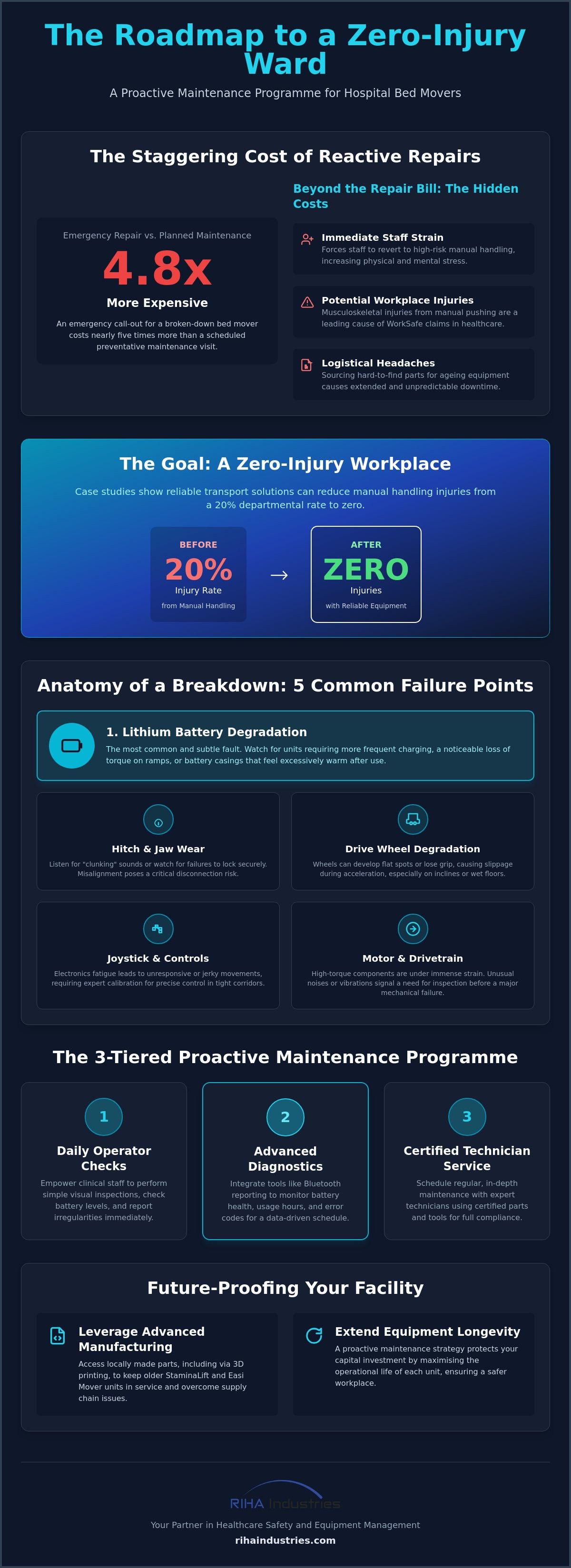
Did you know that an emergency hospital bed mover repair service can cost 4.8 times more than a planned, preventative maintenance visit? When a motorised unit suddenly breaks down in a high-pressure clinical environment, the impact goes far beyond the repair bill. It often leads to immediate staff strain, potential workplace injuries, and the logistical headache of sourcing hard-to-find parts for ageing equipment. You've likely felt the pressure of trying to maintain a safe ward while vital machinery sits idle in a maintenance bay.
We're here to help you move from reactive troubleshooting to a proactive, world-class maintenance programme that guarantees staff safety and extends the operational life of your fleet. This article provides a comprehensive roadmap for 2026, showing you how to achieve a zero-injury workplace while keeping a meticulous compliance audit trail. We'll explore how advanced diagnostic tools and reliable, Australian-made parts for your StaminaLift or Easi Mover units can transform your facility's efficiency and provide long-term peace of mind for your entire team.
Table of Contents
The Critical Role of Bed Mover Maintenance in Healthcare Safety
Maintaining motorised bed movers is more than just a routine check; it's a specialised technical discipline that sits at the intersection of industrial engineering and clinical safety. While general biomedical technicians handle a wide array of devices, a dedicated hospital bed mover repair service focuses on the high-torque, mechanical components that allow staff to transport patients safely. In Australian healthcare settings, where staff frequently move loads exceeding 500kg, the reliability of these units is paramount. Failure to maintain them doesn't just result in broken equipment; it leads to immediate risks for nurses and porters.
Australian Work Health and Safety standards require rigorous risk management for manual handling. When a bed mover is out of service, staff often revert to manual pushing, which is the primary cause of musculoskeletal injuries in the sector. Facilities that commit to a strict maintenance schedule often see a dramatic shift in safety outcomes. For example, South Australian hospital case studies have shown that implementing reliable transport solutions can reduce handling injuries from 20% to zero. This "zero-injury" goal is only achievable when equipment is 100% operational.
Why Motorised Movers Are Not "Standard" Hospital Equipment
Unlike static bed frames or simple trolleys, motorised movers utilise complex 360-degree drive systems and sophisticated electronics. These systems allow for precise movement in cramped corridors, but they require expert calibration to remain effective. The integrity of the "connect and lock" jaw mechanism is especially critical, as it ensures the bed and mover function as a single, stable unit during transit. Preventative maintenance for bed movers is the key to operational continuity.
The Economic Impact of Equipment Downtime
The financial implications of equipment failure are substantial. Emergency repairs in a hospital setting cost 4.8 times more than planned, preventative maintenance. This doesn't even account for the hidden costs of staff downtime or potential injury claims that impact the hospital budget. Effective Medical Equipment Management strategies incorporate specialised servicing to mitigate these risks before they escalate.
Utilising a professional bed mover maintenance service protects the facility budget by preventing premature capital expenditure. By extending the operational life of units like the StaminaLift 2100, facilities maximise their initial investment while ensuring a safer workplace for their most valuable asset: their people. Regular hospital bed mover repair service ensures that every unit in the fleet remains a reliable tool for injury prevention rather than a liability sitting in a maintenance bay.
Identifying Common Faults in Powered Hospital Bed Movers
Operating in a 24-hour clinical environment places immense strain on motorised transport equipment. Unlike static furniture, powered movers are high-torque machines that experience specific mechanical and electronic fatigue. Recognising the early warning signs of failure is the first step in a proactive hospital bed mover repair service strategy. By identifying issues before they cause a total breakdown, you protect your staff from the sudden physical burden of manual handling. Most operational failures in these units stem from five primary areas: batteries, hitches, joysticks, drive wheels, and the gripping jaws.
Lithium battery degradation is often the most subtle fault to detect. Early warning signs include the unit requiring more frequent charging cycles or a noticeable loss of torque when ascending ramps with a heavy load. If a battery casing feels excessively warm after use, it's a clear indicator that the internal cells are failing. Similarly, the patented attachment mechanisms and jaws require precise alignment. If you notice a "clunking" sound during connection or if the jaws fail to lock onto a bed frame on the first attempt, the mechanism likely needs recalibration to prevent a dangerous mid-transit disconnection.
High-use hospital floors also take a toll on non-marking drive wheels. Over time, these wheels can develop flat spots or lose their grip, leading to slippage during acceleration. Establishing a systematic approach to these faults, similar to the principles outlined in the WHO maintenance programme overview, is essential for long-term reliability. Regularly checking these points ensures your equipment remains a reliable asset, and for those managing complex fleets, RIHA Industries provides the diagnostic tools needed to simplify this process.
Electronic and Diagnostic Fault-Finding
Modern units now feature Bluetooth connectivity, allowing maintenance teams to pull usage history and diagnostic reports directly to a tablet. This data is invaluable for identifying "training needs" among staff. For instance, if the usage logs show a high frequency of emergency stop activations, it may indicate that operators need further guidance on safe speed control. Troubleshooting joystick responsiveness is also simplified through these digital tools, enabling technicians to adjust programmable drive settings to match the specific needs of different ward layouts.
Mechanical Wear and Tear in Clinical Settings
In heavy-duty units like the StaminaLift Transfer System 6000, checking hydraulic seals is a priority. Even a minor leak can lead to a significant loss of lifting power, compromising the unit's ability to handle bariatric loads safely. Technicians should also inspect the integrity of the retractable charging cable, as internal wire breaks are a common result of frequent pulling. Finally, always test the "Back Off Button" safety feature on walk-behind tugs. This critical sensor must stop and reverse the unit immediately upon contact to prevent operator entrapment in tight spaces like lifts or linen cupboards. A dedicated hospital bed mover repair service will always prioritise these safety-critical components during every inspection.
How to Organise an Effective Hospital Equipment Preventative Maintenance Programme
Transitioning from reactive repairs to a structured preventative programme is the most effective way to safeguard your facility's operational flow. Organising a comprehensive hospital bed mover repair service involves more than just fixing parts as they fail; it requires a tiered approach that integrates daily vigilance with technical expertise. By following established CMS guidelines on hospital equipment maintenance, facility managers can ensure that every motorised unit remains compliant with both manufacturer recommendations and rigorous WHS standards. A well-managed programme doesn't just prevent breakdowns; it creates a culture of safety where equipment reliability is a given.
A successful maintenance framework relies on three distinct layers of inspection. Daily operator checks focus on immediate safety, such as verifying battery levels and basic jaw function. Quarterly inspections involve more detailed technical assessments of the drive systems and electronic calibration. Finally, an annual overhaul ensures that every mechanical component, from hydraulic seals to the stainless steel chassis, is restored to peak condition. Centralising these records through a digital log of Bluetooth diagnostic reports allows for precise tracking of each unit's health, making it easier to predict when a specific mover might require specialised attention.
Staff certification plays an equally vital role in equipment longevity. When operators are trained in the nuances of 360-degree drive systems and correct hitching procedures, the mechanical strain on the units is significantly reduced. Integrating manufacturer-approved parts into your hospital bed mover repair service schedule is non-negotiable for maintaining FDA registration and ensuring that patented safety features, like the "Back Off Button," function exactly as intended. This holistic approach ensures that your fleet remains a durable, long-term asset for the hospital.
Step-by-Step Inspection Checklist
To maintain a high standard of care, your technical team should follow a rigorous checklist during every scheduled service. This process ensures no critical safety element is overlooked:
Chassis and Jaws: Perform a visual inspection of the stainless steel frame for any signs of stress and ensure the jaw mechanisms are free from debris and properly lubricated.
Safety Systems: Test the automatic braking system and all emergency stop buttons to ensure immediate response under load.
Manoeuvrability: Verify the 360-degree turning radius functionality to ensure the unit can navigate tight corridors without resistance or tracking issues.
Resource Planning for Rural and Metro Facilities
The geographical diversity of Australian healthcare requires a flexible approach to maintenance support. For facilities in major metropolitan hubs, scheduling regular national service coverage visits ensures that expert technicians can handle complex overhauls on-site. Conversely, remote or rural facilities can leverage advanced 3D-viewer tools for in-house servicing, allowing local biomedical teams to perform precise repairs with remote guidance from the manufacturer. You can use the StaminaLift maintenance plan as a proven framework to organise these resources effectively, regardless of your hospital's location.
In-House Servicing vs. Manufacturer-Certified Repair Services
Choosing between an immediate in-house fix and a specialist hospital bed mover repair service is a strategic decision for facility managers. Internal biomedical engineers are invaluable for performing daily checks and resolving minor mechanical issues swiftly. However, the sophisticated drive systems and patented hitching mechanisms of StaminaLift units require a level of precision that generic repairs cannot match. Using non-genuine components on these systems risks compromising the structural integrity of the connection, which could lead to equipment failure during patient transport.
RIHA Industries bridges this gap by providing in-house teams with the resources needed to succeed. We utilise CAD-designed parts and 3D printing to support older machinery, effectively eliminating the threat of "obsolescence." This allows your engineering team to keep veteran units in service with the confidence that every part meets original manufacturing standards. If you're currently evaluating your repair strategy, our technical support team can provide the guidance needed to maintain your fleet's peak performance.
When to Call the Specialists
Complex issues such as major hydraulic system failures or faults within the Printed Circuit Board (PCB) require manufacturer-certified expertise. These components are the "brain" and "muscle" of the unit, and incorrect handling can lead to further damage. Specialists are also essential for post-incident inspections to ensure the unit meets all legal WHS requirements before returning to the ward. Additionally, if you're planning a fleet-wide upgrade to lithium batteries or integrated charging systems, manufacturer oversight ensures the transition is seamless and safe.
Empowering Your Internal Engineering Team
We provide your staff with advanced tools like the RIHA 3D viewer, which simplifies part identification and ensures the correct components are ordered every time. Our commitment to 24-hour part shipping for Australian-made components significantly reduces the time a unit spends out of service. It's important to remember that using certified parts is essential for maintaining the FDA registration of the StaminaLift 2100. By combining your team's local knowledge with our technical resources, you create a robust hospital bed mover repair service framework that prioritises both speed and safety.
Future-Proofing Your Facility with RIHA Industries Support
Investing in a specialised hospital bed mover repair service ensures that your facility remains at the forefront of healthcare safety for years to come. By moving away from reactive "break-fix" cycles, you create a sustainable ecosystem where equipment longevity is prioritised alongside staff well-being. This proactive approach doesn't just save money on emergency call-outs; it reinforces your commitment to improving the lives of healthcare professionals by providing them with tools they can trust every single shift. Reliability is the cornerstone of a safe ward, and a dedicated maintenance partnership provides the technical backbone needed to achieve that goal.
Sustainability is a core component of future-proofing in the modern clinical environment. RIHA Industries utilises advanced CAD technology and 3D printing to manufacture parts for discontinued or older machinery, ensuring that your existing fleet doesn't become obsolete prematurely. This capability allows hospitals to maintain high safety standards without the immediate need for massive capital expenditure. To help justify these essential programmes to hospital boards, we encourage facility managers to utilise our ROI calculator. This tool provides concrete data on the cost-savings associated with reduced injury rates and extended equipment life, making the case for a robust maintenance budget undeniable.
The RIHA Advantage: Australian-Made Reliability
Being an Australian manufacturer means we understand the unique pressures of the local healthcare landscape. Local production translates to faster support and the guarantee of a 24-hour response time for national service calls. Because we design and build our units here, our 24-hour part shipping ensures that "unit down" time is kept to an absolute minimum. This level of responsiveness is only possible through a local supply chain and a deep commitment to engineering sustainability for both new and ageing fleets. Our hospital bed mover repair service is designed to keep Australian hospitals moving without the delays often associated with international parts procurement.
Next Steps for Facility Managers
The first step toward a more resilient facility is a comprehensive audit of your current fleet, including all StaminaLift and Easi series movers. Identifying which units require immediate attention or modernisation allows you to plan your maintenance schedule with precision. If you're looking to enhance your transport capabilities, booking a hands-on demonstration of the latest StaminaLift Transfer System 5000 or StaminaLift Transfer System 6000 models is an excellent way to see the latest safety innovations in action. These units represent the pinnacle of ergonomic design, ensuring your facility is prepared for the bariatric and logistical challenges of the future.
Consult with RIHA Industries for your hospital equipment preventative maintenance needs to ensure your team is protected by world-class engineering and dedicated local expertise.
Securing Your Facility’s Future with Proactive Care
Adopting a proactive maintenance strategy is the most effective way to eliminate the risks associated with manual handling and equipment failure. By focusing on a tiered inspection schedule and utilising specialised technical support, you ensure your motorised fleet remains a reliable asset for your staff. We've explored how identifying early faults and choosing a manufacturer-certified hospital bed mover repair service can prevent the high costs of emergency downtime while maintaining full compliance. Reliability is the cornerstone of a safe ward.
As an FDA-registered manufacturer, RIHA Industries provides the Australian-made quality and 24-hour shipping on essential components needed to keep your facility running smoothly. Our solutions have been proven to reduce handling injuries from 20% to zero in clinical settings, offering peace of mind to both managers and frontline carers. Now is the time to audit your fleet and transition toward a world-class maintenance model that protects your team and your investment. Book a Preventative Maintenance Consultation with RIHA Industries today to start your journey toward a safer, more efficient workplace. Your commitment to excellence today ensures a zero-injury environment for the years ahead.
Frequently Asked Questions
How often should a hospital bed mover be serviced?
A motorised bed mover requires a tiered maintenance schedule to ensure optimal safety and performance. Operators should perform basic visual checks daily, while a comprehensive professional inspection is recommended every quarter. An annual major service is essential for deep mechanical overhauls, ensuring the unit complies with Australian WHS standards and manufacturer specifications for long-term reliability.
Can our in-house engineers perform repairs on StaminaLift units?
Yes, your internal biomedical engineering team can perform routine maintenance and minor repairs. We support in-house teams by providing advanced diagnostic tools, such as 3D viewers for part identification and Bluetooth monitoring. However, for complex hydraulic failures or safety-critical sensor recalibration, engaging a certified hospital bed mover repair service ensures that the unit's patented mechanisms remain within original engineering tolerances.
What are the most common signs that a bed mover needs urgent repair?
Urgent repairs are typically signalled by a noticeable loss of torque when moving heavy loads or ascending ramps. You should also listen for unusual clunking sounds from the jaw mechanism and check for excessive heat in the battery casing during charging. Any lag in joystick responsiveness or failure of the "Back Off Button" safety feature requires immediate technical intervention to prevent workplace accidents.
Is it possible to get parts for older or discontinued bed mover models?
Yes, we provide ongoing support for older and discontinued models like the StaminaLift 2100 through modern manufacturing techniques. By utilising CAD technology and 3D printing, we can produce essential components that are no longer available as stock items. This commitment to sustainability prevents premature equipment obsolescence and allows hospitals to maintain their existing fleet safely for many years.
How does regular maintenance impact WHS compliance in Australian hospitals?
Regular maintenance is the primary mechanism for meeting Australian WHS obligations regarding hazardous manual handling. By ensuring that motorised movers are 100% operational, you eliminate the need for staff to push heavy loads manually, which is a major cause of injury. Meticulous service records also provide a clear compliance audit trail, demonstrating that the facility has taken all reasonable steps to protect its workers.
Do you provide on-site repair services for rural healthcare facilities?
We offer national service coverage that extends to regional and rural healthcare facilities across Australia. While our expert technicians can travel for major overhauls, we also empower rural teams with remote diagnostic tools and 24-hour part shipping. This hybrid approach ensures that even the most remote wards have access to a world-class hospital bed mover repair service without enduring lengthy equipment downtime.
What is the benefit of upgrading to lithium batteries during a service?
Upgrading to lithium batteries provides a significant boost to equipment uptime and operational efficiency. Lithium cells offer a much longer lifecycle than traditional lead-acid alternatives, and they maintain consistent torque even when the charge is low. This ensures that your StaminaLift or Easi series units remain powerful throughout a busy shift, while also benefiting from faster charging cycles and reduced overall weight.
How can Bluetooth diagnostics help in reducing maintenance costs?
Bluetooth diagnostics allow maintenance teams to shift from reactive repairs to predictive care, which significantly lowers long-term expenditures. By monitoring usage data and error logs remotely, technicians can identify potential failures before they occur. This data also highlights operator training needs, such as excessive emergency stop use, which helps prevent the mechanical wear and tear that leads to expensive, unplanned breakdowns.


