Hospital Capital Equipment Budgeting: 2026 Guide
What if the lowest-priced equipment request becomes the most costly choice over its working life? Hospital capital equipment budget planning is challenging when clinical priorities compete for limited funding and the purchase price tells only part of the story. Decision-makers also need to consider service requirements, equipment compatibility, staff impact and the risks of delaying investment.
A defensible budget makes those trade-offs visible. This guide offers a practical framework for comparing requests by lifecycle value, operational risk and workforce impact, so you can explain not only what an investment costs, but why it matters. You’ll learn how to assess purchase and maintenance needs, compare alternatives, and plan for implementation, staff training and ongoing review. It also explains how to assess specialised mobility equipment alongside other capital priorities, with workflow fit and serviceability considered before a business case is finalised.
Table of Contents
What hospital capital equipment budget planning needs to solve
Hospital capital equipment budget planning turns competing equipment requests into a prioritised programme of investment. It weighs significant needs against organisational goals and available resources, so funding decisions support safe, reliable care as well as the facility’s ability to operate. The process goes beyond selecting equipment: it asks what problem needs to be addressed, which options are suitable and what support each option will require over its working life.
Capital budgeting describes the high-level process of allocating resources to major long-term investments. In a hospital, the distinction between capital planning and routine operating expenditure may depend on local accounting policies, asset thresholds and finance procedures. Confirm how your organisation classifies equipment before preparing a request. Don’t assume a particular item is treated the same way everywhere.
Clinical need, staff safety, operational continuity and lifecycle support belong in one discussion because a purchase can affect all four. An option may address a care or workflow need, but the proposal should also consider compatibility with existing assets, staff training, maintenance and the consequences of downtime. This gives decision-makers a more complete basis for weighing urgency against readiness and available funding.
An equipment request identifies a need; an approved capital proposal supports that need with evidence, considered options, lifecycle implications and a clear case for organisational investment.
Which equipment needs belong in a capital plan?
Start with the documented need, not a preferred product. Identify whether the request addresses replacement, capacity, safety, compatibility or serviceability, then record the evidence behind it. Beds, transfer equipment and other assets may belong in the plan when they match a facility’s specific requirements. For transfer workflows, a hospital bed mover procurement guide can help frame the questions to investigate before options are shortlisted.
Who contributes to a defensible budget request?
Bring together the people who understand the need, the environment and the investment decision. Clinical users can describe workflow requirements, while facilities and biomedical engineering can assess site fit and technical compatibility. Procurement can guide the options process; finance can check assumptions and classification; workplace safety stakeholders can contribute relevant risk considerations.
Make ownership explicit. Assign someone to lead the need statement, identify who will complete the technical review, agree who validates financial assumptions and establish the approval pathway. Roles and submission dates vary between organisations, so check your current governance process rather than relying on a previous budget cycle. Clear responsibilities help ensure the request is complete before it reaches decision-makers.
Build the evidence base before comparing capital equipment options
A clear evidence base helps decision-makers distinguish a demonstrated operational need from a preferred solution. In hospital capital equipment budget planning, record what is happening now, who is affected and what changes an investment is intended to support. A hospital capital expenditure budgeting system provides a useful reference for structuring requests and clarifying the participants involved.
Use a consistent sequence to build the case:
1. Define the problem. Describe the task, location, users and current process without naming a solution as the starting point.
2. Gather baseline data. Record relevant measures, such as task frequency, delays, equipment downtime or maintenance events.
3. Consult users. Seek feedback from staff who perform or support the task across relevant shifts and settings.
4. Document options. Include maintaining the current process, replacing an asset or considering alternative equipment approaches.
5. Test assumptions. Check whether the proposed change fits the workflow, site and equipment in use, and identify what remains uncertain.
How to define the operational need
Describe what needs to happen, where it happens, who carries it out and how the current process works. For transfer tasks, document the equipment and route involved, along with relevant constraints such as bed compatibility, corridor and lift access, storage, charging and staff training. These details help teams assess patient handling equipment selection criteria against the actual work, rather than relying on a generic product description.
Which baseline measures can support the case?
Choose measures the facility can collect consistently, such as handling frequency, workflow delays, downtime, maintenance events or reported staff strain. For each, note the collection period, data source, limitations and responsible owner. This makes evidence gaps visible and supports a fair comparison later.
Keep evidence types distinct. Label system records and direct observations as measured evidence, staff feedback as stakeholder reports, and projections as estimates. For example, a reported delay shouldn’t be presented as a verified downtime measure unless it’s supported by a recorded source. Industry figures and individual case studies can inform questions, but they don’t establish what your facility will achieve.
A strong capital request connects a documented need to measurable local outcomes, while making the evidence and assumptions behind those outcomes clear. If transfer workflow is part of the issue, a facility-specific demonstration can help staff assess practical fit before assumptions are built into the proposal. RIHA’s bed movers and tugs are one possible option to include in that evaluation: RIHA’s mobility equipment options.
Compare capital equipment by lifecycle value, not purchase price alone
A lower purchase price doesn’t necessarily mean a better investment if an option also requires extra installation, training or maintenance. For sound hospital capital equipment budget planning, compare each option across its expected ownership period and make the assumptions visible. Lifecycle costing supports a fair comparison, but it doesn’t guarantee a lower total cost or a particular return.
Compare options using the same scope, time horizon and documented assumptions. A simple comparison table can help keep cost categories separate from benefits, risks and other decision criteria:
Keep expected costs distinct from potential benefits, such as workflow suitability or staff usability, and from risks such as compatibility gaps or disruption during implementation. Assess whether an option fits existing assets, transfer processes, service arrangements and facility infrastructure. If information is missing, mark it as unknown and identify who will confirm it. Don’t fill gaps with unsupported estimates.
Which lifecycle costs and risks should be visible?
Ask finance and procurement to confirm the facility’s assumptions for useful life, accounting treatment and any discounting used in comparisons. Include expected servicing, parts, training, implementation, charging needs and potential operational disruption where relevant. Check that options are assessed over a comparable period and that exclusions are clearly recorded.
How can facilities compare operational and workforce value?
Test usability, compatibility, manoeuvrability, training requirements and staff acceptance against the documented need. Powered bed-moving equipment may warrant assessment if bed transfers are a relevant handling task, but suitability depends on the facility’s beds, routes and workflow. A practical demonstration can help staff evaluate fit before assumptions are finalised. For related context, consider the cost of manual bed handling alongside local evidence, without treating projected benefits as guaranteed savings or injury reductions.
Prioritise requests and prepare a credible approval case
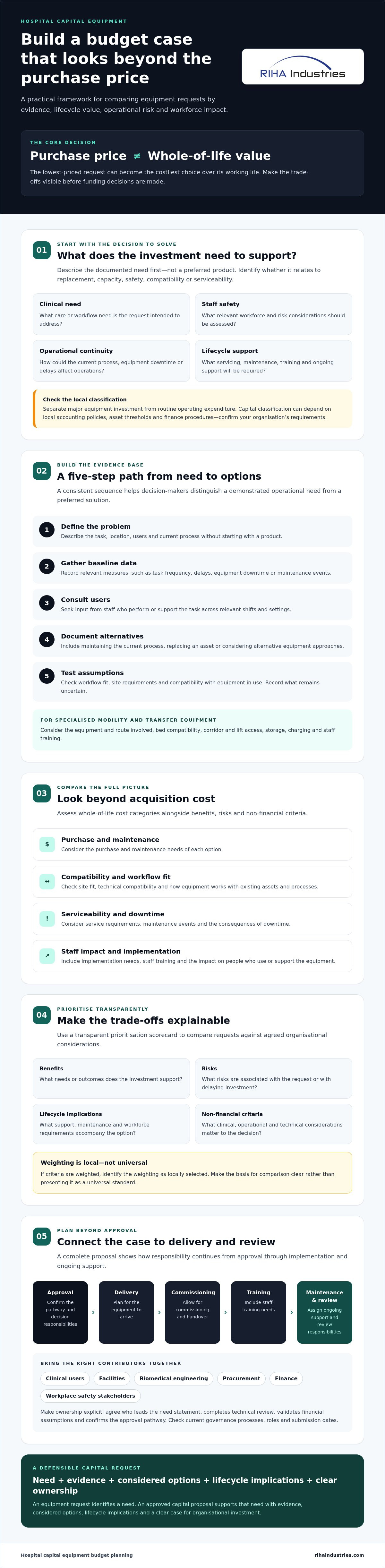
A consistent scorecard helps decision-makers compare competing requests against shared criteria rather than relying on the strength of each submission alone. In hospital capital equipment budget planning, agree how each factor will be assessed and record the evidence behind the rating:
Urgency: What happens if the request is deferred?
Safety: What documented risks or safety needs does it address?
Service continuity: Could the current equipment or process affect the facility’s ability to maintain operations?
Readiness: Are the need, funding assumptions and implementation requirements sufficiently developed?
Compatibility: Does the option fit existing assets, workflows and infrastructure?
Evidence strength: Are the claims supported by local records, direct observations or clearly labelled estimates?
If you assign scores or weights, identify them as locally selected. They aren’t universal Australian healthcare standards. Apply the same approach across requests, and document deferred proposals, dependencies and the likely consequences of delay without overstating urgency. A sensitivity check can show how priorities or feasibility might change if utilisation, service assumptions, implementation timing or available funding differ from the proposal’s base case.
What should a capital equipment business case include?
Summarise the need, options considered and preferred option, then support the recommendation with evidence, risks, implementation steps and lifecycle assumptions. Name accountable owners, proposed measures, dependencies and a post-implementation review point. Confirm the required business-case template, approval thresholds and submission process with the relevant health service, as governance requirements vary between organisations.
How should teams address limited budgets and competing requests?
Separate essential requirements from desirable features, explaining the need and evidence for each. If staging an investment, check that each phase remains safe, operationally workable and compatible with future plans. A lower-cost first step isn’t useful if it leaves a critical need unaddressed or creates avoidable integration issues.
For relevant handling needs, specialised mobility equipment can be considered alongside other requests, with compatibility, serviceability and workflow fit assessed against local requirements. RIHA’s hospital mobility solutions are one option to include in that comparison: RIHA’s hospital mobility solutions.
Once the case is ready, make the decision trail easy to follow: show how the need was ranked, what trade-offs were considered, which assumptions could change the recommendation and who will review the outcome. Bed-moving or transfer equipment can be assessed against the documented workflow need: RIHA Industries mobility equipment.
Plan implementation, maintenance and review after approval
Approval is the start of ownership, not the finish line. A practical hospital capital equipment budget planning process maps each investment from procurement through to routine use, with clear responsibility at every handover. Confirm who will coordinate ordering and delivery, prepare the site, commission the equipment, train staff and accept the asset into service. Build these tasks into the implementation plan so operational teams aren’t left to resolve missing steps after delivery.
Before committing, agree how ongoing support will work. Confirm the maintenance scope, repair access, parts pathways and any internal servicing responsibilities. Check whether staff training, diagnostics and technical support fit the facility’s operating model, and identify how service continuity will be managed if equipment is unavailable. A hospital equipment preventative maintenance programme can help teams consider how scheduled care fits into wider asset planning.
How to budget for reliable use over time
Document who will arrange and track maintenance, how faults will be reported, and which team owns follow-up. Clarify what is included in any service arrangement and what the facility must provide. These details help finance, procurement and operational teams understand the support plan before implementation, rather than relying on assumptions once the equipment is in use.
How to evaluate a specialised mobility solution
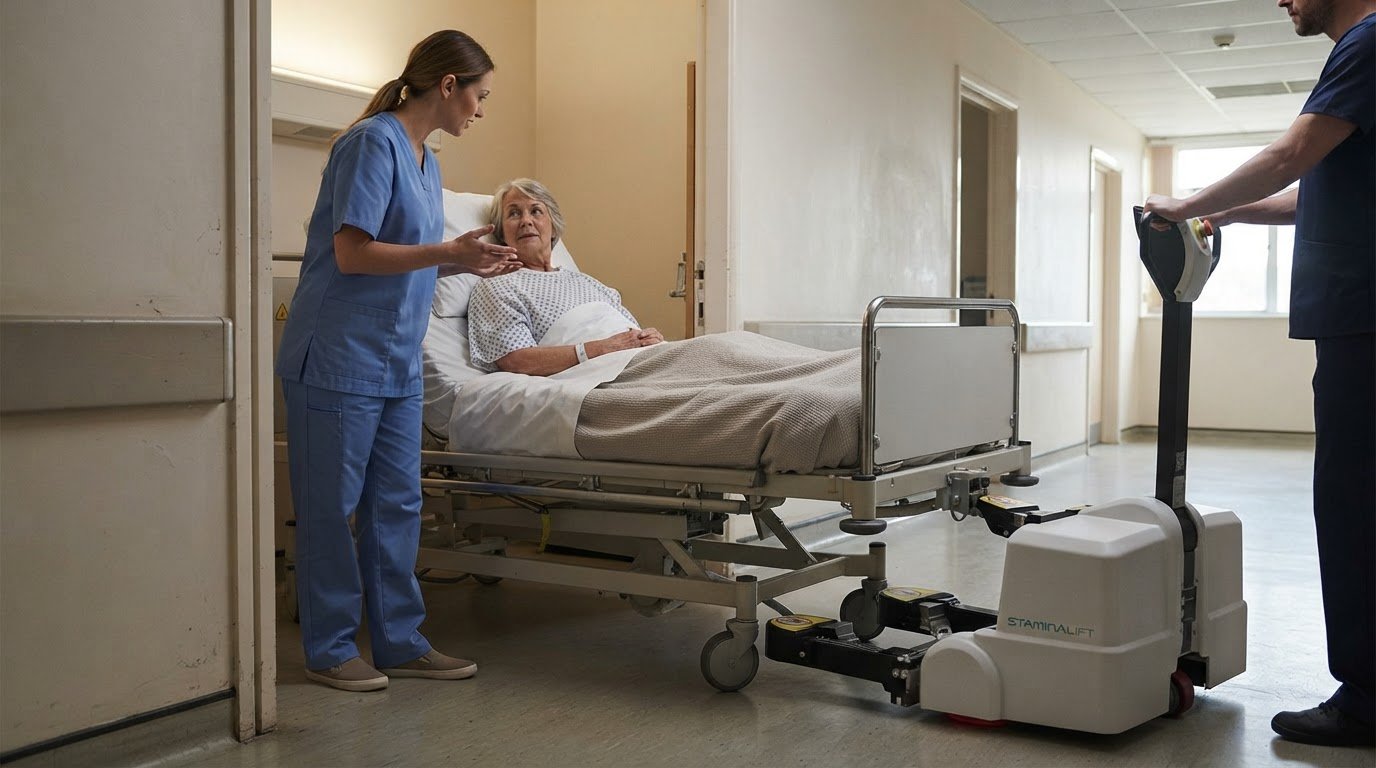
For relevant bed-moving needs, assess compatibility with the facility’s beds and routes, fit with transfer workflows, staff training requirements and ongoing support. RIHA Industries designs and manufactures StaminaLift bed movers and Easi tugs, and offers preventative maintenance and repair services. When comparing models, check the published capacity against the task: the StaminaLift Transfer System 5000 is rated for a 300 kg lift and 600 kg push or pull, while the Transfer System 6000 is rated for a 450 kg lift and 900 kg push or pull. The TS5000 is compatible with 95% of hospital beds, but facility-specific compatibility still needs to be confirmed. Easi Rider and Easi Mover tugs can move equipment weighing up to 1,500 kg. Confirm current specifications, service arrangements and demonstration availability directly before including them in a proposal. A hospital demonstration can help staff assess workflow fit in the intended setting.
Once the equipment is in use, review it against the baseline measures and outcomes documented in the business case. Record whether the intended workflow is being followed, note unresolved issues and assign owners for corrective actions. Separate observed results from estimates, and be cautious about attributing changes to the equipment if other factors may have contributed. Use the findings to refine future requests, implementation plans and maintenance assumptions.
For a relevant bed-moving requirement, a hospital equipment demonstration can help assess practical fit before finalising next steps: RIHA hospital equipment demonstrations.
Make your next capital request evidence-led
Strong hospital capital equipment budget planning connects a clearly documented need with local evidence, a fair comparison of lifecycle costs and benefits, and a practical plan for implementation and support. A transparent scorecard can help decision-makers weigh competing requests, while a post-implementation review captures what worked and what still needs attention.
For equipment that supports bed movement or transfer workflows, assess compatibility, staff training, maintenance and service arrangements against your facility’s requirements. RIHA provides national service coverage in Australia and offers preventative maintenance and repair support. Its website also describes a 3D viewer to assist with in-house servicing and part replacement. Confirm current service details before relying on them in a business case.
If your team is assessing a bed-moving requirement, contact RIHA Industries to discuss whether a hospital equipment demonstration could help evaluate workflow fit. With clear evidence and careful planning, your organisation can make confident investment decisions that support staff and reliable operations over time.
Frequently Asked Questions
What is hospital capital equipment budget planning?
Hospital capital equipment budget planning is the process of assessing and prioritising significant equipment needs against organisational goals and available resources. It considers more than the purchase request: decision-makers evaluate evidence of need, options, operational and workforce implications, lifecycle requirements and implementation readiness. Capital and routine operating expenditure may be classified differently by each organisation, so confirm local accounting definitions and approval processes before preparing a proposal.
How do hospitals prioritise capital equipment requests?
Hospitals can compare requests using a consistent, transparent scorecard. Criteria may include urgency, safety, service continuity, readiness, compatibility and strength of supporting evidence. Any scores or weightings should be selected locally, not presented as universal Australian healthcare standards. Record why requests are deferred, their dependencies and the possible consequences of delay, while avoiding inflated urgency. A sensitivity check can show how changed assumptions or available funding might affect priorities.
What should a hospital equipment business case include?
A hospital equipment business case should explain the documented need, options considered and preferred option, with evidence and assumptions made clear. Include relevant risks, implementation requirements, lifecycle considerations, accountable owners and proposed measures for reviewing outcomes. Identify dependencies and unresolved information rather than presenting estimates as confirmed facts. Before submission, check the relevant health service’s current template, approval thresholds, governance roles and submission dates, as these can differ between organisations.
How do you compare hospital equipment costs over its lifecycle?
Compare options using the same scope, time horizon and documented assumptions. Include acquisition, installation, staff training, maintenance, parts, consumables, charging requirements, potential downtime and end-of-life considerations where relevant. Keep these cost categories separate from benefits, risks and non-financial criteria such as workflow fit or compatibility. Ask finance and procurement to confirm useful-life, accounting and discounting assumptions. Lifecycle costing supports a more complete comparison, but doesn’t guarantee a lower total cost or specific return.
Can workforce safety be included in a capital equipment budget case?
Yes. A proposal can document how an equipment need relates to staff safety and handling tasks, using local records, observations and staff feedback where available. Explain the proposed change and identify how outcomes could be reviewed, while distinguishing measured evidence from reports and estimates. For example, if powered bed-moving equipment is being considered, assess compatibility, route and workflow fit, training and maintenance needs. Don’t present injury reductions or savings as guaranteed results without evidence.
When should a hospital review equipment after it has been purchased?
Set the review point during approval, then assess the equipment after commissioning and staff have had an opportunity to use it in the intended workflow. The timing should suit the implementation plan and the measures selected, rather than assume one interval fits every facility. Compare observed results with the original baseline and documented outcomes, note unresolved issues, and separate measured changes from estimates or impacts that can’t be confidently attributed to the equipment.