Hospital equipment procurement from bid evaluation to delivery
The hospital equipment procurement process moves from identifying a need and reviewing the budget to evaluating bids, awarding a contract, issuing purchase orders and inspecting delivery. Hospitals compare vendor quotations with their requirements, coordinate orders and check that delivered equipment matches the purchase documents. Each stage links purchasing decisions to the safe, reliable equipment staff need to support care.
Price matters, but it is only one part of a sound procurement decision. Clear evaluation criteria, coordinated purchasing across departments and careful delivery checks help hospitals manage spending and resolve discrepancies before they disrupt operations. This article explains how hospitals assess bids and award contracts, turn approved requisitions into purchase orders, coordinate decentralised buying and inspect incoming equipment. Each stage supports a more controlled process and shows why healthcare purchasing involves more than placing an order.
Table of Contents
Purchase orders and vendor acknowledgment
A purchase order turns an approved equipment request into a documented commitment to buy. Before issuing one, a hospital typically records the need in a written or electronic purchase requisition. The requisition describes the required equipment and possible purchasing routes, then is reviewed against organisational needs and budget feasibility. For example, a department requesting a patient transfer system should state the operational need and intended purchasing route.
Once approved, the requisition becomes a purchase order (PO). The PO should identify the equipment, quantity, agreed terms, delivery details and any other information needed to fulfil the order. It gives the hospital and vendor a shared reference for processing and checking the purchase. Accuracy matters: differences between the approved requirement and the PO can create confusion later. A clear description also helps staff distinguish the ordered equipment from similar items.
In the United States, requirements depend on hospital ownership, applicable funding or contract conditions, and the organisation’s purchasing policies. Before issuing an order, procurement teams should align it with the rules that apply to that purchase.
The vendor’s acknowledgment confirms receipt and acceptance of the PO details. In the process described here, that acknowledgment creates a legally binding contract between the parties. The hospital should compare it with the original order rather than treating it as a routine receipt. If the vendor’s confirmation changes an equipment description, quantity or delivery term, staff can identify the discrepancy before fulfilment proceeds.
Order accuracy remains important when reconciling invoices and delivery paperwork. Medical equipment order management includes checking the PO against the vendor invoice and packing slips. Each document serves a different purpose, but the details should correspond. A mismatch in the equipment description or quantity calls for investigation and resolution. Keeping the PO available during receipt gives staff a reliable reference for comparing the delivery with what was authorised.
After purchase, installation, staff training, maintenance and lifecycle planning help integrate equipment into hospital operations. Teams can coordinate installation for the intended location, arrange training for the staff who will use the equipment, and plan maintenance and repairs. Lifecycle decisions also consider whether the equipment continues to meet operational needs and how it should be managed if those needs change.
Recordkeeping continues after payment. Hospitals should retain transaction records for auditing. A complete file can include the approved requisition, PO, vendor acknowledgment, invoice, packing slips and records of issue resolution. Together, these documents help purchasing and finance staff trace how a need became an order and how the delivered equipment was accounted for.
Bid evaluation and contract award
Hospitals request vendor quotations and assess each bid against the equipment need and purchasing priorities. A documented comparison helps decision-makers explain why they awarded a contract.
Evaluating bids
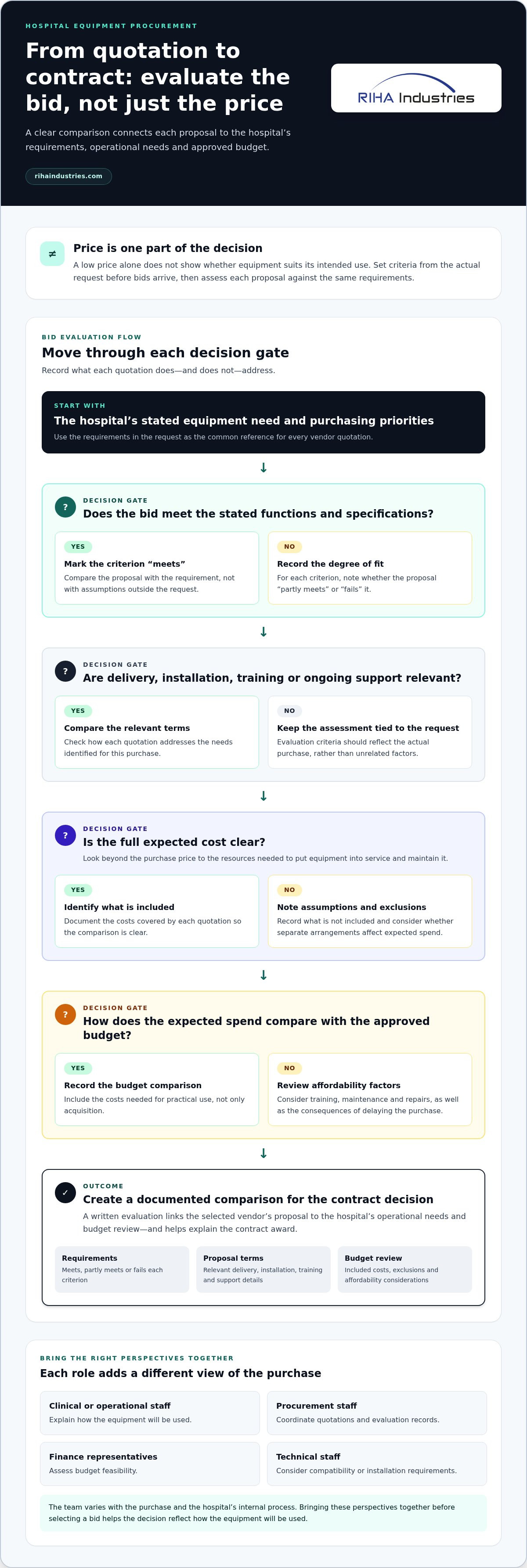
Bid evaluation means comparing vendor quotations with the hospital’s stated requirements. It matters because a low price alone does not show whether equipment suits its intended use.
Start with the required functions and specifications in the request, then compare each quotation against them. For example, if a department needs equipment that works with existing systems, assess whether each bid addresses that requirement. Record whether a proposal meets, partly meets or fails each criterion. This makes differences visible and gives the evaluation team a consistent basis for discussion.
Teams can also compare delivery terms, installation needs, training and ongoing support when relevant to the purchase. Set the criteria before bids arrive, and base them on the actual request. A written evaluation record links the chosen vendor’s proposal to the hospital’s operational needs and budget review.
Considering costs and budgets
Cost assessment considers the purchase price alongside the resources needed to put equipment into service and maintain it. This matters because the available budget must cover both acquisition and practical use.
There is no single typical cost for hospital equipment procurement. The amount depends on the equipment, required configuration, delivery, installation and support arrangements. Hospitals can compare quotations with the approved budget, then consider how training, maintenance or repairs affect affordability. For example, a proposal with a lower initial price may require separate arrangements that change the total expected spend.
Budget review should also account for the equipment’s intended role and the consequences of delaying the purchase. Procurement teams can document assumptions, identify the costs included in each quotation and note exclusions. This makes comparisons clearer and helps decision-makers understand what the approved funding covers.
Involving purchasing decision-makers
Decision-makers assess the need, budget, technical suitability and purchasing implications of proposed equipment. Their involvement matters because a contract must meet operational requirements while respecting organisational controls.
Clinical or operational staff can explain how equipment will be used, while procurement staff coordinate quotations and evaluation records. Finance representatives assess budget feasibility, and technical staff consider compatibility or installation requirements. The team varies according to the purchase and the hospital’s internal process.
Bring these perspectives together before selecting a bid. If ward staff identify a practical requirement that the request overlooked, the team can address it transparently before award. Once a preferred quotation meets the criteria and budget, document the rationale and approve the contract through the hospital’s process. For context on equipment requirements, explore healthcare equipment considerations as part of procurement planning.
Equipment delivery and inspection
Delivery inspection checks whether the equipment matches the purchase and arrives in acceptable condition. Hospitals should examine delivered items and promptly notify the vendor of any issues. At this stage, staff can identify damage, missing components or differences before the equipment enters service. A clear inspection record also provides specific evidence to help resolve discrepancies.
Compare the delivered item with the hospital’s purchase documents. Check the equipment description, quantity and any components listed for delivery. For example, if the order specifies a device with accessories, confirm that each item is present. Check the packaging for visible damage and record concerns before discarding it. This creates a clear account of what arrived and its condition.
Hospitals assess safety and quality by checking delivered equipment against approved specifications, inspecting its condition and carrying out appropriate functional checks. They can review accompanying documentation for applicable regulatory clearance before acceptance and use. Checks should reflect the equipment type, intended use and hospital purchasing requirements.
Identity: Compare the delivered equipment and components with the order description.
Condition: Record visible damage, missing parts or packaging concerns.
Documentation: Review the accompanying records against the hospital’s requirements.
Function: Arrange suitable checks before operational use.
Involve staff who understand the equipment’s intended setting. For example, a clinical or operational team can assess whether the delivered configuration suits the planned location. Technical staff can help review installation requirements or compatibility with existing equipment. If an item appears damaged or differs from the order, keep it separate from equipment ready for use while the issue is assessed.
If a discrepancy arises, document the specific item and concern, then notify the vendor promptly. Distinguish between a missing component, visible damage and an equipment description that does not match the order. Clear details help both parties understand the issue and determine an appropriate resolution. Keep related delivery records with the purchasing file for traceability.
Acceptance should follow the hospital’s receiving and operational processes, not rely solely on a delivery signature. Staff can record who inspected the equipment, what they checked and whether any issues remain open. After installation and required checks are complete, the responsible team can coordinate handover to users. This links delivery records with the equipment’s entry into service and gives the hospital a useful reference if questions arise later.
Importance of healthcare procurement processes
Healthcare procurement aims to improve processes, reduce costs and build relationships with partners. These goals connect purchasing decisions to how hospitals operate, rather than treating an order as an isolated transaction. For example, a department’s equipment request affects budget planning, staff workflows and coordination with the receiving team. A defined process lets each group contribute at the right stage and keeps the decision linked to the original need.
Consistency is one practical benefit of shared requirements and records: procurement staff can compare similar requests more clearly, and teams can identify duplicate needs across hospital units. If two departments request equipment for comparable tasks, the organisation can review the requirements together. This may create an opportunity to coordinate purchasing while preserving each department’s distinct operational needs.
Good procurement also supports better use of budgets. Reviewing organisational need and budget feasibility before buying helps distinguish essential requirements from preferences. Teams can then assess whether a proposed purchase addresses a genuine operational gap. If existing equipment can meet a department’s need, replacement may not be the only option. A clear rationale helps decision-makers allocate funds according to priorities rather than responding to requests in isolation.
Coordination is especially important in decentralised buying, where different departments may initiate purchases. Without shared visibility, units can use inconsistent specifications, duplicate requests or create avoidable administrative work. A central record of requests and decisions helps procurement, finance and operational teams see how each purchase fits broader priorities. It also provides a way to escalate competing needs, such as when several units need equipment but funding covers only some requests.
Healthcare purchasing can be assessed through three connected outcomes:
Process improvement: Clear roles and records show where decisions need review and reduce repeated clarification.
Cost management: Comparing needs and quotations supports informed choices within the approved budget.
Partner relationships: Accurate requirements and documented decisions give vendors a clearer basis for fulfilling orders.
These outcomes reinforce one another. A well-defined requirement makes bid evaluation more relevant; a clear award supports accurate ordering; and consistent records help resolve later discrepancies. Each stage gives the next team usable information, which is particularly valuable when purchasing, clinical and operational staff handle different parts of a transaction.
Procurement extends beyond acquisition. Hospitals need to consider how equipment will be installed, used, maintained and assessed over its working life. Planning for these needs during purchasing can reveal practical constraints early, such as training requirements or servicing arrangements. In short, healthcare procurement works best as a connected management process, linking an identified need to an affordable choice, a coordinated purchase and ongoing operational planning.
Who is involved in hospital equipment purchasing decisions?
Hospital equipment decisions involve staff who understand the need, budget and practical requirements. A ward may identify a gap, but purchasing affects teams beyond the requesting department. For example, selecting equipment for patient movement can involve clinical users, procurement staff, finance and technical personnel. Their input connects the requested function with cost, compatibility and implementation considerations.
Clinical and operational staff explain how equipment will be used in daily work. They can describe the tasks it must support, the setting where it will operate and difficulties with current processes. A ward team might identify a need to move equipment between rooms or integrate it with existing equipment. These details help shape the purchasing requirement, so bids can be assessed against actual use rather than a broad product description.
Procurement staff manage purchasing and coordinate the information needed for a decision. They may organise vendor quotations, compare submissions with stated requirements and maintain evaluation records. Their role is to make the process traceable and ensure the selected offer aligns with the approved request. If a quotation omits a required feature, procurement can raise the gap with relevant decision-makers before the contract is awarded.
Finance staff assess whether a proposed purchase fits the available budget and organisational priorities. Their review can help distinguish the preferred option from the affordable one, especially when departments have competing requests. For example, a hospital may need to compare an equipment request with other planned purchases. A clear rationale lets finance and operational teams discuss trade-offs using the same documented requirements.
Technical staff, such as biomedical or facilities personnel, can assess compatibility, installation and ongoing support needs. Their input is useful when a device must work with existing equipment or fit a particular space. They can raise questions clinical users may not cover, such as where installation will take place or what maintenance planning involves. The technical input required depends on the equipment and its intended setting.
Hospital leaders or authorised approvers may review priorities and approve spending under internal procedures. Their oversight helps resolve competing departmental needs and link individual purchases with wider organisational plans. The approval record is stronger when it explains the need, evaluation outcome and budget rationale, rather than noting only the final selection.
Clear roles help teams coordinate decentralised purchasing without losing oversight. A practical division of responsibilities might include:
Requesting staff: Describe the task, setting and essential requirements.
Procurement: Coordinate quotations and document the comparison.
Finance: Review affordability and budget fit.
Technical and operational staff: Consider compatibility, installation and use.
Approvers: Decide whether the purchase should proceed under internal policy.
For a patient transfer equipment request, these perspectives come together around one decision: does the proposed equipment meet the operational need and can the hospital support it with available resources? Agreeing on responsibilities early reduces conflicting specifications and late-stage delays. It also gives each team a clear opportunity to raise concerns before the hospital commits to a purchase.
RIHA Industries: StaminaLift Transfer System 5000
RIHA Industries’ StaminaLift Transfer System 5000 is designed to integrate with existing hospital equipment. For hospitals assessing patient transfer needs, it offers a specific option to consider against operational requirements, compatibility and budget. RIHA Industries also offers the StaminaLift Transfer System 6000 and StaminaLift 2100 Bed Mover, alongside the Easi Rider and Easi Mover tugs for moving heavy loads.
Include the intended tasks, equipment environment and purchasing criteria in your evaluation. This helps decision-makers assess whether a patient transfer system or bed mover meets the need identified by staff. The right choice depends on the hospital’s requirements and how the equipment fits into existing operations.
Contact RIHA Industries to discuss its patient transfer systems and bed movers, or visit rihaindustries.com.
Make the next procurement decision with clarity
A well-managed hospital equipment procurement process should leave decision-makers with a clear record of why an option suits the organisation’s needs. For the next purchase, turn operational priorities into a focused evaluation brief: identify the users, intended setting, compatibility considerations and ongoing support requirements. This gives clinical, procurement, finance and technical teams a shared basis for assessing whether a proposed solution fits.
Where the requirement involves patient transfer or moving heavy equipment, RIHA Industries’ patient transfer systems and bed movers may suit the discussion. Start with the task staff need to perform and the equipment environment they work in. The hospital can then assess how a suitable option aligns with operational needs and purchasing criteria.
Contact RIHA Industries to discuss your equipment requirements and take a considered next step towards a solution that supports your team’s work.
Frequently Asked Questions
What is Hospital Procurement?
Hospital procurement is the organised way a healthcare organisation obtains equipment, supplies and services needed for its work. It connects an identified requirement with funding, supplier selection, purchasing and ongoing use. For example, a unit planning to replace a mobility device considers how staff use it, where it will operate and how it fits existing workflows. This broader view helps distinguish procurement planning from simply placing an order.
Why is the Right Procurement Process in Healthcare Important?
A suitable healthcare procurement process helps hospitals direct resources towards genuine operational needs and make purchasing decisions consistently. It also supports continuity: equipment choices can affect staff workflows, patient movement and other departments. For example, assessing a device’s intended location before purchase can reveal space or access constraints early. Clear decision records also help teams explain priorities when departments compete for limited funding.
What are the steps in a hospital equipment procurement process?
The hospital equipment procurement process generally moves from defining a need to planning how the selected equipment will be used. Teams identify requirements, assess funding, seek and compare quotations, approve a supplier, arrange the purchase, then receive and assess the delivery. For a practical handover, assign an internal owner to each stage. That person can track outstanding decisions, coordinate affected departments and ensure operational planning continues after the equipment arrives.
How do hospitals evaluate and compare medical equipment vendors and bids?
Hospitals compare vendors by assessing each proposal against the same documented requirements. A comparison table can separate essential needs from preferences, then record how each bid addresses intended function, compatibility, delivery arrangements and support. For example, a team can flag a proposal that meets the core need but leaves a workflow question unresolved. Recording the reason for each assessment makes the final choice easier to explain internally.
How do hospitals negotiate contracts, warranties, service, and delivery terms?
Hospitals negotiate by clarifying what the vendor will supply and how responsibilities will be handled. The written agreement can address equipment configuration, delivery arrangements, installation, warranty coverage, service expectations and how to report problems. Compare these terms with the operational need so important details are not left to informal assumptions. For example, stating who coordinates site access can help avoid confusion on delivery day.