Hospital Orderly Injury Prevention: Protect Staff Wellbeing and Morale
Updated: Oct 16
What if injury prevention began with the everyday work that puts strain on hospital orderlies? Repeatedly pushing beds and moving heavy loads can take a physical toll, especially when equipment, routes or workload pressures make safer routines difficult to follow. Effective hospital orderly injury prevention addresses these realities in daily work, not just in a policy document.
Orderlies understand the demands of their shifts, and their experience can help shape practical safety measures. Training matters, but it works best alongside suitable equipment, realistic workloads and team routines that make safer ways of working achievable.
This article explores common injury risks for hospital orderlies and practical steps healthcare teams can take to reduce physical strain. You’ll learn how staff consultation, training and workload practices can support a more positive workplace, and how powered moving equipment may fit within a broader injury-prevention programme. The aim is a safer approach that recognises staff wellbeing as an essential part of a well-functioning hospital.
Table of Contents
Why hospital orderly injury prevention matters for staff morale
How physical strain affects orderly wellbeing and team morale
Which hospital injury-prevention measures can support orderlies?
How to build an orderly injury-prevention plan staff can trust
How RIHA Industries can contribute to safer hospital movement
Why hospital orderly injury prevention matters for staff morale
Hospital orderly injury prevention means identifying work-related risks during movement tasks and changing how the work is organised, equipped or carried out to reduce those risks. It matters because physical demands are part of the everyday role, not an abstract safety issue. Orderlies may move beds and equipment through busy wards and corridors, often as part of a wider team. The Hospital orderly role can include varied duties, so facilities should consider the tasks actually performed at their site.
Repeated effort or an awkward movement can contribute to discomfort and fatigue. If an orderly is injured, they may need time away or find some tasks harder on returning. That can affect work capacity and add pressure to colleagues, although the effects vary between people and workplaces. These possibilities are reasons to assess and address risks, not proof that a particular task will cause injury.
Staff injury prevention is distinct from patient injury prevention. A patient fall or pressure injury is a patient safety outcome; an orderly’s strain or injury is a workplace health and safety outcome. The same movement activity may raise questions for both, but each needs its own risk assessment and follow-up. Keeping that distinction clear helps teams choose suitable controls and understand whose wellbeing each measure is intended to protect.
Safe work design identifies and reduces movement-related risks so orderlies can do their work with less avoidable physical strain and greater confidence in their wellbeing.
Which orderly tasks can create physical strain?
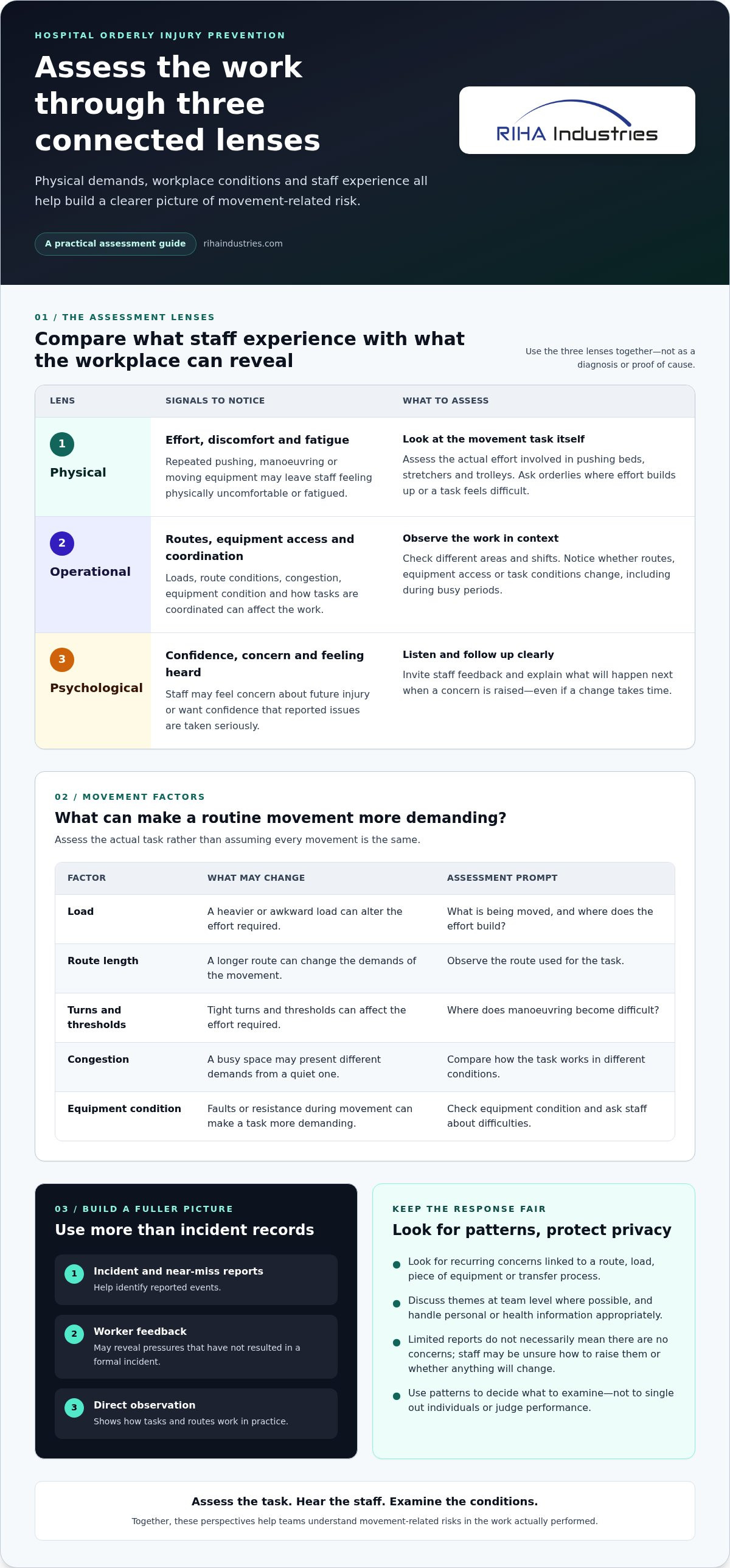
Assess the actual effort involved in pushing beds, stretchers and trolleys rather than assuming every movement task is the same. A heavier or awkward load, a longer route, tight turns, thresholds and congested spaces can all change the effort required. Equipment condition matters too: faults or resistance during movement can make a routine task more demanding. Observe work in different areas and across shifts, then ask orderlies where they encounter difficulty.
How can safer work support morale?
Visible action on reported hazards can help staff feel that their experience is taken seriously. Suitable equipment, workable procedures and clear follow-up may support confidence in how tasks are managed. Injury prevention alone doesn’t determine morale, however. Leadership, staffing, communication, workload and team relationships also shape how people feel at work.
That’s why the response matters as much as the policy. If orderlies raise concerns about pushing a bed around a tight corner, acknowledge the issue, assess the route and equipment, then explain what will happen next. Even when a change takes time, clear communication shows that staff input is part of the decision-making process, rather than an item recorded and forgotten.
Facilities can start by listening to staff, observing the task and addressing risks in a way that fits the work. The aim isn’t to promise that every injury can be prevented or that one change will lift morale. It’s to make safer work a visible part of how the organisation supports its people.
How physical strain affects orderly wellbeing and team morale
Repeated pushing, manoeuvring and moving equipment may leave orderlies feeling physically uncomfortable or fatigued, particularly when demanding tasks recur across a shift. A difficult movement can also prompt concern about whether the same task might lead to an injury in future. Alongside workplace controls, physical conditioning and targeted musculoskeletal rehabilitation—such as the specialised equipment available via iron-neck.co.uk—can support long-term strength and resilience for workers in physically demanding roles. These are experiences worth investigating, not outcomes that should be assumed for every worker or workplace.
Team morale can be affected by how staff experience their work and how leaders respond to concerns. Injury records alone can’t show whether orderlies feel confident, listened to or adequately supported. Records can help identify reported events, while staff feedback and observation may reveal pressures that haven’t resulted in a formal incident. For a broader reference on reducing risks during patient movement, the CDC's Safe Patient Handling and Mobility Strategies discusses safe handling approaches for healthcare workers.
For hospital orderly injury prevention, examine three connected areas: physical demands such as effort, discomfort and fatigue; operational conditions such as routes, equipment access and task coordination; and psychological experiences such as confidence, concern about future injury and feeling heard. This summary is a prompt for assessment, not a diagnosis or proof of cause.
What workplace signals should leaders look for?
Consider incident and near-miss reports alongside worker feedback and direct observation. Look for recurring concerns linked to a particular route, load, piece of equipment or transfer process. A corridor that is easy to navigate when quiet may present different demands during a busy period. Patterns can help teams decide what to examine, but shouldn’t be used to single out individuals or judge their performance.
Protect privacy when gathering and sharing feedback. Discuss themes at team level where possible, and handle personal or health information appropriately. If reports are limited, don’t assume there are no concerns; staff may be unsure how to raise them or whether anything will change.
Why does staff involvement matter?
Orderlies can explain where effort builds up, what makes a task difficult and which changes might work in practice. Invite input from staff across shifts, as well as relevant clinical, portering, facilities and WHS teams. Their perspectives can reveal how task requirements, spaces and equipment interact during real work, rather than relying on assumptions about a typical shift.
Close the feedback loop. Tell staff what was raised, what will be assessed and what decision has been made. If a proposed change can’t proceed, explain why and outline any next steps. Consistent communication shows that speaking up leads to consideration, even when the response takes time.
Facilities reviewing movement tasks can also explore how powered bed-moving equipment may fit within a wider programme of task assessment, staff consultation and follow-up.
Which hospital injury-prevention measures can support orderlies?
Effective prevention combines changes to the task, suitable equipment, practical training and clear communication. Each addresses a different part of the work, so a generic checklist won’t show whether a control suits the routes, loads and procedures orderlies actually encounter. Start with observed tasks and staff input, select measures that address the risks identified, then review how they work in practice.
Use these patient handling equipment selection criteria alongside a site-specific assessment. Equipment selection should reflect the movement task and operating environment, rather than being treated as a stand-alone solution.
How do task design and equipment fit together?
Routes, storage locations, access and workflow can all influence the manual effort a movement task requires. For example, equipment stored away from the point of use may be difficult to access when a move is needed, while awkward storerooms can introduce unnecessary lifting and reaching hazards—challenges frequently tackled in general facility support with material handling and access solutions from specialists like Springwell Industries Pte Ltd. Review the whole task, including where it starts, the path taken and where equipment is returned.
Assistive equipment, including powered movers, can be assessed as one control alongside changes to the task and workplace. It doesn’t replace clinical judgement, staff training or facility procedures. The aim is to find a practical combination that supports the work and can be used consistently.
What makes training and communication useful?
Training is most useful when it relates to the equipment, movement tasks and procedures staff actually use. Give orderlies a clear way to report hazards, near misses and equipment concerns, and explain how those reports will be handled. Refresher support can help staff adapt when procedures or equipment change, but it can’t compensate for unsuitable controls or equipment that isn’t accessible.
Keep the cycle active: gather staff observations, apply appropriate controls, then review what has changed. This turns hospital orderly injury prevention into an everyday operational practice, rather than a checklist completed once and set aside.
How to build an orderly injury-prevention plan staff can trust
A trusted plan turns safety concerns into visible, repeatable action. For hospital orderly injury prevention, use a five-step cycle that gives staff a voice, assigns responsibility and checks whether changes work in practice. Managers, orderly representatives, WHS staff and relevant clinical teams each bring a different perspective on the tasks and conditions involved.
Listen. Invite orderlies to describe where strain occurs, which tasks feel difficult and what changes may help. Provide a confidential way to share concerns, and include staff from different shifts so the plan reflects more than one team’s experience. Managers should acknowledge feedback and explain how it will inform the next steps.
Observe. Watch relevant movement tasks as they happen, noting the load, route, access, equipment and coordination involved. Review incident and near-miss records alongside these observations and staff input. Orderly representatives can help identify practical details that may be missed by someone unfamiliar with the task.
Assess. Use the facility’s risk-assessment process to prioritise recurring tasks or those with potentially serious consequences. Consider the complete task and its setting, rather than relying on a single incident or a generic checklist. WHS staff can guide the assessment, while clinical teams help identify relevant workflow and care requirements.
Act. Record each agreed action, who is responsible and when progress will be reviewed. Managers may coordinate changes to work practices or resources; WHS staff can support risk controls; orderly representatives can help test whether proposed changes fit real tasks. Share any training or communication needs with the teams affected.
Review. Set follow-up indicators that show both implementation and staff experience. These could include injury and near-miss reports, staff feedback on confidence and support, access to relevant training, and whether agreed processes are being used. Interpret indicators together: a change in reports alone doesn’t prove that risk has increased or decreased.
Keep a simple action record with the issue, agreed response, responsible role and review date. This makes ownership clear and helps prevent concerns from disappearing between meetings. If an action is delayed, explain the barrier and update staff on what happens next.
Leaders can show progress by reporting completed actions, unresolved issues and upcoming reviews. Ask orderlies whether changes make tasks feel more manageable and whether they know how to raise new concerns. Revisit controls when tasks, equipment, staffing or facility conditions change. This feedback loop supports trust because staff can see how their input is considered, even when a solution needs adjustment.
Nursing tasks can involve distinct patient-handling demands, so facilities can also use this related guidance on preventing nurse back injuries as a separate resource, not a substitute for an orderly-specific assessment.
Where moving beds or heavy healthcare loads is a priority, powered moving equipment from RIHA can be considered as part of the facility’s broader prevention plan.
How RIHA Industries can contribute to safer hospital movement
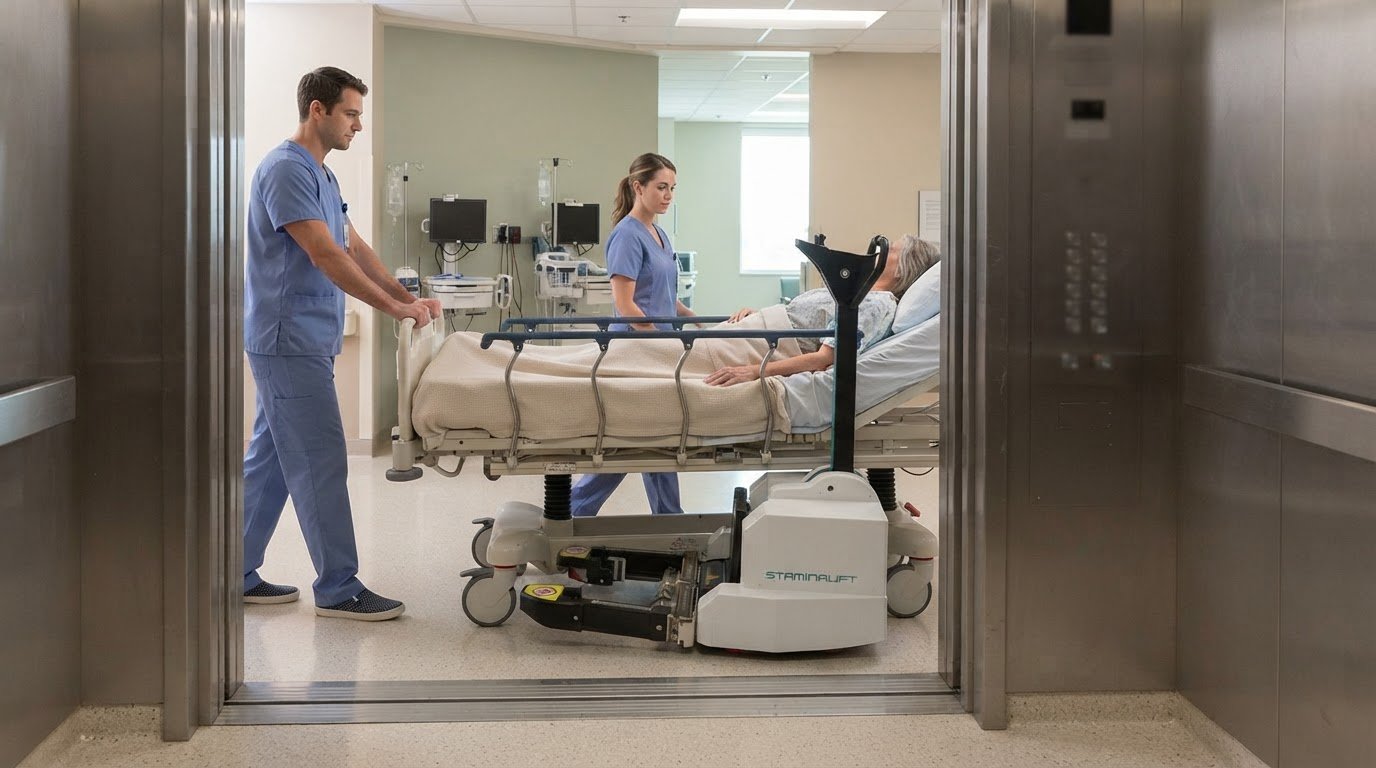
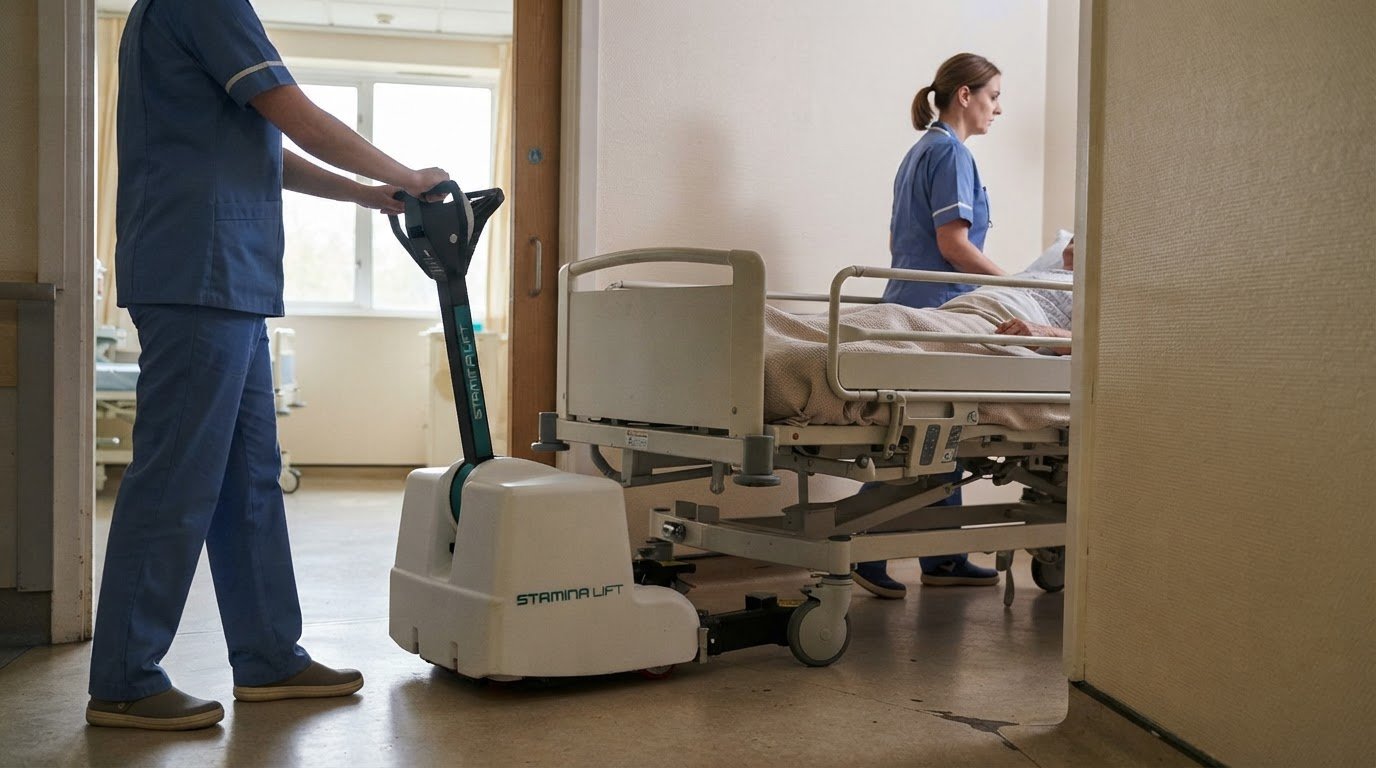
Once a facility has identified demanding movement tasks and considered changes to work practices, suitable equipment can be assessed as one operational control. RIHA Industries designs and manufactures Australian-made powered bed movers and tugs for healthcare settings. Its StaminaLift and Easi equipment assists with moving beds and heavy healthcare loads, helping address the physical demands of those tasks. Equipment is one part of hospital orderly injury prevention, not a stand-alone solution or a guarantee of safer outcomes.
What role can powered moving equipment play?
Powered equipment can be considered where staff observations and task assessments point to repeated effort during bed or load movement. The right fit depends on what needs to be moved, how and where the task takes place, compatibility with the facility’s equipment, and the procedures staff must follow. Involve orderlies in assessing practical use, including the routes and spaces where movement occurs.
RIHA’s StaminaLift range includes the StaminaLift Transfer System 5000, StaminaLift 2100 Bed Mover and StaminaLift Transfer System 6000. The StaminaLift TS5000 is compatible with 95% of hospital beds. This figure can inform an initial assessment, but each facility should consider its own beds and movement tasks. The Easi Rider and Easi Mover are also part of RIHA’s powered moving equipment range for healthcare settings.
A powered mover doesn’t replace clinical judgement, task-specific training or local procedures. Staff still need to understand the movement process and coordinate their work in line with facility requirements. Assess equipment as part of the wider plan, alongside workflow, access, staff familiarisation and follow-up.
What support helps equipment work in practice?
Implementation involves more than introducing equipment. Facilities can plan for staff familiarisation, clear operating procedures and a way to raise questions or report concerns during use. Feedback from orderlies can help managers identify whether equipment suits the intended tasks and whether additional guidance or adjustments are needed.
Maintenance is also part of lifecycle planning. RIHA provides preventative maintenance and repair support for its equipment, helping facilities plan ongoing care alongside selection and implementation. A planned approach makes equipment condition and support responsibilities part of routine operational discussions, rather than waiting for a concern to interrupt work.
Any reported injury-reduction result should be read in its original context and shouldn’t be treated as a forecast for another hospital. Outcomes depend on local tasks, implementation and the broader prevention programme. A considered assessment gives staff and managers a clearer basis for deciding whether powered movement equipment fits their needs.
To explore equipment options for hospital movement tasks, explore RIHA's healthcare mobility solutions and consider how they may align with your facility’s assessment, training and maintenance planning.
Make safer movement the next practical step
Turn your next team discussion into a clear starting point: choose a movement task staff want reviewed, agree who will assess it and decide how orderlies can share feedback. A focused first step makes it easier to put hospital orderly injury prevention into practice and keep staff involved as conditions change.
As your facility considers equipment needs, factor in ongoing support as well as day-to-day use. RIHA Industries designs Australian-made healthcare mobility equipment and provides national service coverage across Australia, supporting facilities as they plan for equipment care over time.
Explore the options for your hospital’s movement requirements with RIHA’s healthcare mobility solutions. With staff experience guiding each decision, your team can keep building a workplace where safer movement is part of how people are supported.
Frequently Asked Questions
How can hospital orderlies prevent workplace injuries?
Hospital orderly injury prevention works best when everyday movement tasks are examined in their actual setting. For example, observe how a bed is positioned before moving, whether the route is clear and how the task changes at doorways or lifts. Use those observations to shape local procedures and equipment access. Orderlies should know how to report discomfort or a near miss promptly, without waiting for an injury to occur.
Can injury prevention improve morale in healthcare?
It may contribute to a more supportive work experience when staff can see that safety concerns lead to considered action. Managers can ask focused questions during team check-ins, such as whether a recent change has made a task feel more manageable or introduced new difficulties. Morale also reflects factors beyond injury prevention, including staffing, leadership and communication, so gather feedback rather than assuming a safety initiative has improved how people feel.
What are common injury risks for hospital orderlies?
Potential risks vary with the work being done and the conditions in each facility. Alongside moving beds, stretchers and trolleys, assess starting and stopping movement, controlling direction and positioning equipment in limited spaces. Changes in floor surfaces or crowded staging areas may also affect how a task is performed. These are prompts for a site-specific review, not evidence that every orderly faces the same level of risk.
How should hospitals involve orderlies in injury prevention?
Give orderlies a defined way to contribute, such as inviting a representative to join task reviews and share themes raised by colleagues. Make it possible for workers on different shifts to provide input, including through a confidential reporting option. After reviewing suggestions, communicate which actions will proceed, who is responsible and what remains under consideration. This makes participation more meaningful than collecting comments without explaining the outcome.
What equipment can help reduce physical strain when moving hospital beds?
Facilities can assess powered bed movers as one option for assisting with bed movement. Consider the beds in use, where they need to travel, available manoeuvring space and how the equipment fits local operating procedures. RIHA Industries designs powered bed movers for healthcare settings and provides maintenance and repair support. Equipment selection should form part of a broader risk-control approach, with staff familiarisation and appropriate procedures in place.
How can managers measure whether an injury-prevention plan is working?
Compare information over time and in context. For instance, consider whether the same types of tasks continue to generate concerns, whether agreed procedures are being followed and whether staff can access relevant training. A change in incident numbers alone may not explain what is happening, especially if reporting practices have changed. Discuss the findings with staff, document decisions and note when each control will be reviewed again.
What Australian guidance should hospitals follow for manual handling risks?
Hospitals should consult current Australian work health and safety guidance, applicable state or territory requirements and their own risk-assessment procedures. Safe Work Australia’s Hazardous Manual Tasks Code of Practice provides practical guidance, while the Work Health and Safety Act 2011 is supported by jurisdiction-specific laws. Requirements can depend on location and circumstances, so verify current official guidance before applying it to a workplace decision. This FAQ is general information, not a site-specific assessment.