How to Reduce Manual Handling Risk in Healthcare: A 2026 Safety Guide
Traditional manual handling training is no longer enough to protect your workforce from the physical demands of modern bariatric and patient care. You've likely seen the toll that repetitive strain and heavy bed transfers take on your nursing staff and porters, leading to rising insurance premiums and staff burnout. It's a persistent challenge when older equipment doesn't integrate with new safety protocols, leaving your team vulnerable. This guide explores how to effectively reduce manual handling risk healthcare by shifting from manual effort to sophisticated motorised integration, ensuring your facility meets 2026 WHS standards.
We'll examine the specific engineering strategies that eliminate musculoskeletal injuries, improve portering efficiency, and solve the common issue of equipment incompatibility. By adopting a "safety-by-design" approach, your organisation can transition away from the physical burden of heavy lifting. You'll discover how advanced motorised movers provide the 360-degree manoeuvrability needed for tight corridors while keeping your caregivers safe. This article provides a clear roadmap to achieving a zero-injury workplace through proven, Australian-made technology and technical excellence.
Table of Contents
Understanding Manual Handling Risks in Australian Healthcare Settings
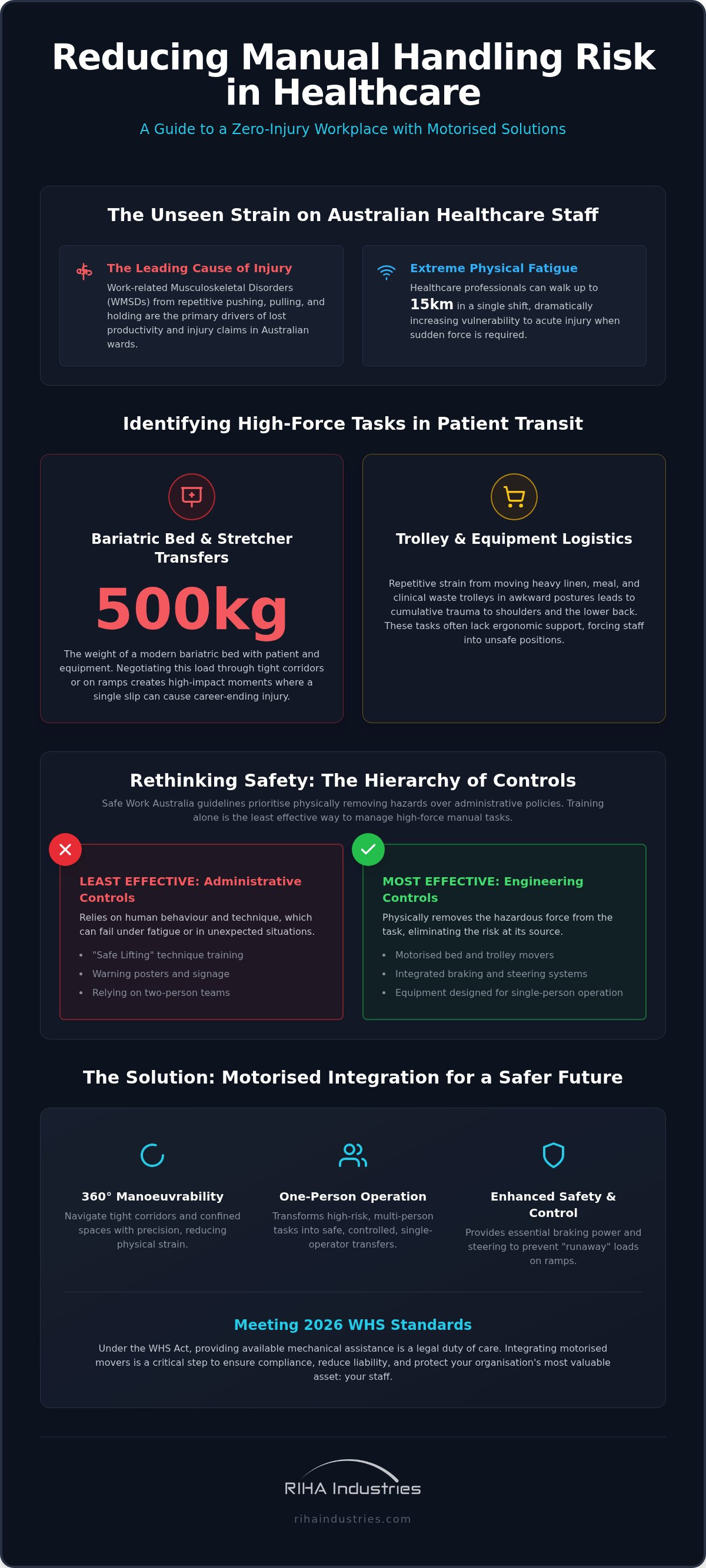
Manual handling in a hospital environment extends far beyond the traditional image of lifting a patient. It encompasses the repetitive pushing, pulling, and sustained holding of heavy equipment and beds. To effectively reduce manual handling risk healthcare, facilities must acknowledge that these cumulative forces are the primary drivers of Work-related Musculoskeletal Disorders (WMSDs). These disorders remain the leading cause of lost productivity in Australian wards, accounting for a significant portion of all workplace injury claims. Healthcare professionals often walk up to 15km during a single shift, creating a baseline of physical fatigue. This exhaustion makes the body significantly more vulnerable to acute injury when sudden force is required to manoeuvre a 500kg bariatric bed or navigate a heavy stretcher through a crowded corridor.
The Economic and Human Cost of Injury
The financial burden of staff injury extends deep into hospital operational budgets. Every successful WorkCover claim represents more than just a direct payout; it initiates a ripple effect of increased insurance premiums and the expensive requirement for agency backfilling. In the context of Australia's current healthcare labour shortage, losing an experienced caregiver or porter to a preventable back injury is a systemic crisis. For the individual, the impact is often permanent. Chronic lumbar issues or shoulder tears frequently result in early retirement or a forced transition away from clinical care. This strips the healthcare system of vital expertise and places an immense emotional and physical burden on the injured worker.
WHS Compliance and the Duty of Care
Under the Work Health and Safety (WHS) Act 2011, employers have a non-delegable duty to ensure the health and safety of their workers. This legal framework requires hospitals to identify hazardous manual tasks and implement solutions that are "reasonably practicable." Safe Work Australia guidelines are clear: administrative controls like training or "safe lifting" posters are the least effective way to manage risk. Instead, the focus must shift toward higher-level engineering controls. By integrating motorised assistance, facilities can physically remove the hazardous force from the task entirely. Failing to provide available mechanical assistance in 2026 is no longer just a safety oversight; it's a significant compliance risk that leaves organisations vulnerable to legal scrutiny and substantial penalties.
Identifying High-Risk Manual Handling Tasks in Hospitals
While many safety programs focus on patient repositioning within the room, the most significant danger often lies in the transit phase between wards. Moving modern hospital beds, which can weigh up to 500kg when occupied by a patient and attached clinical equipment, requires immense physical exertion. To effectively reduce manual handling risk healthcare, facilities must look at the specific mechanics of these transfers. Negotiating heavy loads through tight theatre corridors or onto service lifts creates high-impact moments where a single slip can cause a career-ending injury. It's these high-force tasks, rather than simple lifting, that frequently lead to long-term staff absence.
The Danger of Bed and Stretcher Transfers
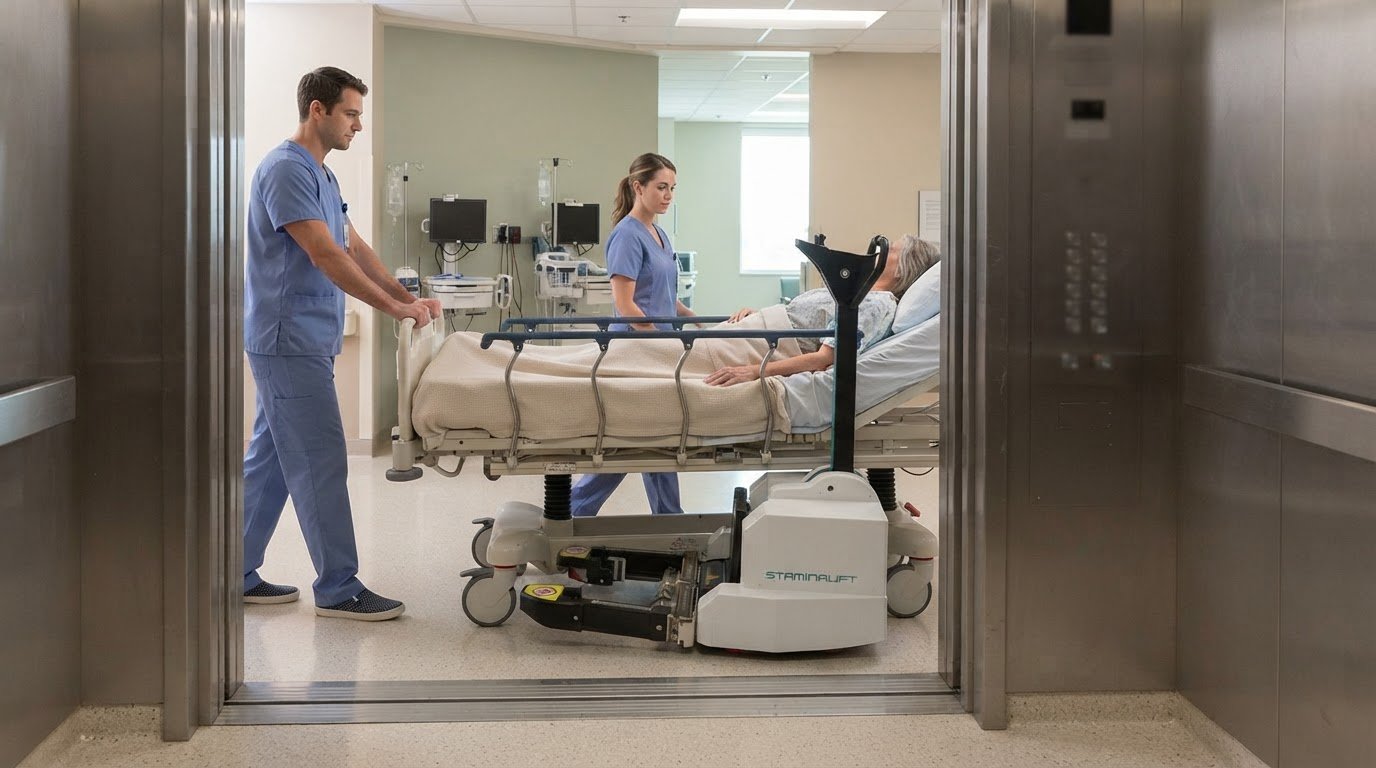
The initial force required to start a heavy bed moving, especially on carpeted surfaces or uneven hospital flooring, often exceeds safe biomechanical limits. Even when two healthcare professionals are assigned to a transfer, the lack of synchronisation can lead to unexpected twisting or jerking movements. This is particularly dangerous on ramps or slight inclines where a bed can become a "runaway" load, putting both the patient and the staff at risk of a crush injury. Motorised assistance transforms this high-risk activity into a controlled, one-person task, providing the braking power and precision steering that manual effort simply cannot match. For bariatric and acute care, the StaminaLift TS6000 is an essential tool, specifically engineered to handle the extreme weights associated with specialist care without placing the burden on the caregiver.
Trolley Logistics and Equipment Movement
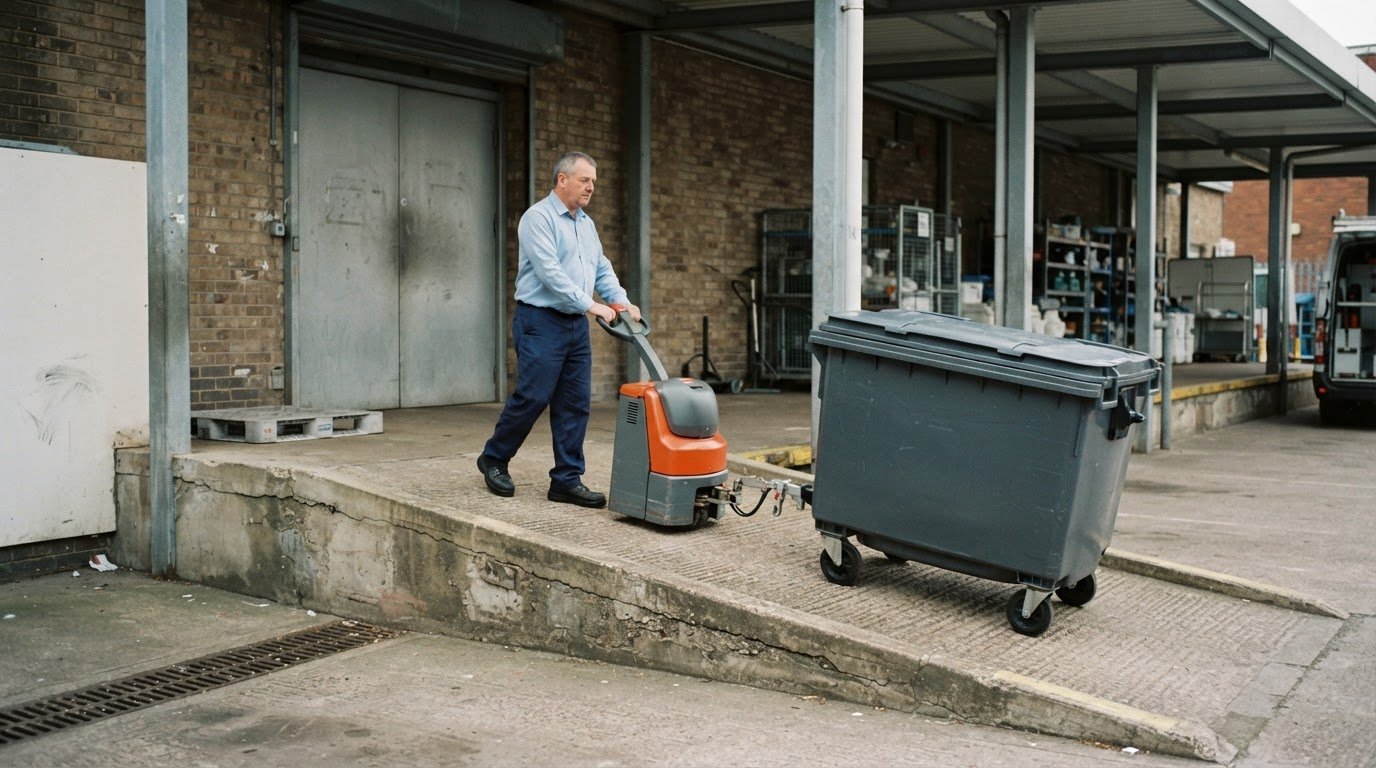
Beyond patient beds, hospital logistics teams face repetitive strain from transporting heavy linen, meal, and clinical waste trolleys. These items are often bulky and lack ergonomic handles, forcing staff into awkward postures while navigating high-traffic areas. Moving these loads multiple times per shift creates cumulative trauma to the shoulders and lower back. By utilising Australian-made specialised tugs like the Easi Mover, your facility can automate the most strenuous parts of the logistics chain. These devices provide the 360-degree manoeuvrability needed for tight hospital corridors, ensuring that porters can move essential supplies quickly and safely. Implementing these engineering solutions directly addresses the "reasonably practicable" requirements of modern WHS standards while protecting the long-term health of your support staff.
Why Training Alone Fails to Reduce Manual Handling Risk
Training programs have been the cornerstone of hospital safety for decades, yet injury rates often remain stubbornly high. This discrepancy exists because relying on administrative controls to reduce manual handling risk healthcare ignores the fundamental physics of the modern ward. In the Hierarchy of Control, training is positioned near the bottom because it requires perfect human performance every time. Even the most highly trained healthcare professional cannot overcome the sheer mass of a fully loaded bariatric bed through "proper technique" alone. Biomechanics has its limits; once a load exceeds a certain threshold, the compression forces on the spinal discs become hazardous regardless of posture.
The Limits of Behavioural Safety
In high-pressure environments, behavioural safety often collapses. During emergency codes or periods of extreme fatigue, staff naturally prioritise speed over ergonomic perfection, reverting to quick manual moves that lead to acute injury. The physiological reality is that repetitive pushing of heavy equipment causes micro-trauma to the musculoskeletal system that accumulates over time. We must shift the focus from "lift training" to "equipment proficiency." Providing caregivers with motorised tools ensures that even in an emergency, the physical burden is managed by the machine rather than the person's back.
Engineering Out the Risk with Motorised Solutions
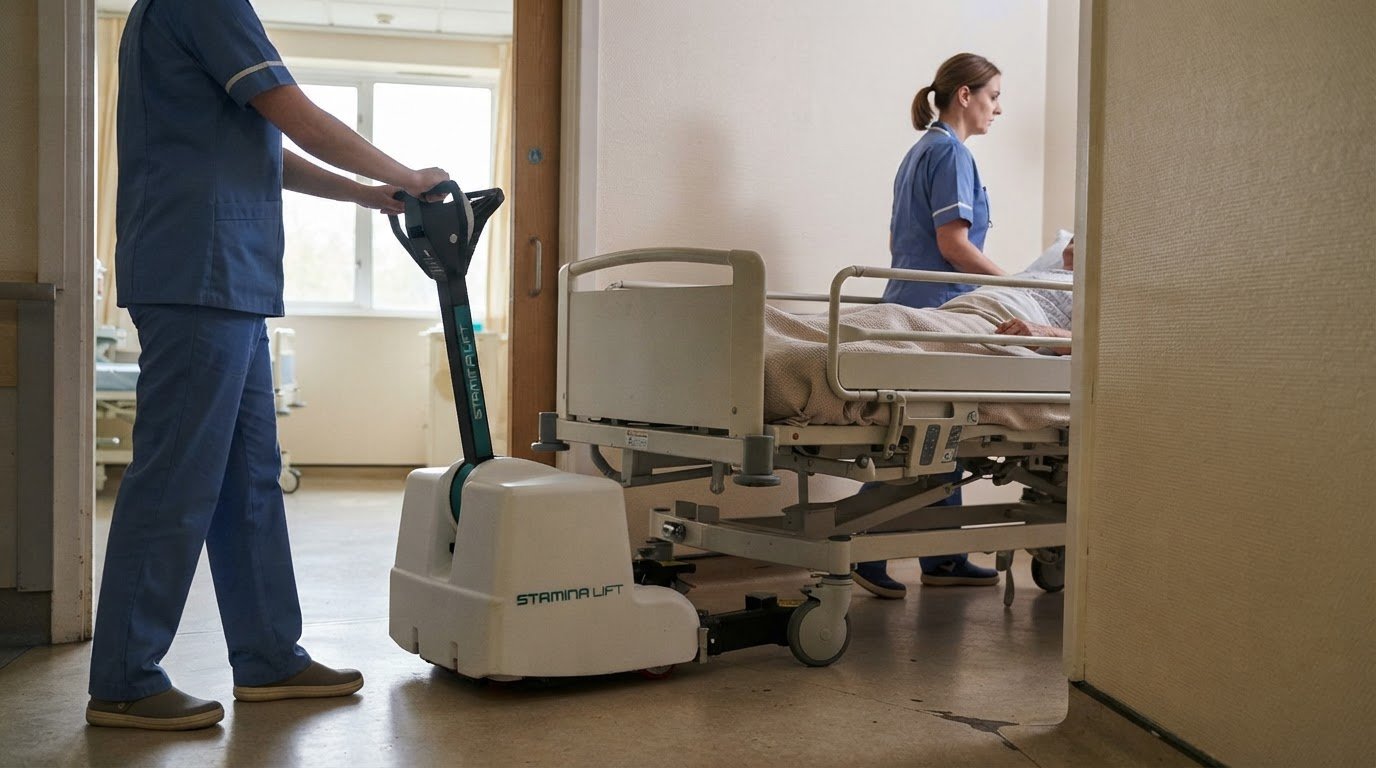
True safety is achieved by engineering the risk out of the workflow entirely. Motorised bed movers, such as the StaminaLift series, eliminate the dangerous "push-off" force required to initiate movement. By using ergonomic joystick controls, the operator bypasses the need for strenuous wrist and shoulder exertion. The results of this shift are quantifiable. One South Australian hospital demonstrated the power of this transition by reducing its manual handling injury rate from 20% to zero within just two years of implementing motorised handling technology. This success proves that when you replace human effort with thoughtful engineering, you don't just manage risk; you eliminate it. Transitioning to these systems allows your facility to meet modern WHS standards while empowering your team to work without fear of injury.
Implementing a Motorised Handling Strategy for 2026
Implementing a successful strategy to reduce manual handling risk healthcare requires a move beyond simply purchasing equipment toward a coordinated facility-wide integration. It begins with a comprehensive audit of every touchpoint where caregivers or porters are forced into manual exertion. This audit should evaluate not only the weight of the loads but the frequency of transfers and the specific environmental barriers, such as narrow doorways or carpeted corridors. By mapping these high-risk zones, management can deploy motorised solutions where they'll have the most immediate impact on staff safety and operational flow. This proactive approach ensures that the physical burden is removed before an injury occurs, rather than reacting after a WorkCover claim is filed.
Assessing Equipment Compatibility
A common hurdle in modernising hospital safety is the diversity of the existing bed fleet. For a motorised strategy to be effective, the chosen movers must offer universal compatibility across various brands and models. The StaminaLift TS5000 is engineered to meet this challenge, providing seamless integration with 95% of global hospital beds. This universal attachment system ensures that your investment isn't limited by the age or brand of your current assets. Beyond attachment, 360-degree manoeuvrability is non-negotiable for older Australian facilities with tight corridors and standard-sized lifts. Integrated charging systems and long-life batteries are also essential to support 24/7 ward operations, ensuring that the equipment is always ready when an urgent transfer is required.
Managing the Transition and Staff Adoption
Cultural change is often the most difficult aspect of implementing new safety technology. To address the common concern that motorised movers might take too long, it's vital to highlight rapid-connect technology that allows for hitching in seconds. Engaging "super-users" within the nursing and portering teams can drive adoption by demonstrating the immediate relief from physical strain to their peers. These champions help shift the ward culture from one of "making do" to one of engineering proficiency. To maintain long-term safety standards, organisations should provide formal certification for staff, ensuring every operator is confident in the equipment's use. When you partner with a specialist provider for your facility audit, you gain access to the technical support and training frameworks needed to make this transition permanent. Factoring in reduced injury leave and improved transfer speeds reveals a compelling ROI that justifies the move toward a fully motorised healthcare environment.
RIHA Industries: Engineering Safety into Every Transfer
RIHA Industries stands as a global authority in the healthcare safety space, providing engineered solutions that transform how facilities manage heavy transfers. By choosing an Australian-made partner, hospitals secure more than just equipment; they gain access to a national support network and 24-hour parts shipping. This reliability is vital for maintaining 24/7 ward operations where equipment downtime directly impacts caregiver safety. Our mission is to reduce manual handling risk healthcare through thoughtful design that prioritises the physical well-being of the healthcare professional. We don't just manufacture tools; we provide the engineering foundation for a zero-injury workplace.
The StaminaLift Transfer System 5000 represents the pinnacle of universal design, offering compatibility with 95% of hospital beds worldwide. It's currently the only FDA-registered bed mover, providing a level of clinical validation that ensures peace of mind for facility managers. For more demanding environments, the StaminaLift Transfer System 6000 serves as the specialised solution for bariatric and acute care. It provides the necessary power to move extreme loads with precision, ensuring that even the most complex transfers are handled with ease and dignity. These systems allow a single operator to move loads that previously required multiple staff members, significantly improving portering efficiency.
The StaminaLift Advantage
Our technology is built around the patented "connect and lock" jaw system, which eliminates the need for caregivers to bend or use manual straps. This single feature removes the primary cause of lower back strain during the hitching process. Once connected, the equipment operates at a quiet 65 dB, ensuring that patient rest and recovery aren't disturbed during transport. To support preventative maintenance and repairs, integrated Bluetooth diagnostics allow facility managers to track usage patterns and identify service needs before they lead to operational delays. This data-driven approach ensures your safety fleet remains in peak condition for years of reliable service.
Customised Solutions for Diverse Healthcare Facilities
Every clinical setting has unique requirements, which is why we offer tailored hitches and attachments for theatre tables and specialised trolleys. This versatility ensures that the Easi Rider and Easi Mover can protect logistics and maintenance teams just as effectively as the StaminaLift series protects nursing staff. We're committed to supporting rural and regional facilities through advanced 3D-viewer-assisted maintenance tools, bridging the gap between our technical experts and your on-site team. If you're ready to see how these systems can transform your ward, enquire about a hands-on demonstration in your facility to experience the difference that world-class engineering makes.
Securing the Future of Your Healthcare Workforce
Transitioning to a motorised handling strategy is no longer just an operational upgrade; it's a vital commitment to the longevity of your staff. By prioritising engineering controls over administrative training, your facility can effectively reduce manual handling risk healthcare and eliminate the physical burden of heavy bed transfers. We've seen how integrating FDA-registered, Australian-made technology can reduce injuries to zero in major hospitals, ensuring your team remains healthy and compliant with 2026 WHS standards. With 95% fleet compatibility and national service coverage, the transition is both seamless and sustainable.
The path to a safer ward begins with a practical assessment of your current workflow. Our team provides the technical expertise and 24-hour parts support needed to keep your facility moving safely. To see these solutions in action, book a hands-on demonstration for your facility today. You have the power to empower your caregivers and create a workplace where safety is engineered into every shift.
Frequently Asked Questions
What is the most common manual handling injury in healthcare?
Work-related Musculoskeletal Disorders (WMSDs), specifically lower back sprains and strains, are the most frequent injuries reported by caregivers. These often occur during the initiation of movement when pushing heavy beds or stretchers across high-friction surfaces like carpet. By addressing the cumulative micro-trauma caused by these repetitive tasks, facilities can significantly lower their long-term injury rates and protect the career longevity of their nursing and portering teams.
How does a motorised bed mover reduce manual handling risk?
A motorised mover functions as an engineering control that physically removes the hazardous force required to transport heavy loads. Instead of using body weight to overcome inertia, the operator uses a joystick to engage powerful electric motors. This technology is a primary way to reduce manual handling risk healthcare because it replaces human effort with controlled mechanical power, ensuring that the operator's spine and shoulders are never subjected to dangerous compression forces.
Are motorised bed movers compatible with all hospital bed brands?
While compatibility varies between manufacturers, the StaminaLift TS5000 is specifically designed to work with 95% of hospital beds found globally. This universal jaw system allows a single mover to integrate with various brands and models within your existing fleet. Having a versatile attachment system ensures that your facility doesn't need to replace expensive beds or stretchers to implement a motorised safety strategy, making it a cost-effective choice for modern wards.
Do we need special training to operate a StaminaLift bed mover?
Yes, providing staff with formal certification and equipment proficiency training is essential for safe operation. While the joystick controls are intuitive, operators must understand how to navigate tight corridors and manage battery charging cycles. RIHA Industries supports this transition by offering comprehensive training for "super-users" who can then maintain safety standards across the facility. This structured approach ensures the equipment is used effectively to prevent injuries during every shift.
Can powered tugs be used on hospital ramps and inclines?
Powered tugs are engineered to maintain absolute control on ramps and inclines where manual beds often become hazardous. These devices feature automatic braking systems that prevent "runaway" loads, providing a level of safety that human strength cannot match. By using a motorised solution, a single staff member can safely navigate a heavy bariatric bed up or down a hospital ramp without the risk of losing control or suffering a strain injury.
How do motorised movers help with bariatric patient transport?
Specialised movers like the StaminaLift TS6000 are essential for bariatric care because they are built to handle weights that exceed safe manual limits. Moving a patient over 300kg plus the weight of a modern clinical bed creates extreme forces that no amount of lifting technique can mitigate. Motorised movers provide the high-torque power needed to initiate and sustain movement, allowing bariatric transfers to be conducted with dignity for the patient and safety for the staff.
What is the Hierarchy of Control in healthcare manual handling?
The Hierarchy of Control is a safety framework where "Engineering Controls" like motorised movers are prioritised over "Administrative Controls" like manual handling training. Engineering solutions are more effective because they physically remove the hazard from the workplace rather than relying on human behaviour. In a high-pressure hospital environment, having a mechanical system that prevents injury is far more reliable than expecting staff to remember complex lifting techniques during an emergency.
How can we calculate the ROI of investing in motorised handling equipment?
ROI is measured by evaluating the reduction in WorkCover claims, insurance premiums, and the costs associated with agency staff backfilling. Facilities should also consider the gain in operational efficiency, as motorised movers often allow a single porter to complete transfers that previously required two people. Over a typical three-year period, the savings from prevented injuries and improved staff retention often far outweigh the initial capital expenditure for the motorised handling fleet.