
How to Reduce Nurse Back Injuries: Patient Handling Equipment Selection Criteria for 2026
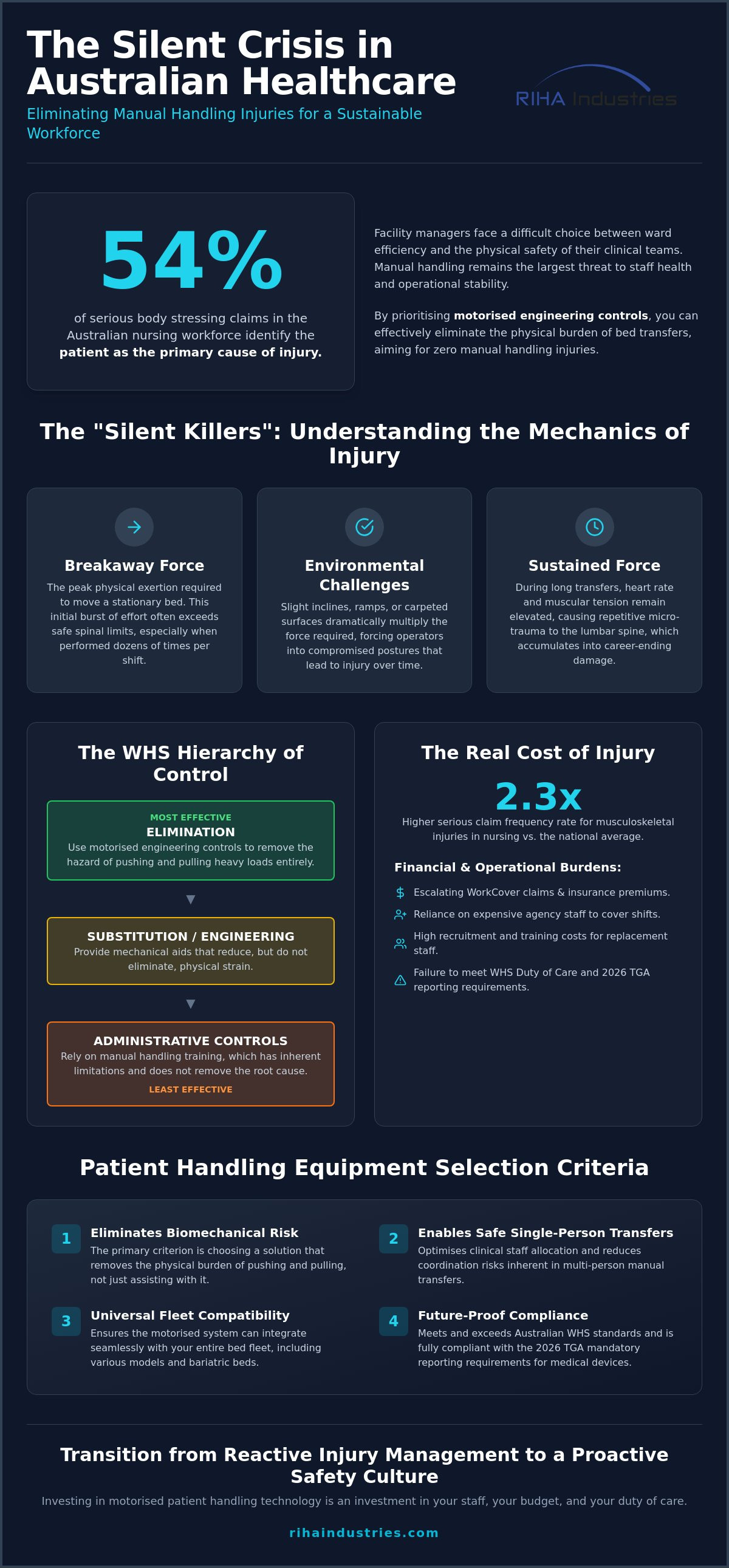
Did you know that over 54% of serious body stressing claims in the Australian nursing workforce identify the patient as the primary cause of injury? It's a sobering reality for facility managers who are currently battling high staff turnover and the relentless climb of insurance premiums. You shouldn't have to choose between ward efficiency and the physical safety of your clinical team, yet manual handling remains the largest threat to your staff's long-term health and your organisation's operational stability.
By refining your patient handling equipment selection criteria to prioritise motorised engineering controls, you can effectively eliminate the physical burden of bed transfers. This guide will show you how to leverage the latest 2026 safety standards and technological innovations to achieve a target of zero manual handling injuries over the next 24 months. We'll examine how advanced systems like the StaminaLift 2100, equipped with new Bluetooth diagnostics and lithium battery upgrades, enable seamless single-person transfers while ensuring full compliance with the latest TGA mandatory reporting requirements and Australian WHS standards.
Table of Contents
The Silent Crisis of Manual Handling Injuries in Australian Healthcare
Understanding the Mechanics of Injury: Why Pushing and Pulling is the Silent Killer
The Hierarchy of Control: Why Mechanical Aids Trump Training
Patient Handling Equipment Selection Criteria: Choosing the Right Solution
Implementing a Sustainable Safety Strategy with RIHA Industries
The Silent Crisis of Manual Handling Injuries in Australian Healthcare
Manual handling in a modern hospital is often misunderstood as merely the act of lifting a patient. In reality, it involves the constant pushing, pulling, and steering of heavy equipment across vast floor plans. The Silent Crisis of Manual Handling Injuries is rooted in the cumulative strain of these everyday tasks. While a nurse might walk 15km in a shift, it's the added resistance of navigating 500kg beds through tight corridors or over carpeted surfaces that triggers physical failure. This repetitive physical strain leads directly to chronic musculoskeletal disorders (MSDs), which are the primary cause of long-term disability in the sector.
By 2026, the Australian healthcare sector is facing a critical juncture in staff retention. Physical burnout is no longer just a personal health issue; it is a systemic threat to ward capacity. With the nursing and support workforce experiencing a serious claim frequency rate for musculoskeletal injuries that is 2.3 times the national average, the need for mechanical intervention is urgent. Establishing robust patient handling equipment selection criteria is a vital component of any workforce sustainability strategy, ensuring that highly skilled clinicians aren't forced into early retirement by preventable injuries.
The Real Cost of Back Injuries to Hospital Budgets
The financial repercussions of manual handling injuries extend far beyond immediate medical costs. WorkCover claims and rising insurance premiums create significant holes in hospital budgets that could otherwise be allocated to clinical care. When a staff member is sidelined by a back injury, the facility must rely on expensive agency staff to fill the gap, which further erodes ward efficiency. There is also the hidden cost of recruitment for new personnel to replace experienced staff who can no longer perform their duties due to permanent physical limitations. These combined expenses often far exceed the initial investment in motorised transfer technology.
WHS Compliance and the Duty of Care
In 2026, Australian WHS requirements place a heavier emphasis on the hierarchy of controls. Employers are no longer expected to simply provide manual handling training; the focus has shifted to eliminating the hazard at its source. Under the principle of "reasonable practicability," the adoption of motorised technology is now considered a standard expectation. Establishing clear patient handling equipment selection criteria ensures that facilities aren't just meeting the minimum legal requirements, but are actively fulfilling their duty of care. This is especially relevant following the March 2026 introduction of mandatory TGA reporting for medical device-related injuries, which has increased the visibility of equipment-related safety failures.
Understanding the Mechanics of Injury: Why Pushing and Pulling is the Silent Killer
The physical act of moving a patient bed is often perceived as a simple task, yet the biomechanics involved tell a much more dangerous story. While lifting injuries traditionally receive the most attention in safety training, it's the physical forces required to push and pull heavy loads that act as a silent killer for healthcare careers. The primary culprit is "breakaway force." This is the peak physical exertion required to overcome inertia and move a stationary bed from a dead stop. In many cases, this initial burst of effort exceeds safe limits for the human spine, especially when performed dozens of times per shift.
When you factor in environmental challenges like ramps or uneven floor transitions, the risk profile changes dramatically. A slight incline significantly multiplies the force required to keep a bed in motion, forcing the operator to lean into the load and compromise their posture. This leads to "sustained force" issues where the heart rate and muscular tension remain elevated for long periods during inter-departmental transfers. Over time, these incidents cause repetitive micro-trauma to the lumbar spine. It's not always one single event that causes a career-ending injury, but rather the cumulative effect of these ward transfers that eventually leads to permanent musculoskeletal damage.
The Bariatric Challenge in Modern Wards
Australian acute care facilities are seeing a steady rise in the frequency of bariatric patient transfers. Moving a patient who weighs over 200kg is inherently unsafe for clinical staff, regardless of how many people are assisting. Manual handling simply cannot compensate for the sheer mass involved, even with three or four staff members pushing at once. This is why high-capacity movers, such as the StaminaLift Transfer System 6000, are becoming essential components of modern patient handling equipment selection criteria. These systems take the entire weight of the transfer, allowing a single operator to move bariatric loads with total confidence and zero physical strain.
Environmental Hazards: Lifts, Carpets, and Tight Corners
The physical layout of a hospital often works against the safety of the staff. Carpeted corridors, while providing a quieter environment, significantly increase rolling resistance compared to vinyl or hard floors. This forces staff to exert more energy just to maintain momentum. Navigating heavy beds into narrow lifts or around tight corners also presents the risk of pinch-point injuries and sudden jarring movements if the bed catches on a frame. To mitigate these risks, patient handling equipment selection criteria must prioritise 360-degree manoeuvrability. Equipment that can rotate on its own axis allows for precise control in confined spaces, preventing the need for the operator to manually "heave" the bed into position or risk a shoulder strain during a sharp turn.
The Hierarchy of Control: Why Mechanical Aids Trump Training
Australian workplace health and safety frameworks rely on the Hierarchy of Control as the definitive gold standard for risk management. At the base of this hierarchy sit administrative controls, such as manual handling training and safe lifting education. While these programmes are common, they are also the least effective method for preventing injuries because they rely entirely on human behaviour and perfect technique under pressure. High-level engineering controls, such as motorised bed movers, are far more reliable. They physically remove the hazard by taking the mechanical load off the human body. When establishing your patient handling equipment selection criteria, it's vital to prioritise these engineering solutions that design safety into the task itself.
The financial argument for motorised assistance is equally compelling. While equipment represents a capital investment, the return on investment is realised through the drastic reduction of recurring injury-related costs. A single WorkCover claim or the ongoing need for expensive agency staff to cover injury-related absences can quickly outpace the cost of a motorised mover. By investing in the right technology, facilities move from a reactive cycle of injury management to a proactive model of safety engineering. This shift not only protects the budget but also preserves the most valuable asset in any hospital: its experienced clinical staff.
The Failure of Safe Lifting Education
Safe lifting education often fails when it's needed most. During high-pressure emergency transfers or in understaffed wards, clinicians frequently revert to unsafe habits to get the job done quickly. The physiological reality is that the human back is simply not designed to push or pull loads exceeding 500kg, especially across the long distances required in modern hospital campuses. No amount of training can change the basic physics of spinal compression. Motorised equipment provides a consistent safety baseline that training cannot match. It ensures that the physical force required for a transfer remains at near-zero levels, regardless of the operator's fatigue or the urgency of the patient's condition.
Engineering Safety into the Workflow
Engineering controls in a healthcare setting mean replacing physical effort with mechanical precision. Motorised systems, such as the StaminaLift range, are designed to integrate seamlessly into the clinical workflow without adding complexity. These systems eliminate the need for the awkward bending, reaching, and strapping that often lead to shoulder and back strains. Advanced features like hands-free connection systems further reduce risk by allowing the operator to hitch to a bed without manual intervention. Incorporating these technical requirements into your patient handling equipment selection criteria ensures that safety is a built-in feature of every transfer, allowing your team to focus on clinical excellence rather than physical survival.
Patient Handling Equipment Selection Criteria: Choosing the Right Solution
Rigorous patient handling equipment selection criteria are the foundation of a sustainable safety strategy. When evaluating motorised solutions for 2026, facilities must look beyond the basic ability to move a load. The focus must shift toward how the equipment integrates with existing workflows and infrastructure while addressing the chronic staffing shortages currently impacting Australian hospitals. The right choice doesn't just prevent injury; it transforms the operational efficiency of the entire ward.
The first priority is universal compatibility. A hospital rarely operates a uniform fleet of beds; usually, it's a mix of legacy models and new bariatric systems from various global manufacturers. Selection criteria must require a mover that can hitch to any bed without the need for specific tools or complex modifications. This is closely followed by the necessity for single-person operation. In an environment where clinical staff are already stretched thin, any equipment that requires two people to operate fails to solve the underlying labour crisis. You need a system that empowers one porter or nurse to complete a transfer that previously required three.
Environmental constraints also play a significant role. Many Australian facilities feature older wings with narrow corridors and small lifts. Equipment must offer a compact footprint and 360-degree manoeuvrability to navigate these tight spaces without increasing the risk of pinch-point injuries. Battery technology has also evolved. Evaluating lithium-ion versus traditional lead-acid is now essential. Lithium batteries, such as the 2026 upgrades found in the StaminaLift range, offer faster charging and longer duty cycles. This ensures the equipment is ready for use across 24-hour shift patterns without unexpected downtime.
Finally, safety features are non-negotiable. Selection criteria should mandate:
Automatic braking systems that engage as soon as the controls are released.
Emergency release mechanisms for manual override during power failures.
Safety lockouts to prevent unauthorised use in high-traffic public areas.
Bed Movers vs. Multi-Purpose Tugs
Choosing the right tool depends on the specific task. A dedicated bed mover like the StaminaLift Transfer System 5000 is engineered specifically for the precision required in patient transfers. It allows the operator to stay at the head of the bed, maintaining eye contact and communication with the patient throughout the journey. Conversely, an electric tug like the Easi Rider is often more suitable for non-patient loads, such as heavy linen trolleys or meal delivery systems. Analysing the specific load-moving requirements of each department ensures that you don't under-equip your facility.
Compatibility and Universal Attachment
The challenge of mixed fleets is a common pain point for facility managers. If a bed mover only works with a portion of your inventory, it becomes a hurdle rather than a help. Patented, tool-free coupling systems are essential because they encourage staff adoption. If the connection process is seamless, staff will use the equipment every time. It's also critical that the attachment adds minimal length to the bed. This ensures the combined unit still fits within standard hospital lifts without requiring the patient to be transferred to a smaller stretcher. Explore our range of TGA-compliant bed movers to find a solution that meets your facility's unique compatibility requirements.
Implementing a Sustainable Safety Strategy with RIHA Industries
Adopting a sustainable safety strategy requires a shift from reactive injury management to proactive safety engineering. While many facilities focus on the immediate aftermath of a workplace accident, true leadership involves removing the physical risk before an injury occurs. By applying rigorous patient handling equipment selection criteria, hospital executives can transition their wards into environments where physical safety is a built-in feature of the daily workflow. This approach does more than just lower insurance premiums; it directly improves staff morale and leads to superior patient care outcomes by allowing clinicians to focus on recovery rather than the physical struggle of a transfer.
To justify the transition to motorised movers, many facilities now utilise an ROI calculator to compare the capital cost of equipment against the recurring expenses of injury claims, agency staff cover, and recruitment. When the data is viewed over a five-year period, the financial benefits of engineering controls become undeniable. Investing in high-quality motorised solutions ensures that your facility remains compliant with the evolving 2026 WHS standards while protecting the long-term health of your most valuable clinical assets.
The StaminaLift Advantage for Australian Hospitals
Major hospitals across the country have reported reducing bed-moving injuries to zero after integrating StaminaLift systems into their portering and nursing workflows. As a South Australian-based manufacturer, RIHA Industries provides a level of reliability that international vendors struggle to match. This local presence ensures 24-hour parts shipping and expert national support, which is critical for equipment that must remain operational around the clock. Beyond standard bed transfers, customisation options are available for specialised equipment, such as theatre tables and surgical centre devices, ensuring that every department benefits from reduced physical strain.
Preventative Maintenance: Ensuring Long-Term Compliance
Regular servicing is a non-negotiable requirement for OHS compliance and ensures the longevity of your investment. Following the July 2026 product updates, the StaminaLift 2100 now includes Bluetooth diagnostics that allow for remote monitoring of fleet health and battery cycles. This technology empowers in-house hospital engineering teams to identify maintenance needs before they lead to equipment downtime. For a deeper look at how to integrate these tools into your facility, refer to our guide on Hospital Porter Equipment: The Ultimate Guide to Safety and Efficiency in 2026.
Taking the Next Step: Trials and Demonstrations
Staff buy-in is essential for the successful adoption of any new technology. Hands-on trials allow your team to experience the ease of use firsthand, proving that motorised movers simplify their tasks rather than adding complexity. RIHA Industries supports healthcare facilities by providing onsite demonstrations and comprehensive staff training to ensure every operator feels confident and empowered. Once your team sees how a single person can safely manage a bariatric transfer, the transition to a safer workplace becomes a shared goal. To begin your facility's transformation, organise an onsite demonstration of StaminaLift solutions today.
Securing the Future of Your Nursing Workforce
We've explored how "breakaway force" and repetitive strain are the primary drivers of musculoskeletal injuries in Australian wards. Shifting the focus from administrative training to robust engineering controls allows facilities to effectively eliminate these hazards. Applying rigorous patient handling equipment selection criteria ensures your team is equipped with tools that offer 360-degree manoeuvrability and universal compatibility.
RIHA Industries provides Australian-made solutions that are FDA-registered and backed by national service coverage. Our technology is compatible with 95% of all hospital beds, stretchers, and trolleys globally. It's already proven to reduce bed-moving injuries to zero in major South Australian hospitals. It's time to empower your staff with engineering that protects their careers and enhances patient care.
View the full range of StaminaLift and Easi series equipment
You have the opportunity to create a safer, more efficient clinical environment for your team today.
Frequently Asked Questions
How much weight can a motorised hospital bed mover actually handle?
The capacity of a motorised mover depends on the specific model selected for your ward's requirements. The StaminaLift 6000 is our high-capacity solution designed for bariatric transfers, safely handling loads up to 600kg. For standard acute care needs, the StaminaLift 5000 and 2100 models are engineered to manage loads up to 500kg, ensuring that staff can move heavy beds and patients without facing dangerous levels of physical resistance.
Do we need to modify our existing hospital beds to use a StaminaLift?
No modifications are required to your current bed fleet to implement our technology. The universal attachment system is designed to hitch onto 95% of hospital beds and stretchers globally without the use of specialised tools. This seamless compatibility is a vital part of effective patient handling equipment selection criteria, as it allows for immediate integration across different departments and bed manufacturers without costly infrastructure changes.
Can one person safely move a bariatric patient using this equipment?
Yes, a single operator can safely move a bariatric patient weighing up to 600kg when using the StaminaLift 6000. The motorised drive system handles all the physical exertion, including the initial breakaway force and steering through heavy corridor traffic. This capability effectively solves staffing shortages by reducing the number of personnel required for a single transfer from three or four down to one, allowing for better clinical staff allocation.
How long does the battery last on a standard shift for an electric tug?
Our electric tugs and bed movers are designed to operate reliably throughout a full 24-hour shift pattern with regular use. The latest 2026 lithium battery upgrades provide significantly faster charging and more consistent power delivery than traditional lead-acid alternatives. This ensures the equipment remains ready for duty across multiple shifts and reduces the risk of downtime during peak transfer periods in busy acute care environments.
Is manual handling training still necessary if we have motorised equipment?
Training remains a vital component of your facility's safety culture, though the focus shifts from physical lifting techniques to safe equipment operation. While motorised movers act as a high-level engineering control that removes physical strain, staff still need to understand how to navigate corridors and utilise safety features correctly. This ensures that the equipment provides a consistent safety baseline and that all operators feel empowered and safe during every transfer.
What is the typical return on investment for a hospital bed mover?
The return on investment is primarily measured through the drastic reduction in WorkCover claims and rising insurance premiums related to musculoskeletal injuries. Facilities often experience a decrease in costs associated with agency staff hire and the recruitment of new personnel to replace injured workers. By improving ward efficiency and staff retention, the equipment pays for itself through operational stability and the preservation of your experienced clinical team.
Are these machines small enough to fit into our facility’s older lifts?
We've engineered our movers with a compact footprint specifically to suit the architectural constraints of older Australian hospitals. The machines add minimal length to the bed, ensuring the entire unit fits comfortably inside standard hospital lifts and navigates narrow corridors with ease. This compact design is a critical factor in patient handling equipment selection criteria, particularly for facilities where space is at a premium.
How do we ensure our staff are properly trained to use motorised movers?
We provide comprehensive onsite training and hands-on demonstrations to ensure your team is confident and proficient with the equipment. Our experts work directly with your porters and nurses to show how easily the machines integrate into their daily routines. This support helps gain staff buy-in and ensures that everyone understands how to use the safety lockouts and emergency release features for total peace of mind during patient transfers.


