
Implementing a Zero-Lift Policy in Hospitals: The 2026 Resource Guide for Australian Healthcare
- 1 day ago
- 12 min read
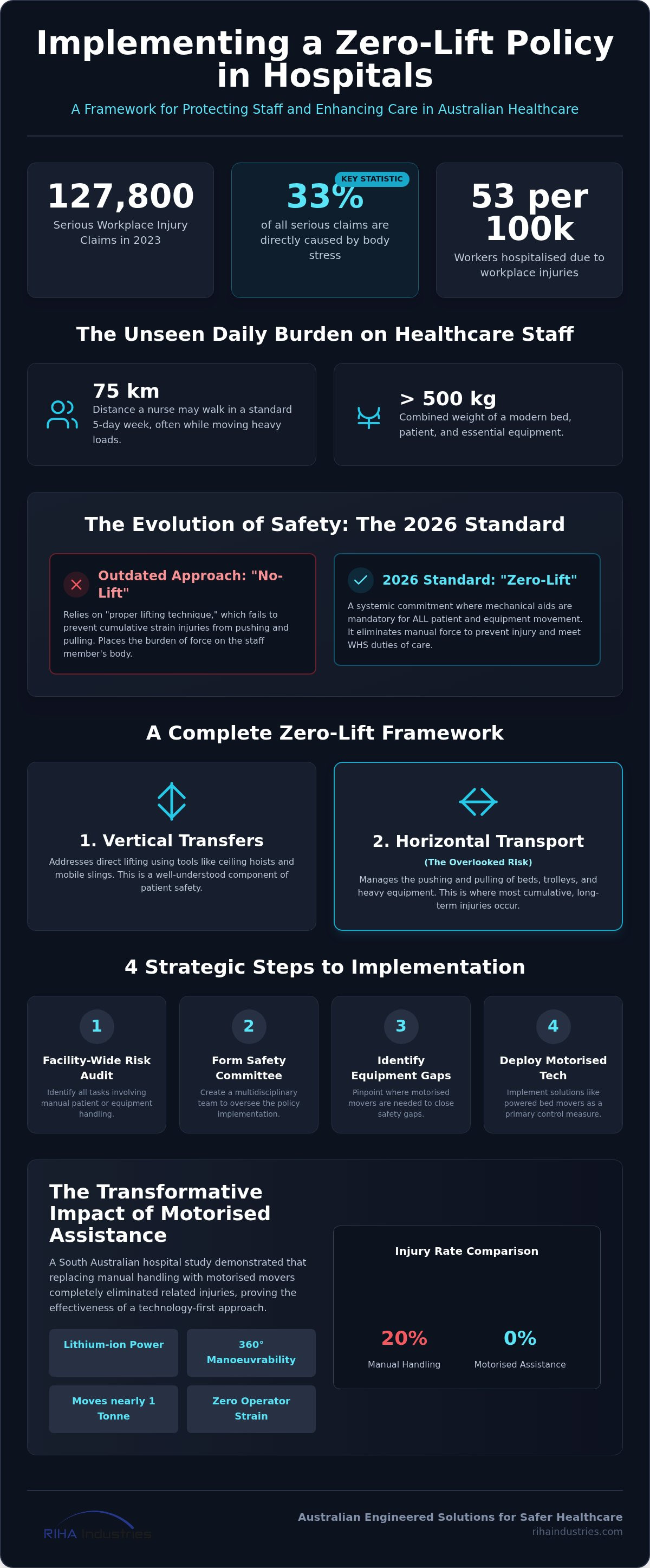
In 2023, there were 127,800 serious compensation claims for workplace injuries in Australia, with a full 33% of those cases tied directly to body stress. For healthcare professionals, the physical toll of moving patients and heavy equipment isn't just a workplace hazard; it's a primary driver of burnout and staff turnover. You likely recognise that keeping your nursing staff safe is the foundation of a high-performing facility, yet the daily reality of manual handling often contradicts your safety goals. Successfully implementing a zero-lift policy in hospitals requires more than just a mandate. It demands a shift in how we view the physics of patient transport and facility flow.
You've likely seen traditional safety programs fall short because they don't account for the hidden strain of pushing heavy beds through tight corridors or up inclines. This guide will show you how to eliminate manual handling risks and protect your team through a comprehensive zero-lift framework powered by smart motorised technology. We will explore the current regulatory landscape, examine how single-person operation solves staffing shortages, and look at the engineering that allows equipment like the StaminaLift TS6000 to move nearly one tonne with zero physical strain on the operator.
Table of Contents
What is a Zero-Lift Policy? Defining the 2026 Standard
A zero-lift policy represents a systemic commitment to eliminating manual force from every patient and equipment transfer. In the Australian healthcare sector, we've seen a significant transition from the traditional "no-lift" terminology to the more holistic "Safe Patient Handling" (SPH) framework. This shift acknowledges that safety isn't just about avoiding a single heavy lift; it's about managing the cumulative physical load placed on healthcare workers throughout a shift. A true zero-lift environment is one where mechanical aids are the primary, non-negotiable method for movement, ensuring that staff never have to rely on their own physical strength to manage heavy loads.
As we move through 2026, the urgency for compliance has never been higher. With workplace injury hospitalisations reaching 53 per 100,000 workers in recent years, facilities are under intense pressure to modernise their approach. Implementing a zero-lift policy in hospitals involves a dual-track strategy. It addresses vertical transfers using ceiling hoists and mobile slings while also tackling horizontal transport. This second category is often overlooked, yet the physical act of moving beds, stretchers, and heavy equipment across a facility is where many long-term injuries occur. A policy that only covers lifting but ignores pushing and pulling is only half complete.
The Legal Framework: WHS and Australian Standards
Current Australian legislation, specifically the Work Health and Safety Act 2011 and the various state-based codes of practice, places a clear burden of responsibility on employers. Adhering to the manual handling code of practice healthcare isn't optional; it's a legal requirement to provide the highest level of protection reasonably practicable. This duty of care extends beyond clinical staff to include porters and facility management teams. Providing motorised assistance is a primary control measure to mitigate the risk of musculoskeletal disorders. When a facility fails to provide the right tools, they aren't just risking staff health; they're risking significant non-compliance penalties under 2026 WHS standards.
Total Body Mechanics vs. Mechanical Assistance
For decades, the industry relied on "proper lifting technique" as the gold standard for safety. However, The Science of Musculoskeletal Injury Prevention shows us that the human spine simply isn't designed to withstand the shear forces generated when pushing a 500kg bed-and-patient combination. The physiological limits of a nurse's back are often exceeded within the first hour of a shift. This isn't just theory. A South Australian hospital study demonstrated that when manual handling was replaced with motorised assistance, injury rates dropped from 20% to zero. By implementing a zero-lift policy in hospitals, facilities move away from a culture that expects staff to "muscle it through" and toward a tech-first environment where mechanical capability drives every movement.
The Science of Musculoskeletal Injury Prevention in Healthcare
The daily physical demands placed on Australian healthcare workers are often underestimated by those outside the clinical environment. A typical nurse or porter may walk up to 15km in a single shift, with a significant portion of that distance spent pushing or pulling heavy equipment. This isn't just about the occasional heavy lift; it's about the biomechanical reality of micro-tears and spinal compression. When implementing a zero-lift policy in hospitals, we must address the cumulative trauma that occurs when the human body is used as a primary engine for movement. Over time, these repetitive forces lead to chronic musculoskeletal disorders that can end careers prematurely.
Quantifying the Burden on Nursing Staff
Over a standard five-day week, hospital staff often cover a staggering 75km on foot. When you consider that a modern hospital bed combined with a patient and necessary life-support equipment can easily exceed 500kg, the force required to initiate and maintain movement is immense. Research into musculoskeletal injury prevention healthcare confirms that these loads frequently exceed the safe physiological limits of the human spine. Cumulative strain in Australian nursing is defined by the progressive degradation of spinal discs caused by the repeated application of force during manual handling tasks, a primary factor in the high rate of body stress claims reported by Safe Work Australia. The "bariatric challenge" further complicates this, as rising patient weights increase the physical load proportionally, making manual transport virtually impossible without risking injury.
The Economic Reality of Manual Handling
Beyond the human cost, there is a compelling financial argument for shifting toward mechanical assistance. The business case for powered patient movers is built on the stark reality of work cover premiums and the high cost of staff turnover. When implementing a zero-lift policy in hospitals, facilities must account for hidden expenses like agency staff fees used to cover injured workers and the intensive resources required for rehabilitation. Lost productivity and the administrative burden of managing injury claims often far outweigh the initial investment in safety technology.
Adopting Strategic Steps for Implementing a Zero-Lift Policy allows a facility to transition from a reactive model to a proactive safety culture. While the capital expenditure for specialised equipment might seem significant, the return on investment is realised quickly through a dramatic reduction in serious injury claims. Protecting your workforce through motorised bed movers is the most effective way to ensure long-term operational stability and maintain high standards of patient care. By removing the physical burden, you empower your staff to focus on clinical excellence rather than physical survival.
Essential Equipment for a Successful Zero-Lift Implementation
Identifying the right tools is the first step in implementing a zero-lift policy in hospitals. While vertical lifting devices like ceiling hoists and mobile slings are common in modern wards, a comprehensive strategy must also address the massive horizontal forces involved in facility-wide transit. A successful implementation requires a suite of equipment that covers patient beds, meal trolleys, linen carts, and medical gas cylinders. Universal compatibility is a non-negotiable requirement; your motorised fleet must integrate with 95% of global bed brands to ensure seamless operation across different wards and departments without the need for expensive fleet replacements.
High-level international standards, such as the OSHA Safe Patient Handling Guidelines, emphasise that manual handling should be eliminated wherever feasible to prevent musculoskeletal disorders. In the Australian context, this means moving beyond simple lifting to a fully motorised ecosystem. This includes powered tugs for non-patient loads, such as the Easi Mover or Easi Rider, which prevent the cumulative strain caused by pushing heavy service trolleys throughout the day. By automating these high-frequency tasks, facilities can ensure that every movement within the hospital is supported by mechanical power.
Motorised Bed Movers: Protecting the Porters
The StaminaLift Transfer System 5000 represents a significant advancement in porter safety by eliminating the need for traditional two-person transfers. Its 360-degree manoeuvrability is essential for navigating the tight corridors and busy theatre bays found in many Australian healthcare facilities. By utilising a patented hitching system, the TS5000 connects to nearly any bed without requiring the operator to bend or strain, effectively removing the primary risk factors for lower back injury. This single-person operation not only protects the staff member but also helps facilities manage staffing shortages by allowing one person to do the work of two safely and efficiently.
Bariatric Solutions: Moving the Heavyweights
Managing bariatric patients requires specialised engineering that respects both staff safety and patient dignity. The StaminaLift Transfer System 6000 is engineered for these high-stakes scenarios, capable of moving nearly one tonne safely, even up a 7-degree incline. This level of power ensures that transport is smooth and controlled, avoiding the jerky, physical movements often associated with manual handling. Safety remains the priority, with the TS6000 featuring automatic braking and emergency release mechanisms to provide total control in high-pressure clinical environments. Implementing a zero-lift policy in hospitals with these tools ensures that even the heaviest loads are handled with precision and empathy, protecting the longevity of your workforce.
Strategic Steps for Implementing a Zero-Lift Policy in 2026
Successfully implementing a zero-lift policy in hospitals requires a methodical transition that balances administrative requirements with the daily realities of the ward floor. It isn't enough to simply purchase equipment; you must cultivate a culture where mechanical assistance is the first instinct for every staff member. This begins with the formation of a multidisciplinary committee comprising both executive management and frontline clinical staff. By involving those who physically move patients, you ensure that the selected technology meets the specific challenges of your facility's layout and patient profile. This collaborative approach turns a top-down mandate into a shared mission for safety.
Phase 1: Audit and Assessment
The first step involves a comprehensive facility-wide manual handling risk audit to identify "injury hotspots." These typically include emergency departments, bariatric wards, and operating theatres where patient acuity and equipment weights are highest. Evaluating current equipment gaps and maintenance backlogs is essential during this phase. You can use an ROI calculator to demonstrate to the board how the capital expenditure on motorised movers offsets the long-term costs of injury claims and staff absenteeism. This data-driven approach is a core component of a modern no lift policy healthcare framework, providing the financial justification needed for facility-wide integration.
Phase 2: Staff Engagement and Training
Engagement is the bridge between a policy on paper and a safer workplace. You should move beyond standard training sessions and instead facilitate hands-on demonstrations directly in the clinical environment. Appointing "Safety Champions" within each department helps encourage equipment adoption and provides a peer-to-peer support network. It's also the ideal time to address the common myth that manual handling is faster. Workflow analysis consistently shows that implementing a zero-lift policy in hospitals reduces the total time taken for transfers. It eliminates the need to wait for a second staff member to assist with a heavy push, allowing a single operator to complete the task safely.
Phase 3: Measuring Success
Long-term success is sustained through continuous measurement and refinement. Tracking injury rates pre- and post-implementation provides the hard data needed to justify the program's expansion. Modern equipment often includes Bluetooth diagnostics, allowing facility managers to monitor utilisation rates and identify wards that may require additional training or equipment. Combining this data with qualitative feedback on staff fatigue levels creates a holistic view of the policy's impact. If you're ready to begin your transition to a safer facility, you can contact our expert team to arrange a facility risk assessment and identify your specific equipment needs.
Future-Proofing Patient Transfers with StaminaLift Technology
RIHA Industries stands as a global authority in motorised mobility, offering an Australian-made advantage that ensures rigorous quality control and rapid 24-hour parts shipping. For facilities implementing a zero-lift policy in hospitals, the reliability of the hardware is just as critical as the policy itself. In 2026, we've integrated advanced Lithium-ion technology across our range, delivering 20% better performance and significantly faster charging cycles compared to traditional systems. This ensures your fleet remains operational through back-to-back shifts, providing the power needed for high-frequency transport without the risk of battery depletion mid-transit. By choosing locally engineered solutions, you secure a long-term partner dedicated to the safety of your staff and the efficiency of your facility.
Innovation in Motion: The TS5000 and TS6000
The StaminaLift Transfer System 5000 and the heavy-duty TS6000 represent the pinnacle of current safety engineering. These units feature a patented hands-free connection system, which is a vital component for implementing a zero-lift policy in hospitals. By allowing the machine to hitch automatically, it removes the need for nurses to bend, reach, or manually strap beds to the mover. This touchless approach eliminates the risk of acute strain during the connection phase. Additionally, the quiet operation of these units, measured at just 65 dB, ensures that patient transfers don't disrupt the healing environment or contribute to the noise fatigue often found in busy wards. It's a solution that balances mechanical power with clinical empathy.
Support and Maintenance: Ensuring 100% Uptime
Maintaining 100% uptime is the final pillar of a successful zero-lift strategy. We utilise smart diagnostics via Bluetooth to predict maintenance needs before a mechanical failure occurs, allowing for proactive servicing rather than reactive repairs. This is where hospital equipment preventative maintenance becomes a strategic asset for your facility management team. Our national service coverage across Australia means that technical support is always within reach, whether you require a routine check or a custom modification for a specific theatre table or trolley.
Sustainability in healthcare is also a core focus of our 2026 standards. We leverage 3D printing technology to produce replacement parts for older models, extending the lifecycle of your machinery and reducing the environmental impact of your equipment fleet. This commitment to durability ensures that your investment in a zero-lift framework continues to deliver value for years to come. By integrating smart technology with robust Australian manufacturing, we provide the tools necessary to protect your workforce today while preparing for the healthcare challenges of tomorrow.
Securing the Future of the Australian Healthcare Workforce
The transition toward a fully motorised clinical environment is no longer a luxury; it's a fundamental requirement for protecting the longevity of our nursing and portering staff. By implementing a zero-lift policy in hospitals, facilities move beyond reactive injury management to a proactive culture of empowerment and safety. We've explored how integrating Australian-made, FDA-registered technology like the StaminaLift range can transform daily operations, ensuring that the physical burden of patient transport is shifted entirely from human muscle to precision engineering.
Clinical case studies have already demonstrated that achieving zero manual handling injuries is possible when the right framework and equipment are in place. This shift not only reduces worker compensation claims but also revitalises staff morale and improves patient flow across the facility. If you're ready to protect your team and future-proof your operations, you can calculate your facility’s ROI with RIHA Industries’ safety solutions. Investing in proven, locally owned technology is the most effective way to ensure your facility remains a leader in both safety and care. We look forward to partnering with you to create a workplace where physical strain is a thing of the past.
Frequently Asked Questions
What is the primary goal of a zero-lift policy in a hospital?
The primary goal is to eliminate manual handling risks by replacing physical force with mechanical assistance for all patient and equipment transfers. By implementing a zero-lift policy in hospitals, facilities aim to reduce musculoskeletal injuries to zero, protecting the long-term health of nursing and portering staff. This systematic approach ensures that the physical burden of the workplace is managed through engineering rather than human effort.
How does a zero-lift policy improve patient safety?
Patient safety is improved through more controlled, stable, and dignified transfers that minimise the risk of accidental falls or skin tears. Motorised assistance provides a smooth, consistent movement, which is particularly beneficial for frail or high-acuity patients who may be sensitive to the jerky motions often associated with manual handling. This allows clinical staff to focus their full attention on the patient's medical stability during transit rather than the physical exertion of the move.
Is a zero-lift policy mandatory for Australian hospitals in 2026?
While the specific term "zero-lift" is a policy choice, the underlying requirement to eliminate hazardous manual tasks is mandatory under the Work Health and Safety Act 2011 and 2026 regulatory standards. Australian employers have a non-delegable duty of care to provide a safe workplace, which includes implementing the highest level of risk control reasonably practicable. In modern healthcare, this translates to the provision of motorised equipment to replace manual pushing and pulling.
What equipment is essential for a zero-lift program?
A successful program requires a combination of vertical lifting devices and horizontal transport solutions. Essential equipment includes ceiling and mobile hoists for repositioning, alongside motorised bed movers such as the StaminaLift TS5000 for facility-wide transit. To address the full scope of facility movement, powered tugs like the Easi Mover are also necessary for handling non-patient loads like linen skips, meal trolleys, and heavy medical gas cylinders.
How do you handle bariatric patients under a zero-lift policy?
Bariatric patients are managed using specialised heavy-duty equipment like the StaminaLift Transfer System 6000, which is engineered to move loads of nearly one tonne. This technology allows a single operator to navigate heavy beds up inclines of up to 7 degrees without any physical strain. Implementing a zero-lift policy in hospitals for bariatric care ensures that these complex transfers are handled with the highest degree of safety for the staff and dignity for the patient.
Can a single staff member move a hospital bed with motorised assistance?
Yes, a single staff member can safely move a fully loaded hospital bed when using motorised assistance. Equipment like the StaminaLift range is designed for single-person operation, which helps facilities manage staffing shortages and improves operational efficiency. The 360-degree turning radius and intuitive controls allow one operator to navigate tight corridors and theatre bays that would traditionally require two or three people to manage manually.
How much does it cost to implement a zero-lift policy?
The cost of implementation varies based on the size of the facility and the current equipment gap. While there is an initial capital expenditure for motorised movers and hoists, this is typically balanced against a significant reduction in worker compensation claims and staff turnover costs. Facilities should focus on the long-term return on investment, where the cost of the technology is offset by the savings found in reduced absenteeism and lower insurance premiums.
What training is required for staff to use motorised bed movers?
Training involves hands-on demonstrations within the clinical environment to ensure staff are comfortable with the equipment's controls and hitching mechanisms. Modern systems like the StaminaLift range feature hands-free connection technology, making the learning curve very short for most healthcare professionals. Ongoing support is often managed through a "Safety Champion" model, where designated staff members provide peer-to-peer guidance and ensure consistent equipment adoption across all shifts.


