Manual handling risk assessment for nurses during resident movement
A safer resident move begins with assessing the person, the task and the physical setting, rather than relying on a blanket lifting rule. A manual handling risk assessment for nurses considers the resident’s individual movement needs alongside factors such as the transfer, available space and equipment. This helps staff plan a suitable approach before assisting with movement or repositioning.
It’s understandable to focus on training when trying to reduce physical strain, but training works best when staff can apply it to the conditions of each transfer. A resident’s mobility, the task and the surrounding environment all shape the physical risks nurses and other healthcare workers face.
This article explains how training, transfer tasks and physical risk assessments relate to musculoskeletal disorders, and why assessments should reflect both the individual resident and the care setting. It also explores how risk can change when a resident’s needs, equipment or environment changes, helping make safer movement planning part of everyday care.
Table of Contents
Staff training and musculoskeletal disorder incidence
Yes. Several US states have enacted safe patient handling legislation, including California’s A-1136, signed into law in October 2011, and Maryland’s SB 879, signed in April 2007. Other examples include Minnesota’s HB 712.2, signed in May 2007, New Jersey’s S-1758/A-3028, signed in January 2008, Texas Senate Bill 1525, signed on June 17, 2005, and Washington House Bill 1672, signed on March 22, 2006. These examples show why nurses need to understand the requirements that apply in their own state.
Training and staffing practices reduce handling risks when they connect knowledge with the actual transfer task. Staff need instruction in safe patient handling and the equipment used in their setting, followed by refresher training at an employer-set frequency. The RCN recommends moving-and-handling updates when staff start a new role and before they begin duties involving manual handling. Patient education matters too: explaining the intended movement and inviting participation can help staff coordinate the transfer with the patient’s ability and comfort.
Named training resources provide practical foundations. OSHA’s Safe Patient Handling Training publication for nursing homes is Publication 3108, issued in February 2014. NIOSH’s Safe Patient Handling Training for Schools of Nursing is Publication No. 2009-127, dated November 2009. NIOSH’s web-based Safe Patient Handling and Movement training presentation is dated March 2010. These resources support structured learning, while workplace instruction should also address the equipment staff use and the tasks they perform.
Dynamic risk assessment training helps nurses apply those principles as a resident’s movement unfolds. In one programme, physiotherapists led nursing team members through a 4-hour dynamic risk assessment session. The RAISE intervention combined a four-hour training session with eight hours of supported workplace behaviour change during the morning shift. This approach connected classroom learning with resident-staff interactions, giving staff time to practise assessment during routine patient handling.
The RAISE feasibility study observed 26 manual handling interactions, split evenly before and after training. Physical risk assessment completion rose from 46% before training to 85% after training. Two focus groups with participating nursing team members took place four months after training, adding their experience of applying the approach at work. These findings describe assessment practice, not proof that training alone prevents injury.
Musculoskeletal disorder figures underline the importance of that work. In 2017, US nursing assistants had 18,090 days-away-from-work cases involving musculoskeletal disorders, with an incidence rate of 166.3 cases per 10,000 workers. Training should therefore be paired with workable staffing, suitable equipment and time to assess each transfer, rather than treated as a one-off course.
High-risk patient transfers and repositioning tasks
Risk rises when a transfer requires staff to support substantial resident weight or reposition someone with limited mobility. Assess the specific task, the person’s abilities and the space before choosing an approach.
Patient handling injury risks
Musculoskeletal injury risks are the physical stresses patient handling can place on a worker’s body during transfers and repositioning. Repeated effort, awkward postures and supporting a person’s weight can strain staff, particularly when movement is unpredictable.
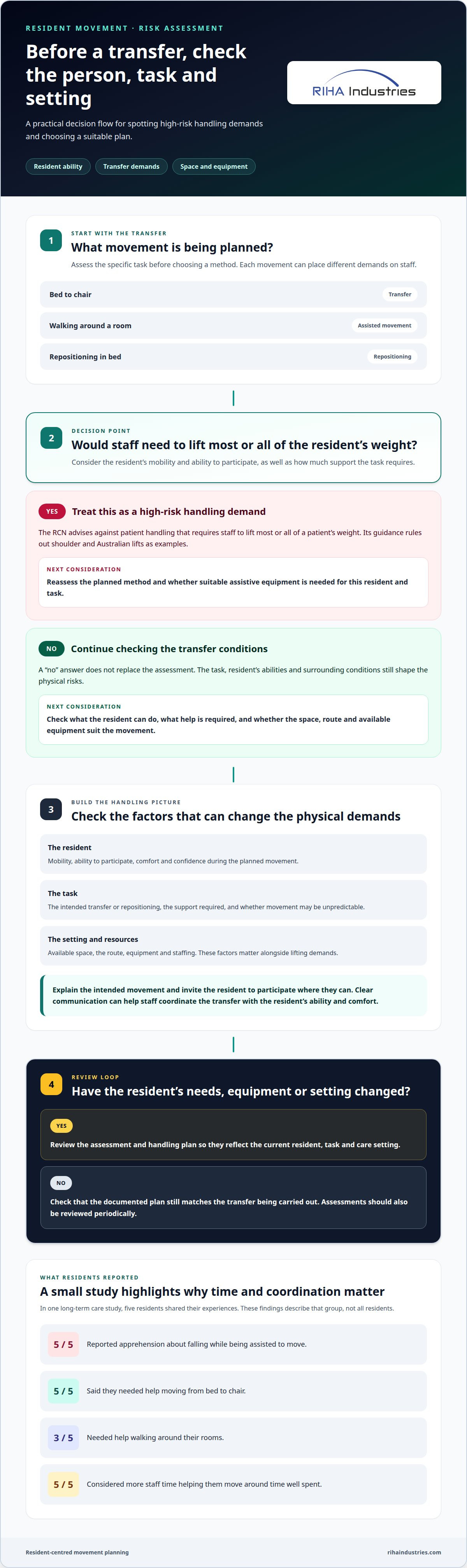
That matters because safe nursing practice must protect both residents and care staff. In long-term care research, all five residents reported apprehension about falling while being assisted to move. This underlines why clear communication and coordinated movement matter: a resident who feels unsteady may move unexpectedly, changing the demands on staff.
Qualitative findings also highlight what residents need from assistance. All five residents said they needed help moving from bed to chair, and all considered more staff time helping them move around time well spent. These accounts add context to injury prevention: a transfer plan should allow staff to provide support without relying on rushed or improvised lifting.
Transfers and repositioning hazards
Transfer and repositioning hazards arise when the task, resident movement or surrounding conditions make the planned method difficult to perform safely. Bed-to-chair transfers, helping someone walk around a room and repositioning in bed each place different demands on nursing practice.
In the same long-term care study, three of five residents needed help walking around their rooms. A hazard assessment should consider the intended movement, the resident’s ability to participate, the route and available equipment. The RCN advises against patient handling that requires lifting most or all of a patient’s weight, citing shoulder and Australian lifts as examples its guidance rules out.
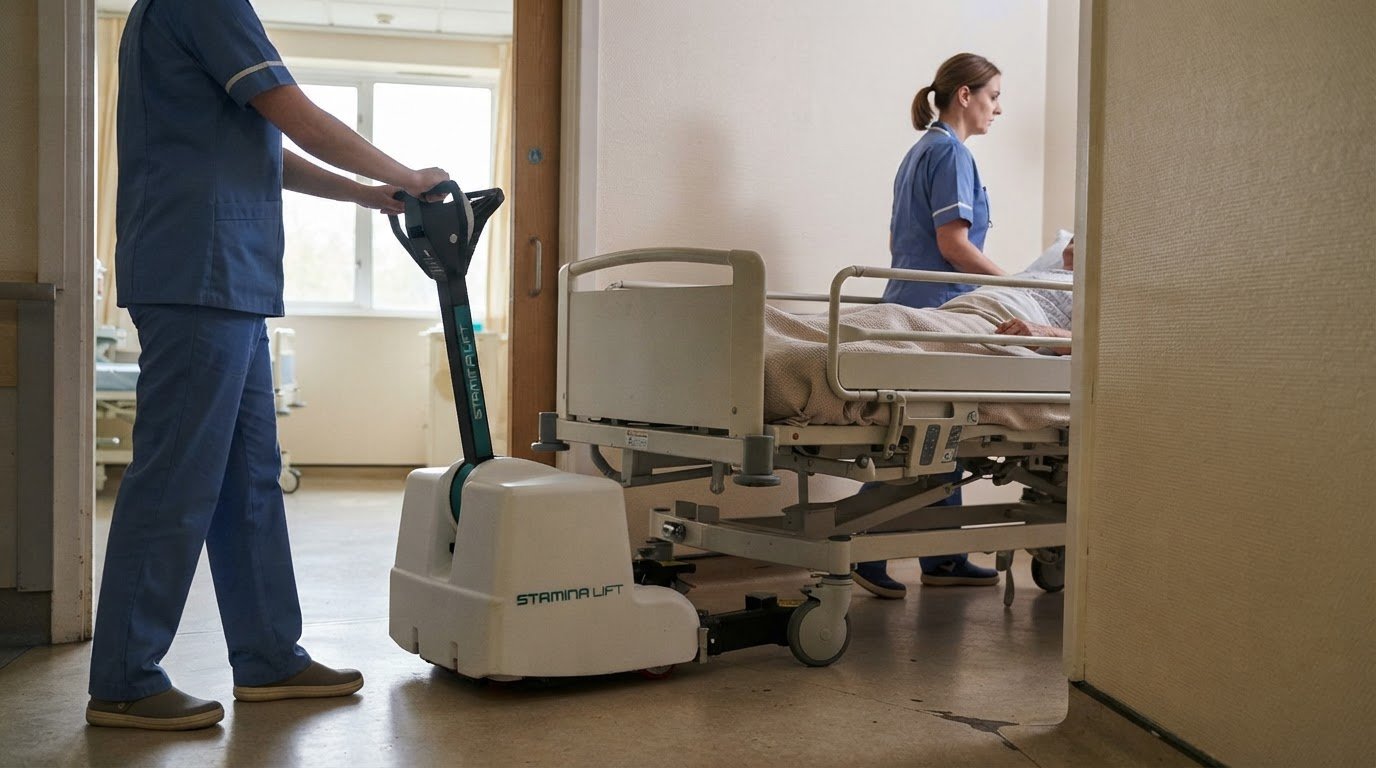
Use suitable assistive equipment when the assessed transfer needs it, rather than defaulting to a manual lift that requires staff to take most of the resident’s weight. RIHA Industries’ StaminaLift Transfer System 5000 and StaminaLift Transfer System 6000 are designed to integrate with existing hospital equipment. The assessment still determines whether a system suits the resident and task.
Assessment review and documentation
A review checks whether the documented handling plan still reflects the resident, task and setting. Assessments should be reviewed periodically and when circumstances change. According to UK Government, legislation.gov.uk, employers must review an assessment if they suspect it is no longer valid or relevant operations change significantly.
Record the assessment’s current findings, the planned movement, the equipment required and any changes that prompt a review. For example, a change in a resident’s ability to participate may alter a bed-to-chair transfer plan. Clear records help care staff apply the current approach consistently and recognise when reassessment is needed.
There is no single review interval in these facts. A regular review schedule, alongside reassessment after meaningful changes, keeps documentation connected to actual care practice instead of leaving an outdated plan in place.
Musculoskeletal disorders in healthcare workers
Musculoskeletal disorders can affect healthcare workers whose duties repeatedly involve moving residents or patients. In hospitals and aged care settings, handling tasks may include transfers, repositioning and supporting movement during care. Physical demands vary with the person’s movement, the task and the environment. Health and safety planning needs to account for these conditions rather than treating every movement as identical.
The workforce impact can reach beyond an individual injury. As many as 20% of nurses who leave direct patient care positions do so because of work-related risks. These figures give context to why nursing teams need to recognise physical demands and address risks as part of routine work.
Research on patient handling covers different methods and settings, so findings need to be read in context. One review included 36 primary research studies, one systematic review and 12 other records, including narrative and government reports. Of the primary studies, 21 used observational cross-sectional designs. Such studies can describe practice and movement demands, but they do not all answer the same question.
The settings and participants also varied. Hospitals were the setting for 13 studies, while nurses were the practitioner population in 13 studies. Patients were simulated in 12 studies, meaning some findings came from controlled practice rather than live care. The review covered English-language literature published between 2002 and 2021, offering a defined period rather than a complete account of every health care setting.
For a health and safety executive or nursing manager, this evidence supports examining the work itself. Consider a bed-to-chair transfer: the resident’s capacity, staff positioning, available space and handling equipment all influence the physical demands. Medication and care routines can also shape when movement occurs. A task-based review helps identify where strain may arise, rather than relying only on job titles or general assumptions about nursing duties.
NIOSH’s Safe Lifting and Movement of Nursing Home Residents, Publication No. 2006-117, dated November 2006, focuses on resident movement. Its topic reflects the need to consider the person and the handling task together. For example, repositioning a resident in bed differs from assisting someone to stand. A practical assessment connects each movement to staff capability, the resident’s needs and the equipment available.
These distinctions matter because a label such as “musculoskeletal disorder” does not explain how a particular injury risk developed. A hospital team can use incident patterns, observed handling practices and task assessments to identify demanding movements. Reviewing these together helps healthcare teams prioritise changes that address the physical work while maintaining safe, respectful support for patients.
Physical risk assessment during resident movement
A physical risk assessment examines the demands of a specific movement and the conditions around it. For nurses, it connects the resident’s needs with occupational health risks, practical controls and the care environment.
A comprehensive assessment usually has two linked parts: a general assessment of the setting and an individual assessment of the resident’s needs. The setting review considers physical conditions such as clutter, access around the bed and whether equipment can be positioned for the task. The individual review considers the resident’s mobility, cooperation and support needs. Together, these assessments help staff plan for the actual movement instead of relying on a general handling instruction.
Assess the task by identifying the movement required and where physical effort may arise. A bed-to-chair transfer, for example, involves different actions from repositioning someone in bed. Consider the resident’s ability to participate, the route between surfaces, available space and equipment. Then identify controls that address the risks, such as clearing an obstructed route or choosing suitable equipment for the planned transfer.
The assessment should consider staff health as well as the resident’s condition. Individual moving-and-handling assessments should take staff health conditions into account. Where a worker has a pre-existing condition, employers may need to make reasonable workplace adjustments. This makes the assessment more responsive to the people performing the task and helps identify when a planned approach may place undue physical demands on a particular worker.
Organisational barriers can affect implementation. Clutter can restrict access and make equipment difficult to position. Equipment challenges may prevent staff from applying the intended control, while staffing challenges can affect how a movement is supported. A competent person is required to conduct moving-and-handling risk assessments. The assessment should clearly identify these barriers so the plan reflects the conditions staff encounter, not an idealised space.
For example, before helping a resident from bed to chair, an assessor can consider the resident’s movement needs, the position of both surfaces, the route and available equipment. If clutter restricts access, that obstacle becomes an identified environmental risk. If staff health conditions affect the task, the assessment can consider adjustments. These connected observations make the plan specific to the movement and the people involved.
Assessment findings are useful only when staff can apply them during care. A clear record can describe the movement assessed, the physical risks identified, the chosen controls and any workplace conditions affecting implementation. This gives nurses and care teams a shared reference for the planned approach. It also helps them recognise when the assessment no longer reflects the resident, staff or setting.
What is a manual handling risk assessment for nurses?
A manual handling risk assessment for nurses is a structured review of a movement task, its hazards and the controls needed to reduce physical strain. It considers the resident, staff involved, setting and method of movement. For example, helping someone move from bed to chair requires different planning from repositioning them in bed.
The assessment is not simply a lifting instruction or a judgement based on a resident’s weight. It identifies what the resident can do, what assistance the movement requires and where staff could face physical demands. In Great Britain, the Manual Handling Operations Regulations 1992 require employers to avoid hazardous manual handling where reasonably practicable, and reduce risks when it cannot be avoided. The regulations do not set specific maximum weight limits for lifting and moving.
A competent person conducts the assessment, considering both the general setting and the individual resident’s needs. The review can draw on observations from nursing staff and relevant therapy professionals. For a bed-to-chair transfer, they might examine whether the resident can participate, how the surfaces are positioned, whether the route is clear and which equipment suits the task. Staff health conditions may also be relevant.
A useful record makes the decision-making clear. It should describe the movement assessed, the hazards identified and the controls chosen. For example, a plan might specify suitable equipment for a particular transfer rather than lifting most or all of the resident’s weight. It should also note conditions that could affect the method, such as restricted access beside the bed.
Assessment has both a planned and an immediate element. A documented plan gives the care team a consistent approach, while a dynamic check before movement helps staff notice changes in the resident or surroundings. If a resident’s ability to participate differs from the plan, or equipment cannot be positioned as expected, staff should respond to the conditions they face rather than proceed automatically.
Review the assessment periodically and when circumstances change. According to UK Government, legislation.gov.uk, employers must review an assessment if they suspect it is no longer valid or relevant manual handling operations change significantly. A change in mobility, the task or the room layout may therefore call for an updated plan and record.
Clear assessments connect resident care with practical controls for staff. To explore equipment designed for patient movement, explore patient transfer solutions.
RIHA Industries
RIHA Industries supports healthcare teams seeking equipment to address the physical demands identified in resident movement assessments. Its patient transfer systems and bed movers are designed to connect with existing hospital equipment, helping teams consider equipment as part of a planned approach to transfers.
The StaminaLift Transfer System 5000 and StaminaLift Transfer System 6000 are options for teams assessing patient transfer needs. The StaminaLift 2100 Bed Mover and Easi Rider are also available for healthcare movement requirements. The right choice depends on the task, setting and equipment already in use, so assessment findings can inform the discussion.
For information about equipment suited to your healthcare setting, contact RIHA Industries.
Put your assessment into practice
A useful next step is to connect each identified transfer need with equipment suited to the care environment. A manual handling risk assessment for nurses can guide discussions about whether existing equipment supports the intended movement and where another solution may be appropriate.
RIHA Industries offers the StaminaLift Transfer System 5000, StaminaLift Transfer System 6000 and StaminaLift 2100 Bed Mover. These options can help healthcare teams explore equipment choices alongside their assessment findings, resident needs and existing hospital equipment.
For a discussion about equipment for your setting, contact RIHA Industries. A considered next step can help your team continue building safer, more workable movement practices.
Frequently Asked Questions
What patient-handling tasks should nurses assess for risk?
Assess any task where staff support, guide or reposition a patient, including toileting, lateral movement in bed, helping someone stand and assisting with walking. Consider routine tasks as well as movements prompted by an unexpected change, such as a patient becoming unsteady. A familiar transfer can present different demands if the patient’s movement, surroundings or required support have changed.
What steps are used to conduct a nursing manual handling risk assessment?
Start by describing the movement and the patient’s participation, then identify possible hazards for staff and the patient. Consider the space, route, available equipment and staff involved. Choose controls that fit the task, such as changing the setup or using suitable equipment. Record the planned approach and communicate it to the care team. Reassess if the movement or conditions differ from the plan.
Which risk factors and assessment tools apply to patient handling, such as the Revised NIOSH Lifting Equation?
Relevant factors include the patient’s movement, the task, staff capability, the surrounding space and available equipment. The Revised NIOSH Lifting Equation may inform assessment of lifting demands, but it should not replace a patient-specific review of transfers or repositioning. Choose an assessment approach that reflects the movement being considered, and include hazards the tool may not capture, such as patient cooperation or restricted access.
How should a patient’s mobility, weight-bearing ability, and cooperation be assessed before transfer?
Base the transfer plan on the patient’s current ability to move and participate, rather than relying only on an earlier record. Before starting, explain the intended movement and observe whether the patient can follow cues, bear weight and maintain a stable position. For example, a patient who can assist with one movement may need more support during another. Include these observations in the task plan.
What injuries and hazards are associated with manual patient handling, and how can they be prevented?
Manual patient handling can expose staff to musculoskeletal injury risks, particularly when a movement involves awkward reaching, sudden effort or supporting substantial patient weight. Hazards can also include restricted space, clutter and equipment that cannot be positioned for the task. Prevention depends on identifying demands before moving, selecting suitable controls and equipment, and ensuring staff understand the planned approach.