
Patient Handling Equipment Maintenance Plan: The 2026 Australian Healthcare Guide
What if the very tools designed to protect your nursing staff from injury are the same ones putting your facility at risk during a WHS audit? You likely understand the frustration of a bed mover failing during a peak ward transfer or the rising costs of reactive repairs that eat into your annual budget. It's stressful to manage clinical safety when equipment reliability feels like a gamble. However, a patient handling equipment maintenance plan is not a cost centre; it's a clinical safety strategy that protects your most valuable asset: your staff.
This guide will show you how to build a robust, compliant framework that ensures a zero-injury workplace and extends the operational life of your StaminaLift and Easi series equipment to well over a decade. We'll explore the essentials of Australian compliance, the shift from reactive to preventative care, and how to create seamless audit trails using advanced 3D tools and 24-hour parts support. By the end, you'll have a clear roadmap to keep your facility moving safely and efficiently through 2026 and beyond.
Table of Contents
The Critical Role of Maintenance in Australian WHS Compliance
A patient handling equipment maintenance plan is a structured, documented schedule of inspections and services designed to keep clinical tools in peak condition. It serves as a cornerstone of medical equipment management, ensuring that every bed mover and transfer system operates within safe parameters. Under Australian Work Health and Safety (WHS) laws, facilities have a non-negotiable duty of care to provide a safe workplace. When maintenance is neglected, the risk of equipment failure increases, leading directly to preventable manual handling injuries and nurse back strain. Neglecting these schedules doesn't just risk physical harm; it invites significant financial impact through rising insurance premiums and expensive WorkCover claims.
Understanding Your Legal Obligations in 2026
Meeting Australian Standards, specifically AS/NZS ISO 10535, is essential for any modern healthcare facility. Compliance isn't a one-off event. It's an ongoing commitment to safety that has shifted toward preventative strategies rather than reactive fixes. In 2026, waiting for a machine to break is no longer an acceptable risk management strategy. Reactive repairs often happen too late to prevent a staff member's injury. Specialised inspections must be carried out by competent persons, which means technicians with the specific training to identify micro-wear in motorised components before they fail. This proactive approach ensures your StaminaLift and Easi series equipment remains a reliable shield for your staff, keeping you on the right side of an audit.
The Human Cost of Equipment Downtime
The physical demands on Australian healthcare workers are immense. Industry data shows that nursing and portering staff can walk up to 75km per week during their shifts. When a single bed mover, such as the StaminaLift 2100, goes out of service, the consequences are immediate. It forces staff back into high-risk manual pushing and pulling of heavy loads. This sudden return to physical strain is often where acute injuries occur. Reliability directly impacts staff morale and retention. In high-pressure wards, knowing that equipment will work every time reduces anxiety and allows clinicians to focus on patient care rather than mechanical troubleshooting.
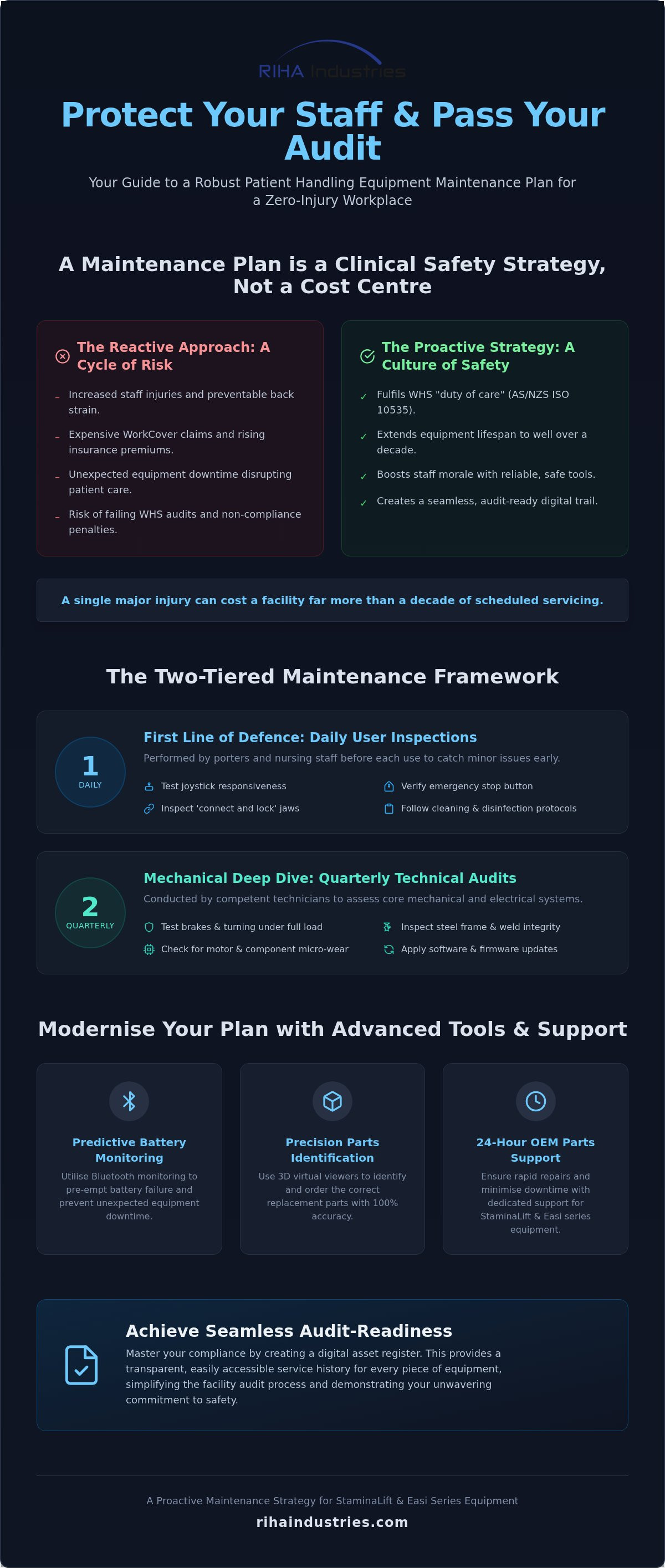
Establishing a robust patient handling equipment maintenance plan is a clinical safety strategy that protects your most valuable asset. A single major injury can cost a facility far more than a decade of scheduled servicing. By investing in regular maintenance, you aren't just fixing machines; you're protecting your bottom line and the well-being of your people.
Essential Components of a Robust Equipment Maintenance Schedule
To transform a safety strategy into a tangible reality, you need a structured patient handling equipment maintenance plan that divides tasks between daily users and technical specialists. This dual-layered approach catches minor issues before they escalate into ward-stopping failures. It provides your clinical staff with the confidence that their tools will perform exactly as expected every time they initiate a transfer. By standardising these routines, you move away from the high costs of reactive repairs and toward a culture of predictable, long-term reliability.
Daily and Weekly User Inspections
Daily pre-start checks are the first line of defence. Porters and nursing staff should perform quick visual and functional assessments before using devices like the Easi Mover or StaminaLift 2100. These checks include testing joystick responsiveness and the immediate activation of the emergency stop button. Staff should also inspect the patented "connect and lock" jaw mechanisms for any signs of debris or misalignment that could compromise a secure hitch. Cleaning protocols are equally vital; wiping down high-touch surfaces with approved disinfectants helps prevent hospital-acquired infections (HAI) and protects both staff and patients in high-pressure clinical environments.
Quarterly Technical Audits for Motorised Movers
While daily checks catch surface-level issues, quarterly deep-dives focus on the mechanical heart of the machine. These technical audits should align with WorkSafe Victoria guidelines on hoist maintenance and motorised mover standards. Technicians must test the 360-degree turning radius and braking systems under full load to ensure stability during transport. They should also verify the integrity of heavy-gauge steel frames and welds to identify any fatigue. Modernising your plan involves checking software and firmware updates, which ensures that Bluetooth diagnostics remain accurate for real-time battery and usage monitoring.
A rigorous battery management programme prevents the common pain point of mid-shift failure. Most power issues stem from inconsistent charging rather than hardware faults. Implementing a "charge-on-rest" policy ensures that equipment like the StaminaLift Transfer System 5000 is always ready for duty. High-wear areas such as hitches, jaws, and drive wheels require specific lubrication and adjustment during these technical sessions to prevent friction-related damage. If your facility requires support in establishing these protocols, choosing a partner for preventative maintenance and repairs can streamline your compliance journey while significantly extending the life of your fleet.
Advanced Diagnostics: Modernising Your Maintenance Plan
Modern healthcare environments demand more than just manual logbooks and visual checks. By integrating digital diagnostics into your patient handling equipment maintenance plan, you move from guesswork to precision engineering. This evolution allows facility managers to anticipate mechanical needs before they disrupt clinical workflows, ensuring that every bed mover in the fleet is ready for duty. Adopting these advanced tools creates a more resilient system where data drives safety outcomes.
The Power of Bluetooth and Digital Monitoring
Bluetooth connectivity has transformed how we monitor the StaminaLift and Easi series. Real-time monitoring allows you to see battery health levels across the entire fleet from a single interface. You can predict replacement cycles months in advance, preventing the frustration of a dead unit during a critical patient transfer. Beyond hardware health, usage history data reveals how often equipment is being utilised in specific wings. This insight helps identify where additional staff training might be needed or where to redistribute the fleet to balance the physical workload. It's about using hard data to justify operational decisions rather than relying on anecdotal feedback from the floor.
3D-Assisted Maintenance for Rural Facilities
Australia's vast geography presents unique challenges for equipment upkeep, especially in remote regional centres. RIHA Industries addresses this through unique 3D maintenance tools and virtual viewers. These digital resources allow on-site engineers in remote locations to identify part replacements with absolute accuracy. By leveraging CAD-designed models, a local technician can visualise the internal assembly of a StaminaLift Transfer System 6000 without needing a specialist to fly in from a capital city. This digital support significantly reduces the need for expensive technician travel and ensures that even the most isolated clinics maintain world-class safety standards.
Integrating this diagnostic data into existing hospital facility management software creates a seamless, automated audit trail. To support this digital-first approach, a "parts-first" strategy is essential for maintaining momentum. RIHA Industries provides 24-hour shipping for critical components, ensuring that once a diagnostic tool identifies a potential issue, the solution is already on its way. This combination of advanced monitoring and rapid logistics ensures that downtime is measured in hours, not weeks, keeping your clinical staff protected and your operations fluid.
Structuring Your Documentation for Safety Audits
Documentation turns a patient handling equipment maintenance plan from a set of intentions into a legally defensible safety shield. In the high-stakes environment of Australian healthcare, an auditor won't just ask if your equipment is safe; they'll ask for the proof. Establishing a centralised digital asset register ensures that every piece of equipment, from an Easi Rider to a StaminaLift 2100 Bed Mover, has a traceable history. Every service intervention, whether it's a minor bolt tightening or a major motorised overhaul, must be recorded. This level of detail transforms your maintenance schedule into a transparent audit trail that demonstrates your facility's commitment to staff well-being.
Building a Compliant Asset Register
A robust register tracks more than just physical locations. It should include serial numbers, purchase dates, and warranty status for systems like the StaminaLift Transfer System 5000 and 6000. Categorising these by risk level and frequency of use allows you to prioritise servicing for the hardest-working units in your fleet. If you are currently expanding your inventory, consulting a hospital bed mover procurement guide can help you align your new assets with your existing safety frameworks from day one. Proper categorisation ensures that high-use equipment never misses a critical inspection window.
Training and Certification Records
Equipment reliability is only half of the safety equation. The other half is the person behind the controls. Staff must be certified to operate specialised motorised movers to prevent operational errors that lead to injury. Your documentation should include these training records alongside the equipment service logs to satisfy OHS compliance inspections. Linking operator proficiency with machine maintenance provides a holistic view of ward safety. For more on choosing the right tools for your team, review the patient handling equipment selection criteria for modern clinical settings.
Conducting an annual review of your patient handling equipment maintenance plan helps identify recurring failure points. If a specific component consistently requires repair, you can adjust your preventative schedule or consider a fleet upgrade. This proactive analysis keeps your facility ahead of the curve and ensures your budget is spent where it matters most. To ensure your documentation and equipment remain audit-ready, you can partner with RIHA Industries for professional preventative maintenance and repairs that meet all Australian Standards.
Optimising Longevity with RIHA Industries Support
Choosing the right partner is the final, most critical step in your patient handling equipment maintenance plan. While general facility contractors can perform basic mechanical checks, they often lack the deep technical knowledge required for specialised medical devices. Engaging directly with RIHA Industries service agents ensures your fleet receives Original Equipment Manufacturer (OEM) care. This direct connection bypasses the delays often associated with third-party distributors, giving you immediate access to Australian-made quality control and technical expertise. With national service coverage across Australia, world-class support is available regardless of your facility's location.
Preventative Maintenance Contracts vs. Ad-hoc Repairs
The financial logic of a bed mover service contract far outweighs the unpredictable costs of ad-hoc repairs. Professional inspections identify the early signs of wear that lead to a "domino effect" of mechanical failure, where one faulty component places undue strain on others. Safety-critical software updates and hardware adjustments are often missed by generalist contractors but are standard in a RIHA service agreement. This proactive approach ensures that your StaminaLift and Easi series equipment remains compliant with Australian Standards while providing a predictable, fixed cost for your annual budget.
Sustainable Engineering for Aging Fleets
Reliability shouldn't have an expiry date. RIHA Industries specialises in extending the operational life of heavy-duty healthcare machinery through sustainable engineering. For older fleets, we utilise industrial 3D printing to manufacture precision parts for machinery that other vendors might consider obsolete. This capability allows you to maintain high safety standards without the capital expense of total fleet replacement. Modernising the StaminaLift 2100 with updated control systems and lithium battery upgrades can transform an aging asset into a high-performance tool. Retractable chargers and software enhancements ensure your older equipment continues to meet the ergonomic needs of your staff.
By choosing to modernise rather than discard, you reduce facility waste and maximise the return on your initial investment. Integrating these upgrades into your patient handling equipment maintenance plan ensures your equipment can provide over a decade of reliable service. This long-term vision positions your facility as a leader in both clinical safety and operational efficiency. It's a commitment to protecting your staff through thoughtful engineering and reliable, lifelong support.
Securing the Future of Your Clinical Environment
A robust patient handling equipment maintenance plan is more than a regulatory requirement; it's a commitment to the long-term well-being of your clinical staff. By moving from reactive repairs to a structured preventative model, you eliminate the risks associated with unexpected equipment failure and ensure your facility remains fully compliant with Australian WHS standards. You now have the tools to leverage advanced Bluetooth diagnostics and 3D virtual viewers to maintain your fleet with unprecedented precision. This shift doesn't just protect your budget; it empowers your team to work without the fear of manual handling injuries.
Reliability is built on the foundation of expert support and high-quality engineering. RIHA Industries provides the stability your facility needs through certified Australian-made quality and comprehensive national service coverage. Because we offer 24-hour worldwide shipping for parts, downtime is significantly reduced, allowing your team to focus on patient care without physical burden. Take the next step in protecting your workforce and extending the life of your StaminaLift and Easi series equipment. Request a comprehensive maintenance audit for your facility today and ensure your ward remains a safe, injury-free environment for years to come.
Frequently Asked Questions
How often should hospital bed movers be serviced in Australia?
Hospital bed movers should be serviced through a combination of daily user inspections and quarterly technical deep-dives. This frequency aligns with Australian Standards and ensures that high-use machines, such as the StaminaLift Transfer System 5000, remain reliable under heavy clinical loads. Regular servicing prevents minor mechanical wear from escalating into a safety hazard, keeping your facility compliant with national health and safety regulations while protecting your staff from the risks of manual handling.
What are the most common failure points in patient handling equipment?
The most common failure points include battery degradation due to inconsistent charging cycles and wear on the "connect and lock" jaw mechanisms. Joysticks and drive wheels also experience high stress during ward transfers. Identifying these issues early is a core component of an effective patient handling equipment maintenance plan. By focusing on these high-wear areas, facilities can avoid the rising costs of reactive repairs and prevent equipment from being out of service during peak times.
Can our internal hospital engineers perform maintenance on StaminaLift machines?
Yes, your internal hospital engineers can perform many maintenance tasks using RIHA Industries' unique 3D maintenance tools. We provide a 3D viewer on our website to assist with in-house servicing and accurate part identification. While daily and basic mechanical checks are manageable on-site, we recommend direct engagement with our service agents for complex quarterly technical audits to ensure the continued precision and safety of your StaminaLift machines.
Does regular maintenance help with Australian WHS audit compliance?
Regular maintenance is essential for Australian WHS audit compliance as it provides a documented history of your facility's "duty of care." A structured maintenance plan demonstrates that you are proactively managing risks associated with patient handling. This documentation creates a seamless audit trail that safety inspectors look for. Facilities using StaminaLift equipment have reported reducing bed-moving injuries from 20% to zero by combining reliable machinery with consistent servicing protocols.
What is the expected lifespan of a motorised bed mover with a proper maintenance plan?
With a proper maintenance plan and OEM support, a motorised bed mover like the StaminaLift 2100 can reliably serve a facility for well over 10 years. Longevity is further extended through modernisation options such as lithium battery upgrades and control system refinements. By choosing Australian-made equipment designed for durability, hospitals can maximise their return on investment while ensuring that their patient handling tools remain a stable, long-term partner in clinical safety.
How do Bluetooth diagnostics improve equipment maintenance?
Bluetooth diagnostics provide real-time feedback on battery health and detailed usage history for your fleet. This technology allows facility managers to predict replacement cycles before a failure occurs during a shift. It also helps identify specific training needs by tracking how staff operate the equipment. This data-driven approach simplifies the servicing process and ensures that your patient handling equipment maintenance plan is based on actual performance metrics rather than estimates.
What should be included in a daily pre-start checklist for bed movers?
A daily pre-start checklist should include a functional test of the joystick, the emergency stop button, and the battery level. Staff should visually inspect the jaw mechanisms for debris and ensure the braking system engages correctly. These quick checks take only a few minutes but are vital for catching surface-level issues. Standardising these routines across your nursing and portering teams ensures that every transfer starts with a safe and fully operational machine.
Are spare parts for StaminaLift equipment readily available in Australia?
Yes, spare parts for StaminaLift and Easi series equipment are readily available and shipped directly from our Australian manufacturing facility. We guarantee 24-hour shipping for parts worldwide, which is a critical factor in reducing equipment downtime. Because we manufacture our systems in South Australia, we maintain strict quality control and a comprehensive inventory of components, ensuring that your facility isn't left waiting for international shipments to arrive during a repair.


