
Single-Carer Patient Transfer: 2026 Buyer's Guide
Body stressing remains the leading cause of serious workers' compensation claims across Australian healthcare, driven largely by staff manually manoeuvring loaded beds that weigh up to 500kg. Ward managers and facility directors know all too well that pulling two nurses away from direct bedside care for routine transit strains rosters and leaves carers vulnerable to debilitating spinal injuries. Truly safe single-carer mobility requires powered mechanical drive rather than passive sliding aids. If you need to identify which equipment for single person patient transfer protects your workforce while adapting to a mixed fleet of hospital beds, you aren't alone.
In this 2026 buyer's guide, you'll discover how single-operator powered systems eliminate manual handling injuries, streamline corridor workflow, and halve the labour hours dedicated to internal transit. We evaluate essential drive technology, universal hitching mechanisms, and compliance benchmarks under Safe Work Australia's Model Code of Practice, giving your procurement team the precise criteria needed to invest with lasting confidence.
Table of Contents
Why Australian Hospitals Are Moving to Single-Operator Patient Handling
Evaluating Single-Person Transfer Technologies: From Slings to Powered Movers
Hospital Bed Mover Comparison: Key Criteria for Single-Person Operation
Implementing Single-Person Transfer Equipment: Facility Planning and WHS Compliance
RIHA Industries StaminaLift: Australian Engineering for Single-Operator Safety
Why Australian Hospitals Are Moving to Single-Operator Patient Handling
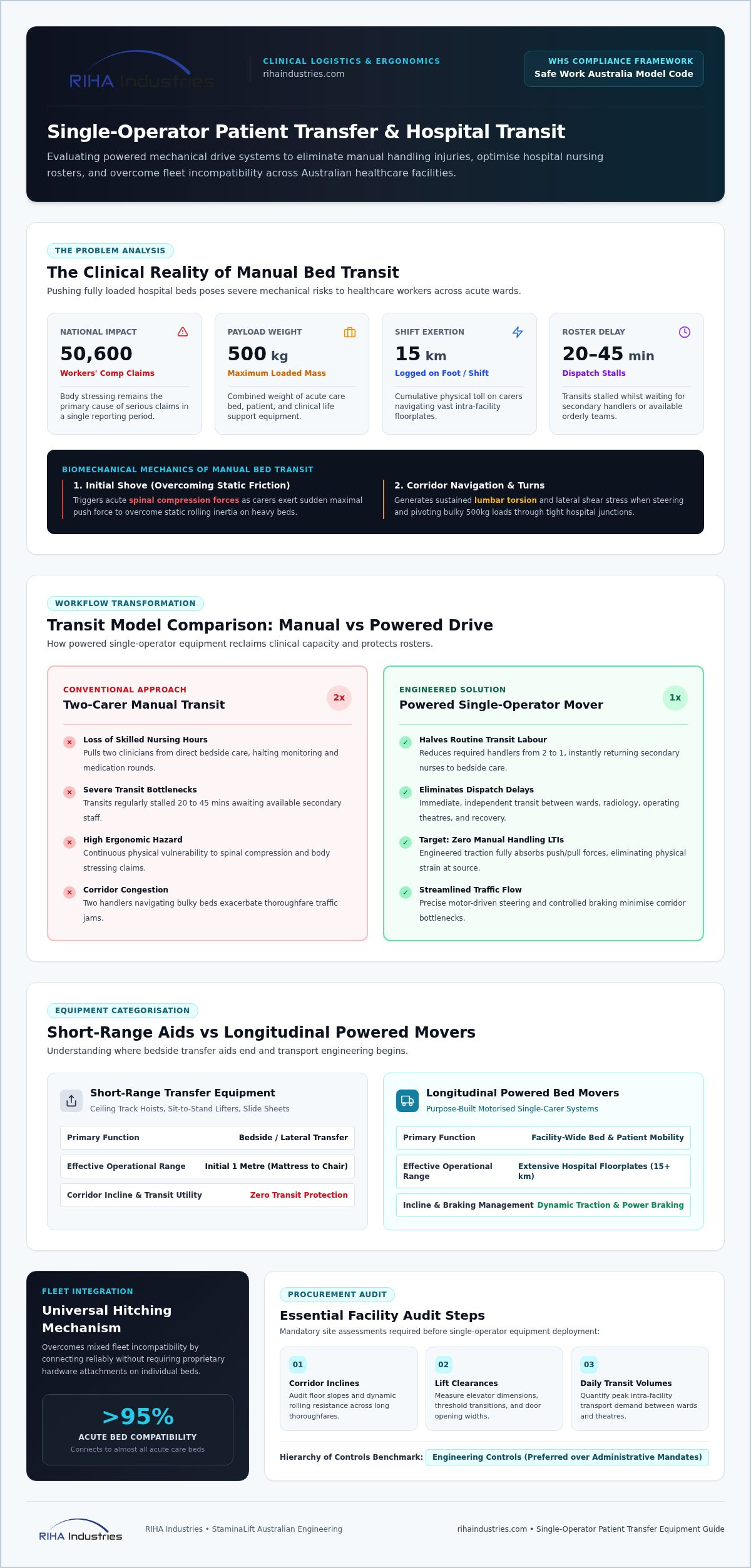
Healthcare workers regularly log up to 15 kilometres on foot during a single working shift. When a significant portion of those footsteps involves manually propelling an acute hospital bed that exceeds 500 kilograms with an occupied patient and attached clinical life support, the cumulative physical toll is catastrophic. Standard operating protocols across Australian health networks have historically mandated two staff members for every intra-facility transit. In an era marked by intense nursing roster shortages, pulling two clinicians away from ward bedsides simply to transport a patient between radiology, operating theatres, and recovery creates an operational bottleneck that compromises patient care.
Adopting purpose-built powered equipment for single person patient transfer shifts patient logistics away from brute physical force. Rather than relying on staff stamina, modern powered systems utilise engineered traction to turn bed movement into a controlled, single-operator process.
The Clinical Reality of Nurse Musculoskeletal Strain
Pushing heavy hospital beds places dangerous mechanical stress on human anatomy. Manual transit triggers acute spinal compression forces during the initial shove to overcome static friction, followed by sustained torsion through the lumbar spine when steering around sharp corridor junctions. Under the Safe Work Australia Model Code of Practice for Hazardous Manual Tasks, pushing loads that exceed safe push-pull thresholds constitutes a defined ergonomic hazard. Safe Work Australia data reveals that body stressing remains the primary cause of serious workers' compensation claims across the nation, generating 50,600 claims in a single reporting period. While a standard patient lift addresses bedside transfers from mattress to chair, it cannot mitigate the sustained physical strain of moving loaded beds through long corridors. Engineering controls eliminate that physical strain at the source, preventing long-term musculoskeletal injuries before they happen.
Roster Efficiency: Releasing Secondary Staff Back to Bedside Care
Beyond ergonomic safety, two-person transport models create severe rostering inefficiencies across acute facilities:
Loss of skilled nursing hours: Removing two clinicians from an acute ward effectively halts bedside monitoring and timely medication administration.
Transit dispatch delays: Transits are frequently stalled for 20 to 45 minutes while wards wait for secondary handlers or available orderly services.
Compounded corridor congestion: Two handlers navigating bulky beds increase traffic bottlenecks across busy hospital thoroughfares.
Deploying dedicated equipment for single person patient transfer directly addresses these inefficiencies. By halving the labour hours required for internal transits, hospitals safely return essential clinical staff to hands-on bedside duties where their expertise delivers maximum clinical value.
Evaluating Single-Person Transfer Technologies: From Slings to Powered Movers
Procurement teams often conflate short-range repositioning devices with long-distance transit equipment. Selecting the right equipment for single person patient transfer requires understanding where short-range manual aids end and longitudinal transport systems begin. While slide sheets and hoists protect staff during bedside handling, they don't solve the ergonomic dangers of moving patients across extensive hospital floorplates.
Short-Range Transfer Equipment vs Intra-Facility Mobility
Ceiling track hoists, sit-to-stand lifters, and lateral slide sheets excel at moving patients across the initial metre, transferring someone safely from a mattress to a commode or chair. Yet they offer zero utility once transit begins. Evidence-based research into preventing healthcare worker injuries emphasises that mechanical controls must align with the specific physical hazard. Longitudinal transit introduces dynamic rolling resistance, emergency braking requirements, and corridor inclines, which are demands that only dedicated powered movers can safely satisfy.
The Mechanics of Modern Motorised Bed Movers
Modern powered bed movers integrate directly beneath or against the bed chassis, converting heavy medical beds into easily steered mobile units. High-torque electric drive systems supply controlled push-pull power capable of managing up to 900kg, removing the entire physical burden from the operator. A true 360-degree turning circle enables a single handler to pivot beds on their central axis inside cramped lifts and narrow ward entrances. Furthermore, hands-free automatic locking jaws latch onto castors securely, so operators don't have to bend down or manually tighten low clamps.
Bariatric Transfer Solutions for Acute Care Environments
Bariatric transit presents extreme ergonomic risks, particularly across corridor link bridges and architectural ramps. Dedicated bariatric movers provide positive drive and automatic braking on 7-degree inclines, eliminating runaway risks on descents and severe spinal strain on ascents. Because clinical environments demand low sensory disturbance, quality systems operate at a quiet 65 dB, ensuring patient distress remains minimal during transport. Reviewing purpose-built designs from RIHA Industries allows healthcare facilities to implement durable equipment for single person patient transfer built specifically for these high-load clinical workflows.
Hospital Bed Mover Comparison: Key Criteria for Single-Person Operation
Procuring medical transport machinery requires comparing core engineering metrics rather than relying on superficial feature lists. Because hospital equipment must function safely within bustling public corridors, engineering managers need to evaluate how hitching versatility, control ergonomics, and active fail-safes interact under daily operational demands. Selecting capable equipment for single person patient transfer means choosing hardware that integrates seamlessly with your existing inventory without introducing secondary hazards.
Fleet Compatibility and Patented Hitching Mechanisms
Hospitals rarely operate single-brand bed fleets. Locking a facility into proprietary brackets or frame-specific clamps creates operational chaos when an incompatible bed arrives in transit. Patented universal jaw designs, such as the mechanism on the StaminaLift Transfer System 5000, secure directly to castor wheels ranging from 100mm to 300mm in diameter. By bypassing frame geometries altogether, universal castor connection delivers immediate operational flexibility across 95 percent of modern acute healthcare beds globally, eliminating the need to modify existing hospital furniture.
Braking, Safety Lockouts, and Ramp Incline Performance
Controlling a heavy load along flat corridors is straightforward; stopping that same load on a descent demands serious engineering. High-performance movers incorporate dynamic regenerative braking alongside electromagnetic park brakes that engage instantly the moment an operator releases the controls. Walk-behind systems should also feature physical back-off safety buttons on the control console, reversing drive direction if pressed against an operator's body. Additionally, key-switch locks prevent unauthorised visitors or untrained staff from tampering with powered equipment stationed in open transit corridors.
Manoeuvrability in Confined Clinical Settings
Corridor junctions, shared service lifts, and crowded recovery bays leave little margin for navigational error. Evaluating drive geometry before purchase prevents regular architectural collisions:
Zero-degree turn radius: Dual independent drive wheels allow true omnidirectional pivoting, preventing costly wall scuffs and doorway corner damage.
Chassis profile: Slimline designs tuck underneath the bed perimeter, keeping thoroughfares clear and eliminating trip points for ward personnel.
Intuitive controls: Proportional joysticks replace coarse thumb throttles, delivering micro-adjustments during delicate patient positioning.
Reviewing our hospital bed mover procurement guide helps clinical asset teams align these mechanical specifications directly with their facility layout, ensuring chosen equipment for single person patient transfer performs reliably across every ward.
Implementing Single-Person Transfer Equipment: Facility Planning and WHS Compliance
Procuring advanced mobility machinery is only half the battle. Successful integration hinges on a rigorous four-stage rollout: auditing daily ward transfer volumes, evaluating architectural choke points, coordinating interdepartmental trials, and certifying every user through formal competency training. Australian Work Health and Safety (WHS) laws place a primary duty of care on employers to implement engineering controls so far as is reasonably practicable. Properly planning your deployment guarantees that new equipment for single person patient transfer delivers immediate safety returns rather than sitting idle in corridor alcoves.
Infrastructure Auditing: Corridors, Lifts, and Charging Points
Every facility presents unique architectural constraints. Before selecting machinery, engineering teams must evaluate their transit corridors, lift dimensions, and recharge infrastructure:
Service lift thresholds: Measure internal elevator depth and door clearance to confirm the attached bed-and-mover footprint fits without awkward diagonal parking.
Corridor intersections: Identify blind corners and ramp transitions to ensure operational sightlines remain unobstructed during single-operator movement.
Recharge real estate: Establish designated transit bays equipped with self-retracting cable reels, keeping trailing power cords off thoroughfare floors.
Staff Training and Cultural Adoption Across Healthcare Teams
Overcoming entrenched operational habits requires hands-on engagement across all shift cycles. Experienced orderlies and ward nurses often believe manual bed movement is faster simply because they are accustomed to it. Overcoming this mindset requires hands-on demonstrations that highlight the effortless power steering of modern units. Integrating manufacturer-delivered competency modules ensures clinical staff build lasting confidence during real-time transit tasks. Modern powered movers also feature Bluetooth diagnostics, giving facility managers objective utilisation data to pinpoint which wards need refresher coaching.
Preventative Maintenance and Equipment Longevity
Australian WHS compliance requires documented evidence that powered patient handling machinery is routinely inspected and kept in roadworthy order. Drive wheels, emergency safety lockouts, and lithium or sealed gel batteries must undergo scheduled servicing to maintain peak reliability. Partnering with a specialist hospital bed mover repair service protects capital investments, ensuring that unexpected machinery downtime never forces carers back into hazardous manual handling routines. To audit your facility infrastructure and trial compliant equipment for single person patient transfer, request an on-site demonstration with RIHA Industries.
RIHA Industries StaminaLift: Australian Engineering for Single-Operator Safety
Engineering excellence in healthcare transport requires addressing the complex realities of acute wards, from uneven floor thresholds to diverse bed frames. RIHA Industries designs and manufactures Australian-made powered bed movers and tugs tailored specifically to solve these heavy transport demands. During a documented trial across a South Australian hospital network, adopting these specialised single-carer movers reduced bed-transit injuries from 20 percent down to zero within two years. Backed by FDA registration and certified Australian-made craftsmanship, these systems set a global standard for hospital transit safety.
The StaminaLift Fleet: TS5000, TS6000, and 2100 Series
The StaminaLift lineup delivers targeted power for varying clinical footprints:
StaminaLift Transfer System 5000: Serving as the universal flagship, this unit provides 300kg of vertical lift and 600kg of towing capacity, operating effortlessly across 95 percent of modern acute beds.
StaminaLift Transfer System 6000: Engineered specifically for heavy bariatric transit, this mover handles payloads up to 900kg on 7-degree inclines without operator strain.
StaminaLift 2100 Bed Mover: Built with a compact footprint, this proven workhorse excels within Australian-made bed fleets and tighter older wards.
Easi Series Tugs: Transforming Hospital Logistics and Portering
Hospital logistics involves moving more than just patient beds; internal supply chains demand heavy daily transit. The Easi Rider ride-on tug handles massive logistical movements up to 1500kg, rapidly moving essential support equipment across expansive facility campuses. For tighter back-of-house corridors, the compact Easi Mover walk-behind tug manoeuvres heavy meal carts, linen cages, and pharmacy distribution trollies. Both models feature automatic electromagnetic braking, non-marking heavy-duty tyres, and belly-button reverse protection to safeguard non-clinical transit teams.
Partnering with RIHA Industries for Hospital Equipment Procurement
Selecting reliable equipment for single person patient transfer requires a collaborative approach grounded in measurable return on investment. Clinical procurement teams can model their operational savings by contrasting orderly labour expenditure against capital machinery investments, proving that eliminating two-carer transit protocols rapidly recovers costs. RIHA Industries supports healthcare providers with comprehensive on-site facility trials, custom hitch engineering, and ongoing preventative maintenance and repairs. Healthcare administrators ready to eliminate manual handling injuries across their corridors can arrange a structured on-site evaluation via RIHA Industries to verify performance firsthand.
Transforming Acute Care with Safe Single-Carer Mobility
Relying on brute physical effort to move heavy hospital beds is an unsustainable operational hazard. Upgrading to purpose-built engineering controls eliminates debilitating musculoskeletal risks, resolves chronic transit bottlenecks, and releases vital nursing personnel back to acute bedside care where they're needed most.
Investing in certified equipment for single person patient transfer safeguards your healthcare workforce while integrating smoothly across diverse bed fleets. Supported by FDA-registered, certified Australian-made manufacturing and dependable 24-hour worldwide parts dispatch, RIHA Industries delivers mobility solutions that achieved a demonstrated reduction of bed-handling injuries from 20% to zero in clinical trials.
Empower your clinical teams with the mechanical capability to transport patients safely, smoothly, and independently. To evaluate your corridors and trial single-operator systems within your wards, book an on-site hospital demonstration with RIHA Industries today.
Frequently Asked Questions
Can a single person safely transport a bariatric hospital bed on an incline?
Yes, specialised powered movers allow a single operator to move bariatric loads up to 900kg along a 7-degree incline safely. Purpose-built systems like the StaminaLift TS6000 provide motorised drive traction and automated regenerative braking on descents. This engineering control eliminates dangerous push forces and runaway risks, letting one handler guide heavy bariatric beds smoothly without secondary assistance.
How do powered bed movers connect to different brands of hospital beds?
Modern bed movers utilise patented universal hitching systems that connect directly to the bed's castor wheels rather than relying on brand-specific frame clamps. Adaptable jaw mechanisms accommodate castor diameters between 100mm and 300mm. This universal connection delivers compatibility across 95 percent of acute care beds globally, allowing facilities to deploy equipment for single person patient transfer across mixed fleets without expensive modifications.
Do electric bed movers increase the overall length of the bed during transit?
Compact powered bed movers add very little overall footprint, typically extending bed length by only 180mm to 200mm when hitched. The drive chassis is engineered to tuck partially underneath the bed perimeter. This streamlined profile preserves clear forward sightlines, prevents corridor trip hazards, and ensures the combined assembly clears standard hospital service lifts and narrow doorways without issue.
What safety features stop the transfer machine if an operator loses control?
Powered movers feature automatic electromagnetic brakes that engage immediately whenever the operator releases the joystick or throttle. Walk-behind units also include a physical back-off safety button mounted on the control console. If this button presses against an operator's body in a confined area, the machine automatically cuts forward power and reverses away for 1.5 seconds to prevent crush injuries.
How long does the battery last during typical hospital transport shifts?
Standard battery configurations provide ample power for a full working shift under heavy transit schedules. High-capacity sealed batteries easily cover the typical 15km transit distance logged across acute wards each day. Integrated onboard chargers with retractable power leads make top-up charging simple between transit runs, while integrated Bluetooth fleet diagnostics track battery performance to prevent mid-shift power dropouts.
Does our facility need to modify doorways or elevators to fit bed movers?
Hospitals rarely need to make structural modifications to accommodate modern powered bed movers. Advanced units feature independent drive systems that deliver a true 360-degree turning circle, allowing handlers to spin beds around their central axis inside tight spaces. This exceptional manoeuvrability enables single operators to guide beds into compact passenger lifts and narrow room doorways without clipping doorframes.
How do motorised transfer systems assist facilities under nursing staff shortages?
Motorised movers halve the labour hours dedicated to internal transit by turning mandatory two-person bed pushes into straightforward single-operator tasks. Wards no longer need to pull a second nurse away from vital bedside clinical monitoring just to move a patient to radiology. Adopting reliable equipment for single person patient transfer protects rostered care hours while stopping staff injuries before they happen.


