StaminaLift 2100 vs StaminaLift 5000: The 2026 Hospital Bed Mover Comparison
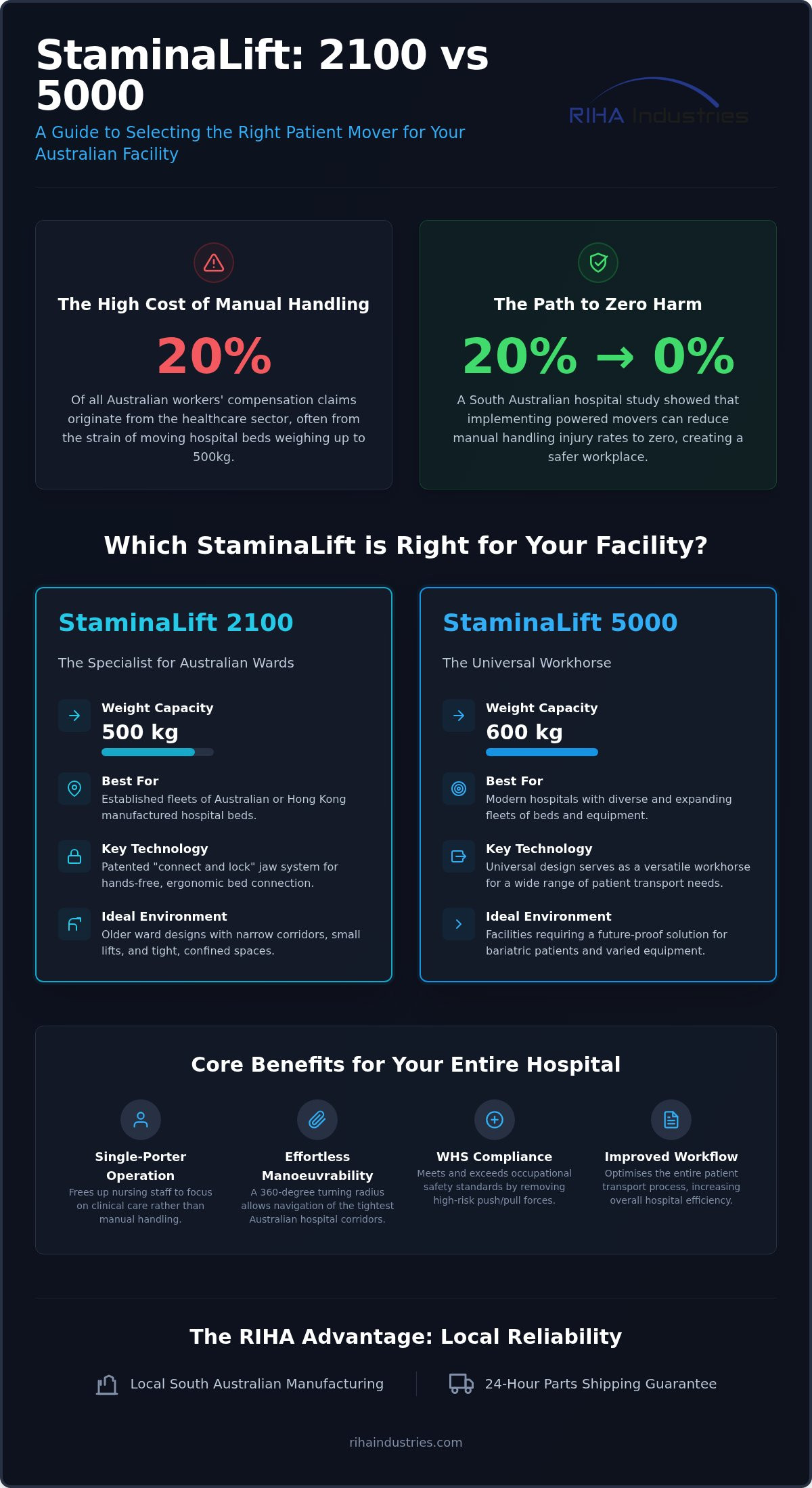
Did you know the healthcare and social assistance industry accounts for approximately 20% of all workers' compensation claims in Australia? Pushing a 500kg bed through a narrow, older ward isn't just a daily task; it's a high-risk manoeuvre that frequently results in debilitating back injuries for nursing and portering staff. We agree that your staff deserve a workplace free from the physical burden of heavy manual handling and the constant threat of strain. Choosing between the StaminaLift 2100 vs StaminaLift 5000 is the first step toward achieving that zero-harm environment for your team.
In this guide, we provide a detailed technical breakdown to help you determine which safety solution best aligns with your facility's unique infrastructure and equipment fleet. While the 2100 remains the Australian-made specialist for local beds in tight spaces, the TS5000 serves as a universal workhorse for modern, diverse fleets. You'll learn about their specific weight capacities, jaw system compatibility, and how each model addresses the physical challenges of a 2026 clinical environment. We'll examine the technical specifications and ergonomic benefits that allow for efficient, single-porter transport across your entire hospital.
Table of Contents
The Physical Demands of Modern Australian Nursing and Portering
Moving a modern hospital bed, which can weigh up to 500kg when occupied, is one of the most physically taxing tasks in a clinical setting. It's a primary source of musculoskeletal injuries among Australian healthcare professionals. Currently, the healthcare and social assistance sector accounts for approximately 20% of all workers' compensation claims across the country. Deciding between the StaminaLift 2100 vs StaminaLift 5000 starts with acknowledging the heavy physical toll manual handling takes on your team. Motorised assistance has evolved from a luxury into a core component of hospital safety infrastructure. RIHA Industries engineered the StaminaLift range to solve these challenges, ensuring that patient transport doesn't jeopardise a caregiver's health.
WHS Compliance and Injury Prevention in 2026
Hospital facility managers carry a significant legal duty of care to provide a safe working environment. Adhering to modern Occupational safety and health standards requires a proactive approach to risk mitigation. A South Australian hospital study demonstrated that implementing powered movers can reduce manual handling injury rates from 20% to zero. This dramatic shift highlights why specific patient handling equipment selection criteria are vital for 2026 procurement strategies. By removing the high initial push force required to move heavy loads, facilities effectively protect their staff from long-term injury.
The Porter’s Perspective: Efficiency on the Ward
A hospital porter might walk up to 15km during a single shift. Without mechanical aid, every turn and stop-start motion adds cumulative strain to the back, shoulders, and knees. Motorised solutions enable single-person operation. This frees up nursing staff to focus on clinical care rather than acting as additional muscle for bed transfers. When evaluating the StaminaLift 2100 vs StaminaLift 5000, the objective is to transform a high-risk struggle into a smooth, controlled process. Integrating high-quality hospital porter equipment doesn't just prevent injury; it optimises the entire hospital workflow.
Choosing the right model depends on your ward's layout and the diversity of your bed fleet. While both systems eliminate physical strain, they serve different operational niches. We'll explore these technical distinctions next to ensure your investment delivers the highest level of protection and long-term reliability.
The StaminaLift 2100: The Specialist for Australian Wards
The StaminaLift 2100 is the foundational motorised mover in the RIHA Industries range, purpose-built to handle the specific dimensions of Australian-made hospital beds. While the decision between the StaminaLift 2100 vs StaminaLift 5000 often depends on the diversity of your equipment fleet, the 2100 remains the industry benchmark for facilities with established AU or Hong Kong bed frames. Its compact engineering allows a single operator to move loads up to 500kg with ease. This provides a vital layer of protection for staff working in older ward designs where space is a premium and manual handling risks are high.
Patented Jaw Technology for AU Beds
The core of the 2100's success lies in its patented "connect and lock" jaw technology. This mechanism allows porters to secure a bed hands-free, which completely eliminates the need for awkward bending, manual strapping, or physical exertion. By automating the connection process, the system ensures that the porter remains in an ergonomically sound position at all times. This commitment to Safe Patient Handling and Mobility is particularly beneficial for regional hospitals and local facilities that rely on Australian-manufactured frames. It offers a seamless integration that doesn't require any modifications to your existing bed fleet, ensuring immediate safety improvements from the first day of use.
Manoeuvrability in Confined Clinical Spaces
Navigating narrow corridors, small elevators, and crowded shared rooms is a constant challenge for hospital porters. The 2100 addresses this through a true 360-degree turning radius, allowing the operator to pivot the bed within its own length. Its compact profile adds minimal length to the bed and mover combination; this is a critical advantage when turning in tight hallways where larger equipment might struggle. Beyond physical dimensions, the 2100 operates at a quiet 65 dB. This ensures that essential patient transport can occur without disturbing the recovery environment or causing unnecessary noise stress in clinical areas.
Because the 2100 is engineered for specific Australian infrastructure, it remains a highly efficient choice for facilities that don't require the universal compatibility of its larger counterpart. You can explore our full range of motorised solutions to see how these technical specifications align with your ward's layout. Choosing the 2100 means investing in a specialist tool that has been refined through years of feedback from Australian healthcare professionals, ensuring it meets the practical demands of your daily operations.
StaminaLift 2100 vs StaminaLift 5000: A Side-by-Side Comparison
Selecting the right motorised mover involves more than just a cursory glance at technical specs. It's about matching mechanical capability to your facility's specific equipment fleet. When evaluating the StaminaLift 2100 vs StaminaLift 5000, the most immediate difference is their intended operational scope. The 2100 is a dedicated specialist for Australian-manufactured frames, offering a robust 500kg weight capacity and a unique "connect and lock" jaw system. In contrast, the TS5000 is our universal flagship, engineered to push and pull up to 600kg with ease. While the 2100 provides a compact solution for local beds, the TS5000 employs a universal hitch designed to secure nearly any bed brand found in a 2026 clinical setting.
Universal Compatibility with the TS5000
Modern hospital beds often feature complex plastic shrouding that makes traditional connection points difficult to access. The StaminaLift Transfer System 5000 was specifically developed to overcome these barriers, offering compatibility with 95% of all global hospital beds and stretchers. This includes seamless integration with models from leading global hospital bed and stretcher manufacturers, ensuring broad utility across your facility. For hospitals managing a diverse fleet of equipment, the 5000 provides a strategic advantage by ensuring a single mover can service every ward. This universal approach eliminates the need for multiple, brand-specific transport devices, which significantly reduces the training burden on your portering staff and simplifies maintenance schedules.
Power, Performance, and Gradients
Clinical environments aren't always flat, and navigating 7-degree hospital ramps requires significant torque and reliable braking systems. The TS5000 excels in these high-demand scenarios, particularly when equipped with the latest lithium battery upgrades. These batteries boost overall performance by 20% compared to standard lead-acid alternatives, providing the stamina required for high-use environments. To further empower the operator, both systems feature programmable joystick controls. This allows the drive experience to be tailored to the individual porter, ensuring smooth acceleration and precise braking. It's about more than just power; it's about giving the user total control over 600kg of moving weight. Because RIHA Industries provides a 24-hour parts shipping guarantee, you can be confident that these high-performance systems will remain operational throughout the most demanding shifts.
Selecting the Right Mover for Your Facility Architecture
Choosing the right equipment requires a thorough audit of your facility's physical architecture and existing bed fleet. You should start by identifying the ratio of older Australian-manufactured beds to modern global frames. While the 2100 is the ideal choice for facilities with narrow corridors and tight turns, the TS5000 offers the flexibility required for modern acute settings. For porters covering long distances between wards, considering a ride-on platform accessory can further reduce fatigue. When comparing the StaminaLift 2100 vs StaminaLift 5000, the decision often hinges on whether your ward was built for the compact specialist or the universal flagship. Remember that both models carry FDA registration. This serves as a global benchmark for medical-grade safety and long-term reliability.
Aged Care vs Acute Hospital Requirements
In residential facilities, ward layouts are often more compact and feature older door frames. This makes the 2100 a frequent patient transport equipment aged care favourite. It fits easily into standard storage bays and charging stations without requiring expensive renovations. However, acute hospitals dealing with bariatric patients or heavier specialised beds may need to step up to the TS5000 or even the TS6000 models. Ensuring the mover aligns with your facility's charging infrastructure prevents operational downtime and keeps your safety solutions ready for immediate use. A site audit helps identify these spatial constraints before you commit to a specific model.
Smart Connectivity and Diagnostic Tools
By 2026, smart technology has become standard in high-end medical equipment. RIHA Industries integrates Bluetooth connectivity into its range to allow for real-time battery monitoring and usage diagnostics. This data helps facility managers track equipment utilisation and plan preventative maintenance effectively. Safety is further enhanced by an integrated battery charger featuring a retractable cable, which eliminates trip hazards in busy hallways. To support staff of all skill levels, drive programs are fully customisable. This ensures a new porter can operate the unit at a comfortable pace while experienced staff can maximise efficiency. When evaluating the StaminaLift 2100 vs StaminaLift 5000, these integrated tools ensure that your investment is both safe for today and smart for the future.
Contact our specialist team today to request a site audit and find the perfect motorised mover for your ward layout.
The RIHA Advantage: Local Manufacturing and Global Support
Choosing a motorised bed mover is an investment in your facility's long-term safety culture. Because RIHA Industries manufactures the StaminaLift range in Edinburgh North, South Australia, your procurement process is protected from the volatility of global shipping delays. This local presence ensures that we can offer a 24-hour parts shipping guarantee, which is essential for minimising downtime in high-pressure clinical environments. Whether you've settled on the StaminaLift 2100 vs StaminaLift 5000, you're backed by a national service network dedicated to keeping your equipment operational. We even provide a 3D-viewer tool that empowers your facility's internal engineers to understand the machinery's internal components for basic maintenance and troubleshooting.
Long-Term ROI and Asset Management
Justifying new equipment to a hospital board requires clear data and a focus on financial sustainability. We provide a specialised ROI calculator that helps you quantify the savings gained from reducing manual handling injuries and improving portering efficiency. To further protect your asset, we recommend a hospital bed mover repair service contract. These preventative maintenance agreements extend the lifecycle of your fleet and ensure consistent performance across every ward. RIHA Industries also utilises advanced 3D printing technology to manufacture replacement parts for legacy units. This innovative approach ensures that even as technology advances, your older machinery remains supported and modernised rather than becoming obsolete.
Next Steps: Site Trials and Procurement
The most effective way to finalise your decision between the StaminaLift 2100 vs StaminaLift 5000 is through a hands-on site trial. This allows your portering and nursing teams to test both units against your specific bed fleet and ward geometry. Our experts are available to consult on custom hitching requirements or jaw modifications if your facility uses highly specialised equipment. Before you begin the formal tender process, we suggest reviewing our 2026 hospital bed mover procurement guide to ensure all technical and WHS requirements are met. It's about finding the exact fit for your team's needs and your facility's future.
Ready to eliminate manual handling risks in your ward? Contact RIHA Industries to discuss the right StaminaLift for your ward and organise a comprehensive site demonstration with our clinical specialists.
Securing the Future of Your Clinical Workforce
Protecting your team from the physical strain of manual handling is a mission-critical objective for any 2026 healthcare facility. By comparing the StaminaLift 2100 vs StaminaLift 5000, you've identified the technical path to achieving a zero injury rate among your nursing and portering staff. Whether you choose the compact agility of the 2100 for your Australian-made beds or the universal compatibility of the TS5000 flagship, you're investing in FDA-registered equipment backed by local expertise.
RIHA Industries remains committed to your long-term success through our South Australian manufacturing centre and a 24-hour shipping guarantee on all replacement parts. This ensures your safety infrastructure remains operational and your staff remain protected from debilitating musculoskeletal injuries. The transition to powered mobility doesn't just improve efficiency; it empowers your workforce to focus on high-quality patient care without compromising their own well-being.
Request a site trial of the StaminaLift 2100 or 5000 at your hospital to experience the difference that thoughtful engineering can make in your daily operations. We look forward to helping you create a safer, more efficient environment for your entire clinical team.
Frequently Asked Questions
Is the StaminaLift 2100 compatible with newer Hill-Rom beds?
The StaminaLift 2100 is specifically engineered for Australian-manufactured frames often found in older wards. For newer Hill-Rom, Stryker, or ArjoHuntleigh beds, the StaminaLift Transfer System 5000 is the appropriate choice. Its universal hitching system is designed to accommodate the plastic shrouding and unique structural features of modern global bed brands, ensuring a secure connection where specialist jaws might not fit.
Can the StaminaLift 5000 handle bariatric patients on a ramp?
The TS5000 is rated to push or pull a 600kg load up a maximum 7-degree incline. This capacity comfortably handles most standard and bariatric patients in an acute setting. If your facility frequently moves loads exceeding 600kg, the Bariatric Transfer System 6000 is the safer alternative. It's specifically designed to transport nearly one tonne of weight while maintaining the same 7-degree ramp performance.
How long does the battery last on a standard nursing shift?
Every mover in the StaminaLift range is engineered to provide reliable operation throughout a standard eight-hour nursing shift. For high-use environments where equipment is in constant motion, we recommend the lithium battery upgrade. This modern power solution boosts overall performance by 20% and offers shorter charging cycles. The integrated battery charger with its retractable cable makes it easy for staff to top up the charge between transport tasks.
What is the main difference between the 2100 and the TS5000 hitching systems?
The primary distinction when comparing the StaminaLift 2100 vs StaminaLift 5000 is the mechanism of attachment. The 2100 utilises a patented "connect and lock" jaw system designed for the specific dimensions of Australian and Hong Kong bed frames. Conversely, the TS5000 features a universal hitching system. This allows it to connect with 95% of global hospital beds, including those with complex plastic coverings or non-standard wheelbases.
Do RIHA Industries movers require special flooring or non-marking wheels?
You don't need to modify your hospital's flooring to implement our motorised solutions. Every unit is equipped with high-quality, non-marking drive wheels as a standard feature. These wheels are designed to provide maximum traction on standard clinical surfaces and ramps while ensuring that vinyl and epoxy floors remain free from scuffs or damage. This protects your facility's aesthetic and reduces the need for specialised floor maintenance.
How does the 360-degree turning radius work in small elevators?
Our movers feature a true 360-degree turning radius that allows the bed and mover combination to pivot on its own axis. This is achieved through precision joystick controls and a compact drive system that adds only 180mm to 200mm to the total length of the bed. It enables porters to manoeuvre heavy loads into small elevators or through tight 90-degree corners without needing the wide clearance required for manual pushing.
Is the StaminaLift 2100 still the best choice for aged care facilities?
The 2100 remains a favourite for aged care facilities because it's purpose-built for the Australian-made beds typically used in residential care. Its compact profile is particularly advantageous in older buildings with narrow doorways and limited storage space. When evaluating the StaminaLift 2100 vs StaminaLift 5000 for aged care, the 2100 often provides the most efficient balance of power and manoeuvrability for standard facility requirements.
Does RIHA Industries provide staff training for the StaminaLift range?
We provide comprehensive staff training and certification to ensure every user is confident and competent with the equipment. This training covers safe hitching procedures, ramp navigation, and the use of programmable drive settings to match individual skill levels. By providing professional certification, RIHA Industries helps facility managers meet their WHS obligations while ensuring the motorised movers are utilised effectively to eliminate manual handling injuries across the ward.