
WHS Manual Handling Healthcare Guidelines: 2026 Compliance and Safety
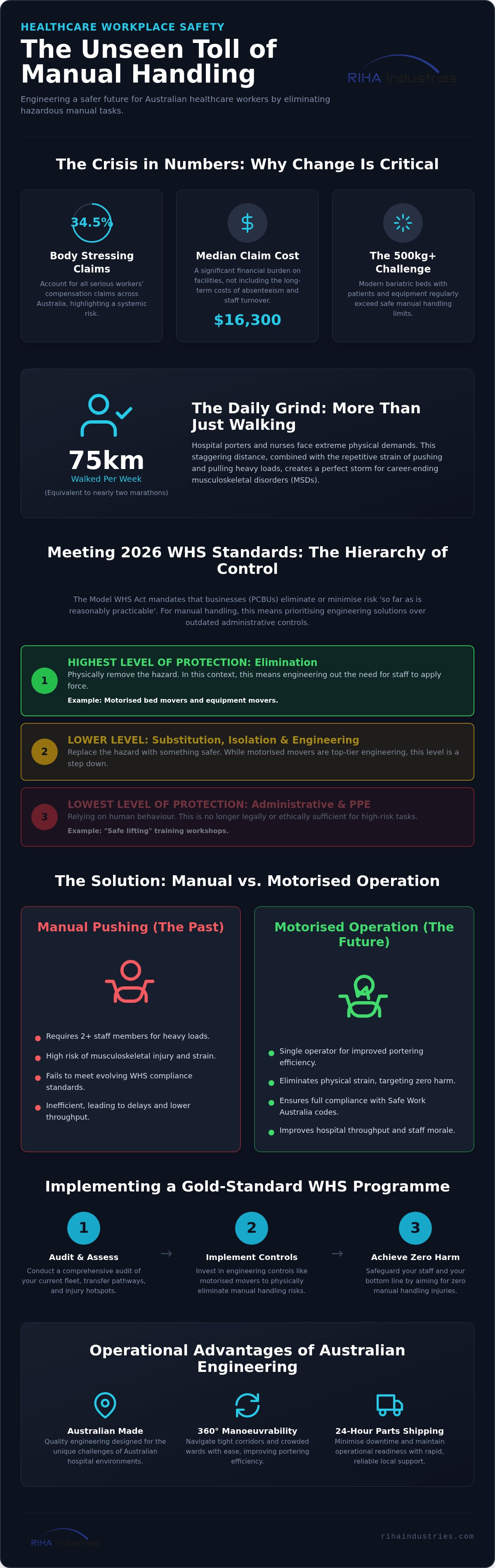
With body stressing now accounting for 34.5 per cent of all serious workers' compensation claims across Australia, the physical toll on frontline staff has reached a critical tipping point. You likely feel the daily pressure of rising nurse back injuries and the unsustainable costs of staff absenteeism. It's exhausting to navigate complex WHS manual handling healthcare regulations while your workforce struggles to push heavy bariatric equipment through crowded wards. We understand that protecting your team is your highest priority, yet the traditional reliance on manual lifting workshops simply isn't enough to prevent musculoskeletal damage in high-pressure environments.
This guide empowers you to master the latest 2026 Australian standards and achieve a target of zero manual handling injuries. You'll discover how motorised engineering controls eliminate the physical burden of patient transport, ensuring your facility remains in full compliance with Safe Work Australia codes of practice. We'll preview the most effective technologies for improving portering efficiency and explain why engineering out the human element of heavy transport is the only way to safeguard your staff and your bottom line.
Table of Contents
Understanding WHS Manual Handling Regulations in Australian Healthcare (2026)
The Model WHS Act places the primary duty of care on the Person Conducting a Business or Undertaking (PCBU). In a clinical environment, this usually refers to the hospital board or health service management. These entities must manage risks so far as is reasonably practicable, which includes a rigorous approach to WHS manual handling healthcare standards. By 2026, the standard for "reasonably practicable" has evolved. If a hazard can be engineered out through technology, relying on staff strength is no longer legally or ethically sufficient. You have a responsibility to ensure that every task involving high force or repetitive movement is assessed and mitigated before an injury occurs.
Safe Work Australia's Hierarchy of Control prioritises engineering solutions over administrative ones. While training staff in "safe lifting" was once the industry standard, it's now recognised as a low-level control that fails to address the root cause of injury: the load itself. Engineering controls, such as motorised bed movers, physically eliminate the strain, moving the risk from the worker to the machine. This shift is essential for maintaining compliance and protecting your workforce from the debilitating effects of physical overexertion.
The Legal Duty of Care for Hospital Administrators
Hospital executives are now held to strict risk assessment protocols for every patient transfer pathway. Across metropolitan and rural Australian health districts, there's a clear shift toward "Zero Harm" targets. This means administrators must prove they've implemented the highest level of control available. If a nurse sustains an injury pushing a 500kg bariatric bed, and a motorised mover was not provided, the facility may face significant legal liability. In 2023-24, the median compensation for a serious claim was $16,300, a cost that doesn't include the long-term impact on staff morale and retention.
Identifying Musculoskeletal Disorder (MSD) Risks
Musculoskeletal Disorders (MSDs) are the most common outcome of poor manual handling. These conditions include chronic back pain, ligament strains, and joint degeneration. The Manual handling of loads in healthcare is particularly dangerous because it combines high force with unpredictable movements. While acute injuries from a single heavy lift are dramatic, the cumulative effect of repetitive tasks often leads to long-term disability. Understanding how to reduce nurse back injuries requires a shift in focus from the worker's technique to the equipment they use. Body stressing accounted for 34.5 per cent of all serious workers' compensation claims recently, highlighting the urgent need for mechanical assistance.
The Physical Burden: Why Traditional Patient Handling Fails
The daily physical demand placed on hospital staff is often underestimated by those outside the clinical environment. Hospital porters and nurses frequently cover staggering distances, with many walking up to 15km during a single shift. Over a standard working week, staff walk up to 75km per week, equivalent to nearly two marathons. When this distance is combined with the repetitive task of moving heavy equipment, the risk of WHS manual handling healthcare incidents increases exponentially. This isn't just about fatigue; it's about the cumulative wear and tear on the human frame that leads to long-term career-ending injuries.
The modern clinical landscape presents a "500kg challenge" that simply exceeds safe human limits. A contemporary bariatric bed, when occupied by a patient and loaded with life-support equipment, can easily exceed half a tonne. Pushing these loads manually requires a level of physical exertion that the human body isn't designed to sustain, particularly when navigating the ageing infrastructure of many Australian hospitals. As our healthcare workforce continues to age, the gap between physical capability and operational demand widens, leading to higher rates of burnout, expensive staff turnover, and rising workers' compensation premiums.
The Physics of Pushing and Pulling
Moving a stationary bed requires a significant "break-out" force to overcome the inertia of heavy castors. This initial burst of energy is where many acute spinal injuries occur. The danger intensifies when staff must navigate ramps or slight inclines in older facilities. Even a minor slope can turn a heavy bed into an uncontrollable hazard if handled manually. These physical risks are compounded by the rising volume of bariatric patients, which necessitates a shift in how we approach acute care safety. Relying on sheer muscle power is no longer a viable or compliant strategy for modern patient transport.
The Psychological Toll of Workplace Injury
Beyond the physical pain, there's a profound psychological impact on a team that feels physically vulnerable. A fear of injury often leads to decreased morale and a sense that the organisation doesn't value the well-being of its caregivers. By providing advanced mechanical assistance, you position the facility as a "Protective Ally" that prioritises staff safety. This investment in equipment doesn't just reduce injury rates; it sends a clear message of empowerment and respect to your frontline workers. To see how engineering can transform these daily challenges, you might explore the range of specialised bed movers designed for Australian clinical settings.
Manual vs. Motorised Handling: A Risk Management Comparison
Transitioning from manual to motorised handling represents a fundamental shift in how hospitals manage operational risk. Traditionally, moving a heavy bed required two or even three staff members to push, steer, and navigate corners. This labour-intensive method is inherently risky and inefficient, often leading to miscommunication and physical strain. In contrast, a motorised bed mover enables a single operator to move loads up to 900kg with absolute precision. By adopting motorised solutions, facilities can align with WHS manual handling healthcare standards while significantly reducing the physical burden on their workforce.
The real-world impact of this technology is best illustrated by a major South Australian hospital trial. By integrating motorised movers into their daily operations, the facility saw manual handling injuries drop from 20 per cent to zero over a two-year period. This success is largely due to the "Connect and Lock" jaw system found on models like the StaminaLift TS5000. Unlike manual strapping or awkward bending to secure a load, this system creates a secure, hands-free connection. It protects the operator's back and limbs from the moment of engagement, eliminating the need for the dangerous "break-out" force discussed earlier.
Efficiency Gains in Ward Transfers
Motorised movers accelerate the pace of theatre and ward transfers, ensuring patients reach their destinations without delay. When a single porter can safely manage a bariatric transfer, clinical staff are no longer pulled away from their primary duties to assist with heavy pushing. This reclaims valuable nursing hours and improves overall hospital throughput. For a detailed breakdown of the financial advantages and labour savings, refer to the 2026 hospital bed mover procurement guide. These efficiency gains demonstrate that safety and productivity are not mutually exclusive; they're actually two sides of the same coin.
Safety Features of Modern Bed Movers
Safety is engineered into every component of modern motorised equipment to provide a fail-safe environment. Features like automatic braking and immediate emergency stop mechanisms provide the operator with total control, even when navigating a 7-degree incline. Advanced Bluetooth diagnostics allow for real-time monitoring of battery health and usage patterns, which helps managers identify when preventative maintenance or additional staff training might be required. Additionally, these units operate at a quiet 65 dB. This ensures that the healing environment of the ward remains undisturbed, providing a calm experience for patients during transport.
Implementing a Gold-Standard Manual Handling Strategy
Establishing a framework for WHS manual handling healthcare excellence requires more than just purchasing equipment. It demands a structured transition that integrates mechanical assistance into the daily workflow of the hospital. By following a methodical implementation plan, facility managers can bridge the gap between regulatory theory and clinical practice, ensuring every staff member is protected by the highest level of control. This proactive approach transforms safety from a compliance checkbox into a core operational strength.
Step 1: Conduct a facility-wide audit to pinpoint injury hotspots and identify high-risk transfer routes where staff are most vulnerable.
Step 2: Evaluate equipment compatibility, noting that the StaminaLift TS5000 is designed to be compatible with 95 per cent of global hospital beds.
Step 3: Trial motorised solutions in high-traffic areas such as the ED, ICU, and bariatric wards where physical demands are most intense.
Step 4: Standardise training and certification to ensure all transport and nursing staff are confident and competent in using the new technology.
Step 5: Establish a preventative maintenance programme to ensure the long-term reliability and safety of your fleet.
Choosing the Right Equipment for the Task
Different clinical environments require tailored mechanical solutions to manage risk effectively. While a bed mover like the TS5000 excels in general ward transfers, a tug like the Easi Rider might be more suitable for specific logistics tasks or lighter loads. For bariatric care, the TS6000 is essential; it's engineered to move 900kg loads up a 7-degree incline, providing the necessary torque to manage heavy patients safely. Rapid response in emergency departments also benefits from tool-free coupling, allowing porters to engage and move equipment without delay during critical moments.
The Role of Preventative Maintenance
Regular inspections are a mandatory component of modern WHS compliance. A well-maintained fleet ensures that safety features like automatic braking and emergency stops remain fully operational, protecting both the staff and the patient. For rural Australian facilities, using 3D-viewer tools for in-house servicing can be a game-changer, reducing downtime and ensuring equipment is always ready for use. For a comprehensive look at maintaining your fleet, consult the hospital bed mover repair service guide. To begin your facility audit and see how these tools fit your specific needs, contact RIHA Industries for an expert consultation.
RIHA Industries: Leading the Way in Healthcare Safety
RIHA Industries stands as a South Australian leader in the design and manufacture of advanced mobility solutions. Their commitment to WHS manual handling healthcare standards is evident in the StaminaLift range, which includes the versatile TS5000, the high-capacity TS6000, and the original StaminaLift 2100 Bed Mover. Being Australian-made provides a distinct advantage in quality control and responsiveness, allowing for 24-hour parts shipping to keep critical equipment operational. This local manufacturing base ensures that hospital fleets aren't sidelined by global supply chain delays, providing a level of reliability that international vendors often struggle to match.
Central to the success of these systems is a patented hitch technology that ensures 95 per cent compatibility with hospital beds found across the globe. This universal integration allows facilities to standardise their transport protocols regardless of their existing bed fleet. Beyond patient transport, RIHA provides specialised solutions like the Easi Rider and Easi Mover for heavy non-patient loads. These units are designed to automate the movement of linen trolleys and meal delivery systems, ensuring that the risk of strain injuries is mitigated across every department in the hospital, not just on the wards.
Innovative Engineering for Caregiver Wellbeing
Engineering excellence at RIHA focuses on the physical comfort and safety of the operator. The equipment features programmable joystick controls and custom drive programmes that allow for smooth, intuitive movement in high-pressure settings. These compact designs are engineered to add only 180mm to the total bed length, which significantly reduces tripping hazards and preserves manoeuvrability in tight corridors. For older fleets, RIHA embraces sustainability through CAD-designed, 3D-printed spare parts. This innovative approach ensures that even discontinued machinery remains safe and functional, extending the lifecycle of your investment while maintaining strict safety standards.
Global Expertise, Local Support
While RIHA is a local manufacturer, its impact is truly international. The brand's recognition as a Top 10 Mobility Aids Provider in 2024/2025 highlights its role as a global visionary expert in the field of medical ergonomics. The StaminaLift series is also the only FDA-registered bed mover in the USA, meeting the most stringent international safety benchmarks. This global validation provides Australian healthcare administrators with the confidence that they're investing in world-class technology backed by local expertise. To see these solutions in action, you can contact RIHA Industries for a hands-on demonstration in your facility.
Securing the Future of Patient Transport Safety
The shift toward engineering out physical hazards is the most significant advancement in modern clinical safety. By replacing manual exertion with motorised precision, your facility doesn't just meet WHS manual handling healthcare regulations; it actively fosters a culture of care for those who provide it. We've seen that the combination of 360-degree manoeuvrability and universal bed compatibility can transform hospital logistics, allowing your team to focus on patient outcomes rather than physical strain.
Choosing a partner like RIHA Industries ensures you're supported by certified Australian-made quality and global award-winning engineering. Our solutions are the only FDA-registered bed movers in the USA, and our South Australian hospital trials have proven that injuries can be reduced from 20 per cent to zero. This level of reliability is essential for maintaining a resilient and healthy workforce.
Take the first step toward a safer workplace by evaluating your current transport protocols. Book a Site Assessment with RIHA Industries today to see how our technology can empower your staff. Your commitment to safety today is the foundation for a sustainable healthcare environment tomorrow.
Frequently Asked Questions
What are the primary WHS manual handling risks in a hospital?
Primary risks include body stressing from moving bariatric beds and equipment, which recently caused 34.5 per cent of all serious workers' compensation claims. Staff frequently face repetitive strain from walking up to 15km a day while pushing loads exceeding 500kg. These hazardous manual tasks often lead to chronic musculoskeletal disorders if mechanical assistance isn't used. Implementing motorised solutions is a key part of managing WHS manual handling healthcare risks effectively.
How does the StaminaLift TS5000 reduce workplace injuries?
The StaminaLift TS5000 reduces injuries by eliminating the physical "break-out" force required to initiate movement. Its patented "connect and lock" jaw system secures the bed automatically, so nurses don't have to bend or strain. By enabling a single person to move heavy beds safely, it removes the risk of miscommunication and physical overexertion. This technology helped one major South Australian hospital reduce its manual handling injury rate to zero within two years.
Is motorised equipment required by law in Australian hospitals?
While the law doesn't specifically name motorised movers, the Model WHS Act requires PCBUs to manage risks "so far as is reasonably practicable." In 2026, this standard prioritises engineering controls that eliminate hazards at the source. Because motorised equipment is a proven method for preventing musculoskeletal injuries, failing to provide it when available could be seen as a breach of your legal duty of care to protect staff from harm.
Can one person safely move a bariatric patient using RIHA equipment?
Yes, a single operator can safely transport a bariatric patient using the StaminaLift TS6000. This system is engineered to handle loads of nearly one tonne, removing the need for a two or three-person manual push. The 360-degree manoeuvrability allows one person to navigate tight corridors and elevators with total control. This efficiency frees up clinical staff to focus on patient care rather than the physical labour of heavy equipment transport.
What is the maximum weight a StaminaLift TS6000 can transport?
The StaminaLift TS6000 has a maximum push and pull capacity of 900kg and a lift capacity of 450kg. It's uniquely capable of moving this full weight up a 7-degree incline while maintaining total control and safety. This high-capacity performance is essential for acute care and bariatric wards where modern hospital beds and patients often exceed safe human limits. It operates quietly at 65 dB to ensure patient comfort remains a priority.
How do I ensure our hospital stays compliant with 2026 WHS standards?
Maintaining compliance involves shifting from administrative controls, like lifting workshops, to engineering solutions that remove the hazard. You should conduct facility-wide audits to identify injury hotspots and implement motorised movers in high-traffic areas. Establishing a rigorous preventative maintenance programme is also essential. These steps ensure your facility meets the 2026 standards for WHS manual handling healthcare by providing the highest level of protection available for your nursing and portering teams.
Does RIHA Industries provide staff training for their bed movers?
RIHA Industries provides comprehensive staff training and certification to ensure every user is confident with the equipment. Our systems include Bluetooth connectivity, which allows managers to monitor usage history and battery health. This diagnostic feedback helps identify specific training needs for individual staff members, ensuring long-term safety and operational efficiency. We also offer 3D-viewer tools to assist with basic in-house servicing, keeping your fleet reliable and compliant in both metropolitan and rural settings.
Are StaminaLift products compatible with non-Australian bed brands?
Our products are designed for universal compatibility and connect with 95 per cent of all hospital beds globally. The StaminaLift TS5000 and TS6000 utilise patented attachment mechanisms that work with various frame types, including round or square tubes. Whether your facility uses Australian-made beds or international brands, our systems integrate seamlessly without the need for manual strapping. This adaptability makes it easier for hospitals to standardise their safety protocols across diverse equipment fleets.


