2026 Guide: Healthcare Safety Equipment Grants in Australia
Body stressing accounted for 34.5% of serious workers’ compensation claims in Australia in 2023-24, according to Safe Work Australia figures cited by RIHA Industries. That makes safer equipment a practical priority. But can a healthcare facility secure grant funding for healthcare safety equipment Australia-wide? It depends on the program, the applicant and how clearly the proposed purchase addresses a documented safety need.
The funding landscape can be difficult to assess. There isn’t one large-scale national grant dedicated to healthcare safety equipment, and a purchase won’t qualify simply because it may improve safety. A stronger approach is to document the safety need and procurement case first, then look for funding pathways that fit.
This guide explains how to find relevant Australian and state-based opportunities, check current eligibility and distinguish grants from rebates or tax provisions. It also covers how to support a proposal with evidence of workplace risks, worker consultation, equipment suitability and whole-of-life considerations. Before approaching decision-makers, assess the facility’s needs, including whether a powered bed mover could address a documented task or hazard. Funding is never assured, so plan practical next steps that can also proceed through other approval pathways.
Table of Contents
Grant funding for healthcare safety equipment in Australia: what may qualify?
Where to look for Australian healthcare safety equipment grants
Compare possible funding pathways before choosing an application
Build an evidence-based application for healthcare safety equipment
Assess equipment fit and plan next steps with RIHA Industries
Grant funding for healthcare safety equipment in Australia: what may qualify?
Grant funding is conditional support for a defined purpose. Applicants must meet the program’s published eligibility criteria, follow its application rules and show how their proposed work aligns with its objectives. A grant opportunity is an invitation to apply, not a funding commitment. Funding is confirmed only if the application is successful and the funder formally approves it.
Equipment being safety-related does not automatically make its purchase eligible. A program may fund a broader work health and safety (WHS) project, service improvement, research or infrastructure rather than standalone equipment. Check whether the guidelines allow capital purchases, which costs are excluded and whether equipment must form part of a wider project. The Australian workplace safety legislation overview provides background on the development of WHS frameworks. Use relevant official sources to confirm current requirements and funding rules.
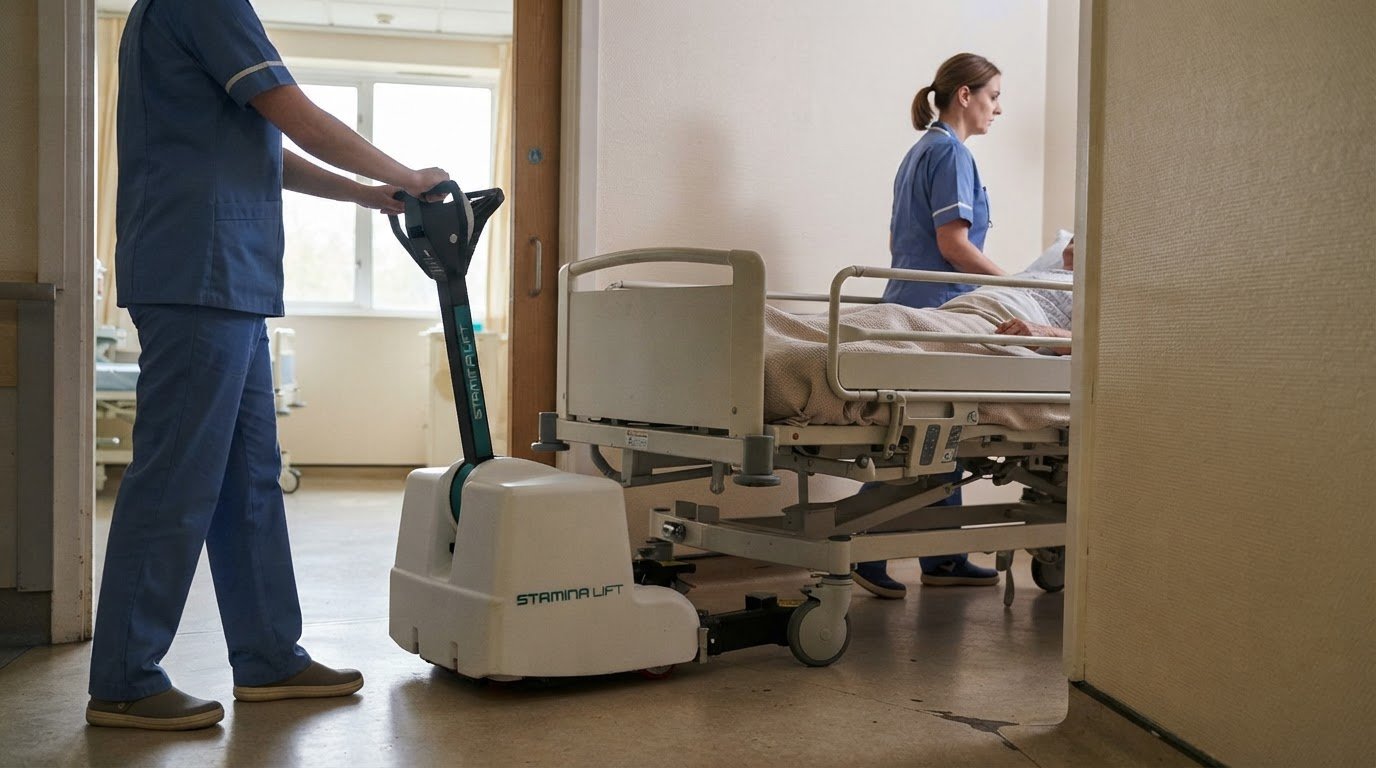
For facilities exploring grant funding for healthcare safety equipment Australia, the first step is to connect a documented need to the specific program. Don’t assume that a purchase will qualify. For example, a powered bed mover might be considered as one response to a recorded hazard involving staff manually repositioning beds. Its suitability and grant eligibility would still depend on the facility’s assessment and the funder’s criteria.
Which healthcare safety needs could support a funding case?
Describe the hazard, the tasks involved and the staff groups affected using available facility records. Incident reports, manual-handling assessments, staff feedback and equipment usage records can help show where and how the risk arises. For example, note which bed-moving tasks are involved, the controls already in place and any limitations staff encounter. Distinguish a patient-handling intervention from routine maintenance or general capital replacement, then explain how the proposed response supports the program’s stated objectives. A clear connection strengthens the case, but doesn’t confirm eligibility.
Who might apply for Australian healthcare funding?
Applicant rules vary. A program may be open to public health services, private facilities, not-for-profits or research partners, or restricted to a particular group. Check whether co-applicants are allowed, whether the project must operate in a specified location and whether endorsements are required. Confirm these details in the current official guidelines or directly with the funder before investing time in an application.
Where to look for Australian healthcare safety equipment grants
Start with official sources, then narrow your search to the facility’s location and documented safety need. GrantConnect and relevant Australian Government grants pages can help identify national opportunities. For state or territory funding, check the relevant health department, workplace safety regulator and regional development agency. Program details can change, so treat search results as leads, not confirmation that a round is open or that equipment is eligible.
Healthcare services can also use the National Safety and Quality Health Service (NSQHS) Standards as a reference when describing relevant safety and quality systems. The standards don’t establish grant eligibility. If a program’s scope is unclear, contact the funder or relevant health service and ask whether capital equipment is eligible, including whether it must form part of a wider project.
Search official sources by purpose, location and applicant type
Use search terms drawn from the documented need, such as manual handling, workplace safety or service improvement. Then filter results by state or territory, eligible applicant type, funding purpose and application status. Keep a funding register to track promising opportunities and compare them without having to rediscover the same information.
Source and owner: Record the official page and the department, agency or funder responsible.
Program documents: Save the current guidelines and note any updates or amendments.
Verification date: Record when you last checked the listing and documents.
Verify whether a funding opportunity is current and relevant
Read the primary program documents before committing time to an application. Confirm opening and closing dates, eligible expenses, any matching contribution requirements and the assessment criteria. Check whether the guidelines have been amended or superseded, whether the round is closed, and which contact details are provided for questions. Search snippets, older articles and shared documents may be out of date.
Verification checklist: Record the relevant GrantConnect listing, Australian Government grants page, state or territory health department, workplace safety regulator and regional development agency, along with the date each source was checked.
These checks help distinguish a relevant lead from an opportunity your organisation can realistically pursue. For grant funding for healthcare safety equipment Australia, confirm that both the applicant and proposed purchase fit the current rules before developing the case. If powered bed-moving equipment is under consideration, review RIHA’s powered bed movers as one equipment category to assess against your facility’s needs and procurement process.
Compare possible funding pathways before choosing an application
A grant is one possible way to fund a safety improvement, but it isn’t the only route. Compare each option against the project’s purpose, eligible applicant, equipment scope, timing and reporting requirements. Use current official guidelines to confirm grant conditions. Treat pathways that haven’t been verified as options to investigate, not available funding.
How do grant rounds differ from internal capital funding?
External grants usually require an application demonstrating alignment with a funder’s objectives, along with any specified evidence, budget and reporting commitments. Internal capital funding follows the facility’s own budget approval, procurement and governance processes. One route may depend on the other. A grant could require prior internal approval or a contribution from the applicant. Check both sets of requirements before committing to a timeline or purchase plan.
For a facility considering grant funding for healthcare safety equipment Australia, compare the full approval sequence, not just the funding amount. A closing date, internal sign-off, procurement review or reporting obligation can affect when a project can proceed. Confirm these dependencies with the funder and the appropriate facility decision-makers.
When might a partnership or staged procurement be considered?
A partnership may be relevant if the guidelines allow multiple applicants or require a research or health-service collaborator. Staged procurement may help organise implementation, but only where each stage remains appropriate for clinical needs, safety and procurement policy. Don’t split a purchase simply to fit an assumed grant limit. Check the rules and operational case first.
For broader equipment evaluation, see this hospital bed mover procurement guide. Apply the same disciplined comparison across pathways, then take forward the option that fits verified rules and your organisation’s approval process. Don’t assume one route is more likely to succeed without evidence.
Build an evidence-based application for healthcare safety equipment
A credible application connects a documented workplace need to an eligible activity and an outcome the facility can measure. It should also show how the proposed equipment fits the task and procurement process, without promising a particular safety result.
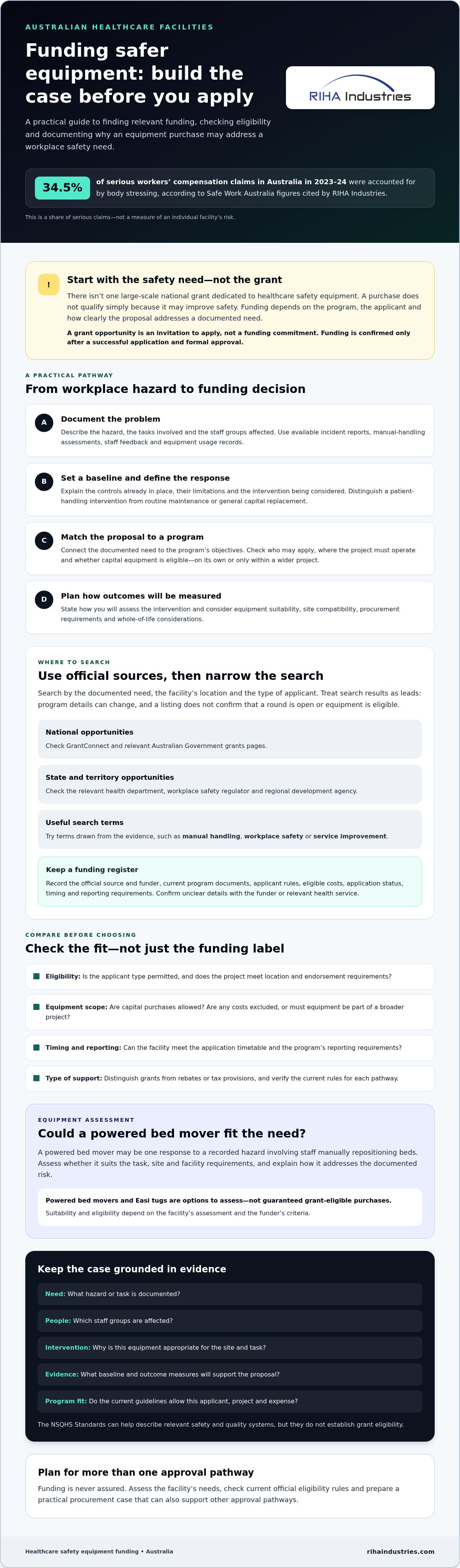
Use a structured sequence to develop the case:
Define the problem. Describe the tasks involved, how loads are moved, which staff groups are exposed and what controls are already in place. Keep the description factual and proportionate.
Establish a baseline. Draw on available incident reports, manual-handling assessments, staff feedback and equipment usage records. State the period covered and any limitations in the data.
Select an intervention. Explain how the proposed equipment or broader project addresses the identified task or hazard. Check equipment fit and program eligibility separately.
Cost the proposal. Use supplier information and facility estimates to prepare a realistic budget, clearly labelling each. Confirm eligible and ineligible costs against the current guidelines.
Measure outcomes. Define practical indicators, how data will be collected and when the facility will review results.
Document the safety need and intended outcomes
Separate measured facility data from estimates, supplier information and intended benefits. For example, describe recorded bed-moving tasks and reported incidents as facility evidence, while labelling forecast changes in staff effort as an estimate. Choose indicators the facility can track consistently, such as equipment use, task observations or relevant incident records. A patient handling equipment selection criteria guide can provide context for assessing needs, but your application should reflect local tasks, controls and records.
Prepare a realistic budget, implementation plan and evaluation
Build the budget only after checking the funder’s rules. Identify which costs are eligible, excluded or still require confirmation. Include relevant procurement approvals, compatibility assessment, implementation responsibilities, and any training or servicing requirements. Assign responsibility for collecting and reporting evaluation data, and ensure the proposed timing works for both the facility and funder.
For grant funding for healthcare safety equipment Australia, a well-supported case is more useful than a broad claim that new equipment will prevent injuries. Set out the need, proposed response, evidence and measurement plan, then acknowledge uncertainties. To assess relevant equipment categories against your documented needs, review RIHA’s healthcare equipment options.
Assess equipment fit and plan next steps with RIHA Industries
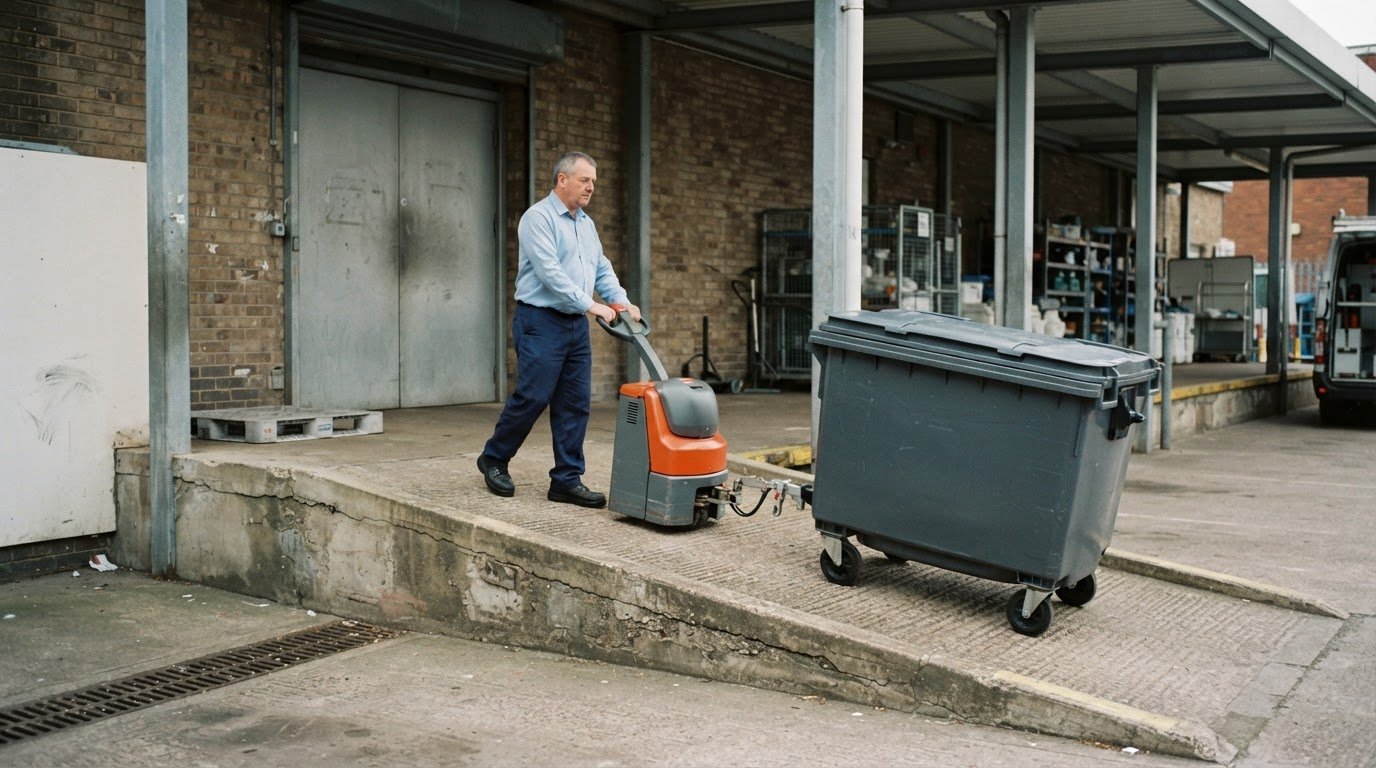
Equipment selection should follow the facility’s documented need, a site assessment and its procurement process. A powered bed mover may be worth evaluating if records identify risks associated with moving beds. A tug may suit other heavy-equipment movement tasks. Neither category is automatically grant-eligible. Confirm the funder’s rules separately from product suitability.
What should a facility assess before considering a powered bed mover?
Check that the equipment is compatible with the beds and trolleys in use, and confirm relevant load requirements with the supplier. Assess corridor widths, ramps, turning areas, storage and charging arrangements at the intended site. Consult staff who perform the tasks, and include training, maintenance planning and local procurement requirements. These checks help determine whether a proposed solution fits daily work, rather than just the application description.
For model-specific considerations, consult the StaminaLift Transfer System 5000 buying guide. Confirm current specifications and compatibility directly before making a procurement decision.
How can RIHA support equipment evaluation and implementation?
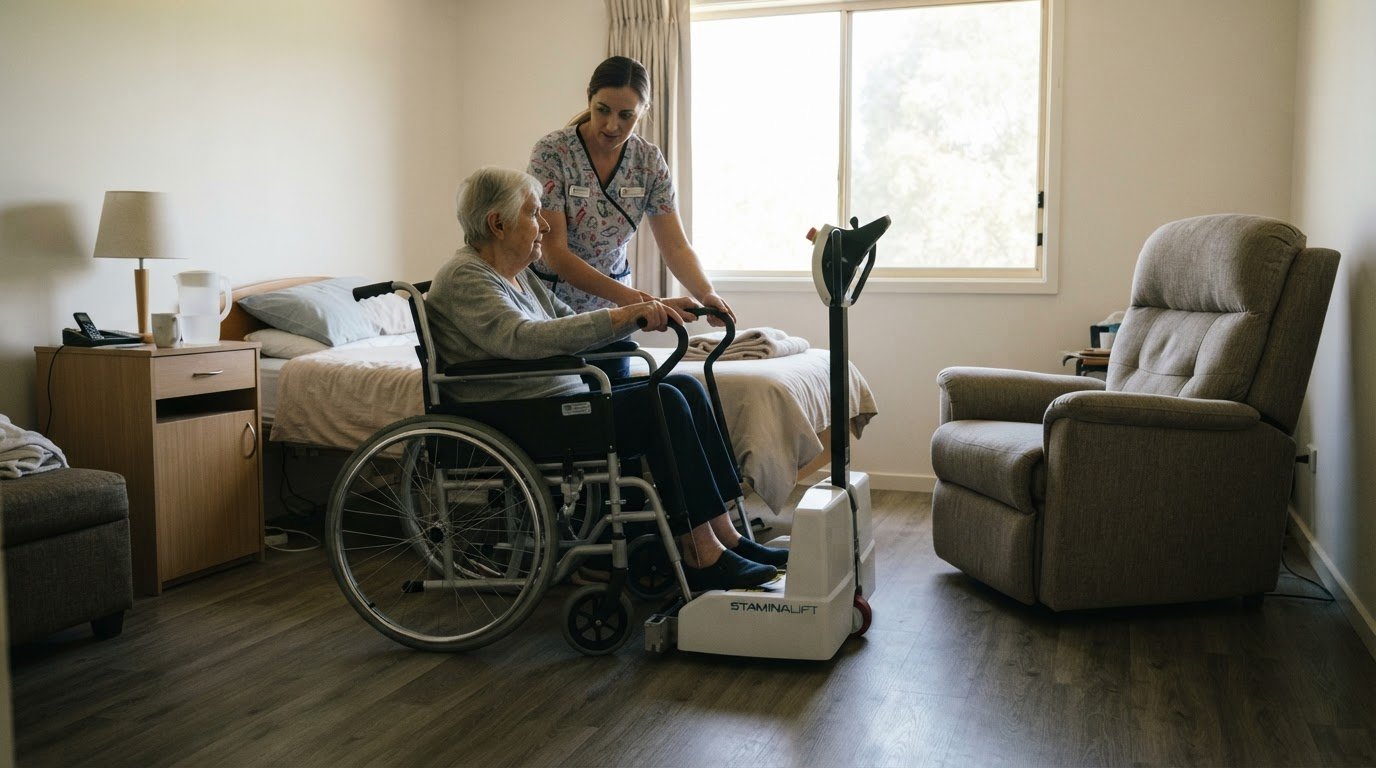
RIHA Industries manufactures powered bed movers and patient transfer systems in Australia, including StaminaLift models, as well as Easi tugs for moving heavy healthcare equipment. It also provides preventative maintenance and repairs. Facilities can ask RIHA to clarify relevant product specifications, compatibility considerations, service coverage and implementation requirements as part of their evaluation.
Treat any reported case-study result carefully. Before including the South Australian hospital result in a business case or funding application, verify its source, context, measurement basis and permission to publish. A reported outcome describes that facility’s experience. It isn’t a promise that another site will achieve the same result.
For grant funding for healthcare safety equipment Australia, keep responsibilities clear: the facility assesses the need and selects equipment through its procurement process, while the funder decides eligibility and whether to award support. RIHA doesn’t administer grants or guarantee funding. Once your requirements are documented, discuss equipment fit and support needs directly with RIHA so your procurement assessment can proceed using verified information.
Turn your safety case into practical next steps
A strong funding approach starts with a clearly documented safety need, then matches it to a current opportunity whose eligibility rules and purpose fit the proposed project. Check official guidelines carefully, and compare grants with internal capital funding or other suitable procurement pathways before deciding how to proceed.
Build your case with facility evidence, a realistic implementation plan and measurable outcomes. Then assess equipment against the tasks, site conditions, compatibility requirements and procurement process. A safety-related purchase isn’t automatically grant-eligible, and funding decisions remain with the applicant and funder.
RIHA Industries manufactures powered bed movers and patient transfer systems in Australia, and states that it provides national service coverage. If these equipment categories may address your facility’s documented needs, Discuss your healthcare equipment requirements with RIHA Industries as part of your evaluation.
Careful assessment can help your team make a confident, evidence-led decision, whether or not a grant opportunity is available.
Frequently Asked Questions
Is there grant funding for healthcare safety equipment in Australia?
Yes, but there isn’t one large-scale national grant dedicated to purchasing healthcare safety equipment, and no purchase is automatically eligible. Grant funding for healthcare safety equipment Australia may be available through specific Australian Government, state or territory programs when the project and applicant meet the published criteria. Check current official guidelines for eligible expenses, application dates and conditions. Other options, such as internal capital funding, may also be relevant.
Can Australian hospitals use grants to buy patient handling equipment?
Potentially, if the specific program allows the hospital to apply and its guidelines include the equipment or project costs being proposed. Some funding is directed towards broader workplace safety, service improvement, research or infrastructure rather than standalone purchases. Read the current rules and, if equipment eligibility is unclear, ask the funder or relevant health service before preparing an application. A safety purpose alone doesn’t confirm eligibility.
How do I find current healthcare equipment grants in my state or territory?
Start with GrantConnect and Australian Government grants pages, then check the health department, workplace safety regulator and regional development agency for your state or territory. Search using the documented need, such as manual handling or workplace safety, and review official program documents rather than relying on search snippets or older articles. Record the program owner, guidelines and date checked, then confirm application status and key dates with the funder.
What evidence should a healthcare facility include in a safety equipment grant application?
Support the request with facility records describing the hazard, affected tasks and staff groups, along with existing controls. Relevant evidence may include incident reports, manual-handling assessments, staff feedback and equipment usage records. Establish a baseline, explain how the proposed intervention addresses the identified need, and set measurable outcomes with a clear data collection plan. Label facility measurements separately from estimates, supplier information and intended benefits.
Are private healthcare providers eligible for Australian government grants?
Some programs may allow private providers to apply, while others are limited to specified organisations, locations or project types. Eligibility depends on the current program rules, not simply on being a healthcare provider. Check the eligible applicant definitions, any co-applicant requirements and whether endorsements are needed. If the guidelines don’t clearly address your organisation type, contact the official funder before developing a proposal or relying on the opportunity.
What happens if a grant does not cover the full cost of the equipment?
First, check whether the program permits co-contributions, matched funding or other sources to cover the balance. Your facility may also consider an approved capital budget or a staged procurement plan, provided it meets clinical, safety and procurement requirements. Confirm internal approvals and the funder’s conditions before committing to a purchase. Don’t assume a shortfall can be covered later or that partial funding will be awarded.
Can a powered bed mover be included in a workplace safety funding application?
It may be considered if the facility can connect the equipment to a documented workplace need and the funding program permits that type of expense. Assess relevant bed and trolley compatibility, site conditions, staff consultation and procurement requirements. Explain how the equipment fits the proposed safety activity and how outcomes will be evaluated. The funder decides eligibility, so confirm the guidelines before including a powered bed mover in an application.