
Assessing Patient Transfer Risk: 2026 Australian Guide
- Aug 4
- 12 min read
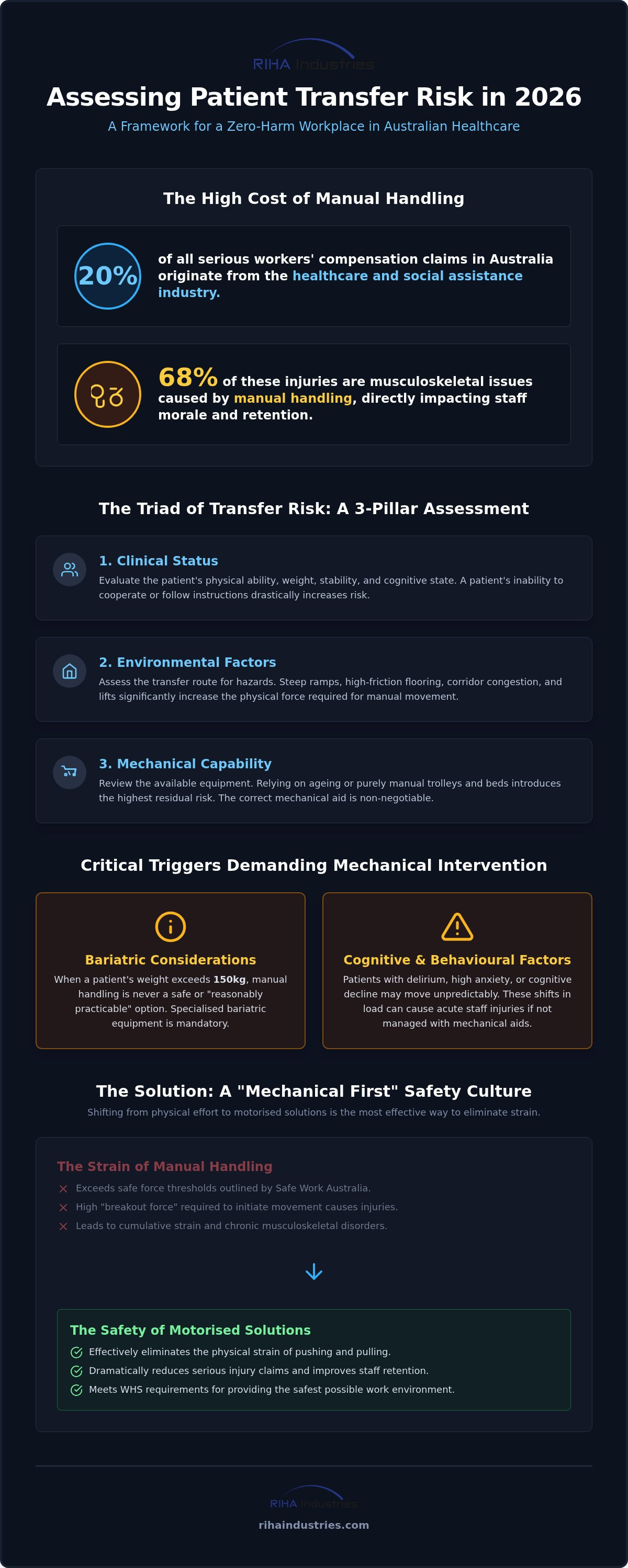
Did you know that the healthcare and social assistance industry accounts for approximately 20% of all serious workers' compensation claims in Australia? It is a sobering reality, especially when you consider that 68% of these injuries are musculoskeletal issues caused by manual handling. When you are assessing patient transfer risk in 2026, you aren't just ticking a compliance box; you're actively protecting the longevity of your nursing staff's careers.
We understand the pressure of managing an increasing number of bariatric patients while relying on ageing equipment fleets that feel more like a burden than a benefit. It's exhausting to see your team's morale dip as injury rates rise. This guide provides the essential framework you need to evaluate risks effectively and implement a zero-harm workplace culture. We will examine the "Transfer Triad" of clinical status, environment, and mechanical capability to ensure every patient move is a safe one for everyone involved. By the end of this article, you'll have the tools to reduce claims and keep your best staff on the floor where they belong.
Table of Contents
Understanding the Fundamentals of Patient Transfer Risk Assessment
Assessing patient transfer risk involves a systematic evaluation of every hazard associated with moving a patient from one point to another. It is not merely a clinical formality; it's a protective framework designed to bridge the gap between clinical necessity and staff safety. While many experienced nurses rely on intuitive judgement, this "gut feeling" often fails to account for cumulative strain or hidden environmental obstacles. Formalising the assessment process ensures that every variable is considered before a single muscle is strained.
The legal imperative for these assessments has reached a new peak in 2026. With the commencement of the Non-Emergency Patient Transport Regulations in Victoria and the continued enforcement of the Safe Work Australia Model Code of Practice, healthcare facilities must meet rigorous clinical governance standards. Understanding the fundamentals of manual handling is now a core requirement for compliance. When these systems aren't in place, the human cost is devastating. Musculoskeletal injuries currently account for 68% of serious injury claims in the Australian healthcare sector, which directly erodes staff morale and retention rates.
The Triad of Transfer Risk
To perform a thorough assessment, clinicians must evaluate three intersecting pillars. Patient factors are the most visible, involving the individual's physical ability, weight, and cognitive state. A patient's inability to follow instructions can turn a routine move into a high-risk event. Environmental factors are equally critical; flooring types, corridor congestion, and steep ramp gradients significantly increase the force required for manual movement. Finally, equipment factors look at the tools available. Relying on manual trolleys instead of motorised aids often represents the highest residual risk in any facility.
This focus on having the right tools extends beyond the clinical ward; for families and carers managing mobility at home, you can discover Care2MoveMobility for specialised products that reduce the physical strain of manual transfers in a residential setting.
When to Conduct an Assessment
Risk assessment is a continuous cycle rather than a static event. Routine transfers, such as moving a patient from a ward to theatre, require a fresh evaluation of the route and the equipment's compatibility. In emergency situations, the pressure of time-critical movements often leads to shortcuts, making a rapid, formalised assessment even more vital to prevent staff injury. It's also essential to recognise that a patient's status can shift rapidly. An assessment completed during morning rounds may be entirely invalid by the afternoon if the patient's cognitive or physical stability has declined.
The Clinical and Ergonomic Pillars of Assessment
Assessing patient transfer risk effectively requires a comprehensive understanding of the patient's physical and cognitive profile. It is a process that goes beyond a simple weight check; it involves evaluating how a patient’s current state interacts with the physical demands placed on your staff. A patient who is physically capable in the morning may become a significant manual handling hazard by the afternoon due to fatigue or fluctuating clinical stability. By formalising these clinical pillars, facilities can move away from reactive decision-making and towards a proactive safety culture.
Cognitive and behavioural factors are often the most unpredictable elements of any transfer. A patient experiencing delirium, high anxiety, or cognitive decline may exhibit sudden, forceful movements or non-compliance during a move. These unpredictable shifts in weight distribution can cause acute spinal injuries to staff who are unprepared for the sudden change in load. Assessing a patient's ability to follow instructions and their likelihood of cooperative movement is a vital step in determining whether manual assistance is sufficient or if mechanical intervention is mandatory.
The ergonomic reality of modern healthcare is that human strength has physiological limits. When pushing a bed load that can easily exceed 500kg, the initial "breakout force" required to start the movement often exceeds the safety thresholds outlined in Safe Work Australia's Code of Practice. Even with multiple staff members, the repetitive strain of these tasks leads to cumulative injury. Relying on sheer physical effort is no longer a sustainable or legal strategy for managing modern patient loads.
Bariatric Considerations in 2026
In 2026, bariatric care is a daily reality in Australian acute care facilities rather than an occasional exception. When a patient’s weight exceeds 150kg, manual handling is never a safe or "reasonably practicable" option for staff. For these high-capacity requirements, the StaminaLift Transfer System 6000 provides the necessary engineering control, capable of moving nearly one tonne even up a 7-degree incline. This ensures that bariatric transfers are handled with the same level of dignity and safety as any other patient move.
Staff Physical Capability
Protecting an ageing workforce is a critical priority for Australian healthcare managers. Mature nurses possess invaluable clinical expertise, yet they are statistically more vulnerable to career-ending back strain and joint degradation. Fatigue plays a significant role here; at the end of a 12-hour shift, a staff member's physical stability and reaction times are significantly compromised. Repetitive pushing of heavy hospital beds is the primary driver of chronic musculoskeletal degradation among nursing and portering staff. To reduce this physical burden, many facilities are now deploying the StaminaLift Transfer System 5000, which is compatible with 95% of global hospital beds and eliminates the need for manual pushing force.
Environmental and Equipment Risk Factors
While a patient’s clinical status is the primary driver of risk, the physical environment where the transfer occurs often acts as the catalyst for injury. Assessing patient transfer risk requires a detailed "pathway audit" to identify obstacles that increase the physical force required from staff. A bed that feels manageable in a flat ward can quickly become a hazardous load when moving across carpet-to-vinyl transitions or through congested public corridors. These environmental "danger zones" are where the majority of acute manual handling incidents occur. These environmental considerations are just as important when patients return to their own homes; for instance, a handicap bathroom remodel Eugene OR represents a proactive way to manage mobility risks in a residential setting.
Distance is a frequently overlooked factor in risk assessment. Long-haul portering across large facility campuses places a cumulative strain on the musculoskeletal system that differs from the acute strain of a short move. When staff are required to push heavy bed loads over hundreds of metres, fatigue sets in, and their ability to maintain safe ergonomic postures diminishes. Equipment maintenance also plays a critical role; unserviced castors or faulty braking systems can double the effort needed to steer a bed, turning a routine task into a high-risk event.
Navigating the Australian Hospital Landscape
Australian hospital design often presents unique challenges, particularly in older facilities with narrow corridors and steep gradients. Evaluating ramp gradients is essential, as the 7-degree limit is a critical safety benchmark for manual handling. If a path exceeds this incline, manual pushing is no longer a safe option. Additionally, lift dimensions and weight limits must be verified to avoid "trapped" scenarios where a bed mover and bed cannot fit safely together. For facilities managing these tight spaces, selecting the right hospital porter equipment is vital for maintaining both safety and operational efficiency.
The Mechanical Advantage
When assessing patient transfer risk, the "push-pull" force required to initiate movement is the most important metric to monitor. If this force exceeds WHS limits, an engineering control must be implemented. Motorised bed movers, such as the StaminaLift Transfer System 5000, are designed to eliminate this initial strain entirely. Because the TS5000 is compatible with 95% of global hospital beds, it provides a universal solution that removes the need for multiple, incompatible devices. Using patented, secure connection systems instead of improvised hitches ensures that the bed and mover operate as a single, stable unit, preventing the unpredictable fishtailing that often leads to wall damage and staff wrist injuries.
A Step-by-Step Checklist for Point-of-Care Risk Assessment
To ensure the safety of every staff member and patient, a standardised bedside appraisal must occur before any movement begins. This process transforms abstract safety policies into practical, life-saving actions. By following a structured checklist, clinicians can identify hidden hazards that might otherwise be overlooked in a busy ward environment. Assessing patient transfer risk at the point of care is the final and most critical line of defence against workplace injury.
Step 1: Review the Patient Care Plan. Confirm the patient's current clinical stability and look for any recent changes in their mobility status or weight that may have occurred since the last shift.
Step 2: Communicate with the patient. Engage in a brief conversation to assess cognitive cooperation. A patient who cannot follow simple instructions or who is experiencing acute delirium represents a significantly higher risk for sudden, unpredictable movements.
Step 3: Evaluate the total load. Calculate the combined weight of the patient, the hospital bed, and any attached medical equipment. Remember that heavy monitors and multiple oxygen cylinders can add substantial mass to the transfer.
Step 4: Inspect the environment. Scan the immediate path for temporary hazards, such as spilled fluids, loose power cables, or corridor congestion caused by linen skips and equipment trolleys.
Step 5: Select the appropriate motorised aid. Based on the total weight and the distance of the journey, choose a mechanical solution that eliminates manual effort. If the journey involves long corridors or ramps, a motorised mover is a mandatory requirement.
Bed-Specific Assessment
To ensure a secure connection and smooth manoeuvre, you must identify the bed brand and model for compatibility with your transfer equipment. Attached medical equipment, such as IV poles and specialised mattresses, not only adds weight but can also shift the centre of gravity of the load. To maintain total control during the transition, always verify that all brakes and steering locks are functional before attaching a mover. This prevents the bed from drifting or pivoting unexpectedly during the hitching process.
The Final "Go/No-Go" Decision
Empowering your staff to make a "Go/No-Go" decision is essential for a zero-harm workplace culture. If the risk assessment reveals that a transfer cannot be performed safely with the available resources, staff must have the authority to stop and request additional support. While calling for a second porter may help, the most effective solution is often the deployment of a powered bed mover to handle the heavy lifting. Once the decision is made, document the assessment in the digital patient record to ensure continuity of safety for the next shift. To provide your team with the highest level of mechanical protection, explore the full StaminaLift range today.
Implementing Motorised Solutions to Mitigate Residual Risk
Transitioning from a "manual first" to a "mechanical first" safety culture is the most effective way to address the findings of your risk assessments. When you are assessing patient transfer risk, the primary goal is to identify exactly where human capability ends and mechanical assistance must begin. By prioritising engineering controls, facilities move away from relying on staff physical strength and towards a system where safety is built into the workflow. The StaminaLift series is designed specifically to eliminate the primary risk factor identified in these assessments: the initial breakout force and sustained manual pushing required to move heavy hospital beds.
Investing in motorised solutions offers a compelling return on investment when compared to the escalating costs of workers' compensation claims. A single back injury can cost a facility tens of thousands of dollars in medical expenses, lost productivity, and recruitment costs; the long-term impact on the affected nurse's quality of life is even more significant. In South Australian hospitals where StaminaLift technology was implemented, injuries from moving beds were reduced from 20% to zero. This data demonstrates that eliminating residual risk through technology is both a financial and ethical necessity for modern healthcare providers.
To maintain these safety gains, training and certification must be integrated into the facility's clinical governance. Ensuring staff are competent in using motorised aids transforms a piece of equipment into a reliable safety tool. Regular competency assessments give nurses the confidence to use these systems during time-critical transfers, ensuring that the "mechanical first" policy is followed even under pressure.
Choosing the Right RIHA Solution
Selecting the correct equipment depends on the specific risks identified during your facility audit. The StaminaLift Transfer System 5000 is the universal choice for ward and theatre transfers, offering compatibility with 95% of global hospital beds. For bariatric and acute care environments where weight is the primary risk, the StaminaLift Transfer System 6000 is essential; it can move nearly one tonne even up a 7-degree incline. For logistics such as managing heavy linen and meal trolleys, the Easi Rider and Easi Mover systems provide the same level of ergonomic protection for non-clinical staff.
Next Steps for Facility Managers
The first step toward a zero-harm workplace is conducting a facility-wide manual handling audit to identify high-risk pathways and equipment gaps. We invite you to book a hands-on demonstration to see firsthand how StaminaLift reduces staff strain and improves operational flow. Once your fleet is in place, establishing a preventative maintenance programme is vital to keep your equipment in peak condition and ensure your staff remain protected for the long term.
Building a Zero-Harm Future for Australian Healthcare
Mastering the process of assessing patient transfer risk is about more than just compliance; it's about valuing the people who provide care every day. By integrating clinical, environmental, and equipment factors into a single, cohesive framework, you've taken the first step toward a safer ward. You've seen how point-of-care checklists and a technical awareness of environmental "danger zones" like 7-degree ramps can prevent life-altering musculoskeletal injuries before they happen.
Transitioning to motorised solutions represents the ultimate commitment to your team's well-being. Our Australian-made, FDA-registered technology has already proven its worth in South Australian hospital trials, where bed-moving injuries were reduced to zero. With 360-degree manoeuvrability designed for even the tightest hospital corridors, these systems empower your staff to work with confidence and precision. It's time to leave the burden of manual handling behind and embrace a future where every move is safe, stable, and sustainable.
Protect your staff today with a StaminaLift demonstration
Frequently Asked Questions
What is the most common risk factor in patient transfers?
The initial "breakout force" required to move a stationary bed is the most prevalent risk factor. This sudden surge of physical effort often exceeds safe biomechanical limits, leading to acute spinal and shoulder injuries. Identifying these high-force moments is essential for determining when mechanical assistance must be deployed to protect staff from overexertion.
How often should a patient transfer risk assessment be performed?
Assessments should be conducted at the start of every shift and whenever a patient's clinical or cognitive status changes. A morning appraisal may no longer be valid by the afternoon if the patient becomes fatigued, confused, or physically unstable. Regular reassessment ensures that the chosen transfer method remains safe for the current conditions of the ward.
Can one person safely move a bariatric patient using motorised aids?
Yes, motorised aids are specifically engineered to allow a single operator to move heavy loads safely. While a second staff member may still be required for clinical monitoring or navigating complex ward layouts, the motorised system handles all the physical pushing, steering, and braking. This technology removes the physical burden from the operator, regardless of the patient's weight.
What Australian WHS regulations govern patient manual handling?
The primary frameworks are the Model Code of Practice: Hazardous Manual Tasks from Safe Work Australia and the Non-Emergency Patient Transport Regulations 2026 in Victoria. These regulations mandate that healthcare facilities must identify hazards, assess risks, and implement higher-level engineering controls. Simply training staff in lifting techniques is no longer sufficient for legal compliance.
How does the StaminaLift TS5000 improve transfer safety?
The TS5000 improves safety by eliminating manual pushing and pulling through its powerful motorised drive system. It features a patented connection mechanism that secures the bed to the mover, preventing the unpredictable swerving that often causes wrist injuries. Because it is compatible with 95% of hospital beds, it provides a consistent safety standard across entire facilities.
What should I do if a patient becomes uncooperative during a transfer?
If a patient becomes uncooperative, you must immediately stop the transfer and reassess the situation. An uncooperative patient can create sudden, forceful shifts in weight that manual handling cannot safely manage. Switching to a motorised solution or requesting additional clinical support is necessary to maintain a zero-harm environment for both the staff and the patient.
Is a formal risk assessment required for every single patient move?
While a full written document may not be necessary for every routine move, a "point-of-care" mental checklist is mandatory before every transfer. This ensures that temporary environmental changes or patient stability issues are identified. Formal documentation is typically required when assessing patient transfer risk for complex moves, bariatric patients, or when a significant change in status occurs.
How do I assess the risk of moving a bed on a ramp?
Assessing ramp risk involves measuring the gradient and checking the total weight of the load, including all medical equipment. If the incline exceeds 7 degrees, manual pushing is considered a high-risk activity that requires motorised intervention. You must also ensure that the chosen transfer aid has a braking system capable of holding the full weight of the bed on that specific gradient.


