
Electric Bed Mover vs Manual Transport: Hospital Safety & Efficiency Guide (2026)
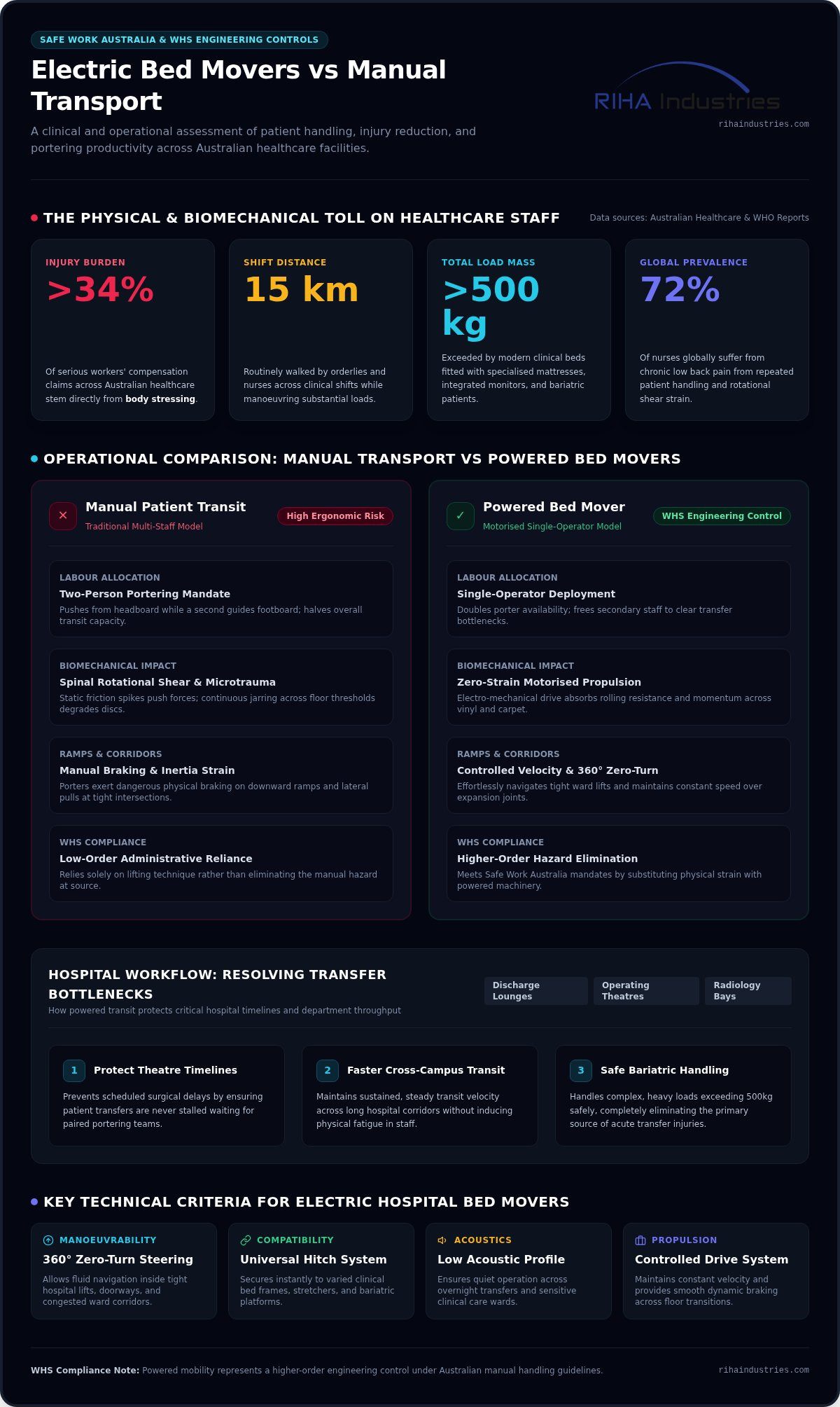
Body stressing accounts for over 34% of serious workers' compensation claims across Australian healthcare, with orderlies and nurses routinely walking up to 15 kilometres a shift while moving loads exceeding 500 kilograms. When evaluating an electric bed mover vs manual transport, healthcare leaders face an urgent operational crossroads. The physical toll of traditional handling isn't just exhausting your frontline staff; it's driving up injury claims and stalling patient flow across critical transfer windows.
You already understand the frustration of pairing two porters for a single transfer while discharge lounges back up and theatre queues grow. Powered handling directly eliminates these bottlenecks, converting heavy, high-risk patient moves into safe, single-operator journeys that align with Australia's WHS engineering mandates. This guide compares both transport models across injury prevention, roster efficiency, and workflow throughput to help you determine whether investing in motorised movers is the right operational move for your facility.
Table of Contents
Electric Bed Mover vs Manual Transport: The Clinical and Operational Comparison
Biomechanical Injury Risks in Manual Patient and Bed Transfer
Hospital Efficiency, Workflow Speed, and Portering Productivity
Key Technical Criteria for Evaluating Electric Hospital Bed Movers
Why Australian Healthcare Facilities Choose StaminaLift Powered Mobility
Electric Bed Mover vs Manual Transport: The Clinical and Operational Comparison
Manual patient transfers demand immediate, intense physical effort. Pushing a occupied bed along linoleum corridors requires porters to overcome static friction, steer around tight corners, and brake on downward ramps. Over an arduous twelve-hour shift, this repetitive physical exertion exhausts staff and slows down facility transit speeds. Examining the choice between an electric bed mover vs manual transport reveals that motorised propulsion shifts this operational load from vulnerable human spines to controlled, electro-mechanical drive systems.
Physical Strain and Force Requirements Compared
Modern clinical beds equipped with specialised mattresses, integrated monitoring devices, and bariatric patients frequently exceed 400kg. Moving this mass manually generates initial push forces that breach recommended ergonomic safety limits. Just as acute care facilities rely on mechanical patient lifts to remove dangerous lifting loads during bed-to-chair transfers, powered bed movers absorb the rolling resistance and momentum of horizontal transit. Powered drive systems maintain constant velocity across vinyl, carpet, and expansion joints without requiring porters to wrench their shoulders or twist their lower backs to navigate inclines.
Labour Allocation: One Porter Versus Two-Person Teams
Hospitals traditionally compensate for unwieldy weights by mandating two porters for manual bed moves. One worker pushes from the headboard while a second guides the footboard, tethering two valuable team members to a single routine transit:
Doubled labour overhead: Two-person manual teams halve the overall transit capacity of the portering department.
Transfer bottlenecks: Non-emergency transfers wait on ward floors because paired porters are delayed across busy campuses.
Single-operator safety: Powered movers provide 360-degree precision steering from a central control point, letting one orderly navigate crowded lifts effortlessly.
Upgrading to purposeful hospital porter equipment transforms this equation entirely. Freeing the secondary porter cuts transit backlogs in emergency bays and radiology suites while keeping the remaining operator safe from fatigue-induced injuries.
Biomechanical Injury Risks in Manual Patient and Bed Transfer
Body stressing accounts for over 34% of serious workers' compensation claims across Australian healthcare, with manual handling representing the primary contributor. Safe Work Australia compliance standards establish clear employer duties to eliminate hazardous manual tasks at the source rather than relying on lifting techniques. When safety managers assess an electric bed mover vs manual transport, the decision centres on substituting high-risk human exertion with compliant engineering controls. Porters walking up to 15km daily while pushing hundreds of kilograms experience cumulative fatigue, which drastically elevates acute injury rates.
Spinal Compression and Musculoskeletal Injury Mechanisms
Repeatedly moving heavy hospital beds subjects spinal structures to dangerous rotational shear forces. The World Health Organization reports that up to 72% of nurses globally suffer from chronic low back pain, driven largely by the documented risks of manual patient handling. Maneuvering around sharp ward intersections requires abrupt lateral corrections that concentrate stress directly across the lumbar spine. Understanding the underlying forces behind these movements reveals practical strategies on how to reduce nurse back injuries through purposeful equipment selection.
High initial rolling resistance: Carpeted corridors and scuffed floor transitions spike the force needed to overcome inertia.
Rotational spinal strain: Pivoting a freewheeling bed to clear doorway frames forces the trunk into compromised postures.
Microtrauma accumulation: Continuous jarring across door thresholds degrades intervertebral discs over long clinical shifts.
The Dangers of Navigating Hospital Slopes and Ramps
Controlling unpowered beds on inclines creates extreme physical hazards. Ascending ramps demands maximum muscular exertion, while descending introduces severe crush and runaway risks if an orderly slips. Manual friction braking relies entirely on operator grip strength and footwear traction. In contrast, powered movers integrate automatic electromagnetic braking systems that halt momentum instantly the moment the controls are released, even on steep hospital grades.
Transitioning away from physical pushing protects staff well-being and stabilises rosters. To see how engineered equipment neutralises these biomechanical hazards, healthcare teams can explore proven Australian-made patient transport systems designed specifically to satisfy strict manual handling codes.
Hospital Efficiency, Workflow Speed, and Portering Productivity
Smooth patient transit underpins clinical efficiency across an entire hospital network. When looking at an electric bed mover vs manual transport, the primary operational advantage lies in transit predictability. Manual transport times fluctuate wildly depending on porter fatigue, ward congestion, and the physical effort required to steer bulky beds. Powered mobility standardises transfer durations, eliminating scheduling bottlenecks across high-dependency clinical departments.
Eliminating Transit Bottlenecks Between Wards and Theatres
A ten-minute transit delay in delivering a pre-op patient to an operating theatre creates costly idle time for surgeons, nurses, and anaesthetists. Manual bed transport is inherently variable; an exhausted team moves slower, takes wider turns, and struggles to maintain momentum across extended concourses. Motorised movers provide smooth, electronically governed propulsion that locks in predictable transfer windows. Crucially, controlled electric acceleration eliminates the abrupt jerks and sudden stops that can dislodge delicate intravenous lines or disturb sensitive patient monitoring arrays.
Reducing Daily Walking Fatigue for Healthcare Transport Teams
Orderlies routinely log between 10 and 15 kilometres on foot during a single shift. When combined with the continuous physical exertion of steering loaded beds, this massive walking burden produces deep muscular exhaustion that degrades alertness and responsiveness later in the day.
To safeguard porter endurance and accelerate dispatch responsiveness, motorised transport systems introduce clear operational advantages:
Sustained transfer velocity: Powered movers maintain consistent transit speeds from the start of a shift to the final hour.
Heightened situational awareness: Relieving operators of heavy pushing allows them to focus fully on hallway traffic, automated doors, and patient comfort.
Ride-on mobility options: Units equipped with ergonomic ride-on platforms allow porters to traverse sprawling hospital campuses quickly without accumulating crippling foot fatigue.
Rapid asset turnaround: Quicker bed returns mean empty beds are cleaned and repositioned in emergency bays without delay.
Weighing an electric bed mover vs manual transport demonstrates that fatigue-free bed transit keeps post-anaesthesia care units clear, radiology suites operating on schedule, and patient transport teams working safely at peak capacity.
Key Technical Criteria for Evaluating Electric Hospital Bed Movers
Procuring powered equipment involves far more than simply selecting a motorised wheel. Evaluating an electric bed mover vs manual transport requires facilities teams and biomedical engineers to examine specific mechanical capabilities that resolve daily transit friction. Choosing the right drive platform means evaluating universal hitching versatility, spatial clearances, dynamic control systems, and gradient ratings before issuing tenders.
Universal Hitching and Equipment Compatibility
Healthcare fleets rarely consist of one uniform bed model. Modern beds feature complex castor systems, low ground clearances, and bulky footboards that resist crude clamping methods. Reliable movers employ patented universal jaw mechanisms that clamp wheelbases securely without forcing orderlies to bend down or secure manual straps. The hitch must connect smoothly across acute beds, stretchers, and treatment chairs while maintaining a minimal footprint so hitched beds fit cleanly inside standard Australian service lifts.
Manoeuvrability in Confined Clinical Spaces
Restricted floor space demands true 360-degree zero-turn rotation. When positioning a patient within a congested four-bed bay or turning through narrow hallway intersections, an intuitive proportional joystick allows effortless micro-adjustments. Acoustic performance is equally critical. Premium hospital tugs operate at a whisper-quiet 65 dB acoustic rating, ensuring clinical transit never disturbs sleeping patients or disrupts high-acuity wards.
Incline Capability and Heavy Weight Ratings
Campus topography often includes covered link bridges and ramped corridors. Moving an occupied bed up an incline requires substantial low-end torque:
Standard acute payload: Daily equipment must manage typical bed, patient, and monitoring weights up to 600kg without speed loss.
Bariatric transfer ratings: Specialised bariatric movers require heavy-duty engineering capable of transporting nearly one tonne across 7-degree inclines.
Active user safety: Integrated collision guards, emergency belly-button reverse switches, and electromagnetic deadman braking ensure equipment halts immediately if the operator lets go.
Reviewing a detailed 2026 hospital bed mover procurement guide helps engineering teams audit these mechanical features thoroughly. Ready to see how an electric bed mover vs manual transport transforms your facility? Request a technical consultation with RIHA Industries to match your ward layouts with the right transport models.
Why Australian Healthcare Facilities Choose StaminaLift Powered Mobility
Deciding between an electric bed mover vs manual transport represents a decisive turning point in hospital risk management and logistics. Rather than relying on imported equipment with distant support lines, Australian healthcare networks turn to locally engineered solutions. RIHA Industries manufactures the proven StaminaLift series domestically, designing purpose-built equipment that protects hospital staff while elevating patient transfer standards across the country.
Proven Zero-Harm Safety Record Across Australian Hospitals
Real-world clinical deployments demonstrate clear, measurable safety transformations. In a landmark study at a major South Australian hospital, bed-moving injuries dropped from 20% down to zero within two years of introducing powered movers. Eliminating physical strain allows facilities to retain experienced staff, enabling orderlies recovering from prior injuries or near retirement to remain productive and pain-free on shift.
Manufactured under strict FDA-registered quality controls, the StaminaLift fleet addresses the full spectrum of patient transport requirements:
Agile daily transit: The StaminaLift 2100 Bed Mover provides compact, responsive steering for standard ward transfers.
Universal acute connectivity: The flagship StaminaLift Transfer System 5000 connects effortlessly to 95% of modern hospital beds without manual hitching effort.
Bariatric power: The heavy-duty StaminaLift Transfer System 6000 moves payloads approaching one tonne up 7-degree ramps under total operator control.
National Service Backing and Comprehensive Maintenance Support
Equipment downtime directly threatens ward workflows. Because StaminaLift systems are designed and assembled in Australia, healthcare facilities enjoy immediate engineering support and 24-hour dispatch on replacement parts, avoiding the multi-week supply delays typical of overseas suppliers.
Hospitals safeguard long-term fleet readiness through structured hospital bed mover repair service programmes and Preventative Maintenance and Repairs agreements. Biomedical engineering teams can also utilise interactive 3D maintenance portals to streamline routine checks and fault diagnoses in-house. Evaluating an electric bed mover vs manual transport across actual clinical shifts proves that purposeful engineering resolves portering shortages and protects staff. To experience the physical relief and operational speed firsthand, arrange an on-site facility trial through RIHA Industries.
Modernising Patient Logistics for Long-Term Hospital Resilience
Weighing an electric bed mover vs manual transport comes down to protecting frontline staff while unlocking vital operational capacity. Replacing high-strain physical pushing with powered engineering controls eliminates repetitive spinal shear, prevents chronic orderly fatigue, and safely transitions two-person transfers into efficient, single-operator tasks that keep acute departments on schedule.
Recognised as a Top 10 Mobility Aids Provider 2024 by MedTech Outlook, RIHA Industries designs and builds FDA-registered and certified Australian-made patient handling technology tailored to demanding acute environments. The clinical outcomes speak for themselves, highlighted by zero bed moving injuries achieved within two years at a major South Australian hospital following fleet deployment.
Protecting your healthcare teams from preventable musculoskeletal harm builds a faster, more dependable hospital workflow. Book an on-site hospital demonstration with RIHA Industries and discover how purposeful engineering delivers complete WHS compliance and lasting physical relief across your wards.
Frequently Asked Questions
How do electric bed movers compare to manual bed transport for injury prevention?
Powered movers completely isolate staff from initial push forces and rolling inertia. In the evaluation of an electric bed mover vs manual transport, mechanical traction eliminates the hazardous spinal shear and rotational strain caused by redirecting freewheeling beds. Clinical evidence confirms that adopting engineered drive systems can reduce acute hospital bed-moving injuries to zero within two years.
Can a motorised bed mover be operated safely by a single hospital porter?
Yes, modern electric movers are specifically engineered for safe, single-operator use. Precision joystick controls and responsive central drive wheels eliminate the need for a second porter at the footboard. A single orderly can steer, brake, and guide heavy beds through crowded corridors and into lifts without straining or needing secondary steering assistance.
What weight capacity is required for standard versus bariatric electric bed movers?
Standard acute transport units should reliably handle a total moving load of 600kg, easily accommodating standard beds, medical equipment, and patients. For heavy-duty and bariatric transfers, specialised machines like the StaminaLift TS6000 provide a 450kg lift rating and 900kg push-pull capacity to transport payloads approaching one tonne safely.
How do powered bed movers perform on ramps and inclined hospital corridors?
Engineered bed movers navigate standard hospital slopes effortlessly by delivering high-torque motor assistance. Purpose-built models handle inclines up to 7 degrees under full payload capacity. Integrated automatic braking systems hold the bed securely on gradients the moment the controls are released, preventing downhill runaways and protecting operators from uncontrolled roll-backs.
Will an electric bed mover fit inside standard Australian hospital elevators?
Yes, compact designs ensure connected beds clear standard hospital lift dimensions without difficulty. High-performance units like the StaminaLift TS5000 feature patented jaws that tuck underneath the bed frame, adding only 180mm to 200mm to the bed's overall length. This ultra-compact profile leaves ample clearance for elevator doors to close safely.
Is specialised operator certification required to drive powered hospital bed movers?
No formal external driver licence is required, but hospitals must provide practical operator competency training. Equipment manufacturers deliver straightforward onboarding programmes covering joystick handling, attachment hitching, and corridor safety. Operators quickly learn the controls, allowing facilities to achieve immediate WHS compliance and smooth workforce adoption across portering rosters.
How long does the battery last on a commercial electric bed mover during shifts?
Commercial movers feature robust battery systems engineered to power an entire standard clinical shift under continuous hospital use. Advanced battery configurations deliver dependable all-day runtime, while optional lithium upgrades boost performance by up to 20%. Units feature integrated chargers with retractable reels, making it effortless to top up power between peak transfer windows.


