Hospital Porter Safety: Australian Guide 2026
A hospital bed doesn’t become safe to move simply because staff are ready to push. Tight corners, heavy loads, poor visibility and unexpected obstacles can put both the patient and porter at risk. Effective hospital porter safety guidelines focus on controlling each move, not relying on strength or guesswork.
Every move needs a clear plan, especially when space is limited or equipment is difficult to manoeuvre. Powered equipment may help with suitable heavy-bed moves, but it doesn’t replace risk assessment, training or sound judgement. If you’re unsure how to assess a bed or trolley, or when to pause and ask for help, treat that uncertainty as a reason to stop and review the plan.
This Australian guide provides a repeatable process for assessing the load, route and equipment before you start, then moving and monitoring safely. You’ll learn what hazards to look for, how to maintain control in tight spaces, and when to stop, get assistance or consider a powered bed mover. The aim is safer movement that supports patient care and staff wellbeing.
Table of Contents
Hospital porter safety guidelines: understand the risks before a move
Before moving a hospital bed, complete a porter risk assessment
Move beds and equipment with controlled, clear communication
Manual handling alone is not enough: address difficult porter moves
Build hospital porter safety into training, reporting and daily checks
Hospital porter safety guidelines: understand the risks before a move
Good porter safety starts before anyone pushes a bed or trolley. Hospital porter safety guidelines are practical controls for moving people, beds and equipment while reducing avoidable risk. They help staff identify what could cause harm, then choose controls suited to the task, route and equipment.
A hazard is something with the potential to cause harm; risk is the chance and possible consequence of that harm occurring. Hazard identification spots what could go wrong; risk control changes how the task is done to reduce the chance or impact. That distinction matters in busy wards, where a familiar route can become hazardous when a corridor is crowded, a lift is unavailable or a trolley has been left in the way.
Hospital porters may move patients, equipment and supplies, but moving equipment is not the same as transferring a patient. Patient-care tasks must follow clinical instructions and facility procedures, including directions about the patient’s condition, position or required assistance. Don’t treat a porter move as permission to make clinical decisions.
Which hospital porter tasks create the greatest safety risks?
Risk can arise when moving occupied beds or stretchers, linen and meal trolleys, or medical equipment. The challenge isn’t weight alone: a bulky load can restrict visibility, while blind corners, narrow doorways, ramps, thresholds and unpredictable corridor traffic limit control. Interruptions can also distract the team or leave one person manoeuvring without clear communication.
A fully equipped bed with a patient may approach 500 kg in some configurations. Treat this as an indicative estimate, not a standard: actual loads vary, so use verified equipment information and assess the specific move rather than guessing. Don’t assume that a bed’s wheels or brakes make it easy to control once it is moving.
What Australian workplace safety guidance applies?
Safe Work Australia’s hazardous manual tasks guidance offers practical information for identifying and managing risks. Check the relevant state or territory WHS regulator as well, because legislation and regulator arrangements vary across Australia. Victoria operates under a separate OHS framework, so avoid assuming that one legal description applies everywhere.
This guide supports safe practice, but it doesn’t replace local procedures, workplace induction or competency training. Follow your facility’s instructions for the equipment and task, and raise uncertainties before moving. The next step is to turn this risk awareness into a consistent pre-move assessment.
Before moving a hospital bed, complete a porter risk assessment
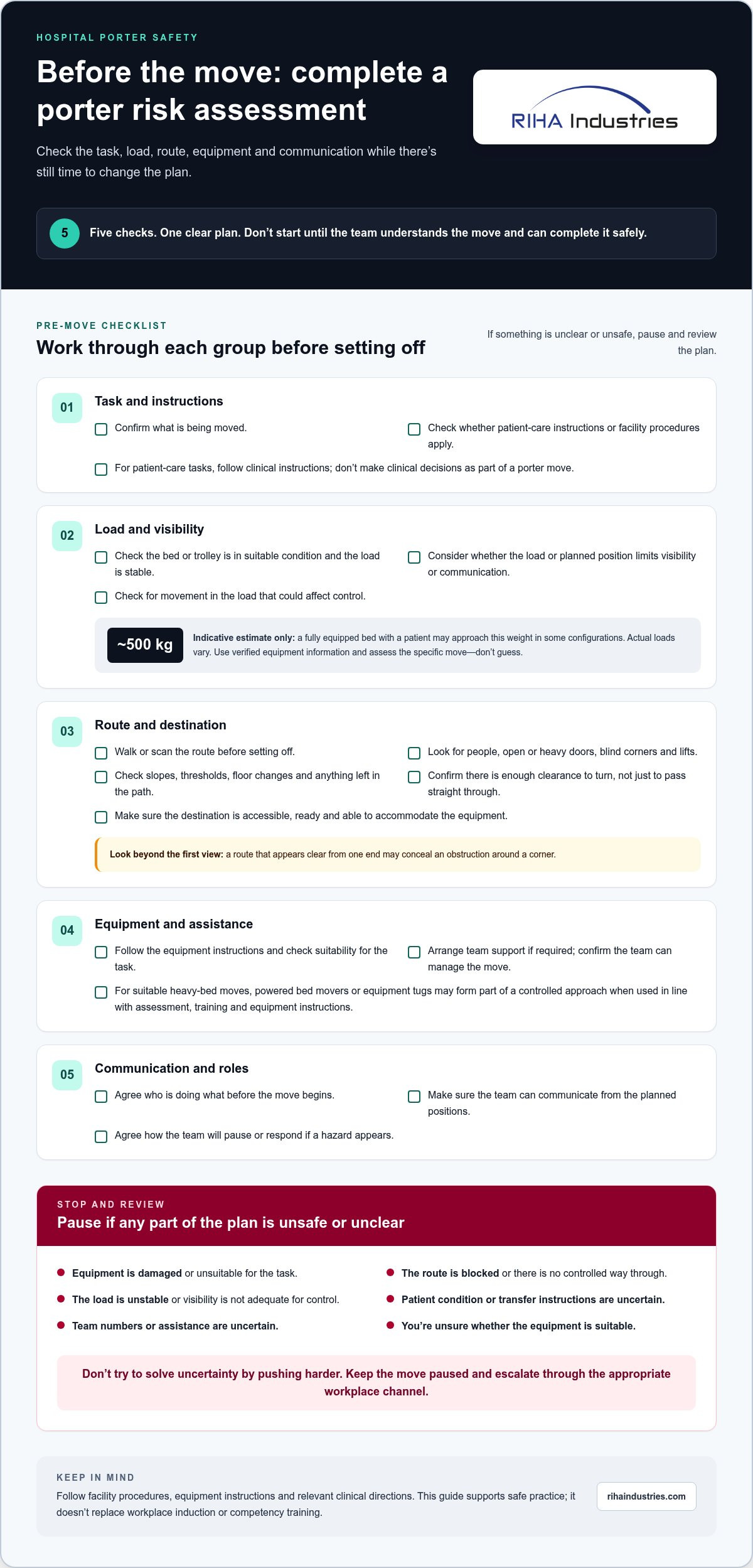
A consistent pre-move check helps the team spot problems while there’s still time to change the plan. These hospital porter safety guidelines work best as a sequence: assess the task, load, route, equipment, communication and assistance required. Don’t start until the team understands the move and has a safe way to complete it.
Check the load and the route before movement begins, because an unstable load or obstructed path can turn a routine transfer into an uncontrolled one.
How should porters assess the load, route and destination?
Start with the task. Confirm whether you’re moving equipment or supporting a patient transfer, and follow the relevant clinical instructions and facility procedure. Check that the bed or trolley is in suitable condition, the load is stable, and the porter can see and communicate effectively from the planned position. Confirm the destination is ready, accessible and able to accommodate the equipment.
Then walk or scan the route before setting off. Look for people, open or heavy doors, blind corners, lifts, slopes, thresholds, floor changes and anything left in the path. Check that the route offers enough clearance for the load to turn, not just pass straight through. A route that looks clear from one end may conceal an obstruction around a corner. For a broader look at equipment considerations, see the hospital porter equipment safety and efficiency guide. WorkSafe Victoria’s Transferring people safely handbook also offers practical assessment material for people-handling tasks.
When should a porter stop and ask for help?
Pause the move if the equipment is damaged, the route is blocked, the load is unstable or you can’t see a controlled way through. Stop as well if there’s uncertainty about patient condition, transfer instructions, team numbers or whether the equipment is suitable for the task. Don’t try to solve uncertainty by pushing harder.
Task: Confirm what is being moved and whether patient-care instructions apply.
Load: Check stability, condition, visibility and any movement that could affect control.
Route and destination: Identify obstacles and confirm the endpoint is accessible and ready.
Equipment and assistance: Follow equipment instructions and arrange team support if required.
Communication: Agree on roles and how the team will pause or respond to a hazard.
Follow facility processes for requesting assistance, entering isolation areas and handing over clinical information. If a safe plan still isn’t clear, keep the move paused and escalate through the appropriate workplace channel. For suitable heavy-bed moves, powered bed movers and equipment tugs can form part of a controlled approach when selected and used in line with assessment, training and equipment instructions.
Move beds and equipment with controlled, clear communication
A safe move depends on the team staying coordinated from start to finish. Before setting off, confirm who is leading, who is steering and how everyone will signal a stop or change of direction. Keep the route clear, move at a controlled pace and avoid sudden starts, stops or turns that could destabilise the load or surprise nearby staff and patients.
Follow facility-approved techniques and the equipment manufacturer’s instructions for the specific task. There isn’t one generic posture rule that makes every move safe: the load, equipment design, route and staffing all affect how it should be handled. If powered equipment is being used, staff must understand its controls and operating limits before moving.
What communication keeps a move coordinated?
Agree on simple, audible cues before movement begins, such as “ready”, “moving”, “stop” and “turning”. One person should lead the communication so instructions don’t conflict. Keep cues brief and appropriate to the clinical environment, especially near patients or during a clinical handover.
Check that everyone can see or hear the person leading. If a doorway or corner separates team members, pause and re-establish communication before continuing. Don’t rely on assumptions or keep moving because the team has already started.
How should porters handle corridors, ramps and confined spaces?
Approach hazards at a reduced speed and reassess before committing. Tight turns, doorways and lift entries can restrict visibility and leave little room to correct the bed’s direction. Check that the lift is ready and there’s sufficient space to enter, position the load and exit safely. Keep equipment and staff clear of emergency access routes.
Ramps and thresholds need particular care because changes in gradient or floor level can affect control. Follow local procedures and the equipment’s instructions for slopes; never assume a gradient is safe simply because the bed or trolley moved over it previously. If the route can’t be kept clear, or the team can’t control the load, stop and find a safer way forward.
Stop movement whenever visibility, control or communication is lost. Pause in a safe position, alert the team and reassess the route or plan before proceeding. This simple decision protects the patient, staff and others sharing the corridor.
Manual handling alone is not enough: address difficult porter moves
Training and sound technique help staff move beds and equipment with greater control, but they can’t make every load, route or task safe. A heavy bed on a confined route, for example, may still call for a different plan. Effective hospital porter safety guidelines consider whether the task can be redesigned, extra assistance is needed or mechanical equipment could reduce the physical demand.
Don’t treat powered assistance as the answer to every move. Match the control to the load, route, equipment and patient-care requirements, then follow facility procedures. For broader context on choosing equipment, see patient handling equipment selection criteria.
When is manual movement a poor choice?
Heavy, frequent or awkward moves are reasons to reassess, particularly when visibility is limited or the route restricts manoeuvring. Repetition can contribute to fatigue, while time pressure may lead staff to rush or overlook hazards. If the task can’t be completed with reliable control, pause and consider changes to the task design or staffing. The appropriate team size depends on the assessed move and facility procedure, not a universal rule.
How can powered assistance support safer movement?
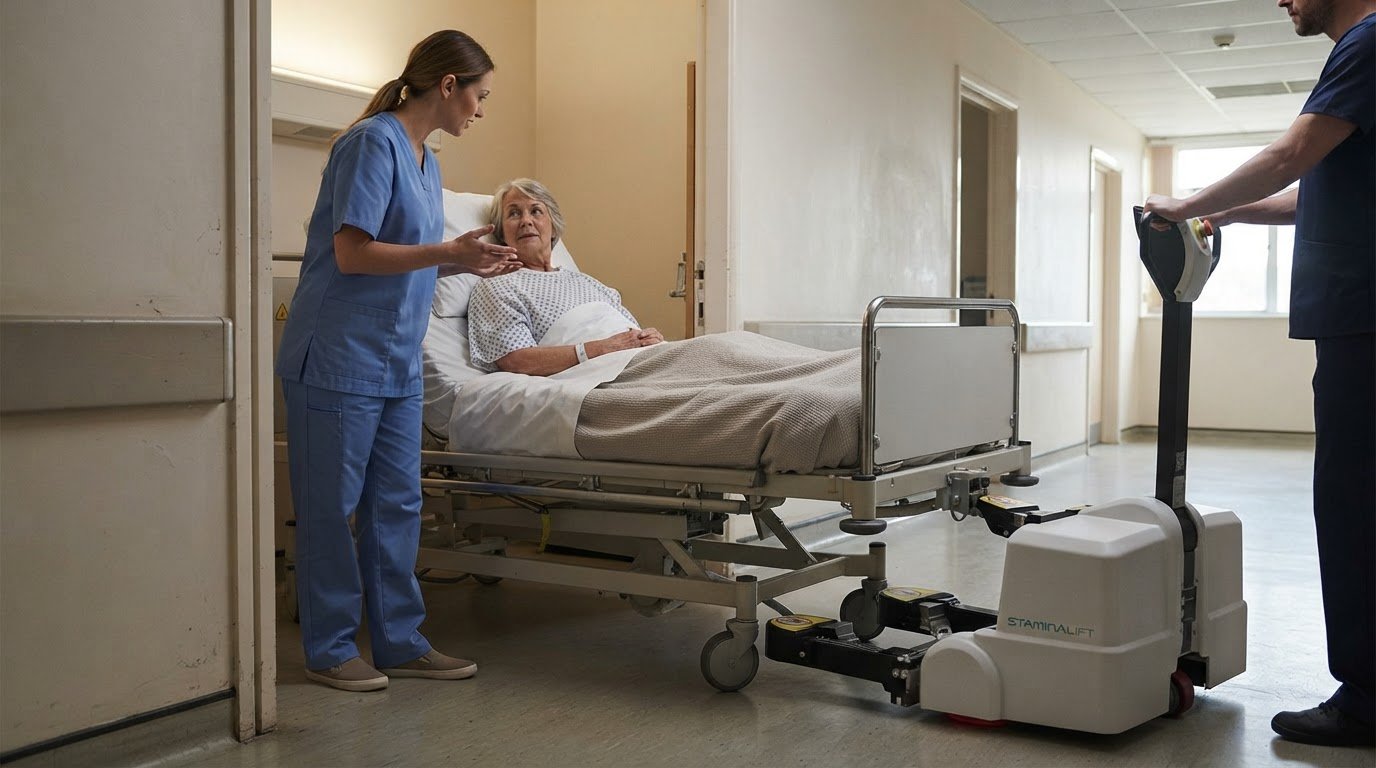
For suitable movement tasks, a powered bed mover can reduce the physical effort required to move a compatible bed. RIHA Industries’ StaminaLift range includes the TS5000, designed to suit modern hospital bed designs and compatible with 95% of hospital beds, and the TS6000, designed for bariatric and acute care beds. The StaminaLift 2100 is suited to Australian-manufactured beds found in Australia and Hong Kong. Choose a model based on bed compatibility, the assessed load and route, and the equipment’s instructions, rather than assuming one mover suits every task.
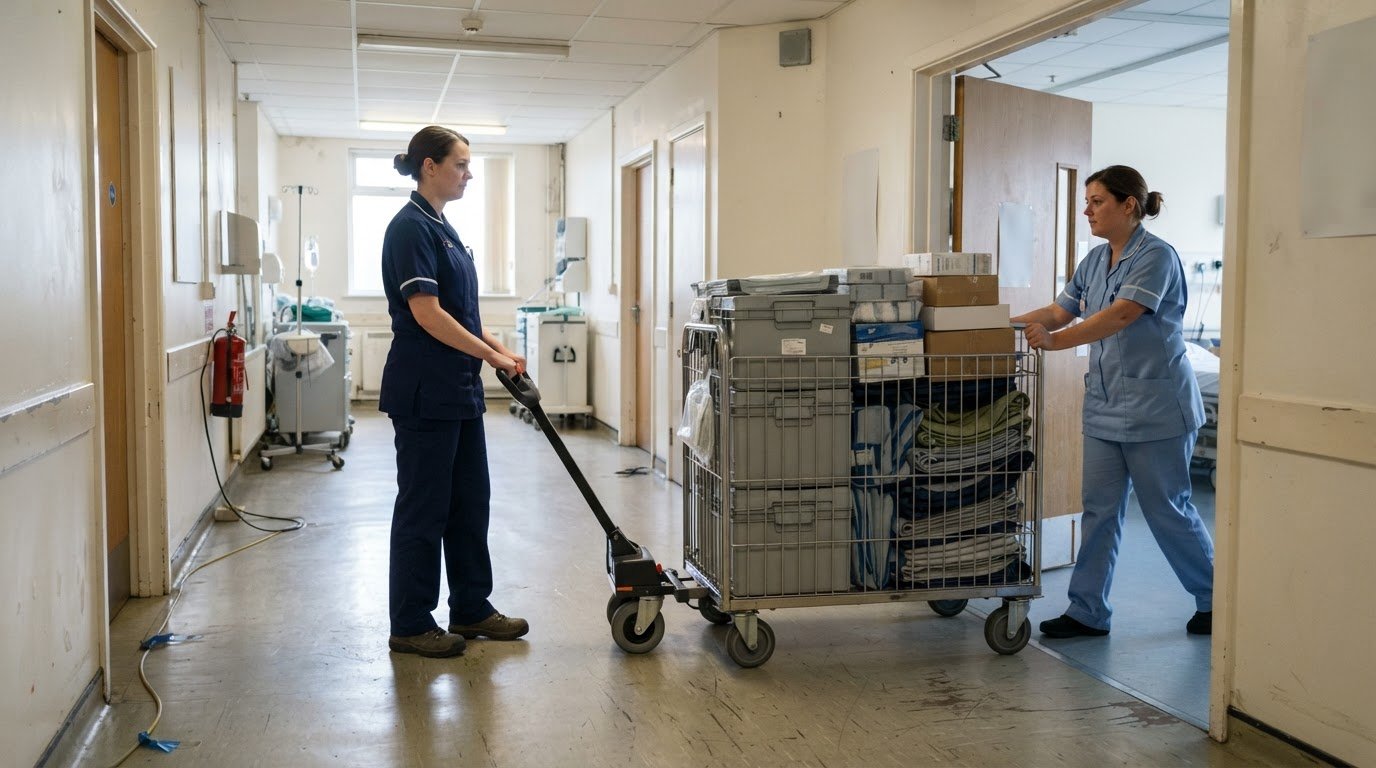
StaminaLift movers are designed for single-person operation, but that doesn’t mean every bed or route is suitable for solo movement. Staff still need to assess the move, follow equipment instructions and arrange additional help when the task requires it. For other heavy equipment, the Easi Rider and Easi Mover tugs are designed to move loads such as linen and meal trolleys or large medical equipment.
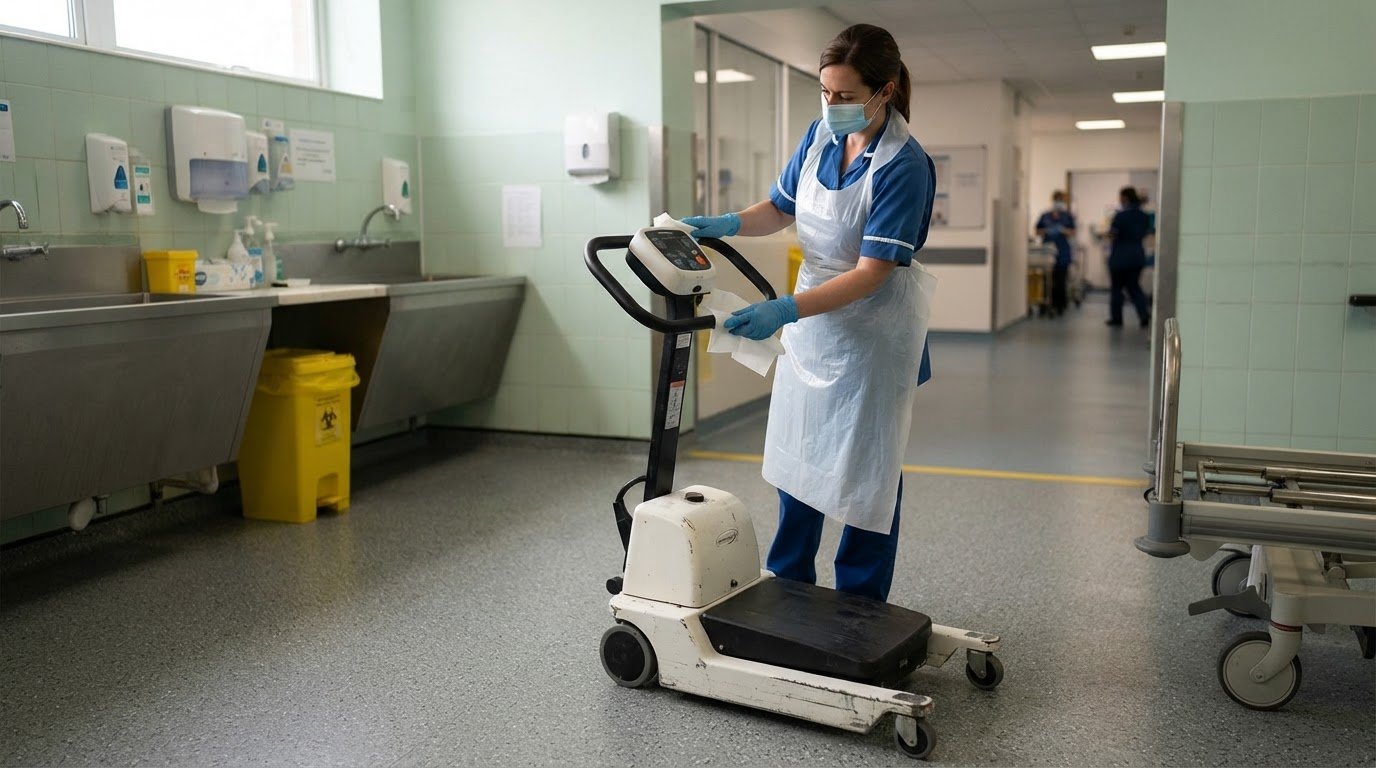
Safe use also depends on preparation beyond the move itself. Staff need training and familiarisation with the equipment, and checks should identify faults before use. Preventative maintenance supports equipment reliability over time; damaged or faulty equipment should be dealt with through facility procedures rather than used regardless.
Mechanical assistance works best as part of a considered safety approach, not as a substitute for judgement or training. Explore RIHA powered bed movers for suitable healthcare bed-moving tasks.
Build hospital porter safety into training, reporting and daily checks
Consistent practice depends on more than knowing how to move equipment. Induction should introduce local procedures, reporting channels and the equipment staff may use. Refresher training, practical equipment familiarisation and supervision help reinforce those processes as tasks or equipment change. Training for a powered mover should cover its controls and operating instructions, with staff supported to use it confidently and correctly.
Daily checks and clear reporting help teams identify problems before they affect another move. Follow the manufacturer’s instructions and the facility’s maintenance system, rather than relying on informal checks or assumed schedules. These steps make hospital porter safety guidelines part of routine work, not just a reminder after an incident.
What should a porter check before using a mover?
Use the site checklist and manufacturer instructions to inspect the mover before use. Check its general condition, charge, controls and attachments, then confirm the mover and hitch are compatible with the bed or trolley. Familiarise yourself with the correct connection and operating procedure during training, rather than learning while managing a live move.
If you find a fault or aren’t sure the connection is secure, don’t use the equipment. Isolate it and report the issue as directed by facility procedure so it can be assessed and addressed through the maintenance system. Routine servicing and repairs also help keep equipment in suitable working order.
How can hospitals learn from incidents and improve procedures?
Report hazards, near misses, equipment faults and injuries through the facility’s established process, even when no one is hurt. Include useful context, such as the route, floor conditions, equipment involved and any issue with visibility or communication. Specific details can help identify whether the contributing factor was the task, the environment, equipment condition or a gap in procedure.
Review patterns with porters, supervisors, maintenance staff and relevant safety representatives. If reports show repeated trouble at a particular doorway, for example, the response might include revisiting route planning or updating local instructions. Findings can also inform training, equipment controls and maintenance arrangements. Close the loop by sharing relevant changes with staff and checking that revised practices are understood.
Reliable equipment is one part of a broader approach built on capable staff, clear procedures and learning from experience. Explore RIHA healthcare mobility solutions to see powered bed movers and equipment tugs designed for healthcare settings.
Make every hospital move safer, one step at a time
Safer portering comes from a consistent process: assess the load and route before moving, agree on roles and communication, and pause if control or conditions become uncertain. Training and good technique are essential, but difficult or repeated moves may also call for changes to the task, extra assistance or suitable mechanical support. These hospital porter safety guidelines help teams make safer choices while protecting patient care and staff wellbeing.
For suitable bed and equipment moves, RIHA’s Australian-made StaminaLift and Easi equipment is designed for healthcare movement tasks. RIHA also provides product training, preventative maintenance and repairs, and national service coverage in Australia, helping facilities support equipment use over time.
Explore RIHA’s healthcare mobility solutions and consider how the right equipment and support can complement your workplace procedures. A clear process, backed by capable staff and well-maintained equipment, helps make each move more controlled and gives teams confidence to work safely.
Frequently Asked Questions
What should hospital porters check before moving a bed?
Before moving a bed, check the load is stable, the bed is in serviceable condition and the route and destination are clear. Confirm any patient-care instructions, who is involved and how the team will communicate. Look for obstacles, tight turns, slopes, thresholds and other people using the corridor. If you’re using a bed mover, follow its instructions and check it’s compatible with the bed before connecting it.
Is manual handling training enough to keep hospital porters safe?
No. Training helps porters recognise hazards and use approved techniques, but it can’t make every load or route safe. Facilities should assess the task and consider whether changes to the work, additional assistance or mechanical equipment would better control the risk. For example, frequent heavy-bed moves through restricted spaces may need a different approach from occasional movement along a clear route.
Can one hospital porter move a patient bed safely?
Not automatically. Whether one porter can move a bed safely depends on the task, bed and mover compatibility, route, patient-care requirements and facility procedures. Some powered bed movers, including StaminaLift, are designed for single-person operation, but that doesn’t make every bed or situation suitable for one-person movement. Follow training and equipment instructions, and arrange team assistance whenever the assessed task requires it.
What should a porter do if a bed mover or trolley is faulty?
Stop and don’t use faulty or damaged equipment. If it’s safe to do so, isolate it in line with facility procedure so another worker doesn’t unknowingly use it. Report the fault through the site’s maintenance or reporting process, describing what happened and any visible problem. Don’t bypass a faulty control or uncertain connection. Use an alternative method only after the move has been reassessed and planned safely.
How should porters move beds through ramps and tight corridors?
Plan for the slope or confined space before starting, and follow the equipment instructions and local procedures for ramps. Don’t assume a gradient is safe just because a bed or trolley has used it before. Reduce speed at corners, doorways and lift entries, and keep the route clear without blocking emergency access. If the team loses visibility or control, stop in a safe position and reassess before proceeding.
What happens if a porter notices a hazard or near miss?
Alert people who may be affected and report the hazard or near miss through the facility’s process. Include practical details such as the location, route conditions, equipment involved and what nearly happened. If someone is injured, follow the workplace’s incident and clinical procedures. Reporting near misses matters too: recurring issues can prompt changes to route planning, equipment checks, training or local work procedures.
Do hospital porter safety requirements differ across Australia?
Yes. Workplace safety legislation and regulator arrangements vary by state and territory. Most jurisdictions have adopted the model WHS framework, while Victoria operates under its own occupational health and safety legislation. Safe Work Australia provides national guidance, but it doesn’t replace the relevant state or territory regulator’s information. Porters should also follow their facility’s induction, procedures and competency requirements for each task and item of equipment.