How to justify buying a bed mover through move costs
A bed mover is easier to justify when you compare its ownership costs with the recurring need to move beds. Reported costs for other types of moves can provide context, but they are not a forecast of what a bed mover will save.
It’s reasonable to want a clear financial case before committing to equipment. Deposits and payment terms affect cash flow, while itemised costs can reveal where repeated handling or disruption deserves closer attention. This article explains how to assess individual move reports and build a practical comparison for your workplace, giving you a clearer basis for deciding whether a bed mover fits the operational need and the available evidence.
Table of Contents
3. What is a bed mover and how does it work?
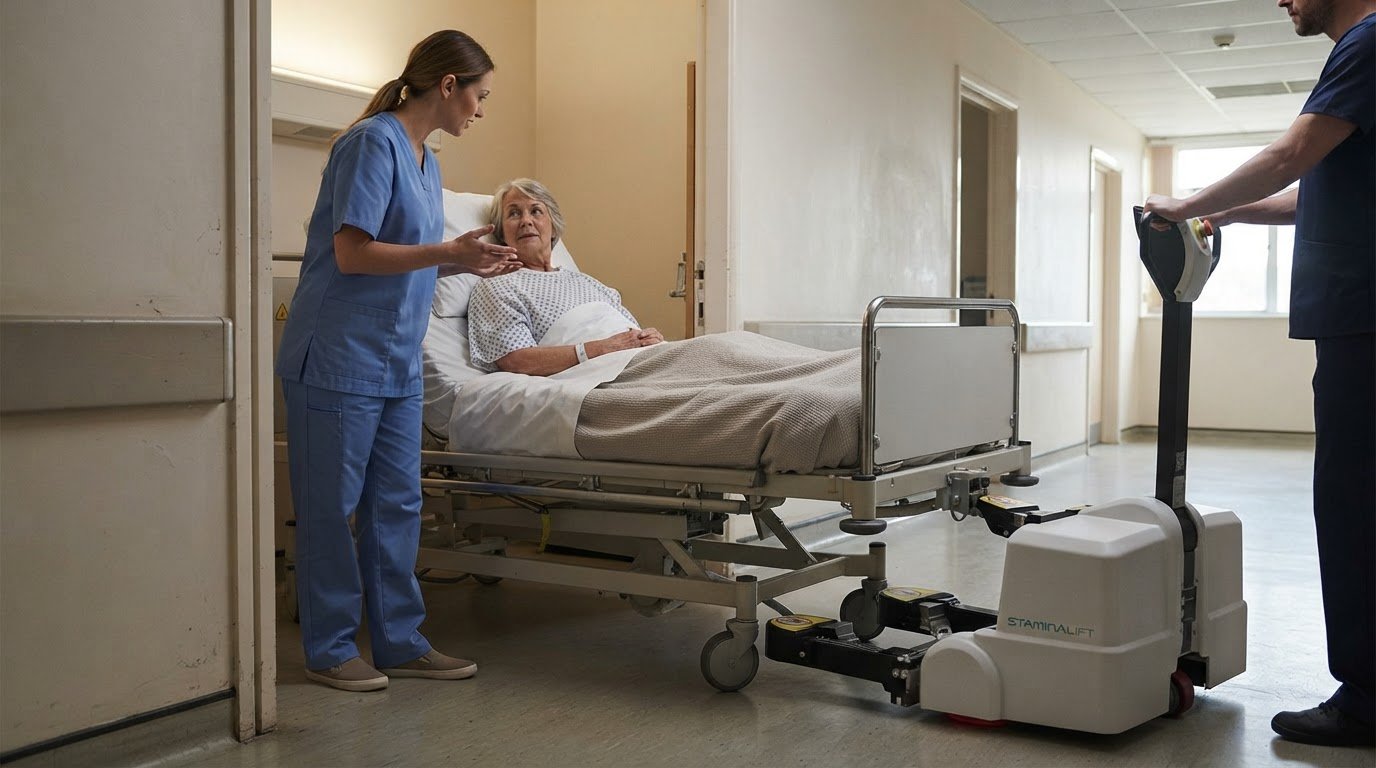
A bed mover is equipment designed to assist with moving a bed between locations. In a hospital, for example, staff might move a bed from one room to another during a room change or ward reorganisation. The device supports bed movement; it does not perform a patient transfer. These are separate tasks with different equipment and handling requirements.
Bed movers differ in how they connect to or support a bed, and the operating process depends on the system’s design. A useful way to understand the task is to follow a move from preparation to arrival. Staff prepare the route and bed, then position and operate the mover according to its instructions. At the destination, they stop the equipment and return it to its appropriate position.
Prepare: Identify the destination and clear the intended route of obstacles.
Position: Set up the bed and mover as directed for that equipment.
Move: Operate the system to guide the bed along the planned route.
Finish: Stop at the destination and make the bed ready for its next use.
This sequence matters because a bed mover is part of a workplace process, not a standalone device. A corridor turn, doorway or change in floor layout, for example, can affect how staff plan a route. The equipment’s instructions guide setup and movement, while staff also need to account for the bed, surrounding space and destination. The exact procedure depends on the mover’s design and the task.
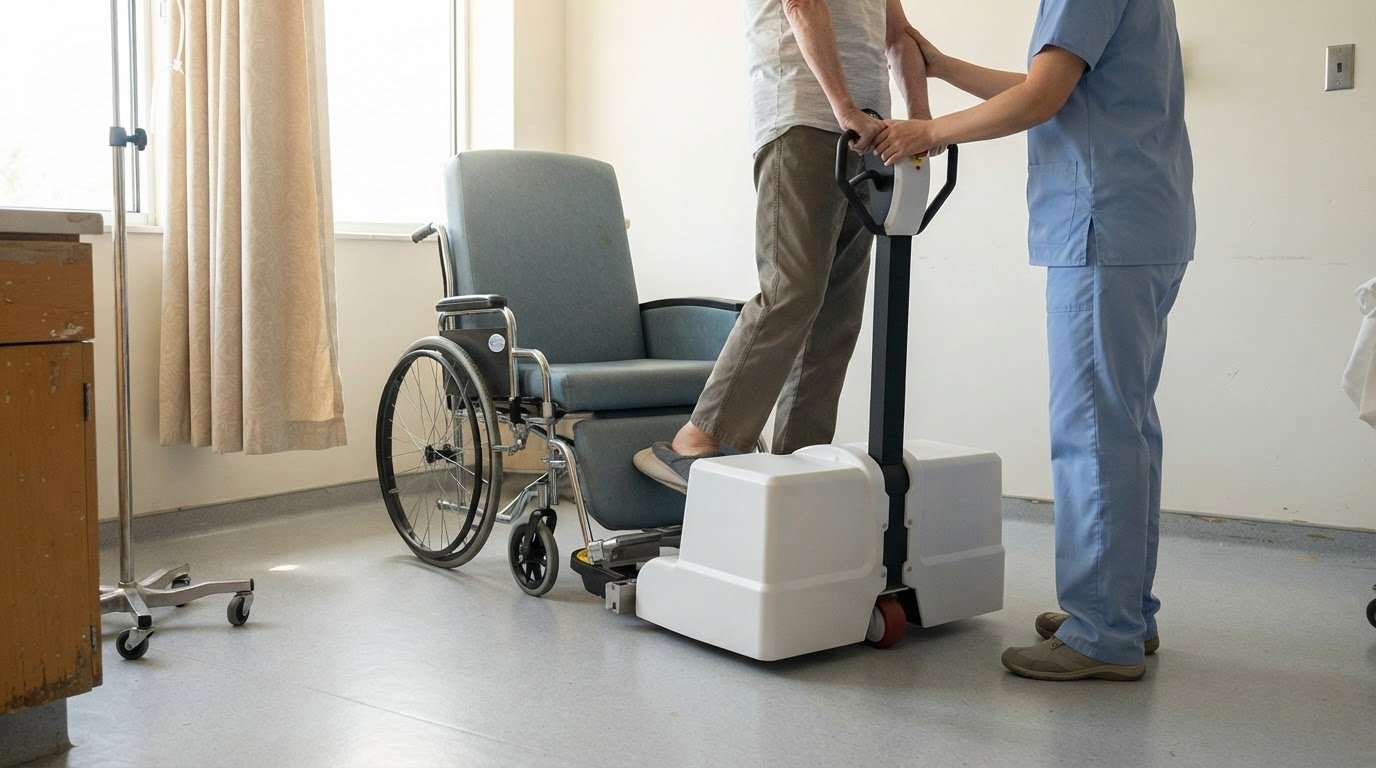
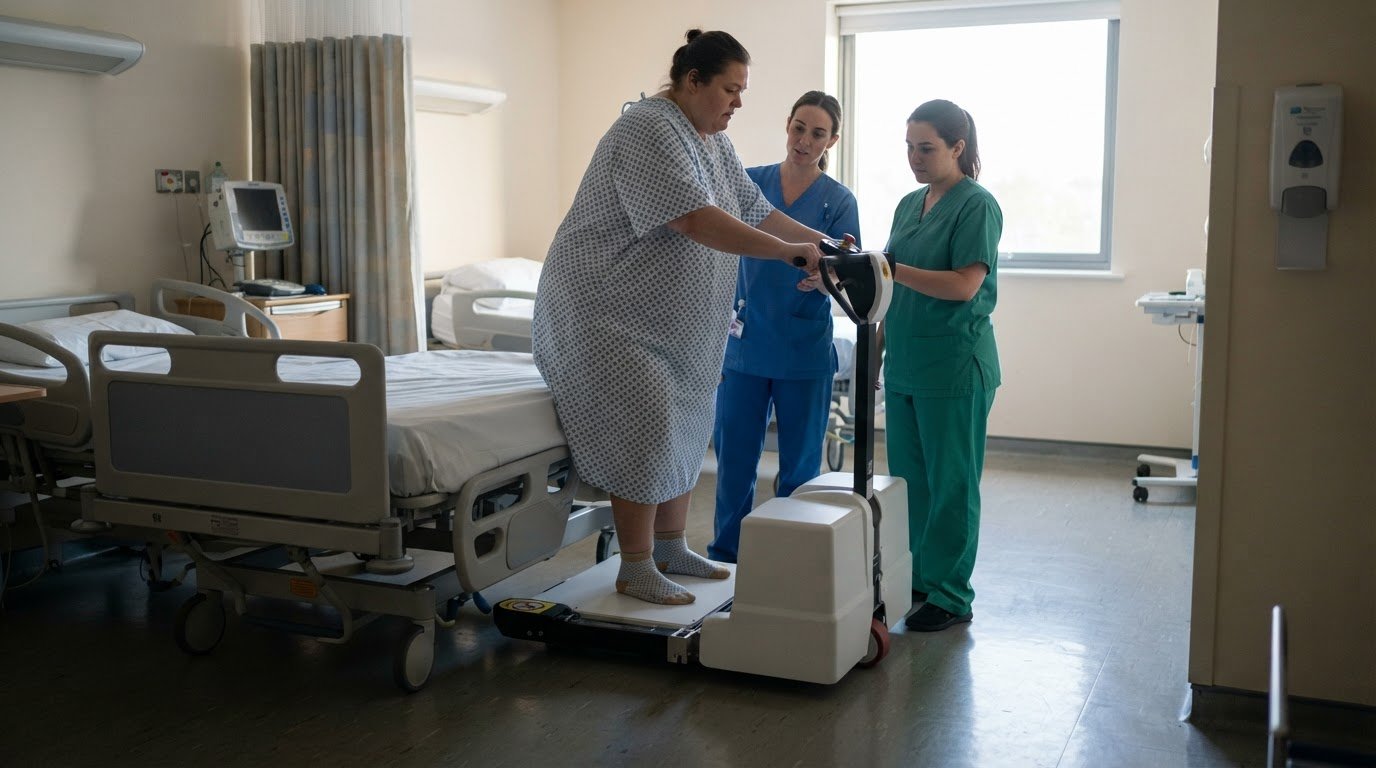
Distinguish bed movers from equipment designed to help transfer a patient. Moving a bed means repositioning the bed itself. A patient transfer means moving a person between surfaces or locations, so it calls for different equipment and procedures. Define the task before considering a purchase: if the recurring need is relocating beds, assess bed-moving equipment; if it is transferring patients, assess patient-transfer equipment.
To understand how a bed mover would work in your setting, map a real movement from start to finish. For a bed travelling from a room through a doorway and along a corridor, note where staff position the equipment, how they direct it and what happens at the destination. This makes the operational requirement concrete without assuming every mover uses the same mechanism. It also separates the work the equipment must support from other tasks that happen during the move.
This distinction provides a stronger basis for evaluating a purchase. Record the bed movements your workplace needs to support, the routes involved and the steps staff follow. Then compare those requirements with the equipment’s operating method and intended use. A clear task definition helps decision-makers assess fit without treating all bed-moving and patient-handling equipment as interchangeable.
4. What are the benefits of buying a bed mover versus hiring professional movers?
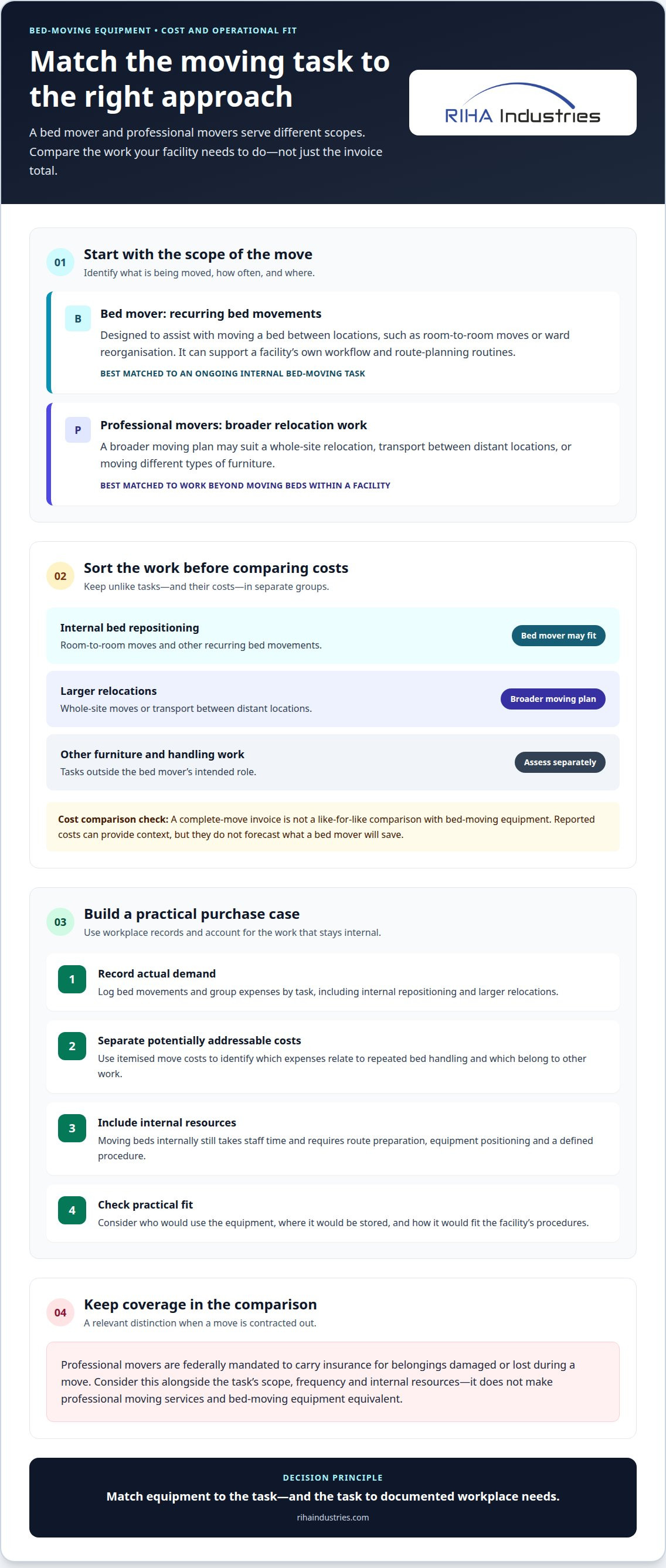
A bed mover suits recurring bed movements within a workplace, while professional movers handle broader relocation tasks. Reported costs for a complete move provide context, but they are not a like-for-like comparison with bed-moving equipment.
Buying equipment gives a facility a bed-moving method that fits its own workflow. Staff can, for example, plan routes between rooms without arranging a separate moving service for every internal relocation. This approach is relevant when bed movements are an ongoing workplace task. A single unusual relocation does not demonstrate the same continuing need.
Ownership also lets a facility align bed movement with local routines, including route preparation, equipment positioning and movement. These steps still take staff time and require a defined procedure. The financial case should therefore compare external moving costs with the resources needed to complete the task internally. This comparison helps explain how to justify buying a bed mover for recurring work.
Professional movers remain useful for work beyond a bed mover’s purpose. A whole-site relocation, transport between distant locations or movement of different types of furniture calls for a broader moving plan. Bed-moving equipment addresses bed movement, not every task in a relocation. Compare the scope of the move with the equipment’s intended role rather than treating the two options as interchangeable.
Build a practical comparison from workplace records. Group expenses by task, such as internal bed repositioning, larger relocations and other handling work. Identify which tasks a bed mover could address and which would still require professional movers. For example, repeated room-to-room moves belong in one category, while a facility-wide relocation belongs in another. This separation prevents a broad moving invoice from overstating the potential benefit of specialised equipment.
Finally, consider operational fit alongside costs. Identify who would use the equipment, where it would be stored and how its use would fit the facility’s procedures. If recurring bed movements are the main requirement, explore bed mover purchase options as part of the assessment. For teams working out how to justify buying a bed mover, the key is matching equipment to the task and the task to documented workplace needs. If the need centres on a one-off, broader relocation, professional moving services address a different scope.
Also assess how responsibility for belongings is handled. Professional movers are federally mandated to carry insurance for belongings damaged or lost during a move. This requirement is relevant when comparing a contracted relocation with an internally managed bed movement, but it does not make the services equivalent. Consider it alongside the task’s scope, frequency and internal resources, so the decision reflects both operational fit and the coverage associated with hiring movers.
5. How often to use a bed mover to justify buying one?
Use recorded demand, rather than an arbitrary weekly target, to assess how often a bed mover would be used. Log each bed movement over a representative operating period, recording the date, origin, destination, reason and whether equipment was involved. A room change and a bed repositioned for a ward layout are separate examples of demand.
Next, group the log by task and frequency. Separate planned movements, such as room preparation, from less predictable needs, such as a change in room layout. This shows whether use is steady or concentrated around particular activities. A mover used regularly for room-to-room relocations presents a different case from equipment needed only for a one-off facility change.
Count actual movements, not just the days when staff expect a bed to move. If several beds move during one operational task, count each movement as a use and record the reason for the task. Note periods with little activity too. Those gaps help show whether the equipment would support a continuing process or spend much of its time unused.
Then test the purchase case against the recorded pattern. Estimate expected uses over the period relevant to your decision and compare that figure with the equipment’s ownership cost and the resources involved in each move. A simple measure is total ownership cost divided by expected uses. This gives a cost-per-use view, but does not capture workflow or safety considerations on its own.
Regular demand: repeated bed relocations appear across the log and arise from normal operations.
Clustered demand: movements occur around a particular activity, such as room preparation.
Occasional demand: isolated moves appear without a recurring operational pattern.
Use the recorded pattern to explain the decision rather than setting a universal minimum number of uses. A facility with recurring room changes, for example, can show how often the task occurs and which teams are involved. A facility recording only an exceptional relocation has less evidence of ongoing demand. In either case, the log connects the proposal to observed work.
Revisit the estimate when operations change. A ward refurbishment, a change in room use or a new bed-moving process may alter expected demand. Keep the original record and compare it with the new pattern so decision-makers can see what changed. A well-supported purchase case rests on documented frequency, the tasks involved and expected use over time.
4. What types of beds and mattresses are compatible with bed movers
Compatibility depends on the bed’s construction and the mover’s intended connection, not simply the mattress name. A hospital bed, adjustable bed and fixed bed frame can have different moving requirements. The mattress sits on the bed, but the mover needs to work with the bed structure. Assess the complete setup before deciding whether a bed is suitable.
Start by identifying the bed base and how it is assembled. Note whether it has a fixed frame, an adjustable platform or another support arrangement, then identify where the mover is designed to connect. These details help distinguish a suitable connection from one that could interfere with bed components.
Mattress type is relevant, but it is not enough on its own. A foam mattress and a spring mattress may sit on the same bed base, yet the structure beneath them determines how the bed can be moved. Record whether the mattress stays in place during relocation or needs separate handling. This difference affects both the task and the equipment assessment.
Check each bed configuration against the mover’s instructions and intended use. Include the frame, base, moving components and mattress in the review. For an adjustable bed, consider how its sections and controls relate to the movement process. For a fixed frame, focus on its structure and the point where the mover connects. A bed type alone cannot establish compatibility.
Bed structure: Record the frame, base and any adjustable sections.
Mattress arrangement: Note its type and whether it remains on the bed during movement.
Connection point: Identify the part of the bed the mover is designed to engage.
Operating conditions: Consider the route and the bed’s configuration during movement.
Two beds described as hospital beds, for example, may have different frames or adjustment mechanisms. Their labels do not prove that they are equally compatible. Compare the actual configurations instead. An inventory recording frame type, base arrangement and mattress placement gives the assessment useful detail.
Consider compatibility alongside the movement task. A bed that suits the mover’s intended connection may still require a different process if its configuration changes. Record the usual setup and any variations, such as moving the bed with its mattress in place. This clarifies what the equipment needs to handle in everyday use.
For a purchase decision, group beds by matching construction and configuration, then assess each group against the mover’s documented operating requirements. Flag variations for separate consideration instead of assuming they are equivalent. This gives decision-makers a practical view of which beds the equipment is intended to move and whether the facility’s actual inventory suits that use.
5. What weight capacity and safety features should I look for in a bed mover
Start with the heaviest bed configuration the equipment is expected to move. Include the bed base, mattress and any components that remain attached during movement. A bare frame may weigh less than a fully prepared bed, so assess the actual operating setup rather than relying on the frame alone.
Next, compare the total load with the bed mover’s stated capacity and instructions. Check what the capacity rating covers, including whether it refers to the bed, the load being moved or another defined measure. If the facility uses several bed configurations, assess each against the same rating. Do not assume similar-looking beds have identical loads.
Consider a bed with an adjustable base and mattress left in place. Assess that complete configuration, not a lighter bed used for demonstration. Record the relevant components and compare them with the equipment documentation. This provides a clear basis for deciding whether the mover’s rated capacity suits the work.
Assess safety throughout the movement, from connection to stopping. Examine how the equipment engages with the bed, how the operator controls movement and how the system stops. For a corridor turn, consider whether the bed remains under control throughout the manoeuvre. The manufacturer’s operating instructions explain the intended setup and procedure.
Capacity: Match the rating to the complete bed configuration being moved.
Connection: Assess how the mover engages with the bed and whether that setup is intended.
Controls: Understand how the operator starts, guides and stops movement.
Operating procedure: Review instructions for setup, movement and routine inspection.
Assess the route and work process too. A level route between rooms presents different practical demands from one with tight turns or thresholds. Identify these features before selecting equipment, then consider how operators will maintain control along the planned path. Base the suitability assessment on the facility’s actual movement tasks, not an idealised route.
Evaluate safety features as documented functions, not assumptions based on appearance. A visible control, for example, does not prove a particular stopping function. Check each control’s purpose in the equipment instructions, and include operator training and maintenance procedures in the assessment. This connects equipment capability with the people and processes involved.
Use the results to compare required load, bed configuration, connection method and movement conditions with the equipment’s stated use. For a purchase discussion grounded in those requirements, discuss bed-moving equipment needs. A documented match gives decision-makers a more useful basis than choosing by capacity alone.
For belongings being moved, label boxes on all sides, including the top, to help organise them and identify fragile contents. Wrap fragile items individually, place them in sturdy boxes and prevent shifting with packing peanuts or foam padding.
If hiring a moving company, request a written estimate that itemises the service costs. Do not sign blank moving documents, as terms could be added later, including a large deposit or full payment requirement. Online reviews can help prospective customers understand what it may be like to work with a moving company.
RIHA Industries
RIHA Industries offers bed movers and patient transfer systems to help healthcare teams assess equipment against their operational needs. If your records show recurring bed movements, the StaminaLift 2100 Bed Mover is a relevant option to consider. The StaminaLift Transfer System 5000 and StaminaLift Transfer System 6000 address patient transfer needs, while Easi Rider and Easi Mover assist with moving heavy loads.
Use movement records, bed configurations and workplace requirements to frame the decision. These details connect the practical task with the equipment under consideration, rather than relying on move costs alone. Contact RIHA Industries to discuss your bed-moving requirements and available equipment options.
Turn the purchase case into a practical decision
A sound equipment decision should guide more than the initial purchase. It can also shape staff procedures, equipment allocation and future reviews. Decide who will oversee those responsibilities, how the equipment will fit existing workflows and what operational changes would prompt a reassessment. Clear ownership keeps the decision connected to the work it is intended to support.
The strongest way to justify buying a bed mover is to make the reasoning clear to everyone involved. Set out the operational need, explain the intended use and record the factors behind the recommendation. This gives decision-makers a shared basis for discussing the proposal and helps teams understand how the equipment fits their work.
For a conversation about equipment suited to your requirements, contact RIHA Industries to discuss your options. A considered next step can help turn a well-framed operational need into a confident, practical decision.