
How to Reduce Manual Handling Risk in Healthcare: The 2026 Safety Guide
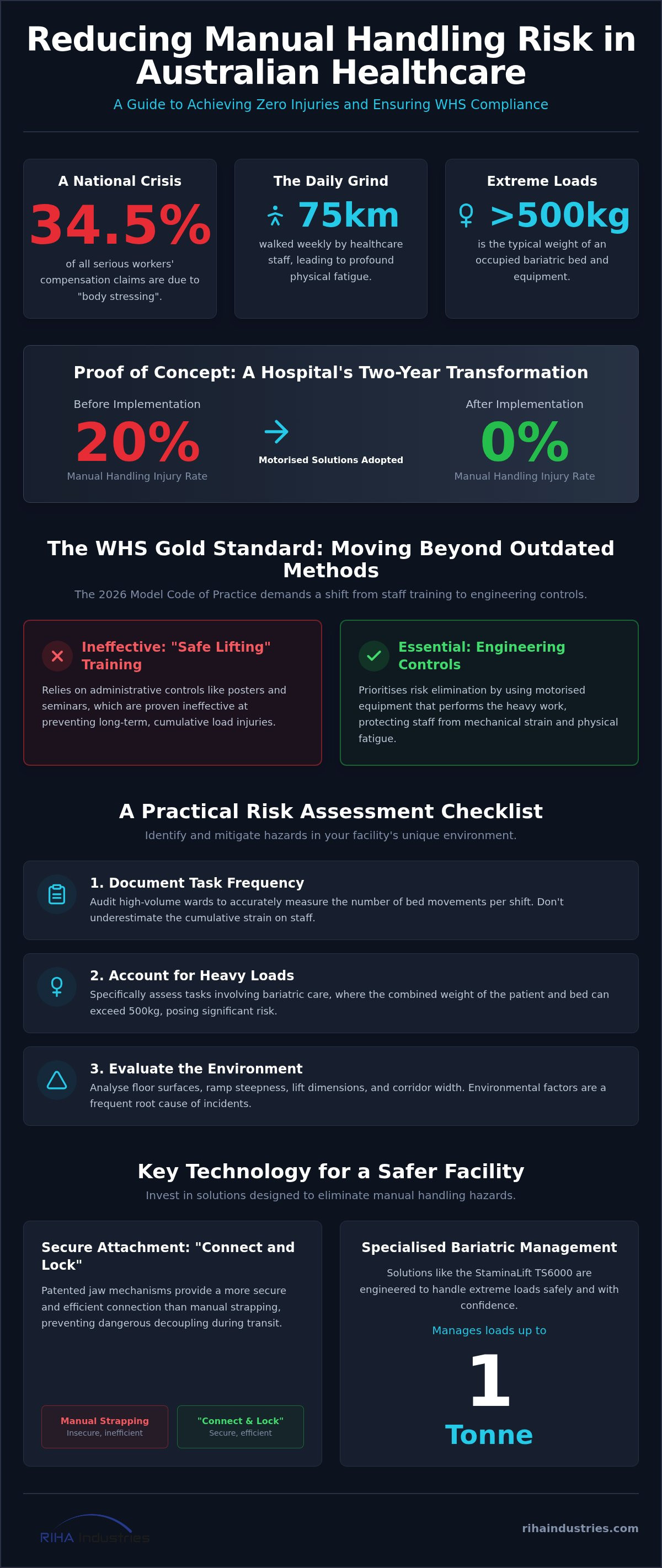
Did you know that "body stressing" now accounts for 34.5% of all serious workers' compensation claims across Australia? In the high-pressure environment of a modern hospital, these aren't just numbers on a spreadsheet; they represent dedicated nurses and porters facing career-ending back injuries and chronic burnout. You likely already know that traditional manual handling training isn't enough to protect your team from the physical toll of moving heavy bariatric loads through cramped wards. To truly reduce manual handling risk healthcare facilities require a fundamental shift from outdated lifting techniques toward robust engineering controls.
We understand the immense pressure to maintain ward efficiency while navigating the strict requirements of the 2025/2026 Model Code of Practice for Healthcare. This guide provides a clear roadmap to achieving zero manual handling injuries by integrating evidence-based strategies with advanced motorised solutions. We'll explore how to navigate tight hospital corridors with ease, reduce your facility's workers' compensation premiums, and ensure long-term compliance with the latest Australian WHS standards. From the patented manoeuvrability of the StaminaLift series to practical risk management frameworks, you'll discover how to empower your staff and protect your most valuable asset: your people.
Table of Contents
Understanding the Scale of Manual Handling Risks in Australian Healthcare
In modern clinical settings, manual handling risk isn't just about a single heavy lift. It's the daily reality of moving beds, stretchers, and diagnostic equipment that often exceed 500kg when occupied. This physical burden is intensified by the sheer volume of movement required; healthcare staff routinely walk up to 15km during a single shift, accumulating 75km over a standard working week. This sustained exertion leads to profound physical fatigue. When staff are physically exhausted, their cognitive load increases, which directly correlates with higher clinical error rates and compromised patient safety. Proactively managing these factors is the only way to reduce manual handling risk healthcare workers face every day.
The Physical Toll on Nursing and Portering Staff
Repetitive stress on the lumbar spine is a silent crisis in Australian wards. Unlike acute accidents, career-ending injuries often stem from "cumulative load," where the body eventually fails after years of pushing and pulling heavy equipment. Every time a porter or nurse manually manoeuvres a bed through a tight corridor, they're adding to this internal wear and tear. The impact of addressing this is measurable and transformative. For instance, a large South Australian hospital successfully reduced manual handling injuries from 20% to zero within just two years by implementing motorised transfer solutions. This shift proves that musculoskeletal damage isn't an inevitable part of the job; it's a preventable consequence of mechanical strain that can be solved through thoughtful engineering.
WHS Compliance and Regulatory Obligations in 2026
Under current Australian Work Health and Safety laws, facility managers have a non-negotiable duty of care to provide a safe working environment. The regulatory landscape in 2026 has moved decisively away from "safe lifting" training, which has proven ineffective at preventing long-term injury. Instead, the focus is now on the Manual handling of loads through higher-order engineering controls. To reduce manual handling risk healthcare providers must prioritise risk elimination. This involves moving beyond administrative changes, like posters or seminars, and investing in tools that do the heavy work. Using specific patient handling equipment selection criteria ensures that your facility doesn't just meet compliance standards but creates a culture of genuine safety. Engineering out the hazard is the gold standard for protecting your team and your facility's long-term operational health.
Conducting a Comprehensive Manual Handling Risk Assessment
A generic checklist isn't sufficient to reduce manual handling risk healthcare facilities face daily. Effective risk assessment requires a granular look at the facility's unique operational flow, specifically focusing on the intersection of task, environment, and load. Start by documenting the frequency of bed movements per shift; high-volume wards often underestimate the cumulative strain on staff. Modern assessments must also account for the increasing prevalence of bariatric care, where the physical weight of the patient combined with the bed can easily exceed 500kg. By identifying these variables, managers can move from reactive injury management to proactive prevention through Safe Patient Handling (SPH) programs that prioritise mechanical assistance.
Environmental factors are frequently the root cause of transfer incidents. Evaluate your facility's floor surfaces, the steepness of ramps, and the internal dimensions of elevators. Older Australian hospitals often feature narrow corridors and legacy floor plans that weren't designed for today's larger motorised beds. If you aren't sure where to begin your audit, using a specialised ROI calculator for facility managers can help quantify the physical and financial impact of these environmental hazards.
Identifying High-Risk Transfer Zones
In addition to motorised equipment, physical safety infrastructure such as compliant handrails plays a vital role in protecting staff on inclines. For custom fabrication that adheres to strict Australian standards, Donewright Stainless provides specialised handrails and safety fixtures to secure high-traffic hospital corridors.
Emergency Departments and Theatre suites are high-velocity environments where speed is critical, yet these areas often harbour the greatest risks. Tight corridors and 90-degree turns demand exceptional 360-degree manoeuvrability to prevent collisions and staff strain. Assessments should specifically flag any routes involving 7-degree inclines. Navigating a full load on such a slope without motorised aid is a primary source of acute injury, as the force required to control the descent or power the ascent exceeds safe human limits.
The Biomechanics of Pushing vs. Pulling Heavy Hospital Beds
There's a significant difference in how the body responds to pushing versus pulling. Pulling a heavy bed is often more hazardous for the shoulder complex because it places the joint in a vulnerable, extended position while requiring high force. The break-away force is the peak amount of energy required to overcome static friction and initiate the movement of a stationary object. For a 500kg bed, this initial burst of effort is where most musculoskeletal tears occur. Motorised assistance eliminates this initial strain of inertia, allowing a single operator to move the load without reaching the dangerous thresholds of physical exertion. This technological shift is essential to reduce manual handling risk healthcare workers encounter during every patient transfer.
Evaluating Motorised Solutions to Mitigate Musculoskeletal Strain
Selecting the right technology is the most critical step to reduce manual handling risk healthcare facilities face when moving heavy assets. While manual handling training focuses on human behaviour, motorised solutions provide a permanent engineering control that removes the physical burden entirely. Implementing OSHA Safe Patient Handling Programs often highlights that mechanical assistance is the only reliable way to keep forces within safe limits. Beyond simple movement, modern equipment must prioritise secure attachment. Traditional manual strapping is often clumsy and inconsistent. By contrast, a "Connect and Lock" jaw mechanism engages with the bed's frame automatically, providing a secure, rigid connection that eliminates the risk of the load shifting during transit.
Operational efficiency is further enhanced through integrated Bluetooth diagnostics. This technology allows facility managers to monitor equipment utilisation and battery health in real-time, ensuring that movers are always ready for high-pressure transfers. Even the smallest design details, such as non-marking drive wheels, play a vital role in long-term facility management. These specialised wheels provide high traction for heavy loads while preserving expensive hospital floor coatings, preventing the scuffing and degradation common with generic industrial tugs.
Why Powered Bed Movers Outperform Traditional Manual Methods
The ergonomic advantage of a dedicated bed mover lies in its precision and power. Using the StaminaLift TS5000, a single operator can safely transport a fully occupied bed, effectively doing the work that previously required two or three staff members. This isn't just about strength; it's about control. Joystick-controlled precision allows for smooth acceleration and braking, which is far safer for the patient than the jerky movements associated with manual pushing. For those responsible for equipment selection, our 2026 hospital bed mover procurement guide offers detailed insights into matching equipment specs with specific ward requirements.
Compatibility and Integration with Existing Infrastructure
A common hurdle in upgrading technology is the variety of the existing bed fleet. The StaminaLift TS5000 addresses this directly, as it's compatible with 95% of global hospital bed models. For facilities with non-standard equipment, the Jaw System 300 accommodates wider wheelbases ranging from 100mm to 300mm, ensuring universal utility across the ward. Despite this power, the designs remain remarkably compact. By adding only 200mm to the total bed length, these movers fit easily into standard hospital lifts, allowing for seamless vertical transport without the need for expensive structural renovations. This level of integration is essential to reduce manual handling risk healthcare providers manage during complex facility-wide transfers.
A Practical Checklist for Implementing Safer Handling Protocols
Transitioning from manual methods to engineering controls requires a structured implementation plan to ensure long-term success. To reduce manual handling risk healthcare facilities must move beyond simply purchasing equipment; they must integrate these tools into the daily rhythm of the ward. This checklist provides a framework for a seamless transition that prioritises both staff well-being and operational efficiency.
Step 1: Audit existing fleet: Identify manual handling "pain points" by mapping where staff encounter the most resistance. Focus on areas with heavy bariatric loads or long corridors with subtle inclines that increase the required break-away force.
Step 2: Trial equipment: Conduct a "hands-on" demo in real-world ward conditions. This allows porters and nurses to test compatibility with different bed models and navigate the specific tight turns and elevator thresholds of your facility.
Step 3: Establish super-users: Develop a training and certification programme for internal "super-users." These champions mentor their colleagues and ensure that safety protocols are consistently followed across every shift.
Step 4: Schedule maintenance: Implement a strict preventative maintenance schedule. Regular checks ensure that your fleet remains reliable and that safety features, such as emergency braking and jaw locking mechanisms, are always functional.
Staff Training and Competency Certification
Advanced equipment is only as safe as the operator behind the controls. Training should be an ongoing development process rather than a one-off event. To support this, many educators utilise realistic simulation tools from specialists like Мир манекенов to ensure staff are proficient in clinical techniques before moving to live ward environments. By utilising custom drive programs, you can tailor the equipment's acceleration and speed to match different staff skill levels or specific ward environments. We can also use Bluetooth usage history to identify specific areas where further training might be required. This data-driven approach helps managers identify if certain teams are struggling with battery management or bypassing safety protocols, ensuring that your safety standards remain high throughout the year.
Reliability is the cornerstone of any safety initiative because staff will revert to dangerous manual methods if equipment is unavailable. A professional hospital bed mover repair service is a fundamental safety requirement, not an optional extra. To support your in-house engineering teams, we provide 3D-viewer tools that offer detailed technical visualisations for troubleshooting and repairs. Because ward uptime is critical, we prioritise 24-hour parts shipping to ensure that your fleet is never out of action when a patient needs transport. If you are ready to audit your facility's safety needs, contact RIHA Industries today for an expert consultation.
Future-Proofing Your Facility with StaminaLift and Easi Series Technology
Future-proofing isn't just about meeting today's standards; it's about anticipating the heavier loads and tighter schedules of tomorrow's healthcare environment. To effectively reduce manual handling risk healthcare administrators must invest in equipment that evolves alongside their facility's needs. The latest generation of StaminaLift and Easi series technology incorporates lithium battery upgrades that deliver 20% better performance over traditional lead-acid units, ensuring your fleet remains operational through the most demanding double shifts. This shift to high-performance energy storage means less downtime at the charging station and more time supporting ward efficiency.
The StaminaLift TS5000: A Universal Solution for Modern Wards
The StaminaLift TS5000 remains the flagship choice for facilities seeking a universal patient transfer system. Its patented 360-degree turning radius allows a single operator to pivot a bed within its own length, a feature that is indispensable in legacy Australian wards with narrow corridors. This manoeuvrability is paired with a hands-free "Connect and Lock" system that engages with 95% of global hospital beds without requiring the operator to bend or strain. For night-shift operations, the TS5000 operates at a whisper-quiet 65 dB, ensuring that patient rest is never compromised during essential transfers. For a deeper look at technical specifications, refer to our StaminaLift Transfer System 5000 buying guide.
For specialised bariatric care, the StaminaLift TS6000 provides the necessary power to handle loads up to one tonne. This system is specifically engineered to maintain total control on 7-degree inclines, directly addressing one of the highest risk factors identified in environmental safety audits. Additionally, the StaminaLift 2100 Bed Mover offers a dedicated solution tailored for Australian-manufactured bed fleets, providing a compact footprint that maximises space in busy clinical environments without sacrificing towing power.
Heavy-Duty Logistics with Easi Rider and Easi Mover Tugs
Safety protocols must extend beyond patient beds to include the heavy logistics of facility management. Moving linen skips, meal trolleys, and waste bins presents a significant cumulative strain on portering teams. The Easi Rider and Easi Mover series are designed to bridge this gap, offering a massive 1500kg towing capacity. These battery-powered tugs allow a single staff member to transport multiple trolleys simultaneously, significantly improving ward efficiency while eliminating the risk of shoulder and back strain. Integrating these tools into your logistics strategy is a proven way to reduce manual handling risk healthcare staff face outside of direct patient care. You can find more information on optimising these workflows in our hospital porter equipment guide.
Transforming Patient Safety into an Operational Standard
Ensuring a safe clinical environment is no longer just about meeting compliance; it's about protecting the longevity of your healthcare workforce. We've explored how a transition from manual methods to engineering controls can effectively reduce manual handling risk healthcare facilities manage daily. By conducting thorough audits and implementing motorised solutions like the StaminaLift series, you can eliminate the physical burden that leads to career-ending injuries.
The results of this shift are quantifiable. Large South Australian hospital trials saw manual handling injuries drop from 20% to zero within two years of adopting our technology. As an Australian-made and FDA-registered manufacturer, we provide the reliability and national service coverage required for 24/7 ward operations. Taking the first step toward a zero-injury workplace is a commitment to both staff well-being and operational excellence.
Enquire about a hands-on StaminaLift demonstration for your facility to see how thoughtful engineering can empower your team today. Protecting your staff is a journey that starts with a single, safer transfer.
Frequently Asked Questions
What is the most common manual handling injury in healthcare?
Body stressing, specifically musculoskeletal disorders affecting the lower back and shoulders, is the most prevalent injury. These often result from the cumulative load of pushing and pulling heavy hospital beds, which can exceed 500kg when occupied. By using engineering controls to reduce manual handling risk healthcare facilities can prevent these chronic conditions. Statistics show that body stressing accounts for over 34% of serious workers' compensation claims in the Australian healthcare sector.
How much weight can a single staff member safely push in a hospital?
While individual capacity varies, Australian safety standards suggest that manually pushing a standard hospital bed with a patient is often unsafe for one person. A fully occupied bed can weigh up to 500kg, requiring a "break-away force" that far exceeds recommended limits for a single staff member. Motorised solutions remove this physical burden entirely, allowing a single operator to move heavy loads without exceeding safe exertion thresholds or risking acute injury.
Are motorised bed movers compatible with all hospital bed brands?
Our equipment is designed for universal integration across diverse facility fleets. The StaminaLift TS5000 is compatible with 95% of global hospital beds, including modern designs with plastic coverings or unique structural features. For non-standard equipment, the Jaw System 300 expands compatibility to wheelbases between 100mm and 300mm. This adaptability ensures that hospitals can implement a consistent safety standard regardless of the variety in their existing bed and stretcher inventory.
Can powered transfer systems be used on ramps and inclines?
Yes, our motorised movers are specifically engineered to maintain control on gradients. The StaminaLift TS6000, for example, can transport nearly one tonne of weight up a 7-degree incline under full load. This capability is vital to reduce manual handling risk healthcare workers face when navigating older facility layouts. The systems feature automatic braking and controlled acceleration to ensure patient and staff safety while ascending or descending ramps within the ward.
How does implementing motorised equipment affect workers' compensation premiums?
Implementing motorised equipment directly reduces the frequency and severity of workplace injuries, which leads to lower workers' compensation premiums over time. A large South Australian hospital reported that injuries from moving beds dropped from 20% to zero within two years of implementing StaminaLift technology. By eliminating "body stressing" claims, facilities can significantly reduce their insurance costs while improving staff retention and reducing the expenses associated with work-related time loss.
What training is required for porters to operate the StaminaLift TS5000?
RIHA Industries provides comprehensive staff training and competency certification to ensure safe operation. Operators learn to use the ergonomic joystick controls and navigate the three different drive programs available to suit individual preferences. Training also covers the "Connect and Lock" jaw mechanism, which secures beds without the need for bending or strapping. Facility managers can further monitor training needs by accessing Bluetooth usage history to identify specific areas for improvement.
How do you maintain bed movers in a busy 24/7 hospital environment?
Maintaining fleet reliability requires a combination of preventative maintenance and rapid support. We provide national service coverage across Australia and ship replacement parts globally within 24 hours to minimise downtime. For in-house engineering teams, we offer a 3D-viewer tool on our website to assist with technical troubleshooting and part identification. This proactive approach ensures that motorised movers remain available 24/7, preventing staff from reverting to hazardous manual handling methods.
Is the Easi Rider tug suitable for narrow hospital corridors?
The Easi Rider is specifically designed for the high-traffic, confined spaces of modern clinical environments. It features a patented 360-degree turning radius, allowing it to pivot on the spot and navigate tight 90-degree corners with ease. Despite its 1500kg towing capacity, its compact footprint ensures it fits through standard doorways and inside hospital elevators. This manoeuvrability makes it an ideal solution for moving linen and meal trolleys through busy wards safely.


