
Reducing Porter Back Injuries: 2026 Hospital Guide
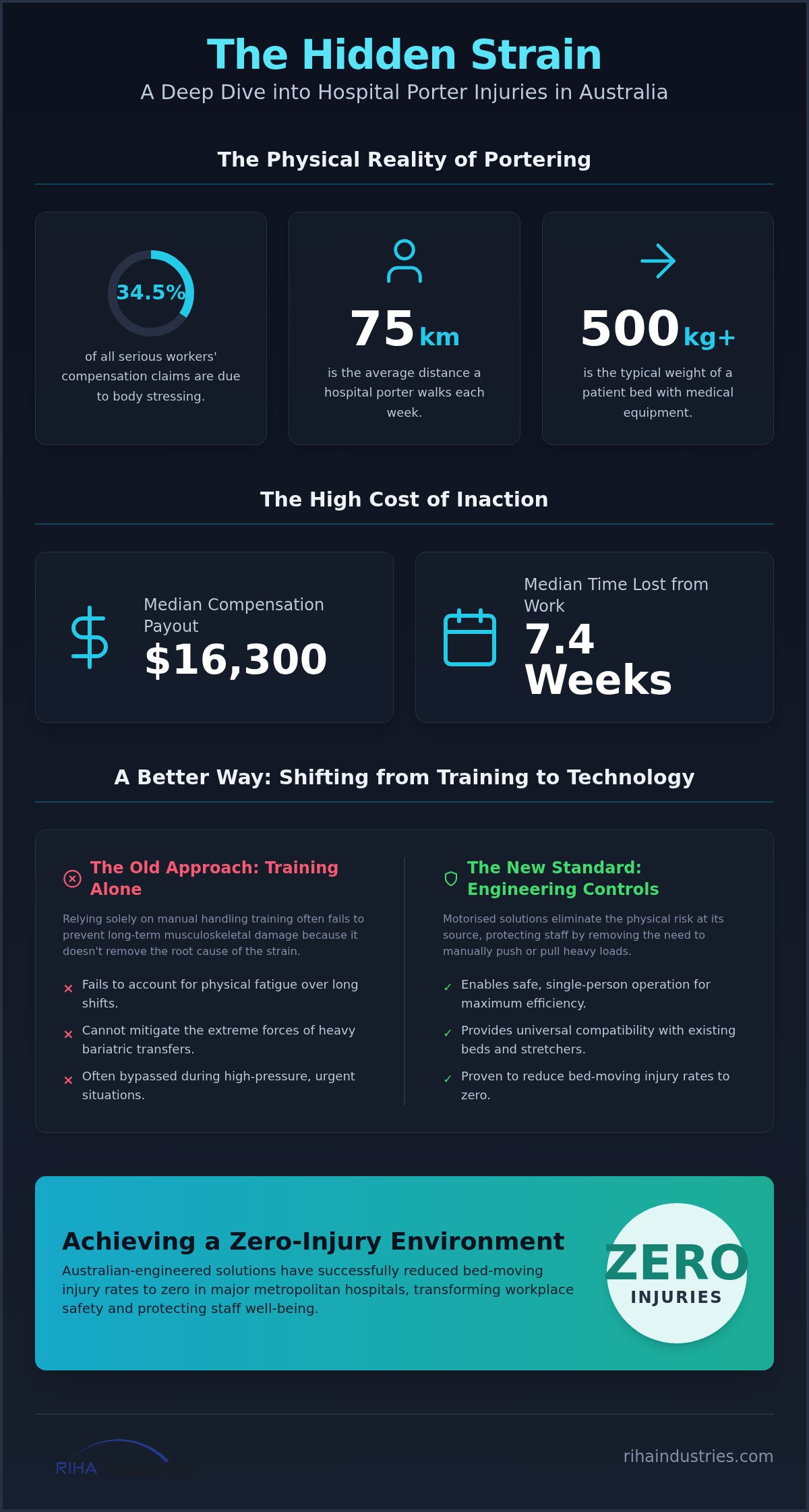
Did you know that body stressing remains the leading cause of serious workers' compensation claims in Australia, accounting for 34.5% of all workplace injuries? For hospital porters who walk up to 75km a week while manoeuvring loads that often exceed 500kg, the physical toll is frequently accepted as an unavoidable occupational hazard. You likely recognise the heavy burden placed on your transport team, where increasing bariatric challenges and staff shortages create a cycle of burnout and physical strain. It's a common frustration that traditional manual handling training often fails to prevent long-term musculoskeletal damage in such high-pressure environments.
This 2026 guide provides a roadmap for hospital leaders on how to reduce porter back injuries by moving beyond administrative controls toward motorised engineering solutions. We will explore evidence-based strategies to eliminate physical risks, improve portering efficiency, and meet the latest Australian WHS compliance standards. By the end of this article, you will understand how implementing advanced tools like the StaminaLift TS5000 can transform your facility into a zero-injury environment, helping you protect your most valuable asset: your people.
Table of Contents
The Physical Reality of Hospital Portering in Australia
In the high-pressure environment of a large Australian hospital, the physical demands on transport staff are often underestimated. While clinicians focus on immediate patient care, porters manage the constant logistical flow of equipment and people. This role involves far more than simple movement; it requires manoeuvring heavy, awkward loads through narrow corridors and busy wards. Understanding the sheer scale of this burden is the first step in learning how to reduce porter back injuries and creating a sustainable workplace for your team.
Most workplace injuries in this sector aren't the result of a single catastrophic event. Instead, they stem from cumulative strain. According to 2023-2024 data, body stressing remains the leading cause of serious workers' compensation claims in Australia, accounting for 34.5% of all cases. For a porter, this means years of micro-trauma to the spinal discs and soft tissues. This damage is often exacerbated by a lack of adherence to ergonomic principles for manual handling during peak periods when speed is prioritised over safety.
Walking 75km a Week: The Porter's Marathon
It's common for porters in busy metropolitan hospitals to walk up to 15km per shift, which totals a staggering 75km per week. This constant movement leads to significant physical fatigue. As a shift progresses, muscle exhaustion makes it harder to maintain proper posture. This fatigue doesn't just affect the feet and knees; it compromises the core stability needed to safely push and pull heavy beds. When staff are tired, they're more likely to use "shortcut" movements that put the lower back at risk, especially when navigating tight Australian hospital corridors.
The Bariatric Challenge and Heavy Loads
The 'invisible' weight of hospital equipment is a primary risk factor for musculoskeletal damage. A standard hospital bed, combined with a patient and attached medical equipment, often exceeds 500kg. With the rising frequency of bariatric transfers, these loads can grow even heavier. Even with two staff members, the force required to initiate movement or steer around corners exceeds safe manual limits. Protecting staff from these extreme loads requires engineering controls like the StaminaLift Transfer System 6000. This system is designed to handle up to 900kg push/pull capacity, effectively removing the physical burden from the operator and ensuring single-person operation is both safe and efficient.
The financial consequences for Australian healthcare budgets are significant. With the median compensation payment for a serious claim sitting at $16,300 and the median time lost at 7.4 weeks, the cost of inaction is high. Reducing these injury rates isn't just a safety priority; it's a financial necessity for modern hospital management.
Ergonomic Principles to Reduce Manual Handling Risk
While engineering controls are the gold standard for safety, understanding the fundamental mechanics of the human body is essential for immediate risk reduction. The human spine is remarkably strong when aligned, but it becomes highly vulnerable when subjected to rotational forces. Twisting while under load is the single most significant risk factor for disc herniation and acute muscle strain. For this reason, porters must be trained to move their feet rather than their waists when navigating obstacles, ensuring the spine remains neutral during every manoeuvre.
Managing common hazards in hospitals involves more than just physical strength; it requires a proactive approach to workspace design. Adjusting bed and trolley heights to the 'Power Zone' (between mid-thigh and mid-chest) prevents staff from bending unnecessarily. This simple adjustment significantly reduces the compressive pressure on the lumbar spine. Before every equipment move, porters should perform a 'dynamic' risk assessment. This quick mental check identifies potential hazards like floor spills, narrow doorways, or unexpected patient movements that could force a porter into a dangerous, sudden bracing posture.
Proper Posture and Pushing Techniques
Maintaining the load close to the body's centre of gravity ensures that the largest muscle groups perform the work. Pushing is almost always safer than pulling. Pulling often forces the porter to walk backwards or use smaller muscle groups in the arms and shoulders while placing the back in a vulnerable, twisted position. It's also vital to avoid the common 'jerk' motion when starting a move. Smooth, gradual acceleration allows the body to engage stabilising muscles. If a load requires a sudden burst of force to initiate movement, it's too heavy for manual handling and requires mechanical assistance.
Environmental Factors in Hospital Corridors
Hospital layouts present unique challenges like tight 90-degree corners and steep ramps. Gradients are particularly dangerous; a gradient of just 7 degrees can effectively double the force required to keep a 500kg bed under control. This makes manual braking nearly impossible for a single operator. Maintaining a clear line of sight is also non-negotiable. Sudden stops caused by unexpected foot traffic lead to bracing injuries, where the porter's muscles must absorb the kinetic energy of the moving load instantly. Proper footwear with slip-resistant soles and well-maintained flooring are the final pieces of the puzzle, providing the necessary traction to apply force safely.
Learning how to reduce porter back injuries involves a combination of individual technique and environmental awareness. However, even the most disciplined technique has physical limits when facing heavy bariatric loads. To see how engineering can take the strain out of these daily tasks, you can view our range of specialised transfer systems designed specifically for the rigours of Australian healthcare environments.
Why Training Alone Fails: The Case for Engineering Controls
For decades, the standard response to workplace strain has been more manual handling training. However, evidence consistently shows that relying on human behaviour to manage extreme physical risk is flawed. In the Australian Work Health and Safety (WHS) Hierarchy of Control, administrative measures like training are ranked near the bottom. They don't remove the hazard; they simply ask the worker to navigate it. To truly understand how to reduce porter back injuries, we must look at engineering controls that eliminate the high-force requirement altogether.
Motorised aids, such as the StaminaLift series, replace physical exertion with thoughtful engineering. This shift removes the human variable from the safety equation. A compelling example of this success occurred at a large South Australian hospital. Within two years of implementing StaminaLift equipment, the hospital's bed-moving injury rate dropped from 20% to zero. This wasn't achieved through more training, but by providing staff with the mechanical power to perform their jobs without risk.
Training vs. Engineering: A Direct Comparison
Manual pushing requires significant physical effort, leading to rapid fatigue. When a porter is exhausted, their form inevitably slips, creating a 'point of failure' where injury occurs. In contrast, joystick operation requires zero physical force, regardless of the patient's weight. This makes single-person operation a safe, standard procedure rather than a risky necessity. During emergencies, when adrenaline often leads to poor manual handling choices, a motorised mover ensures the equipment handles the momentum, not the porter's spine.
The ROI of Preventing a Single Back Injury
The financial impact of a single serious back injury is substantial. Beyond the median compensation payment of $16,300, hospitals face the costs of rehabilitation, lost productivity, and hiring replacement staff. Using StaminaLift's ROI calculator helps facilities visualise these hidden expenses and the long-term savings provided by engineering controls. Beyond the balance sheet, there is the human value of staff retention. By reducing physical burden, you keep experienced porters in the workforce longer, maintaining a stable and reliable transport team for your metropolitan wards.
Implementing Motorised Bed Movers and Tugs
Success in reducing musculoskeletal risks begins with a thorough audit of your current equipment fleet. By identifying which specific beds and trolleys require the most physical force to steer or initiate movement, you can prioritise where to deploy motorised assistance. This data-driven approach is fundamental to understanding how to reduce porter back injuries across different wards. Compatibility is a critical factor here. It's essential to ensure your movers feature patented hitches that connect seamlessly with global bed brands, which avoids the need for manual strapping or awkward bending during the connection process.
Gaining staff buy-in is equally important for a successful rollout. Porters shouldn't view motorised aids as a sign of weakness, but as an essential, professional tool that extends their career longevity and protects their health. To keep these tools shift-ready, establish a clear maintenance schedule and charging protocol. Modern lithium battery upgrades ensure high-use metropolitan wards have the uptime they need, while regular preventative maintenance prevents the mechanical downtime that might otherwise force porters back into risky manual handling practices.
Choosing the Right Mover for Your Ward
Not every ward has the same requirements, so selecting equipment based on specific environmental challenges is vital. The StaminaLift TS5000 is the versatile choice for standard acute care beds, offering 360-degree manoeuvrability that's perfect for modern hospital wings. For long-distance transport tasks, such as moving linen or meal trolleys, the Easi Rider provides an efficient solution that significantly reduces walking fatigue. In older facilities with narrow corridors and tight lifts, the StaminaLift 2100 offers a compact footprint without sacrificing the power needed to protect staff from strain.
Safety Features to Look For
Effective engineering controls must enhance safety without complicating the porter’s workflow. High-quality movers should include automatic braking and emergency stop buttons, which are vital when navigating crowded corridors or unexpected obstacles. Hands-free jaw connections are a significant advantage, as they eliminate the need for porters to bend down or manually secure the load. Finally, consider the patient experience; equipment like the TS5000 operates at a quiet 65 dB. This ensures that while you protect your staff, you also maintain a peaceful and professional healing environment for those in your care.
Taking the first step towards a safer workplace requires the right technical partner and the correct equipment for your specific needs. To find the ideal fit for your facility's layout and load requirements, you can explore our full range of bed and trolley movers today.
Zero-Injury Success with RIHA Industries' Solutions
Achieving a zero-injury environment isn't a theoretical goal; it's a practical outcome of choosing the right engineering partner. RIHA Industries provides a proven roadmap for how to reduce porter back injuries by removing the physical burden from the staff entirely. As the only FDA-registered bed mover manufacturer in the world, we bring a level of precision and reliability that is essential for high-stakes healthcare environments. Our Australian-made equipment is designed to withstand the rigours of 24/7 metropolitan wards, supported by a commitment to 24-hour parts shipping that ensures your fleet remains operational when it's needed most.
The technological edge of our solutions lies in their seamless integration and ease of use. For example, our systems are compatible with 95% of global hospital bed brands, which allows facilities to standardise their safety protocols without replacing existing furniture. We've also introduced advanced features like Bluetooth diagnostics for rapid troubleshooting and lithium battery upgrades for extended performance in high-use wards. Beyond the initial implementation, we support the entire equipment lifecycle through comprehensive preventative maintenance and repair services, ensuring that safety is a permanent fixture in your facility, not a temporary initiative.
StaminaLift: The Gold Standard in Bed Moving
The StaminaLift series is engineered to transform the way patients are moved through complex hospital layouts. With a 360-degree turning radius, these movers allow a single operator to navigate tight lifts and sharp corners with total confidence. The 'Connect and Lock' mechanism is particularly vital; it requires zero manual effort from the porter to secure the bed, effectively eliminating the bending and reaching that often lead to acute strain. To understand which model best fits your facility's specific requirements, see our StaminaLift Transfer System 5000 Buying Guide.
The Easi Series for Facility Logistics
While patient transport is a high-risk area, facility logistics like moving linen, meals, and medical waste also contribute to staff burnout. The Easi Rider is designed to handle these heavy-duty tasks, moving up to 1500kg with ease. By utilising ride-on platforms, these units significantly reduce the walking burden on logistics staff, preventing the cumulative fatigue that often precedes a manual handling injury. Investing in the right tools for these secondary transport tasks is a critical component of a holistic safety strategy. You can further explore Hospital Porter Equipment for 2026 to see how these solutions integrate into a modern, efficient hospital workflow.
Building a Safer Future for Australian Hospital Staff
Protecting your portering team from the physical toll of 500kg loads is no longer just a training challenge; it's a strategic engineering opportunity. You've seen how the shift from administrative controls to motorised solutions can transform ward safety while improving operational efficiency. By prioritising the long-term health of your transport staff, you're not only meeting Australian WHS compliance but also ensuring a stable, empowered workforce for the high-pressure years ahead.
Discovering how to reduce porter back injuries effectively requires moving beyond traditional methods toward proven, world-class technology. Our Australian-made, FDA-registered equipment is compatible with 95% of hospital beds and has already demonstrated the power to reduce injury rates from 20% to zero in South Australian hospital trials. These results prove that the right equipment doesn't just manage risk; it eliminates it by taking the physical burden off the human frame.
Take the next step in safeguarding your team's well-being. Protect your staff and request a hands-on StaminaLift demonstration today. Let's work together to make musculoskeletal strain a thing of the past in your facility.
Frequently Asked Questions
What is the most common cause of back injuries for hospital porters?
The most common cause is body stressing, which accounts for 34.5% of serious workers' compensation claims in Australia. This usually results from the cumulative strain of pushing and pulling heavy hospital beds that often exceed 500kg. While acute injuries happen, most porters suffer from long-term musculoskeletal damage caused by repetitive force and poor posture. Understanding these physical stressors is the first step in learning how to reduce porter back injuries across your entire facility.
How much weight can a hospital porter safely push manually?
There is no single "safe" weight, as risk depends on individual posture and the hospital environment. However, Australian WHS guidelines suggest that loads exceeding 200kg to 300kg generally require mechanical assistance to prevent injury. Since a standard hospital bed with a patient and equipment often weighs 500kg, manual pushing is inherently hazardous. Using motorised movers ensures that the equipment handles the momentum, protecting the porter from the high-force requirements of bariatric transfers.
Do motorised bed movers really reduce injury rates to zero?
Yes, evidence from Australian healthcare trials supports this outcome. A large South Australian hospital reported that bed-moving injury rates dropped from 20% to zero within just two years of implementing StaminaLift equipment. By replacing manual exertion with motorised power, the physical point of failure is removed from the task. This transition effectively eliminates the musculoskeletal risks associated with transporting heavy patients through busy metropolitan wards and narrow, high-traffic corridors.
Are StaminaLift movers compatible with all hospital bed brands?
StaminaLift movers are designed for universal compatibility, integrating seamlessly with approximately 95% of all hospital beds globally. This is achieved through our patented hitching systems, which include options like the Pin Hitch and Electric Adjustable Hitch. These mechanisms allow the mover to connect to various frame types and wheelbases without the need for manual strapping. This ensures that facilities can standardise their safety equipment across diverse fleets of beds, stretchers, and trolleys.
How long does the battery last on a motorised bed mover?
Our motorised movers are engineered to last through a standard hospital shift on a single charge. For high-use wards that require constant equipment movement, we offer a lithium battery upgrade that boosts performance by up to 20% compared to conventional batteries. These units also feature integrated chargers with retractable cables, making it easy for staff to top up the power during quiet periods to ensure the equipment is always shift-ready and reliable.
Can motorised tugs be used on ramps and inclines in hospitals?
Yes, our equipment is specifically rated for use on hospital ramps and inclines. The StaminaLift TS6000, for example, can safely transport nearly one tonne up a 7-degree incline under full load. This is a critical safety feature, as gradients significantly multiply the effective weight of a bed. Motorised braking ensures the load remains under total control while descending, preventing the "runaway" risks often associated with manual handling on slopes or uneven flooring.
What safety features are essential for a hospital bed mover?
Essential safety features include automatic braking upon joystick release, emergency stop buttons, and a 360-degree turning radius for confined spaces. Quiet operation at 65 dB is also vital to maintain a healing environment for patients. Our movers include "connect and lock" jaw mechanisms that secure the load without requiring the porter to bend or reach. These systems are a key component in a comprehensive strategy for how to reduce porter back injuries while maintaining high operational standards.
Is there a ride-on option for porters moving equipment over long distances?
Yes, we provide several options to reduce walking fatigue for transport staff. The Easi Rider is a dedicated ride-on tug designed for moving up to 1500kg of linen or meal trolleys over long distances. Additionally, our StaminaLift bed movers can be fitted with a fold-up ride-on platform accessory. This allows porters to stand on the unit during transport, significantly reducing the 75km per week walking burden often experienced in large metropolitan facilities.


