Infection control for patient transport equipment and risks
Patient transport can expose staff and others to infection if precautions, equipment cleaning and the route are not managed carefully. Infection control for patient transport equipment includes assessing the risk before transfer, using appropriate precautions and cleaning reusable equipment and high-touch surfaces after use.
It’s understandable to focus on the patient’s safe arrival, but the journey matters too. Close contact and contaminated surfaces can create opportunities for infection to spread, so careful planning and clear communication are part of safer transfers.
This article explains the main transmission risks during patient transport, how standard and transmission-based precautions apply, and what to consider when choosing disinfectants and following their contact times. It also shows how cleaning procedures, personal protective equipment and equipment design contribute to a consistent approach to protecting patients and healthcare staff.
Table of Contents
What are the risks of transport of infected patients?
During transport, pathogens may be present on equipment and frequently touched surfaces, creating a risk of transmission. Cleaning routines need to cover the vehicle, reusable equipment and the surfaces staff handle while moving a patient.
Cleaning vehicles and equipment
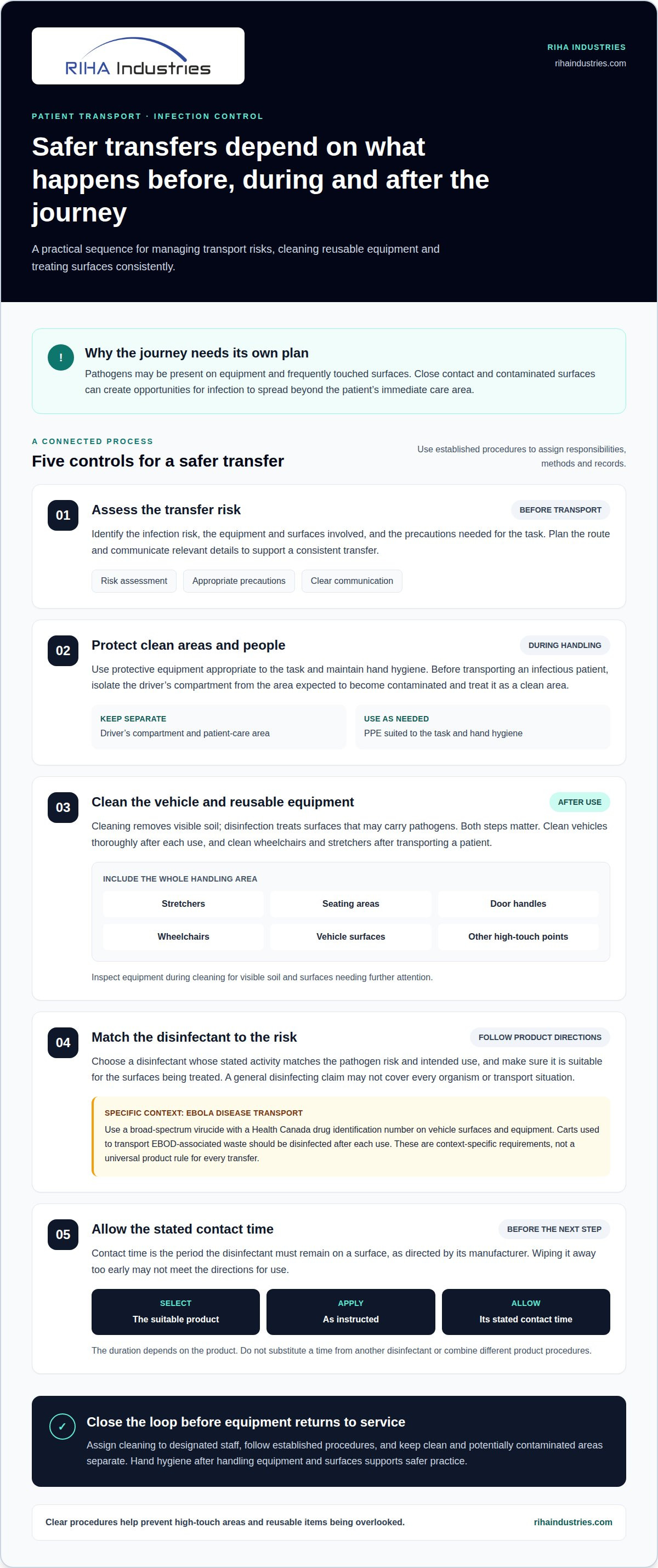
Cleaning removes visible soil, while disinfection treats surfaces that may carry pathogens. Both steps matter because door handles, stretchers and seating areas are touched repeatedly during a journey. Thoroughly clean patient transport vehicles after each use, paying particular attention to high-touch points. Reusable medical equipment also needs proper cleaning as part of infection control.
Cleaning procedures should identify all relevant surfaces and equipment, not just the patient’s immediate area. For example, staff may need to include a stretcher, nearby seating and door handles in the same post-use process. A clear procedure helps ensure frequently touched areas aren’t overlooked between transfers.
Handling equipment after contagious transport
After transporting a patient with a contagious infection, clean reusable equipment before using it again. Clean wheelchairs and stretchers after transporting a patient, and thoroughly clean transport vehicles after each use. Staff should follow established procedures and use protective equipment appropriate to the task. Hand hygiene after handling equipment and surfaces supports safer practice.
Keep clean and potentially contaminated areas separate. Before transporting an infectious patient, isolate the driver’s compartment from the area expected to become contaminated and treat it as a clean area. This separation helps limit the spread of contamination from the patient-care area into the driver’s space during the journey.
For CDC, OSHA and state rules, transport providers should use their applicable infection-control and workplace procedures to set cleaning responsibilities, methods and records. These procedures should cover vehicles, reusable equipment and frequently touched surfaces.
How often should patient transport equipment be inspected and cleaned? Vehicles should be thoroughly cleaned after each use, and wheelchairs and stretchers should be cleaned after transporting a patient. Inspect equipment during cleaning for visible soil and surfaces that need further attention.
Who is responsible for cleaning transport equipment in hospitals and ambulances? The organisation’s procedures should assign this task to designated staff and describe how they clean vehicles and equipment after use. Clear responsibility helps prevent a stretcher or other reusable item from returning to service before its cleaning is complete.
A reliable process links equipment handling with the next patient’s safety. Teams can identify the transport area, clean its high-touch surfaces and reusable equipment, and maintain hand hygiene after handling them. This makes cleaning a defined part of patient transfer, rather than an overlooked task between journeys.
Disinfectant selection and manufacturer contact time
Choose a disinfectant suited to the infection risk and the surfaces being treated. Follow the manufacturer’s instructions, including the stated contact time, for safe and consistent use.
Selecting a disinfectant
Choose a disinfectant whose stated activity matches the pathogen risk and intended use. A general disinfecting claim may not cover every organism or transport situation. For Ebola disease transport, use a broad-spectrum virucide with a Health Canada drug identification number on vehicle surfaces and equipment.
The product also needs to suit the surfaces in the cleaning procedure. A stretcher, seating area and vehicle handle may all need attention during post-transport cleaning. Healthcare teams can make the process clearer by identifying surfaces to treat and using the product according to its directions. Washing and cleaning are distinct from disinfection, so address visible soil within the established procedure.
Following manufacturer contact time
Contact time is the period a disinfectant must remain on a surface, as directed by its manufacturer. Following that instruction matters because wiping the product away too early may not meet the directions for use. Staff should read the product instructions and apply them consistently to each relevant surface.
For example, a cleaning procedure can specify how staff apply disinfectant to a stretcher or vehicle handle, then allow the stated contact time before the next step. The duration depends on the product instructions, so don’t substitute a time from another disinfectant. Staff training and clear procedures help reduce variation between shifts and care facilities.
For Ebola disease transport, disinfect vehicle surfaces and equipment with the specified broad-spectrum virucide, following the manufacturer’s instructions. The same product criteria apply to carts used to transport EBOD-associated waste, which should be disinfected after each use. These requirements are specific to that context, not a universal product rule for every patient transfer.
Exposure risk also shapes how teams apply the procedure. The cleaning plan should identify the equipment and surfaces involved, the disinfectant selected and the instructions staff must follow. A clear record of these steps can support consistent practice across healthcare settings. If product instructions differ, staff should follow the directions for the product in use rather than combining procedures.
Infection transmission risks during patient transport
Patient transfer can create opportunities for infection to spread beyond the patient’s immediate care area. People with suspected COVID-19 can infect others during transfer and transport. Staff, other patients, visitors and members of the public may be exposed if movement is poorly coordinated. The risk depends on the infection, the patient’s condition and contact with people or shared spaces along the route.
Transport isn’t always avoidable, but move infectious patients only when highly necessary. A transfer may be needed to access essential care or another facility. Before moving the patient, the team should consider their condition and infection status, the destination and who they may encounter in transit. This assessment helps determine suitable precautions and whether the planned journey can proceed safely.
Inside a hospital, route planning can reduce exposure to others. For an infectious patient, plan the route and clear other patients, visitors and the public from it during transport. If a lift is needed, secure it against use until the patient arrives and the lift has been contaminated. These measures limit access to shared spaces while the patient passes through them.
Communication helps make these arrangements practical. Healthcare teams and transport staff should share relevant infection-control information before moving the patient. Staff need to understand the precautions required and the route arrangements. Without clear communication, a receiving team may be unprepared, or people may enter a route that should remain clear during the transfer.
Infection prevention relies on coordinated practices, not a single action. The transfer plan should connect the patient’s risk assessment with appropriate personal protective equipment, route management and post-transfer procedures. Protective equipment adds to other precautions, but doesn’t replace them. Staff should follow their organisation’s procedures so each part of the transfer supports the same infection-control plan.
Consider a patient moving between hospital departments. The team assesses infection status, communicates the required precautions, plans the route and coordinates movement through shared areas. If a lift is needed, access is controlled during the transfer. Each step addresses a different opportunity for exposure, from contact with people to movement through common spaces.
Transport decisions also affect people beyond the clinical team. A route may pass through corridors or other shared areas where visitors and patients could be present. Limiting unnecessary movement and coordinating the journey helps reduce avoidable contact. Clear instructions before departure help staff respond consistently if the route or transfer plan changes.
Standard and transmission-based precautions
Precautions connect patient assessment, staff protection and equipment handling during a transfer. Apply standard practices for every patient, then add precautions suited to identified transmission risks.
Standard precautions
Standard precautions are the minimum infection-prevention practices used at all times for every patient and situation. They matter during transport because staff handle patients, equipment and nearby surfaces as part of one transfer.
Perform hand hygiene before putting on gloves and immediately after removing them. Use alcohol-based hand rub on dry hands when they aren’t visibly soiled. Wash with soap and water when hands are visibly soiled or after using the toilet. These actions support infection prevention before and after patient contact, and after handling equipment or surfaces.
Healthcare professionals should wear appropriate personal protective equipment during every patient contact. For contact transmission precautions, use gloves for manual contact with the patient, associated devices and immediate environmental surfaces. Gloves are single-use, so don’t wash them or apply hand rub for reuse. Reusable instruments and equipment also require reprocessing under standard precautions.
These procedures work together: hand hygiene doesn’t replace protective equipment, and gloves don’t replace hand hygiene. For example, a transport worker handling a patient’s device needs to follow the applicable precautions and clean their hands after contact. Staff should follow their organisation’s policies for handwashing methods and for putting on and removing protective equipment.
Applicable equipment infection-control guidelines
Transmission-based precautions are additional measures used when standard precautions alone may not prevent infection from spreading. Applying them according to the identified risk helps teams select suitable protective equipment and handling procedures for a transfer.
Transport may require contact, droplet or airborne precautions. For droplet transmission, Victorian guidance calls for a surgical-style mask. It also describes a standard single room with its own ensuite, or cohorting patients with the same infection. For droplet or airborne risks, people identified as at risk should be attended to immediately and placed under appropriate precautions.
Signage for a patient under transmission-based precautions should sit prominently outside the room and state the precautions and protective equipment required. Transport staff need risk-appropriate PPE and training in putting it on and removing it. The Victorian guidance refers to AS/NZS 1715 for additional information about P2 respirators and AS 4381:2015 for surgical-style masks.
In Australia, patient transport services should follow national and organisational infection-control standards. Ongoing education, accurate records of infection risks and procedures, and regular audits help teams identify gaps. Together, these practices connect staff precautions with equipment reprocessing and disinfection after transfer.
What infection-control guidelines apply to patient transport equipment?
Guidance for transport equipment forms part of broader infection-control procedures for health services. In Australia, patient transport services should follow national and organisational infection-control standards. Procedures should cover transfers from a person’s home to a health facility, between facilities and within a hospital, addressing movement, equipment and waste in each setting.
For a hospital evacuation during a fire or severe weather, the plan should avoid exposing other patients and medical staff. Infection risk is one consideration in route and movement planning, alongside the immediate emergency. Transport teams and hospital staff need clear communication about the patient’s infection risk and the transfer arrangements.
Vehicle turnaround can affect service planning after an infectious patient transfer. An ambulance carrying an infectious patient usually requires two to four hours for disinfection before its next transport. Full disinfection of a medical helicopter can take up to a day after transporting an infectious patient. These periods differ by transport type, so procedures should account for the vehicle involved.
Guidance also covers the safe handling and disposal of medical waste. Segregate and manage transfer waste under the applicable procedures for its type and destination. Handle sharps separately from other waste and dispose of them at the point of use. For EBOD-associated waste, the stated handling details include:
Securely seal non-sharps waste bags when they are two-thirds full.
Securely close sharps containers when they are two-thirds full.
Keep EBOD-associated sharps waste separate from other waste and discard it at the point of use.
Canadian requirements illustrate how waste procedures can vary by jurisdiction. Health-care waste handling is covered by Canadian Standards Association Standard Z317.10:21, while sharps-container requirements are covered by Canadian Standards Association Standard Z316.6:20. EBOD-associated waste transported off-site in Canada should follow applicable legislation, including Transport Canada’s Transportation of Dangerous Goods Regulations.
These examples don’t replace the standards that apply in Australia. They show why procedures need to distinguish routine patient transfers from specific infection risks, waste types and transport arrangements. Provide staff with ongoing infection-control education, and use records of risks and procedures to maintain continuity between teams. Regular audits and quality checks can identify gaps and guide improvements.
For an operational review, map the journey from collection to handover, then account for vehicle turnaround, waste handling and the receiving facility. This connects transport decisions with the applicable infection-control procedures, rather than treating equipment as a separate concern.
Cleaning is part of broader infection-control procedures, and turnaround depends on the vehicle. After an infectious patient transfer, an ambulance usually requires two to four hours for disinfection, while a medical helicopter can take up to a day.
RIHA Industries
RIHA Industries supports healthcare teams with patient transfer systems and bed movers designed to move patients and equipment through care environments. These solutions address movement challenges, while infection-prevention procedures remain essential for cleaning, disinfection and staff protection.
For facilities reviewing how patient transfers fit into their infection-control processes, RIHA Industries offers the StaminaLift Transfer System 5000, StaminaLift Transfer System 6000 and StaminaLift 2100 Bed Mover. The Easi Rider also assists staff with moving heavy loads. These offerings support transfer and movement needs; they don’t replace equipment cleaning or infection-control protocols.
Contact RIHA Industries to discuss patient transfer equipment for your healthcare setting.
Make safer transfers part of everyday practice
A lasting approach to infection control for patient transport equipment takes more than a written procedure. It depends on making the intended practices workable for the people moving patients, so safe handling remains part of the transfer process rather than an extra task.
Consider how equipment, staff responsibilities and movement requirements fit together in your healthcare setting. A practical review can reveal where workflows need clearer handovers or better alignment with infection-control procedures. This gives teams a useful basis for improving transfer management over time.
RIHA Industries’ patient transfer equipment can form part of that wider operational picture. Start by identifying the movement challenges your facility needs to address, then consider which equipment may support those needs.
Start a conversation with RIHA Industries about patient-transfer equipment for your setting. With thoughtful planning and the right operational fit, your team can keep safer movement at the centre of patient care.
Frequently Asked Questions
How should wheelchairs, stretchers, and transport trolleys be cleaned and disinfected between patients?
Clean and disinfect reusable items after patient use, following the organisation’s procedures and the product instructions. Include parts touched during handling, such as wheelchair controls, stretcher rails and trolley handles. A consistent approach to infection control for patient transport equipment also covers items used to move waste. For example, disinfect trolleys used for EBOD-associated waste after each use, following the product directions.
Which EPA-registered disinfectants are effective for patient transport equipment?
Choose a disinfectant suited to the infection risk and the equipment’s intended use, then follow its label and organisational procedures. The information here doesn’t identify a universal EPA-registered product for Australian transport equipment. For Ebola disease transport, the specified criterion is a broad-spectrum virucide bearing a Health Canada drug identification number. That criterion applies to this specific context, not every patient transfer.
How long must disinfectant remain wet on transport equipment surfaces?
Keep the surface wet for the contact time stated in the disinfectant manufacturer’s instructions. No single duration applies to every product, so follow the directions for the disinfectant selected rather than borrowing a time from another product. For example, staff treating stretcher rails should follow the product’s application and contact-time instructions before returning the equipment to service.
What personal protective equipment should staff use when cleaning patient transport equipment?
Use protective equipment suited to the infection risk and cleaning task. Depending on the risk, this can include gloves, masks, gowns and eye protection. Staff should be trained to put PPE on and remove it correctly. Perform hand hygiene before putting on gloves and immediately after removing them. Gloves are single-use and shouldn’t be washed or treated with hand rub for reuse.
What steps should staff follow to clean and disinfect transport equipment safely?
Follow the organisation’s established procedure: identify the equipment and surfaces involved, use appropriate PPE, then clean and disinfect as directed. Allow the disinfectant its stated contact time. Handle waste under applicable procedures and complete required records of infection risks and actions. These practical steps make infection control for patient transport equipment part of the handover, including when another team takes responsibility for the patient or equipment.
What infection risks arise from improperly cleaned patient transport equipment?
Contaminated equipment and surfaces can contribute to pathogen transmission between patients, staff and others who handle or encounter them. A stretcher rail or wheelchair control that hasn’t been cleaned may carry contamination into another care interaction. Gaps in cleaning can also undermine wider transfer precautions, even when staff use PPE. Consistent post-use procedures help address opportunities for equipment-related spread.